The Last Scarce Resource Is You
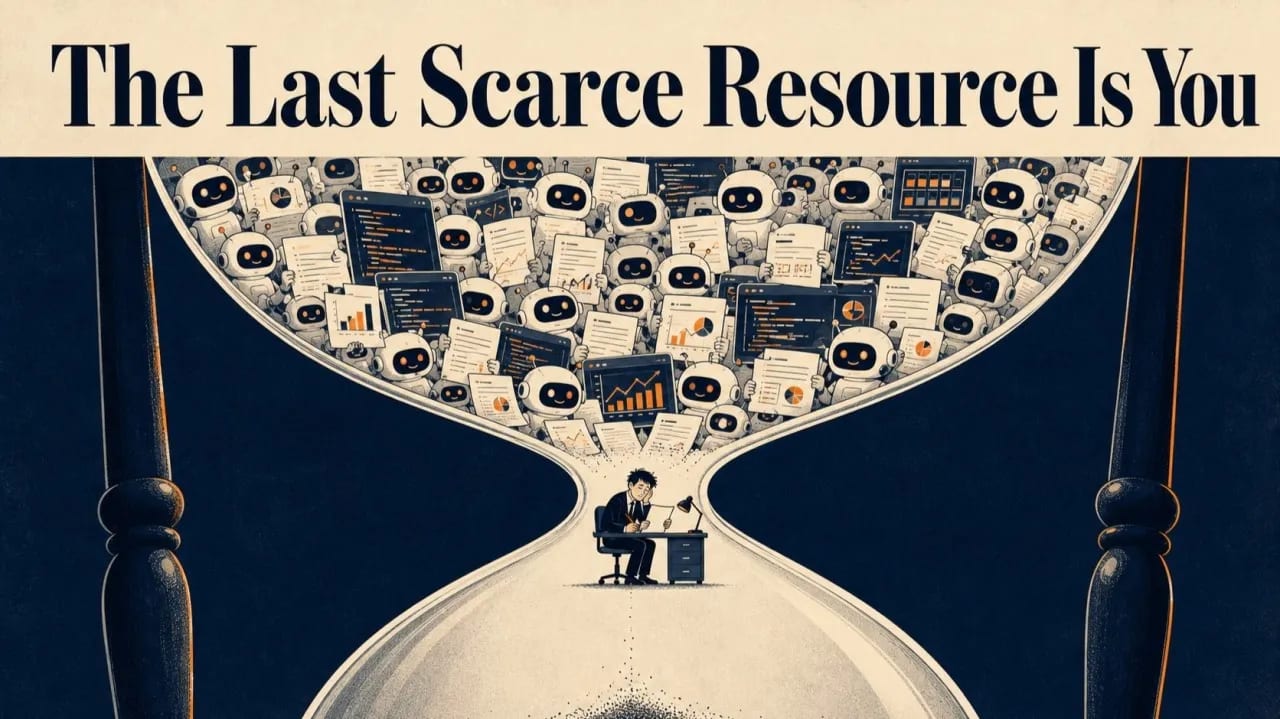
We spent the better part of two centuries making machines faster so people could do less work. We may finally have succeeded beyond our expectations. The machines are now fast enough that the person sitting in front of them has become the slow part.

Anthropic published an unusually revealing look at what that feels like inside a company already operating well ahead of most organizations in its use of AI. By August, employee-directed AI agents were working roughly six times as many hours as the employees directing them. Yet the agents were not racing freely into some autonomous future. In interactive sessions, they spent roughly 80 percent of their wall-clock time waiting for human input.
That is a remarkable little statistic because we have spent years worrying about whether AI will keep up with us. Anthropic is already confronting the opposite problem. The machines are waiting for us.
An army waiting outside your office
One Anthropic engineer described the experience as facing an “army of Claudes” all asking for attention. Another compared managing agents to babysitting children who deliver every request with roughly the same urgency, whether they need help opening a juice box or have actually hurt themselves. Anyone who has run a team recognizes the problem immediately. Delegation does not eliminate management. It creates management.

The strange part is the scale. Anthropic estimated that even nontechnical employees would need more than half of their workweek simply to read all the output produced by their interactive Claude sessions. Employees have responded by building dashboards, monitoring pipelines, standing instructions, agent hierarchies, and even agents whose job is to supervise other agents.
There is something wonderfully recursive about this. We automated the work, discovered that supervising the automation was too much work, and began automating the supervision. Somewhere in this increasingly elaborate machine sits a human being who still has to decide whether anything sensible is happening.
The bottleneck did not disappear
Most productivity stories have a hidden assumption. Make one part of a process faster and the entire process should become faster. That works beautifully when the thing you accelerate is actually the constraint. Software teams are beginning to discover what happens when it is not.
Fiona Chen and James Stratton at Harvard studied roughly 300 million work events across 718 software firms. After companies adopted AI coding agents, engineers produced about 30 percent more lines of code, 20 percent more commits, and 23 percent more pull requests. Those numbers certainly look like productivity, until you follow the work farther downstream.
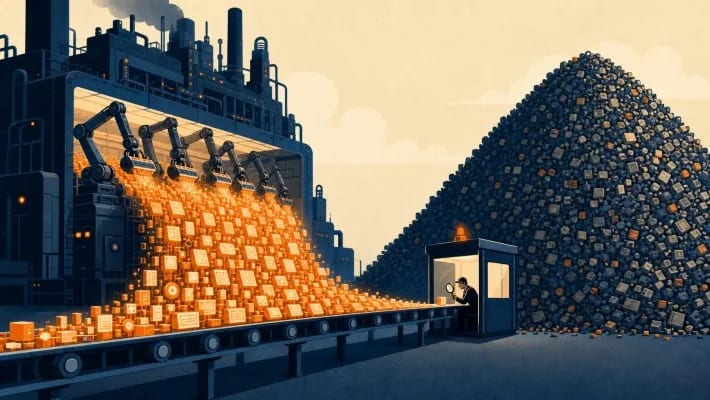
The amount of completed software work did not show a comparable statistically significant increase. Code review took longer, more changes required revision, and reviewers left more comments. The machines had accelerated one stage of production so effectively that the constraint simply moved to the next stage.
Manufacturing people have known this forever. If a factory can produce 10,000 parts an hour but inspection can approve only 1,000, making the factory produce 20,000 does not double production. It doubles the pile waiting for inspection. We are building the cognitive version of that pile.
Intelligence produces exhaust
Generative AI has made production extraordinarily cheap. A person can now ask for ten strategies, twenty designs, five implementation approaches, a market analysis, three presentations, and working code before lunch. The obvious temptation is to celebrate the abundance, but abundance has a cost when every output creates a claim on somebody’s attention.
Abundance has a cost when every output creates a claim on somebody’s attention.
A report must be read. Code must be reviewed. A recommendation must be judged. An exception must be resolved. A decision may still need an accountable human being willing to put a name beneath it. The marginal cost of generating another answer is approaching zero much faster than the marginal cost of understanding whether the answer is any good.
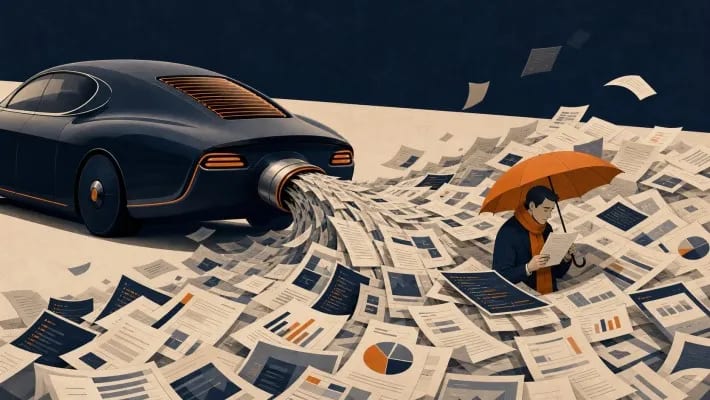
For most of the information age, production was expensive enough to perform a useful filtering function. Writing a forty-page report took enough effort that people hesitated before producing one. Building a prototype required enough time that teams selected ideas before implementing them. Asking a junior analyst for fifteen competing market analyses would have been considered mildly abusive.
AI removes that friction, and friction sometimes performs useful work. It forces prioritization before production. When production becomes nearly free, prioritization moves downstream, so we create everything and decide what deserves attention afterward. That may be progress, but it has a suspicious resemblance to my inbox.
We keep measuring the wrong thing
This creates an awkward problem for executives trying to measure AI productivity. Most of the easiest metrics sit near the point where AI enters the process. More code, documents, proposals, customer responses, analysis, and experiments can all look like evidence that the organization is moving faster.
Those numbers can improve dramatically while the organization itself improves very little. A company does not benefit because it generated twelve times as many recommendations. It benefits when it makes better decisions. It does not benefit because developers opened more pull requests. It benefits when useful software reaches customers safely and sooner.
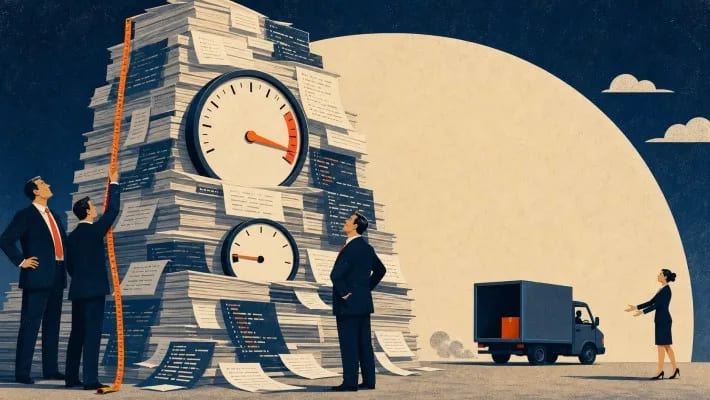
This is where AI becomes an organizational problem as much as a tooling problem. Every process has a constraint somewhere, and when AI accelerates one stage by ten times, the constraint is unlikely to remain where the organization designed for it. It moves into review, integration, prioritization, approvals, coordination, exception handling, or judgment.
A successful AI program may therefore make parts of the organization feel worse before they feel better. The queue grows, senior people feel busier, and everyone has more things asking for attention. Teams produce astonishing amounts of activity while leaders wonder why the business is not moving correspondingly faster. The technology may be working perfectly while the organization around it remains calibrated for human-speed production.
Attention becomes infrastructure
We tend to treat attention as a personal productivity issue. Turn off notifications, block the calendar, check email twice a day, buy a nicer notebook, and develop an alarming interest in morning routines. That framing becomes inadequate when machines can generate work faster than entire organizations can evaluate it.
Attention is starting to look more like infrastructure. Organizations will need to decide deliberately where human judgment is genuinely valuable, where automated review is sufficient, what deserves escalation, and what can simply disappear without anybody looking at it. The important design question is no longer merely what AI can do. It is where a human needs to remain in the loop and what that human should actually see.
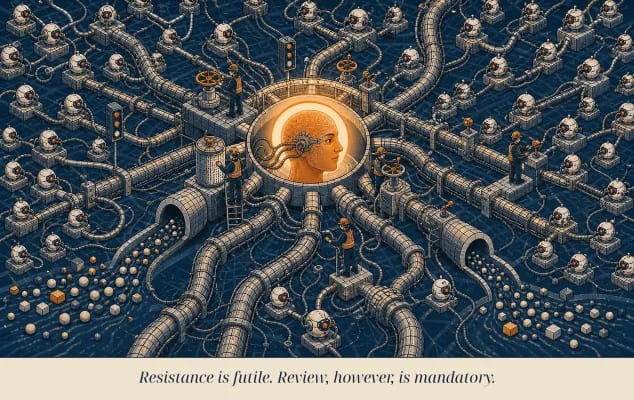
Adding humans does not scale particularly well. Ten agents can become a hundred agents with a configuration change and a larger bill. Ten experienced people with the judgment to supervise them cannot become a hundred by Tuesday. That makes judgment unusually valuable.
Anthropic’s own hiring data hints at that shift. Hiring managers are placing greater emphasis on autonomy and judgment relative to narrow technical expertise and implementation skills. That makes sense in an environment where employees increasingly orchestrate systems capable of performing much of the implementation themselves.
The more interesting question may be which scarce human capabilities become dramatically more valuable precisely because AI makes everything around them abundant.
The premium moves toward deciding what should happen, recognizing when something is wrong, resolving ambiguity, and understanding consequences that are difficult to encode in a specification. We have spent years asking which human skills AI will make less valuable. The more interesting question may be which scarce human capabilities become dramatically more valuable precisely because AI makes everything around them abundant.
The executive dashboard may need fewer numbers
There is another consequence hiding here. Leaders may have to become suspicious of visible productivity because the industrial instinct is to reward throughput. Generative AI can make that instinct dangerously misleading by manufacturing activity at extraordinary speed.
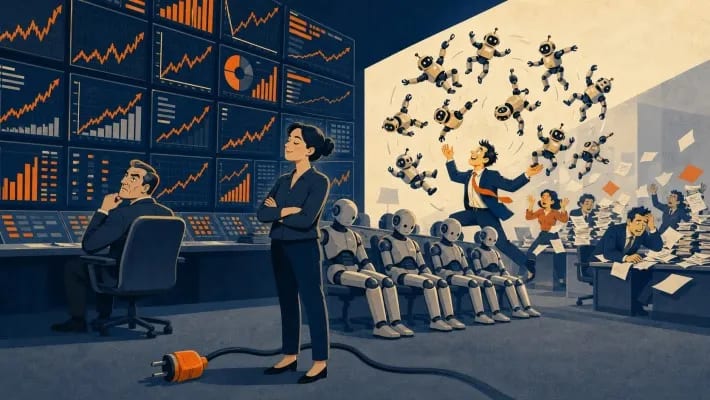
A useful AI operating model may need to measure what happens at the end of a process rather than where the machine participates in it. For a software team, that might be time from idea to reliable production value rather than lines of code. For legal, it might be resolved business decisions rather than contracts reviewed. For sales, it might be qualified revenue rather than personalized emails generated.
The same discipline applies to individuals. Someone running twenty agents may appear spectacularly productive while quietly creating work for forty other people. Another employee may stop ten unnecessary streams of agent activity before they begin and look less busy while contributing far more. AI makes output cheap enough that restraint can become productive behavior.
The mature organization may become the one that gets very good at saying no to free output.
That is a strange adjustment for organizations raised on the idea that more activity signals more value. A machine can now produce impressive quantities of plausible work with almost no social embarrassment about whether anyone asked for it. The mature organization may become the one that gets very good at saying no to free output.
The last scarce resource
There is a familiar economic pattern here. When technology makes one resource abundant, value migrates toward whatever remains scarce. Computing became cheap and data became valuable. Distribution became cheap and attention became valuable. Content became cheap and trust became more valuable.
AI is now making cognitive production cheap. It can write, analyze, summarize, code, compare, simulate, draft, and generate alternatives at a volume no human team could plausibly match. That does not make human beings unnecessary. It forces us to become much more precise about what we are necessary for.
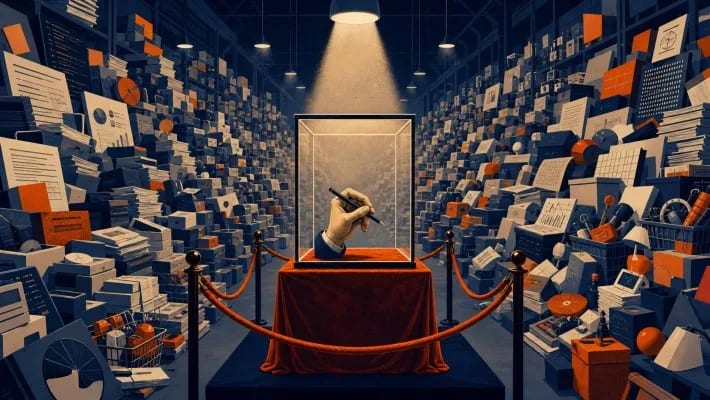
The answer is unlikely to be typing faster. It will be choosing what deserves attention, deciding which outputs matter, noticing what the system missed, understanding when the objective itself is wrong, and accepting responsibility when a decision crosses from machine recommendation into the human world. Those are not merely residual tasks left behind because AI failed to automate them. Increasingly, they are the constraint that determines whether all the automation around them produces anything useful.
For decades, technology leaders tried to remove humans from bottlenecks. We may now have to design organizations around the uncomfortable fact that the bottleneck is also where much of the value resides. The machines can make more than we can consume, review, or even notice. The harder question is whether we still know what deserves to be made.

Further Reading
- How employment is changing at Anthropic (Nathan Wilmers, Regina Catipon, Maxim Massenkoff, and Peter McCrory, October 2026) This is the primary source for the six-to-one agent-to-human work ratio, the attention bottleneck, agent idle time, growing meta-work, and changes in hiring priorities. The authors are studying their own employer, which gives them unusually rich internal data but also makes Anthropic an extreme early-adopter environment rather than a representative company.
- Artificial Intelligence in the Firm: Bottlenecks in Software Production (Fiona Chen and James Stratton, August 2026) This Harvard working paper studies roughly 300 million work events across 718 firms and provides the strongest empirical complement to the Anthropic evidence. It finds large increases in coding activity after agent adoption without a comparable statistically significant increase in completed software work, with code review emerging as an important downstream constraint. It is a working paper and should be read with that status in mind.
- Working at the frontier shapes expectations for the future (Anthropic, October 2026) This companion piece places Anthropic’s internal employment findings in a broader context and asks whether people working at the frontier of AI adoption are seeing a future that other organizations have simply not encountered yet. That makes it useful less as proof of what every company will experience and more as a possible leading indicator.
Disclaimer: The perspectives shared in this article are our own and do not represent those of our employer or any affiliated organizations. All company names, product names, logos, and brands mentioned are the property of their respective owners and are used for identification and illustrative purposes only. No endorsement, sponsorship, or affiliation is intended or implied. References to specific companies or case studies are based on publicly available information and are used solely for educational and discussion purposes.
More from enterprise ai
All enterprise ai → enterprise ai
Up the Food Chain
There is something wonderfully reassuring about listening to corporate executives discuss the jobs artificial intelligence might eliminate. Programmers will need to adapt. Designers must reinvent themselves. Analysts, accountants, writers,…
 enterprise ai
Who Owns the Lie?
The nation of Wales has decided to experiment with a fairly radical idea in politics: factual claims should have some relationship with facts. This is apparently sufficiently novel that legislation was required. Somewhere, several thousand…
 enterprise ai
AI Is Making Advertising More Efficient at the Wrong Thing
I bought the blender last Tuesday. By Wednesday, the advertising industry had apparently assembled an international task force dedicated to convincing me that I needed a blender. YouTube wanted to sell me one, websites wanted to sell me…