Up the Food Chain
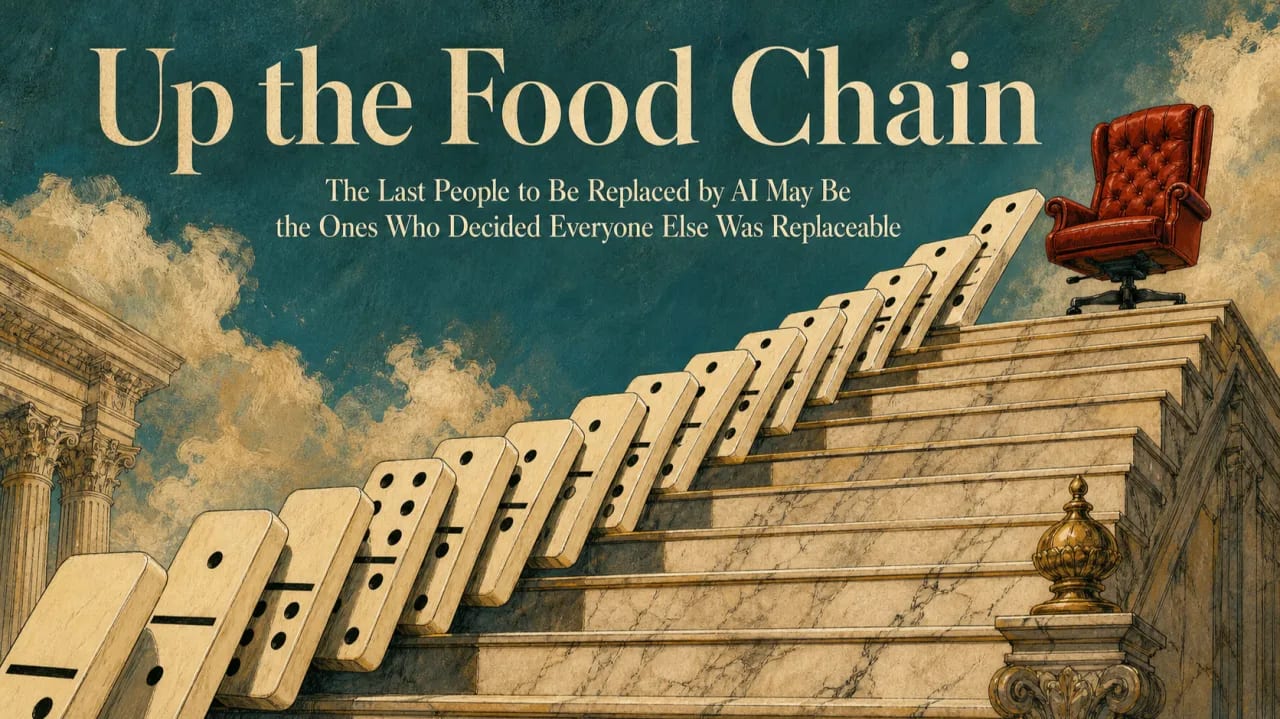
The Last People to Be Replaced by AI May Be the Ones Who Decided Everyone Else Was Replaceable
There is something wonderfully reassuring about listening to corporate executives discuss the jobs artificial intelligence might eliminate. Programmers will need to adapt. Designers must reinvent themselves. Analysts, accountants, writers, and customer service representatives should prepare for a future in which much of their work can be performed by machines. The executives explaining all this generally seem quite comfortable. They occupy the top of the corporate food chain, where the prevailing assumption appears to be that AI will transform everyone else’s work while leaving the people making those decisions comfortably in charge.

I find that confidence fascinating, particularly because the mechanism that could threaten executive leadership is already appearing in software development. AI is making certain kinds of work dramatically faster, but the organizations surrounding that work are not necessarily becoming faster with it. Instead, the limiting factor moves elsewhere. First it is code review, then testing, deployment, prioritization, budgeting, or approvals. Each improvement exposes the next constraint, and somewhere near the top of that increasingly productive organization sits an executive wondering why everyone still wants a decision before Thursday’s steering committee.
The Developers Ate First
Software engineering offers an unusually clear view of what happens when AI accelerates one part of a larger production system. Developers can now use AI to generate substantial amounts of code, investigate defects, create tests, and explore alternative implementations. Work that once required weeks can sometimes be completed in hours. The excitement is understandable, particularly for organizations that have spent decades regarding engineering capacity as a scarce and expensive resource. There is just one complication. Writing code was never the same thing as delivering working software.
A remarkable study by Harvard researchers Fiona Chen and James Stratton, published in August 2026, examined approximately 300 million work events across 718 firms. They found that adopting AI coding agents was associated with 30 percent more lines of code, 20 percent more commits, and 23 percent more pull requests. Yet those gains did not translate into statistically significant increases in their measures of completed software output. Instead, average pull request review time increased by 49 percent, while the proportion requiring changes nearly doubled. The researchers had found something familiar to anyone who has managed a production system. Accelerating one stage can overwhelm the next.
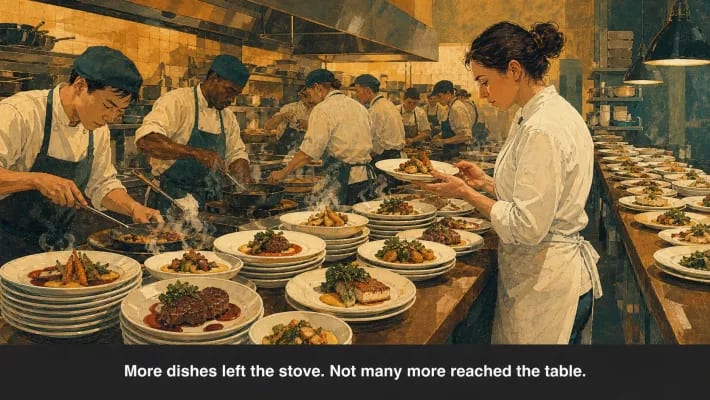
JetBrains encountered a similar pattern in its 2026 CI/CD research. Among organizations using AI in their delivery workflows, reviewing the growing volume of changes and establishing their reliability emerged as major concerns. The machines were becoming quite enthusiastic about producing work. The humans responsible for deciding whether that work belonged in production were having a less enjoyable experience.
The solution seems straightforward enough. Apply AI to code review, testing, security analysis, and deployment. Some organizations are already doing precisely that, although the Harvard research suggests AI-assisted reviewing does not automatically eliminate the review constraint. But suppose those downstream activities eventually accelerate too. Where does the bottleneck go next?
The Bottleneck Learns to Climb
Manufacturing engineers have understood this problem for decades. Eliyahu Goldratt’s Theory of Constraints describes how the performance of an entire system can be limited by a relatively small number of constraints. Make one machine on an assembly line twice as productive, and you have accomplished remarkably little if the next machine cannot process the additional output. You may simply have created a larger pile of unfinished work. Improve that second machine, and the limiting factor may move to a third.
AI introduces an unusual variation on this familiar problem because it can accelerate activities across the organization, including the intellectual work involved in coordinating other work. Once developers produce more code than reviewers can evaluate, review becomes the obvious constraint. Improve review and testing, and release management or product acceptance may become the limiting factor. Accelerate those processes, and the organization may discover that its capacity to build products now exceeds its capacity to decide which products are worth building.
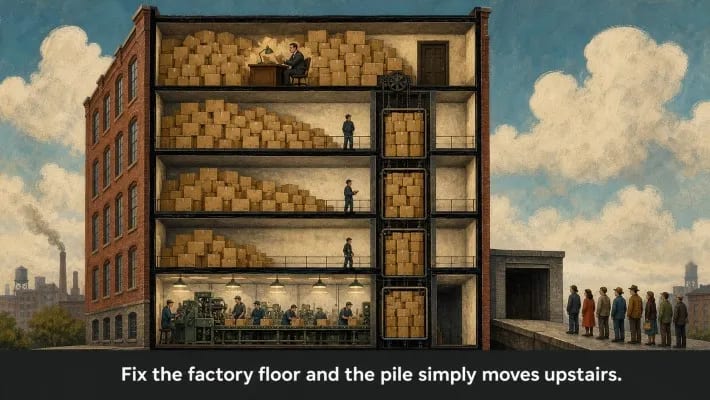
Consider a product organization whose engineering teams can deliver ten credible prototypes in the time they once needed for two. That sounds like extraordinary progress until someone must evaluate the business cases, resolve competing priorities, allocate funding, and decide which opportunities deserve further investment. The product managers become overwhelmed, so AI helps them compare alternatives and develop recommendations. Those recommendations then move to directors, vice presidents, and eventually executives whose available attention has not expanded at anything resembling the same rate. The organization’s productive capacity keeps growing, but its decision-making capacity may remain stubbornly human.
The bottleneck does not necessarily move upward in a tidy sequence. It may move sideways into customer adoption, infrastructure, regulatory compliance, or the simple difficulty of distinguishing valuable output from more output. Faster code can produce more defects, just as faster content generation can produce more material nobody wants to read. But when an organization systematically improves its execution capabilities, unresolved constraints in coordination and decision-making become increasingly conspicuous. And unlike a slow server, a slow executive cannot always be upgraded over the weekend.
The Management Layer Becomes Visible
The pattern extends well beyond programming. Marketing teams can use AI to generate campaign variations, analyze audiences, and produce creative material faster than human approval processes can absorb it. Financial analysts can examine scenarios faster than investment committees can select among them. Designers can produce concepts faster than stakeholders can agree on what they actually want. The technology reduces the cost of developing possibilities, but possibilities still require selection, commitment, and occasionally the courage to disappoint somebody important.
This changes the economics of management in ways that are easy to underestimate. Traditional corporate hierarchies evolved partly because human attention, information processing, and coordination are expensive. Managers organize teams, directors coordinate managers, and executives reconcile priorities across departments. Reports travel upward, decisions travel downward, and an impressive quantity of presentation slides travels in both directions. Much of this structure is entirely reasonable when producing and interpreting information requires substantial human effort.
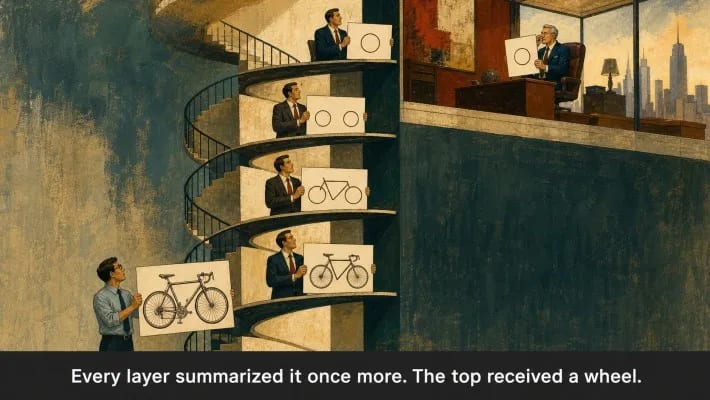
But what happens when information becomes cheaper, analysis becomes faster, and much of the coordination can be automated? The same hierarchy that once helped an organization manage complexity may begin restricting its ability to act. The value of management cannot continue to be measured primarily by how many people report to someone, how much information passes through their office, or how many approvals require their signature.
A managerial layer that primarily collects, summarizes, forwards, and authorizes information must eventually explain what it contributes that could not be accomplished more effectively another way.
There is a distinction here worth preserving. Some delays are valuable. A security review that prevents a serious breach or a board discussion that prevents a disastrous acquisition is not wasted time. The point is not to eliminate deliberation or treat every human intervention as friction. It is to distinguish decisions that genuinely require human judgment from decisions that have accumulated human approval simply because the organization has always operated that way. AI makes the cost of failing to distinguish them increasingly visible.
The Corner Office Is the Last Stop
Eventually, the question reaches the executive suite. An organization may become capable of evaluating markets continuously, exploring strategic alternatives, detecting operational problems, and preparing credible investment proposals far faster than its leadership can absorb them. The executive who once depended on analysts to assemble information may now receive more analysis than they know how to use. The scarce resource is no longer necessarily information, expertise, or even viable options.
It is the capacity to make good decisions, commit to them, and organize execution around those choices.
This is where the familiar conversation about AI replacing jobs becomes insufficient. AI does not need to perform every responsibility of a CEO to make an existing CEO less valuable. It only needs to change what effective leadership looks like. An executive who depends on slow reporting cycles, elaborate approval hierarchies, and instinctive resistance to unfamiliar technology may increasingly struggle against competitors whose leaders operate differently. The replacement, when it comes, may arrive wearing a business suit rather than running on a server.

We can already see signs that executive expectations are changing. PwC’s 2026 Global CEO Survey found that 56 percent of surveyed CEOs reported no significant financial benefits from AI, while only 12 percent reported both revenue and cost improvements. Meanwhile, Ralph Lauren’s 2026 proxy statement disclosed an AI scorecard connected to executive incentive compensation, with measures involving AI learning and employee enablement. These are different forms of evidence, and neither demonstrates that executive displacement is underway. They do suggest that adopting AI is becoming something leaders must account for, rather than merely something they instruct employees to do.
There is a certain irony in this development. For years, executives have evaluated employees using productivity metrics, performance indicators, utilization rates, and increasingly sophisticated monitoring systems. AI could eventually make organizational performance more transparent in the other direction. Boards may become better equipped to examine the consequences of executive decisions, compare strategies, and identify delays that previously disappeared into the respectable fog of corporate governance. The executive who enthusiastically introduced algorithmic accountability may discover that the algorithm has learned to look upward.
Two Executives Enter the Same Future
Imagine two equally experienced executives running similar organizations. Both recognize that AI matters, both invest in the technology, and both want better results. The first approaches AI as an operational improvement program. Employees receive new tools, departments establish adoption targets, consultants prepare roadmaps, and management monitors productivity. The executive remains comfortably outside the transformation, reviewing progress through the same committees and reporting structures that existed before the technology arrived.
The second executive recognizes that increasing productivity beneath management creates obligations for management itself. She examines how decisions move through the organization, which approvals protect the business, which merely preserve authority, and where AI can improve the quality and speed of judgment. She gives capable teams greater autonomy within explicit boundaries, makes accountability clearer, and redesigns processes that no longer serve their original purpose. Most importantly, she includes her own position in that examination. There is no executive exemption from organizational improvement.

Over time, these two organizations may become very different competitors. One has faster employees working inside a largely unchanged system. The other has reconsidered the system itself. One continues asking employees to produce more, while the other asks what prevents additional productive capacity from becoming additional business value. The distinction matters because competitive advantage does not come from generating the most code, reports, designs, or recommendations. It comes from turning capability into outcomes that customers value.
This is also why the prospect of an autonomous AI CEO is something of a distraction. Leadership involves responsibility, judgment under uncertainty, conflicting human interests, and decisions whose consequences cannot be captured by a spreadsheet, at least that’s our assumption thus far. Those responsibilities are not disappearing simply because machines become better at analysis. If anything, they may become more important as the range of available options expands. But executives who confuse leadership with controlling information, protecting authority, and approving decisions may find that their particular interpretation of the job is becoming obsolete.
Natural Selection Doesn’t Respect Job Titles
There is something almost Darwinian about this progression, although the mechanism is economic rather than biological. The organizations that thrive will not necessarily be those with the largest AI budgets or the greatest enthusiasm for replacing workers. They may be those whose leaders most successfully adapt their institutions to the capabilities now available. In one company, AI allows employees to accomplish more while management struggles to keep pace. In another, AI helps leadership redesign the organization so that greater capability actually produces greater value.
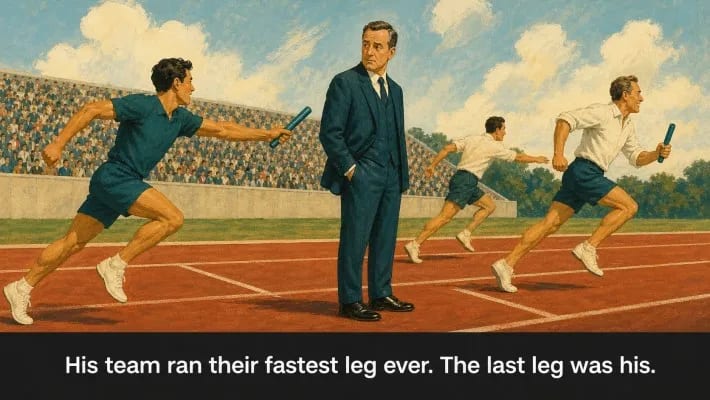
The executives who cannot adapt are unlikely to disappear overnight. Corporate hierarchies have considerable inertia, and senior leadership possesses the useful advantage of influencing who gets replaced. But competition is less sentimental than an organizational chart. When one company repeatedly makes better decisions, responds faster, operates more efficiently, and converts opportunities into results, its competitors must eventually confront the reasons they cannot do the same. Sometimes the answer will be technology, talent, capital, or market conditions. Sometimes it will be leadership.
What makes this transformation particularly uncomfortable is that the threat may emerge from the very successes executives have been celebrating. Each improvement in employee productivity raises expectations for the rest of the organization.
Each eliminated constraint makes the remaining constraints more visible. Eventually, the executive who spent years demanding that employees embrace new tools may discover that the greatest unrealized productivity opportunity is sitting behind their own desk.
The best executives will recognize that moment as an invitation to evolve. They’ll use AI to expand their judgment, improve organizational design, and remove constraints, including those created by their own habits and authority. Others may defend the old structure while wondering why competitors keep pulling ahead. Their problem will not be that artificial intelligence has learned to do their jobs. It will be that another human executive has learned to do those jobs considerably better with AI.
For years, the people at the top of the corporate food chain have been deciding whose work technology can replace. They have encouraged adaptation, rewarded efficiency, and explained that no profession has a permanent claim on relevance. All reasonable observations, as far as they go. But the bottleneck is moving, and the logic of productivity improvement has no reason to stop at the boardroom door. The last people to discover that their positions are subject to the same forces may be those who spent the most time explaining why everyone else’s were.

Further Reading
- Artificial Intelligence in the Firm: Bottlenecks in Software Production (Fiona Chen and James Stratton, August 2026) The strongest empirical foundation for the article. Using roughly 300 million work events across 718 firms, the researchers find substantial increases in coding activity without corresponding statistically significant gains in completed software output. Increased review demands explain part of the gap. This is a working paper based on proprietary data, and its findings should not be generalized automatically to every industry.
- State of AI-assisted Software Development 2025 (Google DORA, September 2025) Examines the relationship between AI use, software delivery, organizational capabilities, and performance. Its central finding is that AI amplifies existing organizational strengths and weaknesses. An important counterweight to the assumption that adopting better tools automatically produces better business results.
- The State of CI/CD in 2026 (JetBrains, October 2026) Provides contemporary survey evidence of review and verification constraints as organizations adopt AI in software delivery. The research draws on several surveys with different populations and methods. Its results are useful indicators of industry experience rather than universal measures of organizational performance.
- What Is the Theory of Constraints, and How Does It Compare to Lean Thinking? (Sergio Rattner, September 2006) Explains the management theory developed by Eliyahu Goldratt and the importance of identifying system constraints rather than optimizing individual activities in isolation. This provides the conceptual foundation for understanding how bottlenecks move as organizations improve their productive capacity.
- PwC’s 2026 Global CEO Survey (PwC, January 2026) Based on responses from 4,454 CEOs across 95 countries and territories, this survey documents the gap between AI investment and measurable financial returns. It suggests that organizational foundations and integration matter, although its self-reported results do not independently establish causation.
- 2026 Proxy Statement (Ralph Lauren Corporation, June 2026) A primary corporate disclosure illustrating how AI readiness is beginning to appear in executive compensation. The company’s AI scorecard included learning completion and employee survey measures. It is evidence of changing executive expectations, not proof that AI has already improved leadership performance or reduced the need for executives.
Disclaimer: The perspectives shared in this article are our own and do not represent those of our employer or any affiliated organizations. All company names, product names, logos, and brands mentioned are the property of their respective owners and are used for identification and illustrative purposes only. No endorsement, sponsorship, or affiliation is intended or implied. References to specific companies or case studies are based on publicly available information and are used solely for educational and discussion purposes.
More from enterprise ai
All enterprise ai → enterprise ai
The Last Scarce Resource Is You
We spent the better part of two centuries making machines faster so people could do less work. We may finally have succeeded beyond our expectations. The machines are now fast enough that the person sitting in front of them has become the…
 enterprise ai
Who Owns the Lie?
The nation of Wales has decided to experiment with a fairly radical idea in politics: factual claims should have some relationship with facts. This is apparently sufficiently novel that legislation was required. Somewhere, several thousand…
 enterprise ai
AI Is Making Advertising More Efficient at the Wrong Thing
I bought the blender last Tuesday. By Wednesday, the advertising industry had apparently assembled an international task force dedicated to convincing me that I needed a blender. YouTube wanted to sell me one, websites wanted to sell me…