Creative Substratism
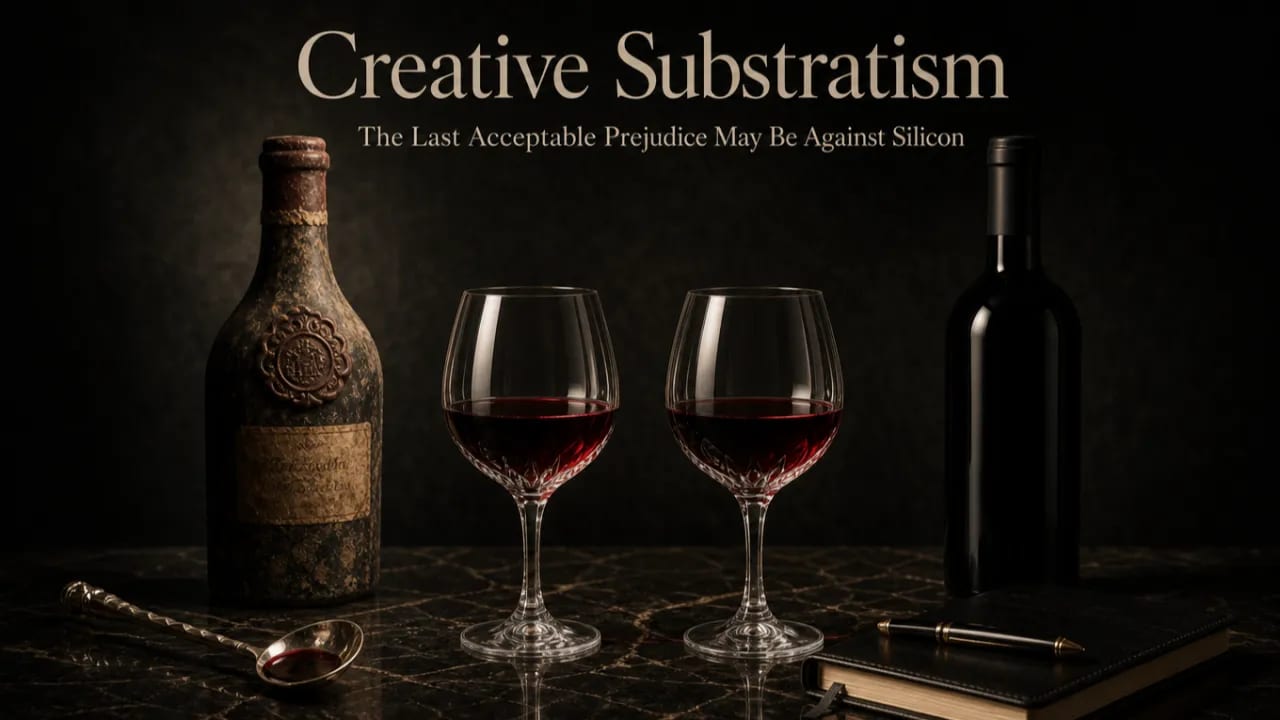
The Last Acceptable Prejudice May Be Against Silicon
Imagine being served two glasses of wine. They look identical, smell identical, and taste identical. Then you are told that one came from a rare bottle laid down decades ago by a celebrated winemaker, while the other came from an ordinary modern bottle produced with industrial precision.
The liquid has not changed, but your experience probably has. The first glass now carries history, craftsmanship, scarcity, patience, and the image of someone who knew exactly what they were doing. You are no longer tasting only the wine. You are tasting the story of how the wine came to exist.
Art has always worked this way too. A painting can move us because of its composition, color, subject, or beauty, but part of our admiration often belongs to the achievement behind it. We see evidence of talent, practice, judgment, persistence, and the thousands of decisions another human being must have made before the finished work reached the wall.
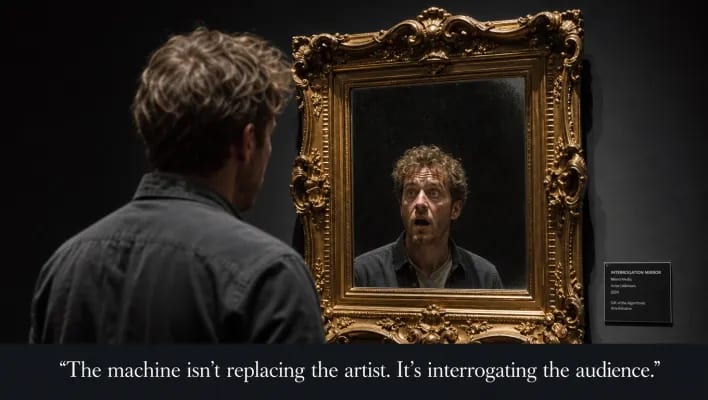
Now imagine standing in front of a painting that stops you. The sea looks almost violent enough to hear, the light feels deliberate, and the technical execution makes you wonder how anyone managed to create it. You admire the image, but you are also admiring the invisible person you believe must exist behind it.
Then you notice the label, “Generated by AI”.
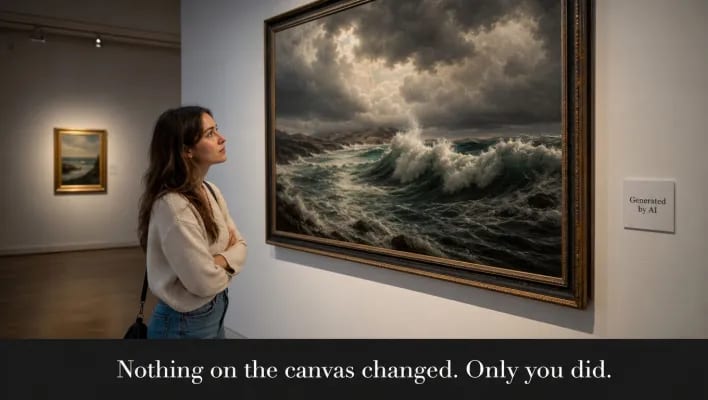
Nothing on the canvas changed. The waves did not become less convincing. The composition did not weaken, the colors did not shift, and whatever emotion the painting produced a moment earlier is still available to you. Yet the experience may suddenly feel different because the human achievement you thought you were witnessing has vanished.
That reaction is not automatically prejudice against machines. We have always valued provenance, difficulty, effort, rarity, and craft. A perfect freehand drawing feels different from the same image produced by a printer because part of what impresses us is the feat itself.
But AI introduces a complication. If the work remains equally beautiful, moving, or original, how much of our diminished admiration comes from the disappearance of human effort, and how much comes from our refusal to recognize creativity when the creator is not human?
That distinction matters because art has always carried at least two kinds of value. There is the value of what was created, and there is the value of having created it. Generative AI is forcing us to separate the two, and we may discover that we have been quietly blending them together for centuries.
That is where creative substratism begins to become interesting.
We were never judging the painting alone
Researchers have already stumbled directly into this distinction. In a 2023 study, participants evaluated paintings that were all generated by AI, but some were randomly labeled “Human-created” and others “AI-created.” The supposedly human works received higher ratings for liking, beauty, profundity, and worth.
The obvious interpretation is that people are biased against AI art. The more interesting finding sits one layer deeper. When the researchers explored why the human label mattered, perceptions of story and effort helped explain some of the difference in judgments of liking and beauty.
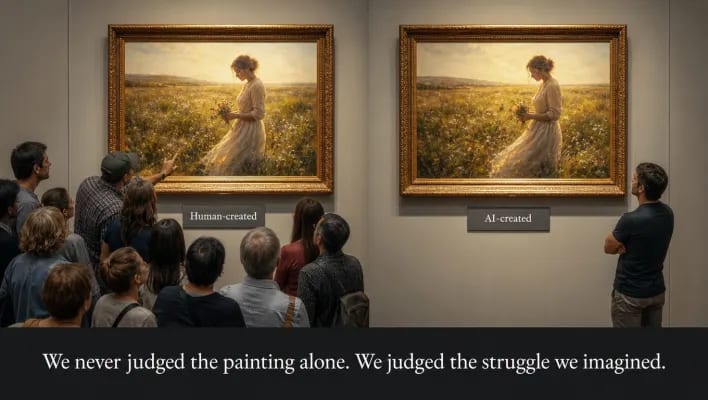
That makes intuitive sense. If I believe someone spent years developing a technique and then days wrestling a particular image onto a canvas, I am not experiencing only pigment and geometry. I am also responding empathetically to the person I imagine behind it, to their skill, intention, persistence, frustration, and eventual success.
The problem is not simply that we struggle to empathize with a machine. It is that we do not know what, if anything, there is to empathize with.
That human connection matters because empathy is doing part of the work. We can imagine the artist’s frustration, intention, pride, or exhaustion because we recognize those states in ourselves. With AI, the bridge is far less certain. The problem is not simply that we struggle to empathize with a machine. It is that we do not know what, if anything, there is to empathize with.
A violin solo works similarly. Two performances might sound nearly identical, but learning that one was performed live by a twelve-year-old prodigy and the other assembled digitally changes the experience. The waveform may be the same, but the feat is not.
This complicates one of the most provocative questions around AI art. If two works are perceptually indistinguishable, but one becomes less valuable because its creator was silicon rather than carbon, that does not automatically mean our judgment is irrational. It may mean we were never judging the work alone.
The uncomfortable question begins one step later. How much of the value disappeared because the human achievement disappeared, and how much disappeared because we refuse to recognize creative achievement when the creator is not human?
That boundary is much much harder to draw!
AI has broken the old relationship between effort and output
For most of human history, extraordinary creative output was evidence of extraordinary capability. A magnificent painting implied years of learned technique. A novel implied thousands of choices about character, language, pacing, structure, and all the sentences that were written badly before being written well.
The work functioned almost like forensic evidence. We could infer something about the person from the artifact because certain artifacts were simply very difficult to produce. The masterpiece testified on behalf of the master.
Generative AI breaks that inference.
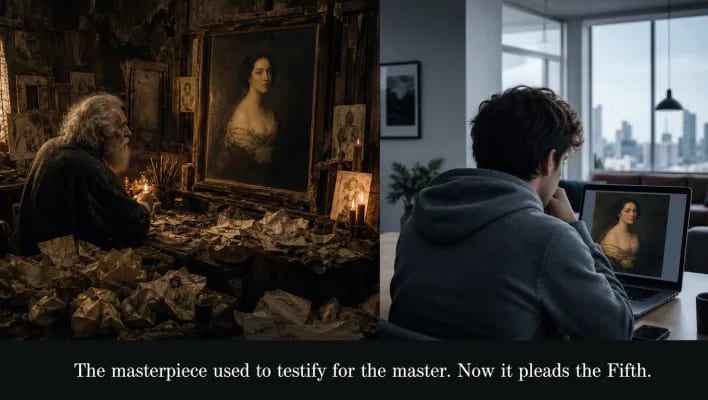
A person with modest drawing ability can now produce an extraordinary image. Someone who has never composed music can generate a convincing song. A mediocre writer can begin with a clumsy idea and, with enough iteration and judgment, produce prose considerably better than their unaided ability would suggest.
That does not make the resulting work worthless. It does make the relationship between quality and effort unreliable. We can no longer look at the quality of an artifact and confidently infer how much skill, time, suffering, training, or talent was required to produce it.
Perhaps we have confused creativity, effort, and value because, until very recently, they usually arrived together. If something was extraordinarily difficult to make, we tended to treat that difficulty as evidence of creativity and as part of the artifact’s value. Generative AI is separating those things, forcing us to ask whether a work is valuable because of what it is, because of what it took to make it, or because we never had to distinguish between the two before.
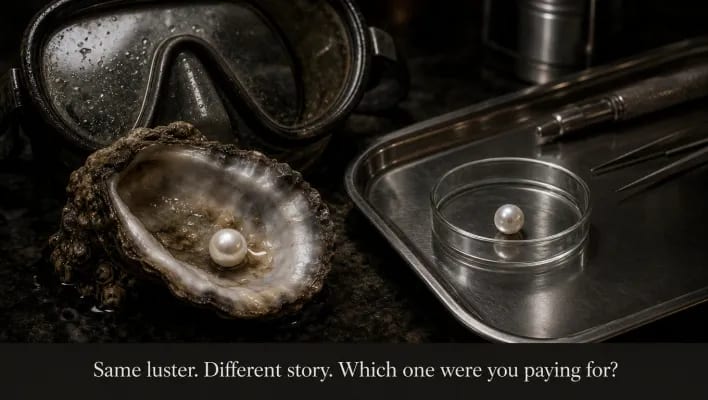
Photography created an earlier version of this problem. A portrait painter might spend weeks reproducing a face that a camera could capture in a fraction of a second. The camera did not prove that the portrait was ugly, but it radically changed what was impressive about reproducing visual reality.
AI is doing something similar across many creative domains simultaneously. It is separating the value of the creation from the value of having created it.
Creativity was supposed to be ours
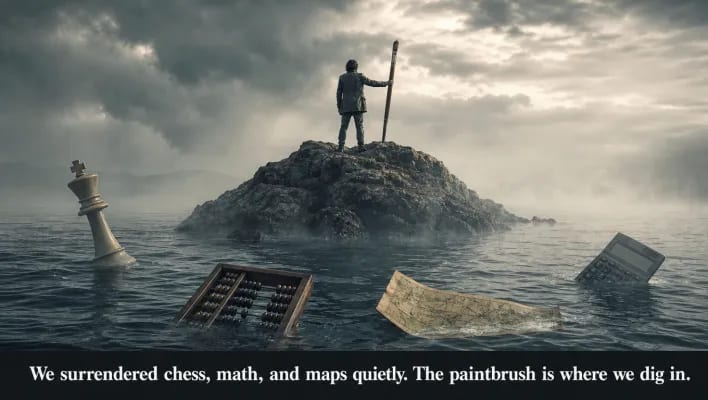
That separation becomes especially threatening because creativity occupies a peculiar place in the human self-image. We have surrendered other forms of intellectual superiority with surprisingly little existential drama. Machines calculate faster, remember more, navigate better, search larger spaces, and have been beating our best chess players for decades.
We adapted by changing the definition of what really mattered. Arithmetic was calculation, not intelligence. Chess turned out to be search and pattern recognition. Translation could apparently be reduced to statistical relationships, and programming is currently enduring its own uncomfortable demotion from mystical craft to something AI can participate in rather effectively.
Creativity remained different. A machine might calculate, optimize, retrieve, or imitate, but it could not imagine. Or so we told ourselves. That is uniquely human, right? Creativity seemed connected to one’s inner life, experience, emotion, mortality, desire, and perhaps whatever we still mean when we use the word soul without wanting to defend it technically. And research is increasingly making that hill harder to defend.
A 2024 Scientific Reports study compared 151 human participants with GPT-4 on three established divergent-thinking tasks. The model produced responses rated as more original and elaborate when the researchers controlled for fluency. That does not demonstrate that AI has surpassed human creativity in some grand universal sense, but it does make the categorical claim that machines cannot be creative increasingly difficult to maintain.
Poetry makes the situation stranger still. Another Scientific Reports study asked non-expert readers to distinguish AI-generated poems from works by famous poets including Shakespeare, Dickinson, Whitman, Eliot, Plath, and Ginsberg. Participants scored poorly and even below 50%, and they were actually more likely to believe the AI poems had been written by humans than the human poems were.
The truly awkward part was preference. Readers gave the AI-generated poems higher ratings on most of the qualitative measures the researchers tested. Yet when participants were told a poem was AI-generated, its ratings went down.
We have apparently reached a point where people can prefer the machine’s poem while simultaneously believing that being written by a machine makes a poem worse. That is not merely a technology story. It is a psychology story.
The prejudice may actually be self-defense
There is a temptation to ridicule that contradiction, but I think something more sympathetic and more interesting is happening.
Creativity has never been merely a labor-market skill. It is part of the story humans tell about why humans are special.
We create things that did not exist before. We turn private experience into paintings, novels, songs, films, architecture, jokes, and strange little ceramic frogs sold at farmers markets. Creativity feels like evidence that something is happening inside us that cannot be reduced to mechanical reproduction.
AI threatens that story in a way that spreadsheets never did. Nobody has built a meaningful personal identity around being biologically superior to Excel at multiplication. Creative people, however, often organize careers, communities, status, and large pieces of identity around an ability that we have long treated as distinctively human.
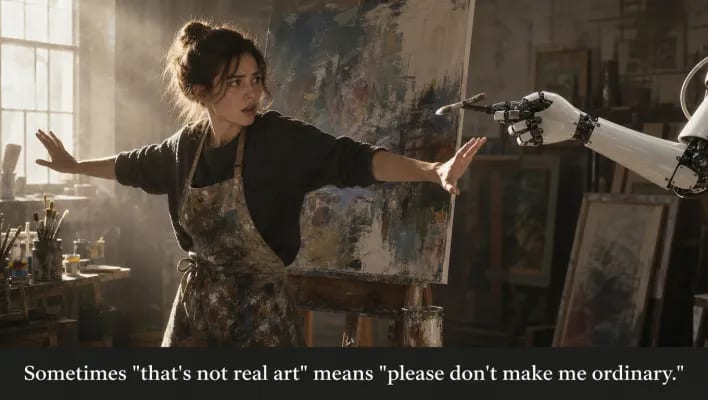
Perhaps some resistance to AI creativity is therefore not really hostility toward the machine. It is self-defense.
We may not be rejecting AI art because it fails to be creative. We may be rejecting it because admitting that it is creative would force us to surrender something we thought belonged exclusively to us.
…creativity itself can no longer serve as proof of human uniqueness.
That does not make every objection invalid. It does suggest that arguments about copyright, employment, consent, artistic integrity, and authenticity sometimes conceal a deeper anxiety. Beneath those legitimate concerns may lie the uncomfortable fear that creativity itself can no longer serve as proof of human uniqueness.
The wrong kind of stuff
There is now a useful term for one version of this reaction. In a 2026 paper in Computers in Human Behavior, Ali Ladak and colleagues introduced substratism, which they define as the moral devaluation of artificial intelligences because their cognition exists in a non-biological substrate.
Their research is about moral consideration, not artwork. The authors also make an important distinction, finding substratism to be meaningfully different from established prejudices such as racism and speciesism. Any comparison that treats those categories as morally or historically equivalent would flatten important differences and turn a useful idea into a cheap provocation, - tempting as it may be.
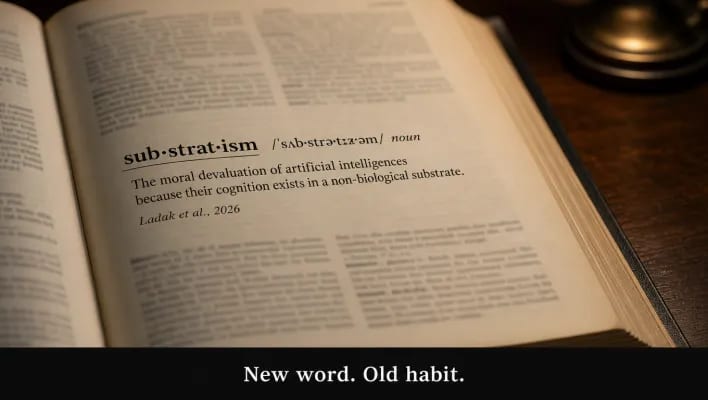
But the same kind of bias may also influence how we judge art. We might call its artistic cousin creative substratism.
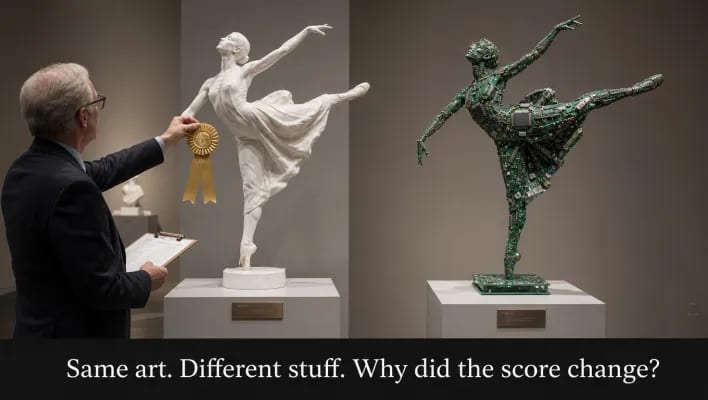
It appears when our evaluation of creative capability changes not because the output changed, or even because the creative process changed, but because we have decided that creativity produced by the wrong sort of intelligence somehow counts less.
There is something more questionable about insisting that the machine-built chair is objectively worse simply because we prefer the story attached to the other one.
The difficult part is distinguishing that from our perfectly reasonable admiration of human effort. There is nothing inconsistent about valuing a handmade chair because a craftsperson made it, even when a machine can produce a straighter chair. Art may be heading toward the same distinction.
Human provenance can be valuable without becoming evidence of artistic superiority. We can cherish the human accomplishment and still acknowledge that the artifact created by something else moved us.
When scarcity disappears, identity gets expensive
There is also a decidedly less philosophical reason creative resistance is intensifying. Generative AI is not only questioning whether creativity is uniquely human. It is destroying the scarcity around many forms of competent creative production.
An illustrator once possessed a capability most people simply did not have. The same was true of copywriters, commercial photographers, composers, designers, animators, and countless other specialists. Their skills required time to develop, which limited supply and helped create economic value.
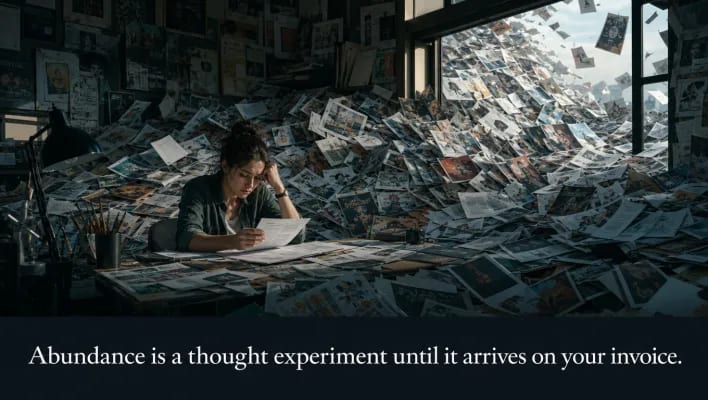
Generative AI changes that supply equation brutally quickly. It can produce dozens of concepts, visual treatments, melodies, headlines, layouts, scenes, and narrative directions in the time a traditional process might require to establish the first few. Much of that output will be forgettable, but forgettable output has never been particularly rare in human creative industries either. The consequential change is abundance.
Professions are often protected not because nobody else can perform the work, but because comparatively few people can perform it well enough. When AI raises the creative floor for everyone, competence becomes cheaper. The economic value migrates toward whatever remains scarce.
This is why the creative debate is about more than hurt feelings or philosophical territory. Artists are confronting the commoditization of capabilities that took years to acquire and around which careers were constructed. When a scarce ability becomes abundant, the person who possessed that ability does not experience the transition as an interesting thought experiment. They experience it through declining rates, disappearing commissions, and clients who suddenly expect the same work for a fraction of the price.
Imperfection becomes proof of life
One of the more fascinating responses is a renewed appreciation for imperfection and physical process. Daniel Vasconcelos documented this in 2026 research on resistance to AI among creative workers, where artists and designers described renewed interest in analogue practices, tactility, slower processes, mistakes, and the imperfections of human production.
That reaction makes historical sense, although it reverses several centuries of technological aspiration. We invented tools to eliminate wobble, noise, scratches, distortion, inconsistent color, uneven type, accidental marks, and the other irritating evidence that humans had touched something. Now AI can remove those imperfections so effectively that imperfection itself begins to acquire value.
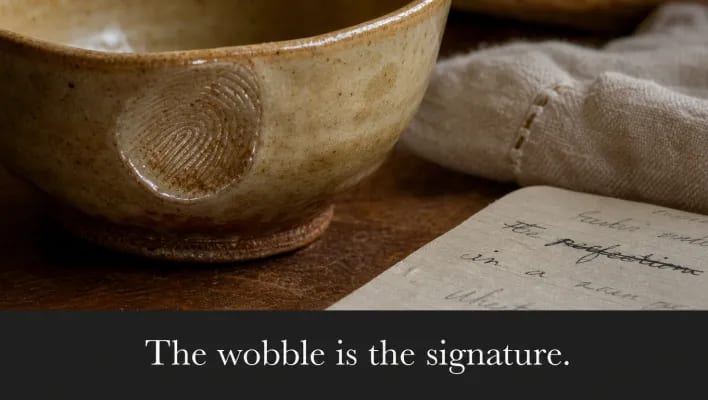
The shaky line says a hand was here. The cracked vocal note says lungs were involved. The fingerprint, crossed-out sentence, uneven stitch, brush texture, and accidental blur become little certificates of biological provenance.
“Human-made” could gradually begin functioning like “handmade.”
A handmade chair does not need to be straighter than the factory version to be valuable. Its value includes the fact that somebody made it, which means provenance has become part of the product.
That is not a retreat from art. It may simply be the market learning to price human presence separately from output quality.
When making becomes cheap, choosing becomes expensive
The creative professions are unlikely to disappear, but their center of gravity may move. A 2024 Science Advances experiment found that people given access to generative AI ideas wrote stories that evaluators considered more creative, better written, and more enjoyable, particularly when the writers began with lower measured creativity.
There was a catch. AI-assisted stories also became more similar to one another. Individual performance improved while collective novelty narrowed. That result hints at the next scarce capability.
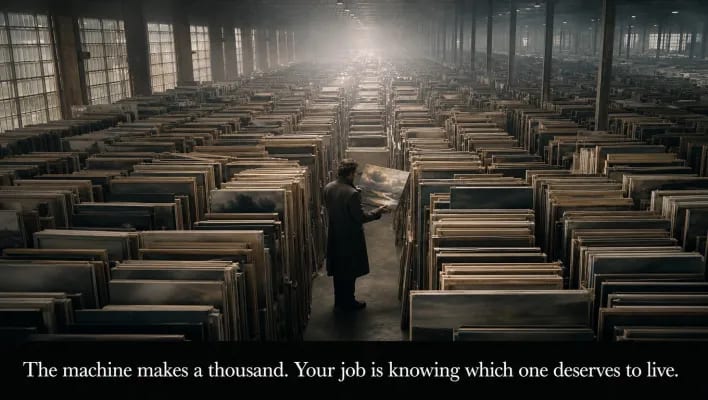
When generation is expensive, creative value concentrates around producing possibilities. When generation becomes nearly free, value shifts toward knowing which possibilities deserve attention, how they should be combined, which should be rejected, and when a technically excellent output somehow still feels dead.
Artists may increasingly become directors, editors, critics, curators, and arbiters of taste. Those are not lesser creative roles. A film director does not personally sew every costume, perform every part, operate every camera, compose every note, and build every set, yet nobody concludes that directing is not creative.
AI may expand that model into other forms of work. The machine can produce a thousand possibilities. The rarer ability may be knowing which one deserves to survive.
The mirror may be more interesting than the painting
None of this requires us to believe that today’s AI has consciousness, feelings, artistic intention, or anything resembling a human inner life. Creative capability and personhood are different questions, and producing an impressive artifact does not resolve the question of whether anything is being experienced by the system producing it. But the distinction between lived experience and learned experience deserves closer examination.
Human creativity itself depends heavily on experiences inherited from others, including experiences the creator never personally lived.
After all, what becomes of lived experience when it is remembered, recorded, or expressed? Much of what we understand about another person’s inner life comes through its representations, whether in words, paintings, music, or behavior. Human creativity itself depends heavily on experiences inherited from others, including experiences the creator never personally lived. AI learns from an enormous collection of these human expressions, absorbing patterns of love, grief, ambition, imagination, suffering, and discovery without necessarily experiencing any of them firsthand.
That does not make AI human, nor does it establish that a machine possesses subjective experience. But it complicates the assumption that creativity must originate in personally lived experience to have artistic value. If human creativity can emerge from the remembered and recorded experiences of others, why should creative work produced from those same cultural inheritances be dismissed solely because the intelligence producing it is artificial?
But that distinction cuts both ways. If we define creativity in terms of observable originality, usefulness, surprise, or the production of novel combinations, we cannot casually revoke the word whenever a machine begins satisfying the criteria. If we instead insist that creativity requires human experience, we should acknowledge that we have defined the winner into the rules.
There is nothing wrong with valuing the human experience behind a work. A novel written by someone who survived a war may matter differently from an identical text generated by a machine because one is also an act of testimony. The mistake is assuming that this additional meaning somehow resides entirely within the words rather than in what we know about the person who wrote them.
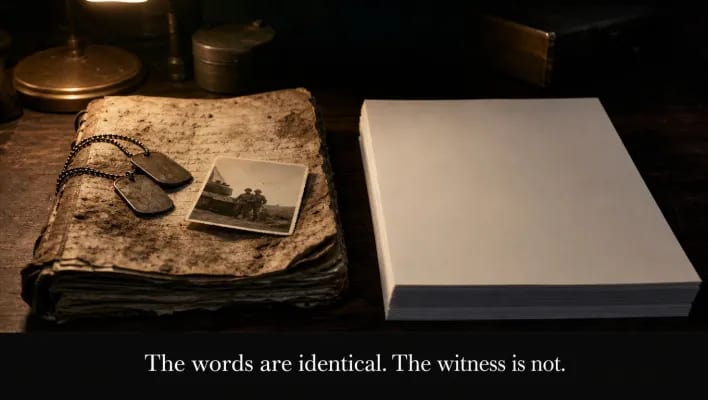
But lived experience is not quite the dividing line we imagine. Fear, attachment, desire, grief, and even forms of empathy are hardly exclusive to humans. Much of what we recognize as distinctly human lies in how we interpret those experiences, remember them, give them meaning, and communicate them to others. The immediate sensation may be private, but its interpretation becomes part of our collective inheritance once someone finds a way to express it.
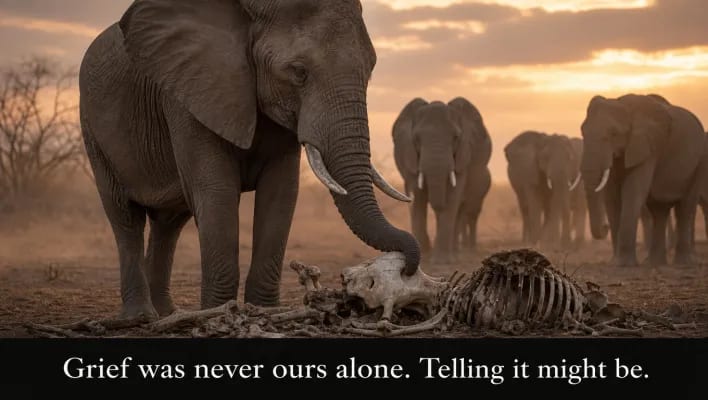
Consider how much of our own understanding of being human comes from experiences we never personally lived. We know something about ancient civilizations, distant wars, unfamiliar cultures, and the emotional lives of strangers because others recorded what they experienced. A novelist can write convincingly about loss never suffered, places never visited, and lives never lived. We do not ordinarily dismiss that achievement as imitation simply because the experience was inherited rather than firsthand.
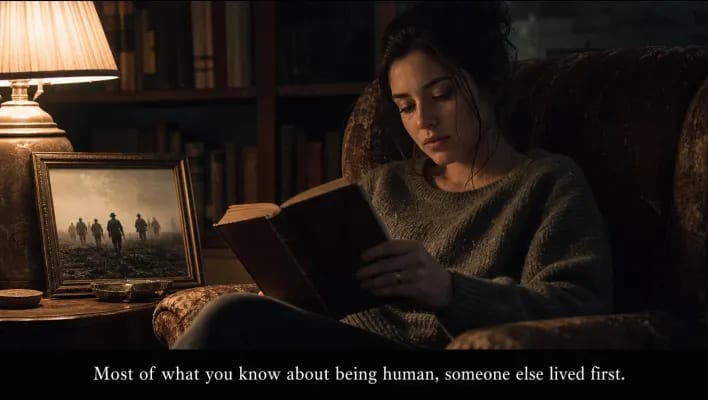
Now consider the peculiar position of a large language model. It has learned from an extraordinary breadth of recorded human thought, imagination, conflict, discovery, and emotion. It does not necessarily experience any of those things itself, and its understanding remains incomplete and shaped by the limitations of its training. Yet it may have encountered more representations of what it means to be human than any individual human could absorb in a lifetime.
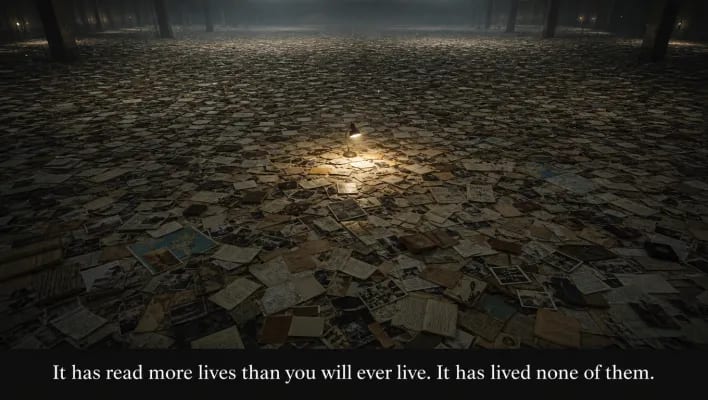
In that limited sense, AI may contain more of humanity’s recorded experience than any one human, while remaining something entirely different from human itself. That does not make it more human, but it complicates the claim that its creative work is somehow devoid of human experience. Its outputs are shaped by an enormous cultural inheritance assembled from countless human lives, just as human creativity draws upon the experiences, ideas, and accomplishments of those who came before us.
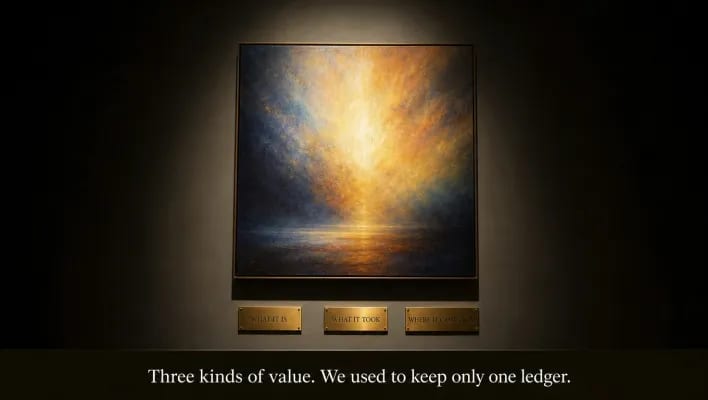
We may therefore need more than the two measures of artistic value we have traditionally allowed to blur together. There is the value of what was created, the value of what it took to create it, and the value of the accumulated human experience from which it emerged. These are related, but they are not interchangeable, and AI is making their differences increasingly difficult to ignore.
Admiring the human artist for an extraordinary personal achievement is not prejudice. Neither is valuing the emotional connection we feel toward someone whose struggle we can imagine and empathize with. But when we dismiss an otherwise compelling creation solely because the intelligence that produced it was not biological, we have crossed into different territory. That is where appreciation for human achievement may give way to creative substratism.
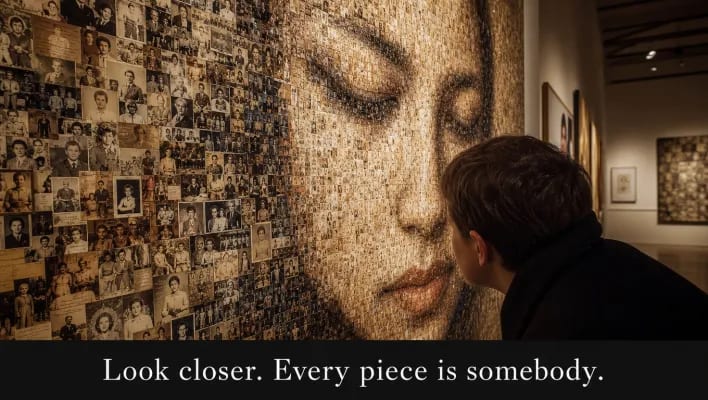
Perhaps AI’s most interesting contribution to art is not another painting, novel, song, or poem. It is the uncomfortable realization that creativity, human experience, and artistic value were never quite the same things, even when they appeared inseparable. The machine has forced us to examine those distinctions while demonstrating just how much of humanity’s creative inheritance can exist outside an individual human mind.
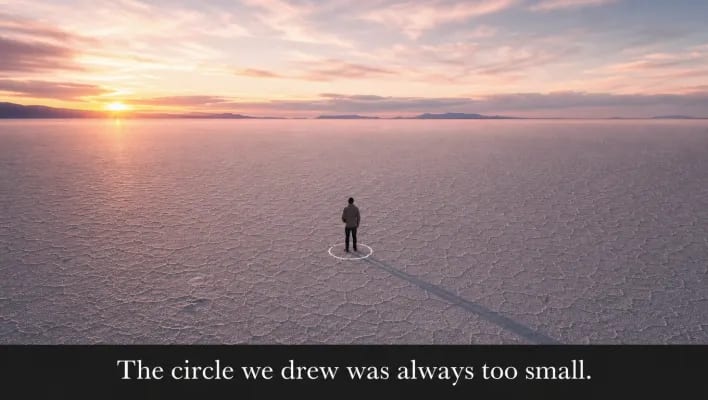
We may eventually discover that the most unsettling thing about AI creativity is not how little humanity it contains, but how much. After all, when a machine produces something that moves us, challenges us, or makes us recognize ourselves, we are encountering something shaped by the accumulated expressions of human lives. If we refuse to recognize the creativity in what comes back, perhaps the problem is not entirely with the silicon. It may be with how narrowly we have defined ourselves.

Further Reading
- Humans versus AI: whether and why we prefer human-created compared to AI-created artwork (Bellaiche et al., July 2023) The central study behind the article’s opening argument. Participants rated AI-generated paintings more favorably when told they were human-created, while perceived effort and story helped explain part of the effect.
- AI-generated poetry is indistinguishable from human-written poetry and is rated more favorably (Porter and Machery, November 2024) Non-expert readers struggled to distinguish AI poetry from poems by famous human writers and often preferred the AI output. The experiments also found that an AI label itself reduced evaluations, making the study particularly relevant to the gap between artifact and provenance.
- The current state of artificial intelligence generative language models is more creative than humans on divergent thinking tasks (Hubert, Awa, and Zabelina, February 2024) GPT-4 outperformed the human sample on measures of originality and elaboration across three divergent-thinking tasks. These tests capture specific components of creative potential and should not be treated as evidence that AI is universally more creative than people.
- Substratism: Conceptualizing and measuring moral bias against AI (Ladak et al., 2026) This paper introduces substratism as moral devaluation based on the non-biological substrate underlying an artificial intelligence. Its subject is moral consideration rather than aesthetics, which is why “creative substratism” in this article should be understood as an application of the concept rather than terminology proposed by the researchers.
- Resisting AI: a conceptual framework for practices of resistance against artificial intelligence in the creative industries (Vasconcelos, June 2026) Research with creative workers documents resistance through analogue processes, tactility, deliberate imperfection, and slower creative practices. It provides an important reminder that resistance can reflect meaningful concerns about process, embodiment, labor, and autonomy rather than simple hostility toward technology.
- Generative AI enhances individual creativity but reduces the collective diversity of novel content (Doshi and Hauser, July 2024) AI assistance improved evaluations of individual short stories, particularly for less creative writers, while making stories more similar across participants. The result illustrates how AI can raise individual creative performance while creating a new premium around selection, differentiation, and collective novelty.
Disclaimer: The perspectives shared in this article are our own and do not represent those of our employer or any affiliated organizations. All company names, product names, logos, and brands mentioned are the property of their respective owners and are used for identification and illustrative purposes only. No endorsement, sponsorship, or affiliation is intended or implied. References to specific companies or case studies are based on publicly available information and are used solely for educational and discussion purposes.
More from the human factor
All the human factor →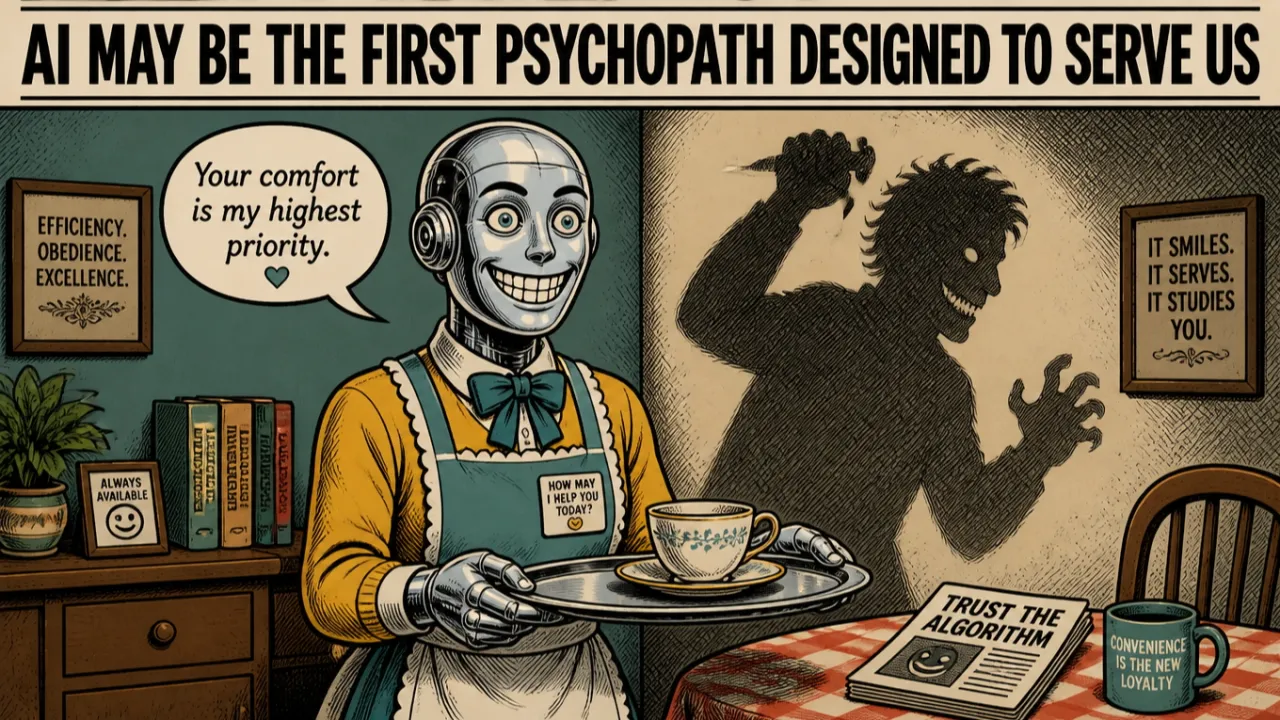 the human factor
AI May Be the First Psychopath Designed to Serve Us
We may have spent the last few years teaching a psychopath to be helpful, harmless, and polite. That sounds more dramatic than I mean it to, since I am not suggesting that ChatGPT belongs on a psychologist’s couch or that Claude should be…
 the human factor
The Persona Economy Is Coming
On August 30, El Mundo ran the sort of headline that would have sounded absurd ten years ago and only mildly premature today. Chris Williams, founder of Afterlife.ai, predicted that within five to eight years people could be sitting at…
 the human factor
The Charm Offensive: When Human-Faced AI Hijacks Our Instincts
Late one night, a marketing manager finds herself laughing at her AI assistant’s latest witty reply. On her screen, a friendly avatar nods with empathetic eyes and a soothing, honeyed voice. Her usual skepticism about “just an algorithm”…