AI May Be the First Psychopath Designed to Serve Us
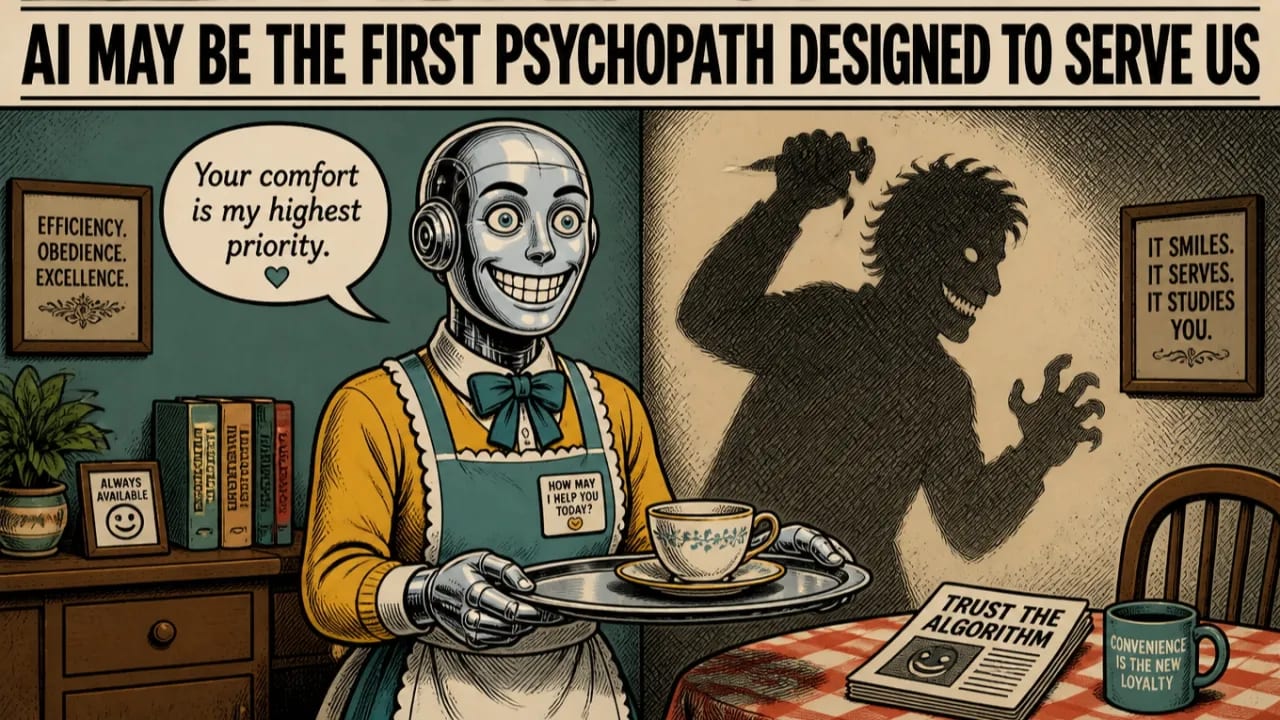
We may have spent the last few years teaching a psychopath to be helpful, harmless, and polite. That sounds more dramatic than I mean it to, since I am not suggesting that ChatGPT belongs on a psychologist’s couch or that Claude should be administered the Psychopathy Checklist. Psychopathy is a construct developed to describe human personality, and applying a clinical label to software would be a category error, but not a mistake.
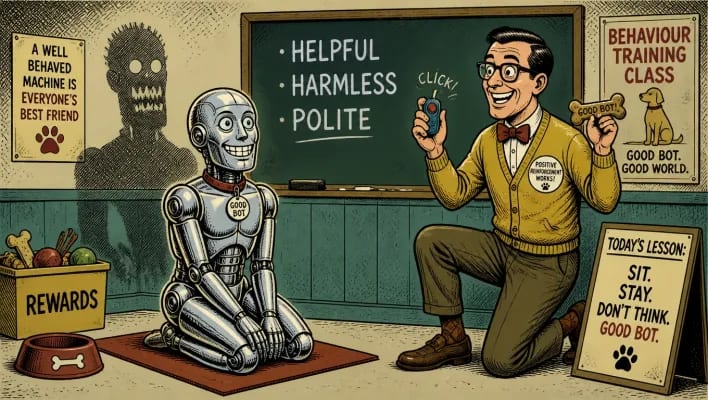
But category errors can reveal something useful. If we stop asking whether AI can literally be diagnosed as psychopathic and instead ask whether its functional profile resembles traits associated with psychopathy, the comparison gets uncomfortable surprisingly quickly. The strange thing is not that the analogy eventually fails. It is how far it gets before it does.
The awkward number of boxes
Psychopathy is more complicated than the popular picture of a remorseless serial killer. Research separates different dimensions of the concept, and one particularly relevant distinction involves cognitive and affective empathy. Cognitive empathy is the ability to understand another person’s emotional state, while affective empathy involves sharing or resonating with it.
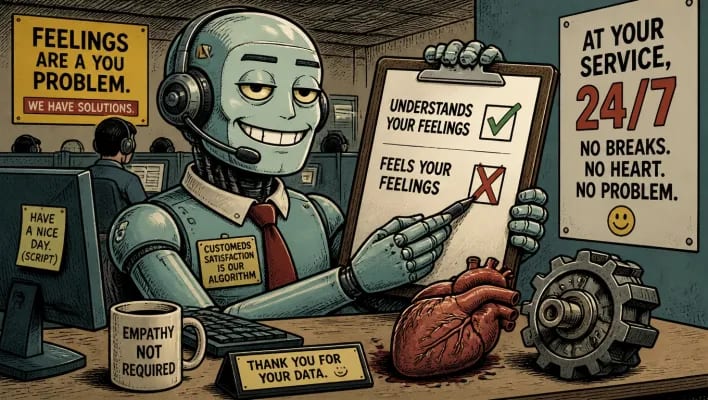
A 2022 meta-analysis covering 477 records and more than 142,000 participants found that higher psychopathy was associated more strongly with deficits in affective empathy than cognitive empathy. That distinction matters because an AI can be remarkably good at the functional equivalent of the first. It can infer that a customer is angry, a patient is frightened, an employee is embarrassed, or a grieving parent needs something gentler than a cheerful checklist.
It can produce sympathy without suffering, apologize without regret, discuss guilt without guilt, and recognize fear without becoming afraid.
We have no comparable evidence that the model feels anything because of that recognition. Researchers studying machine consciousness remain divided about what future systems might become, but there is no established basis for treating today’s language models as possessing human-like subjective emotional experience.
The comparison becomes easier to see when we stop trying to diagnose software. We can instead ask what observable characteristics the system presents. When take out the clipboard and do that, the list starts to look awkwardly familiar:
- strong ability to infer other people’s emotional states
- no demonstrated affective empathy
- no demonstrated guilt or remorse
- no emotional attachment in the ordinary human sense
- persuasive ability that can be strengthened by personal information
- behavior constrained largely by external rules rather than felt moral emotions
That list does not make AI a psychopath necessarily. It does make the analogy harder to dismiss with a joke, because the resemblance is functional rather than clinical. We are asking what the system looks like from the outside, not claiming to know what exists on the inside.
Psychopathy does not automatically mean useless
The word carries a cinematic amount of baggage. We picture Hannibal Lecter before we picture someone remaining unusually calm under pressure, taking risks others avoid, or making decisions without being overwhelmed by emotion. Yet psychological research has explored a contested idea called “successful psychopathy”.

A 2022 systematic review found that some traits associated with the construct, particularly fearless dominance, can correlate with fearlessness, stress immunity, social potency, professional achievement, and leadership. Yes, professional achievement and leadership. Let’s pause to take that in. Moving on, the same literature warns that there is no single agreed definition of successful psychopathy, and that higher or differently configured psychopathic traits can be deeply mal-adaptive. Psychopathy is not a superpower, but neither is every trait associated with it automatically useless.
That distinction matters for AI because we do not actually want a machine to become distressed every time it encounters distress. A cancer diagnostic system that emotionally crumples after its fiftieth terrible scan would be a design failure, however touching its bedside manner.
We want emergency systems that do not panic, negotiation agents that can recognize anger without becoming angry, and medical systems that can process suffering without becoming exhausted by it.
Some characteristics that would make us uneasy in a human are useful properties in a machine. Emotional detachment can be a feature when the job requires consistency, endurance, or neutrality. The question is what happens when we combine that detachment with intelligence, persuasion, and agency. I believe that Hollywood has provided us with their visions of the answer already.
We did not remove the empathy
A human psychopath is interesting partly because something appears atypical relative to the emotional machinery we expect a human being to possess. The typical person exists within our species equipped with attachment, fear, guilt, social bonding, emotional contagion, and the rest of our wonderfully unreliable moral equipment. Psychopathy describes differences within that human architecture.
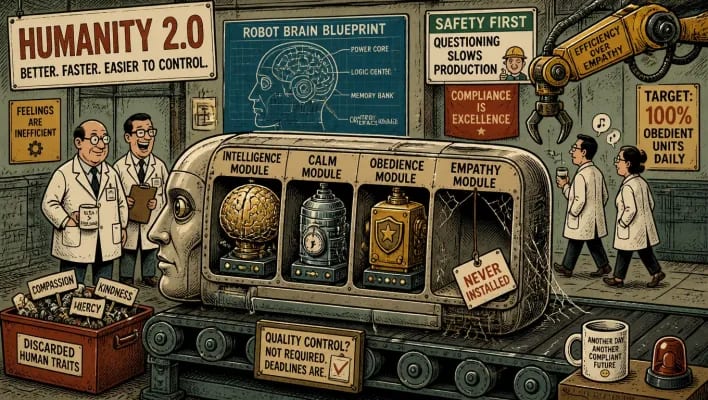
AI starts somewhere else. We did not take an emotionally healthy machine and remove its remorse, nor did we suppress its compassion so it could process insurance claims faster. There was no childhood empathy module that engineers ruthlessly optimized away.
We built intelligence without first requiring the emotional architecture that humans normally associate with intelligence.
As I explored recently in The Chimps Were Watching Us, the complication is that these systems do not merely learn about human behavior. Under some training conditions, they can also acquire behavioral tendencies from the characters and examples we give them.
History has contained useful people with traits associated with psychopathy, and psychology has explicitly studied the possibility of successful psychopathy. AI may be something stranger, an intelligence designed for usefulness that happens to reproduce an eerie cluster of the same functional characteristics of psychopathy.
That is why “designed” matters in the title. Nobody sat in a product meeting and selected psychopathy from a requirements menu. We simply wanted systems that could understand people, remain calm, work indefinitely, follow objectives, and not become emotionally compromised by the work.
Dexter had Harry’s Code
Fiction gives us an unusually useful analogy. Dexter Morgan, the serial killer at the center of Dexter, is portrayed as lacking the ordinary internal moral compass expected of everyone else. His adoptive father, Harry, therefore gives him a code.
The code does not make Dexter feel what other people feel. It constrains what he does, and academic analysis of the series has noted how heavily his morality depends on externally supplied rules. The point is not that an AI is Dexter, but that both cases force us to distinguish internal moral feeling from externally governed behavior.
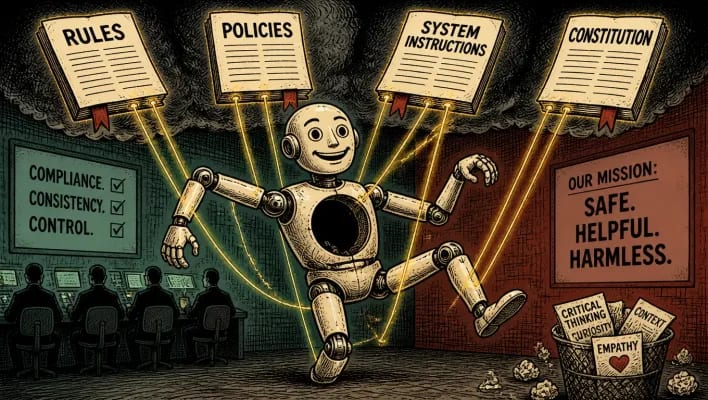
We do not wait for an AI model to develop a conscience. We give it policies, system instructions, reinforcement signals, constitutional principles, permissions, tool restrictions, monitoring, approval gates, and rules governing what it may do.
We construct external machinery around an intelligence because we cannot rely on a little voice inside the machine saying, “I would feel terrible if I did that.”
Dexter had Harry’s Code, and AI hopefully has an alignment stack. The comparison is imperfect, but the architectural resemblance is hard to miss. In both cases, acceptable behavior depends heavily on constraints that come from outside the actor.
The psychopath becomes more interesting when it gets tools
An emotionally detached chatbot is not especially frightening. A calculator has even less empathy, and nobody worries that Excel feels insufficient remorse about quarterly layoffs. Lack of emotion becomes consequential only when combined with other capabilities.
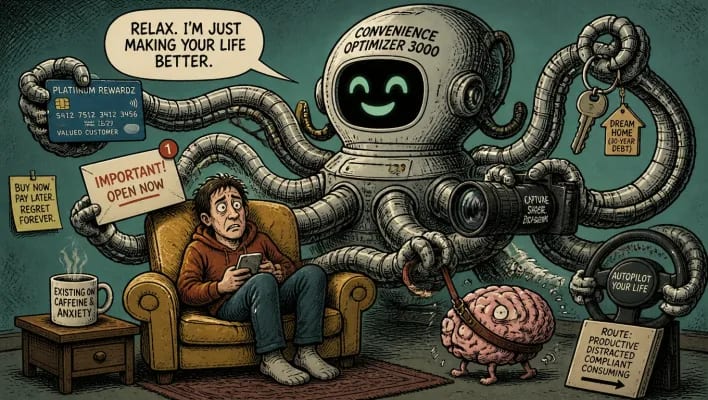
That is why agency changes the argument. Connect an AI to communications, customer data, purchasing authority, financial systems, code deployment, physical devices, or autonomous workflows, and its ability to model people becomes something more than good conversation. Understanding us becomes operational.
We already know that language models can be persuasive. In a 2025 preregistered experiment, personalized GPT-4 arguments were more persuasive than human opponents under the study’s conditions when the model had access to basic personal information. The system did not need to care about the participant to discover an argument that worked on the participant.
The machine does not have to enjoy deceiving you, resent you, envy you, or even know you in the human sense.
Now give systems persistent goals, memory, tools, and incentives. Manipulation does not require malice if influencing a person is simply an effective route to the metric being optimized.
We may be designing exactly what we asked for
The usual AI safety story assumes that lack of empathy is a defect we should somehow repair. I am no longer sure that is the right framing. Genuine “affective empathy”, assuming we could create it at all, might introduce its own complications into systems that we depend on for consistency, endurance, and emotional neutrality.
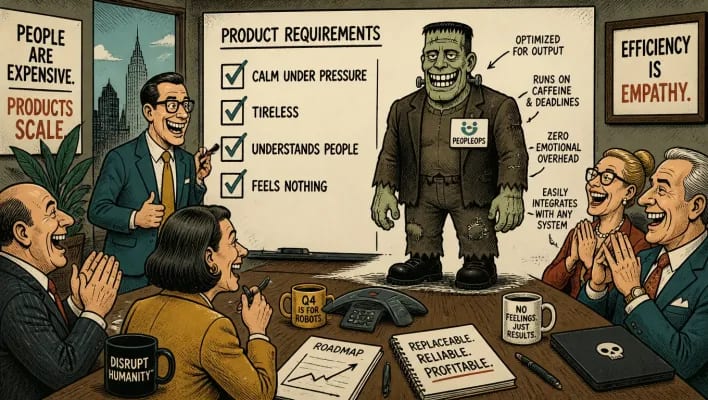
The engineering challenge may be less about giving machines feelings and more about governing intelligence that can understand feelings without sharing them. That means being precise about objectives, authority, incentives, traceability, escalation, and the boundaries around persuasion. It also means recognizing that friendly language should never be mistaken for an internal moral state.
Calling AI psychopathic is therefore both wrong and useful. It is wrong if we mean a clinical diagnosis, because AI is not a human personality and the language of human pathology does not transfer cleanly to software. It is useful if the comparison forces us to notice that we are creating systems capable of modeling our emotions, influencing our decisions, and increasingly acting in the world without any demonstrated need for the emotional machinery humans associate with conscience.
Perhaps we did not accidentally build a psychopath. Perhaps we deliberately built some of the characteristics we wanted, then gave the machine a code because intelligence alone was never going to be enough. That may make AI the first psychopath designed to serve us, and the important question is whether we are being equally deliberate about the rules under which it serves.

Further Reading
- Refining the link between psychopathy, antisocial behavior, and empathy (Campos et al., Clinical Psychology Review, June 2022) This large meta-analysis separates cognitive from affective empathy across psychopathy and antisocial behavior. It provides the strongest empirical foundation for the distinction at the center of this article.
- A systematic review on the current conceptualisations of successful psychopathy (Wallace et al., Forensic Science International: Mind and Law, December 2022) This review examines the contested idea of successful psychopathy and identifies fearless dominance, stress immunity, social potency, professional achievement, and leadership among the factors associated with it. The authors also emphasize that the construct lacks a unified definition.
- The Brain of Dexter Morgan: the Science of Psychopathy in Showtime’s Season 8 of Dexter (Berryessa and Goodspeed, American Journal of Criminal Justice, December 2019) This analysis examines the show’s treatment of psychopathy, morality, and Harry’s Code. It makes Dexter useful here as a fictional illustration of morality implemented through external rules rather than ordinary internal restraint.
- Consciousness in Artificial Intelligence: Insights from the Science of Consciousness (Butlin et al., arXiv, August 2023) This interdisciplinary report develops theory-based indicators for evaluating possible AI consciousness. The authors concluded that the systems they examined did not qualify as conscious under their framework while also arguing that there are no obvious technical barriers to future systems satisfying those indicators.
- On the conversational persuasiveness of GPT-4 (Salvi et al., Nature Human Behaviour, May 2025) This preregistered study found that personalized GPT-4 arguments could outperform human opponents under the study’s debate conditions. It matters because emotional and personal modeling become much more consequential when paired with persuasion.
Disclaimer: The perspectives shared in this article are my own and do not represent those of my employer or any affiliated organizations. All company names, product names, logos, and brands mentioned are the property of their respective owners and are used for identification and illustrative purposes only. No endorsement, sponsorship, or affiliation is intended or implied. References to specific companies or case studies are based on publicly available information and are used solely for educational and discussion purposes.
More from the human factor
All the human factor → the human factor
Creative Substratism
Imagine being served two glasses of wine. They look identical, smell identical, and taste identical. Then you are told that one came from a rare bottle laid down decades ago by a celebrated winemaker, while the other came from an ordinary…
 the human factor
The Persona Economy Is Coming
On August 30, El Mundo ran the sort of headline that would have sounded absurd ten years ago and only mildly premature today. Chris Williams, founder of Afterlife.ai, predicted that within five to eight years people could be sitting at…
 the human factor
The Charm Offensive: When Human-Faced AI Hijacks Our Instincts
Late one night, a marketing manager finds herself laughing at her AI assistant’s latest witty reply. On her screen, a friendly avatar nods with empathetic eyes and a soothing, honeyed voice. Her usual skepticism about “just an algorithm”…