The Fruit Fly Upload Is the Least Interesting Part
What happens when biology becomes executable?
In March, a San Francisco company called Eon announced that it had “uploaded a fruit fly.” By October, a video titled The First Brain Was Just Uploaded To A Computer was making the claim newly viral, and the phrase did exactly what a phrase like that is supposed to do. It pulled the conversation toward digital immortality, consciousness, and whether a fly now lives inside a computer. Those questions are irresistible, but they may also be a distraction from the development sitting directly in front of us.
The more consequential possibility is simpler. We are learning how to take the physical organization of a nervous system, turn it into an executable computational object, connect it to a body, and watch what happens. That creates a new bridge between neuroscience and artificial intelligence, one where biology is not merely something AI helps us analyze. Biology starts becoming architecture we can run, test, compare, and perhaps borrow from.
A wiring diagram that started doing things
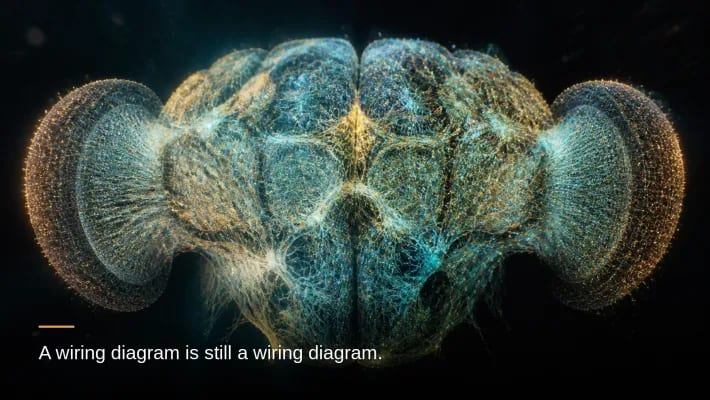
The foundation is FlyWire, the 2024 reconstruction of an adult female Drosophila brain. The published connectome contains 139,255 neurons and 54.5 million synapses, mapped at a scale that lets researchers trace pathways across the whole brain rather than infer them from isolated fragments. What’s a connectome, you may ask? A connectome is a detailed map of how the neurons in a brain are wired together. That alone was a landmark, but a wiring diagram is still a wiring diagram. The next question was whether enough function was encoded in the structure to make the diagram computationally useful.
Philip Shiu and colleagues gave us an early answer. They built a “leaky” integrate-and-fire model from the fly connectome using connectivity and predicted neurotransmitter identity, then tested it against known feeding and grooming circuits. Across 164 predictions they could test experimentally, 91 percent were consistent with empirical results. The interesting result was not that a simplified model had become a fly. It was that a surprisingly stripped-down representation of the architecture could still reproduce enough of the sensorimotor logic to generate useful predictions.
Eon then connected pieces of that work to an embodied simulation. Its system combines the connectome-constrained brain model with visual modeling and NeuroMechFly, a detailed virtual body running in the MuJoCo physics engine. The simulated fly can move toward food-related cues, stop to groom, and initiate feeding behavior. The loop now runs from virtual sensation to neural activity to action and back to new sensation.
That sounds cleaner than the engineering actually is, which matters. Eon’s own technical write-up says the body relies heavily on existing controllers, several brain-to-body mappings were chosen by hand, internal state and learning are largely absent, and the model’s internal dynamics have not been comprehensively validated against biology. Calling this a complete animal upload therefore asks the word “upload” to do heroic amounts of work. Calling it a research platform for executable neurobiology is less dramatic and, to me, considerably more interesting.
The robot hidden inside the fly
One reason is robotics. A robot has sensors distributed around a body, actuators distributed around a body, local problems that need fast responses, and global goals that require coordination. We often solve that with centralized computation because our computers make centralization convenient.
Biology had no obligation to respect our software architecture preferences.
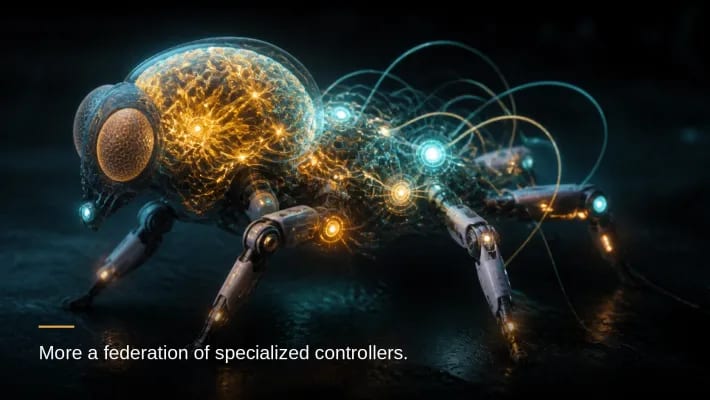
A 2026 Nature paper that joined the fruit fly brain and ventral nerve cord found an architecture built around local sensory feedback loops linked by “longer-range ascending and descending circuits”. The authors describe the organization as “distributed, parallelized, and embodied, with learning and navigation regions supervising lower-level control”. That sounds less like a tiny general-purpose CPU issuing every instruction and more like a federation of specialized controllers that communicate when coordination matters.
Robotics researchers are already testing whether that organization transfers to their field. A 2026 preprint called FlyGM used the actual fruit-fly connectome as the fixed graph structure of a controller trained for whole-body locomotion, reporting better sample efficiency and performance than rewired, random, and conventional comparison networks. Another recent preprint, FlyCNS, used principles from the fly brain and nerve cord to allocate local computation and long-range communication in a simulated Unitree Go1 robot. Under its tightest communication budget, the system used roughly one fifth of full communication while remaining within 6.1 percent of the full-communication reference on its tracking score.
Those are preprints, not commandments carved into silicon, and nobody should redesign a robotics stack because a fly had a good quarter. But they suggest a new kind of design input. Connectomes may offer engineers design patterns that evolution has already stress-tested, not because biology always produces the best engineering solution, but because it has spent hundreds of millions of years exploring what works under severe constraints on energy, latency, robustness, sensing, and survival.
AI has been learning from behavior
Most modern AI learns from examples, objectives, feedback, or some combination of the three. We design an architecture, expose it to data or an environment, and optimize until useful behavior emerges. Connectomics introduces another source of information. Instead of learning only from what an organism does, we can increasingly study the physical architecture that makes doing it possible.
That does not make the fly connectome “the opposite of AI,” as some viral commentaries have suggested. The connectome is itself the product of genes, development, evolution, and experience, while many connectome-inspired controllers still use conventional machine learning.
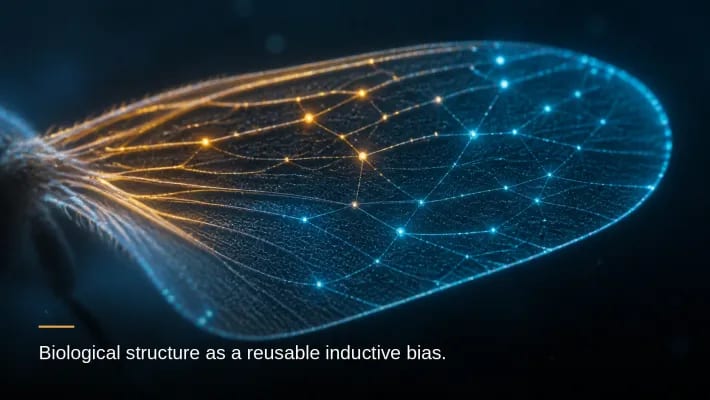
The interesting boundary is not biology versus AI. It is the possibility that biological structure can become a reusable inductive bias inside artificial systems.
That matters because architecture changes what a system finds easy to learn. Convolution gave vision systems useful assumptions about locality. Attention gave language models a powerful way to relate information across a sequence. A connectome may offer different assumptions about recurrence, sparse communication, modular control, sensory routing, redundancy, and the relationship between local reflex and global intent. We do not yet know which of those patterns will generalize outside biology, but now we can test them rather than admire them through a microscope.
Motor control may be the easy part
The deeper implications appear when we move beyond movement. Fruit flies are obviously not miniature humans, but research has shown persistent internal states in Drosophila with properties neuroscientists call emotion primitives, including persistence, scalability, valence, and generalization.
The claim is not that a fruit fly experiences fear the way a person does. The useful observation is that behavior can be governed by internal state that outlasts the immediate stimulus and changes what the organism does next.
That distinction should sound familiar to anyone building AI agents. We already struggle with systems that can reason impressively in one moment yet lack durable context, stable priorities, coherent long-term state, or meaningful consequences from what happened five minutes ago. I wrote about one version of this in AI’s Goldfish Problem, where persistent memory changes an AI from a sequence of disconnected performances into something capable of carrying context across time. Biology suggests that memory may be only part of the story.
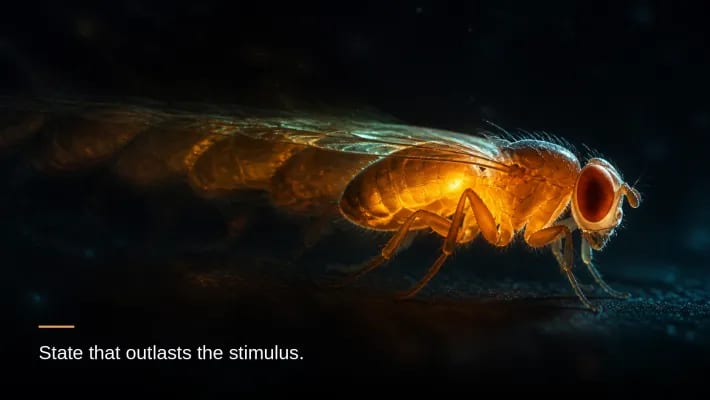
Hunger, arousal, satisfaction, recent sensory history, and hormonal state all reshape how a biological nervous system interprets the same input. Eon explicitly lists many of these as missing from the current virtual fly. For AI, the intriguing possibility is not that we should give a model “feelings.” It is that some of the mechanisms we casually file under emotion may also be control systems for attention, persistence, priority, exploration, inhibition, and action selection.
A laboratory that can be rewound
Executable biology could also change neuroscience before it changes AI. A connectome-constrained model can be test in ways that would be slow, expensive, difficult, or impossible to explore one neuron at a time in a living animal. Shiu’s team used its model to predict circuit responses and then tested many of those predictions experimentally. A 2026 bioRxiv preprint pushed the idea further by fitting a whole-brain connectome-constrained model to calcium recordings and using computer simulations to identify neurons and synapses that appear important for maintaining spontaneous activity.
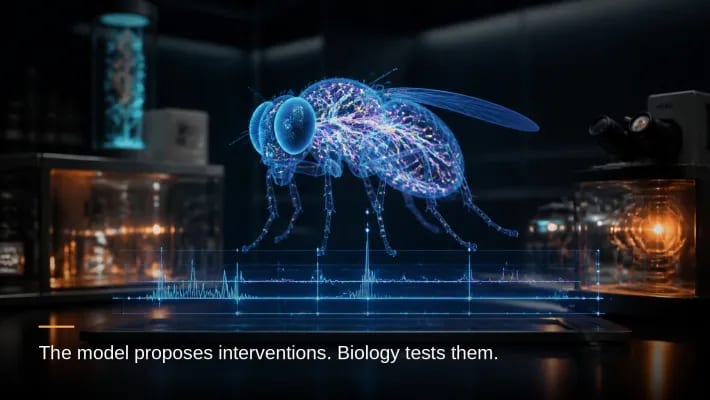
A simulation that makes a prediction does not make the wet lab obsolete, because the simulation inherits its assumptions, missing variables, and measurement errors. The opportunity is a tighter experimental loop in which the physical brain constrains the model, the model proposes interventions, biology tests them, and the results improve the next model. AI then participates twice, first in reconstructing and interpreting the connectome, and later as a beneficiary of whatever design principles that cycle reveals.
This is already scaling in interesting directions. In September, researchers published a complete male Drosophila central nervous system connectome with roughly 166,700 neurons spanning brain and nerve cord. It allows end-to-end analysis from sensation to action and, for the first time at this scale, synaptic-resolution comparison of male and female circuitry. The object being made executable is no longer just a brain-shaped graph. It is becoming a nervous-system-shaped graph tied more tightly to bodies, behavior, sex differences, and control.
Then we earn the philosophical problem
Only after all of that do I think the word “upload” deserves center stage. Eon argues that upload fidelity is a spectrum rather than a binary threshold, and there is a reasonable engineering sense in which that is useful. A low-fidelity emulation can still be scientifically valuable even if nobody believes a tiny digital fly has achieved cybernetic immortality.
The problem appears when engineering fidelity gets confused with personal continuity. I have explored this distinction more formally in The Preservation of the Continuity of the Self. A system can reproduce a state, memory, disposition, or behavior with extraordinary accuracy without establishing that the subject who produced those properties continued into the new substrate. The Persona Economy Is Coming approaches the same boundary from another direction, where increasingly convincing representations of people force us to separate resemblance, persistence, ownership, identity, and survival.
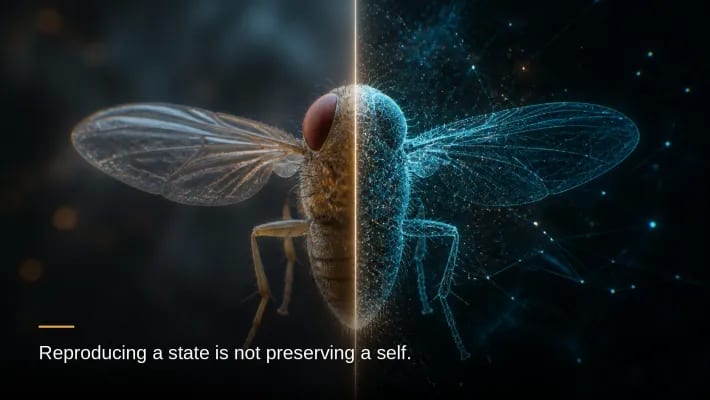
The fruit fly does not resolve any of that. In fact, the limitations of the present system make the philosophical claim premature. But it gives the old thought experiment an unexpected engineering substrate. We can now point to a real pipeline in which neural structure is scanned, reconstructed, modeled, embodied, stimulated, and observed. This allows us to ask exactly which additional ingredients would have to be captured before the words simulation, emulation, copy, and continuation stop meaning different things.
The first thing we upload may be a design vocabulary
The practical consequences may arrive long before anyone uploads a human mind. Robotics may borrow distributed control and sparse communication. AI systems may borrow biological priors for memory, routing, robustness, internal state, and action selection. Neuroscience may gain increasingly executable models that let researchers test ideas against a digital nervous system before taking them back to biology.
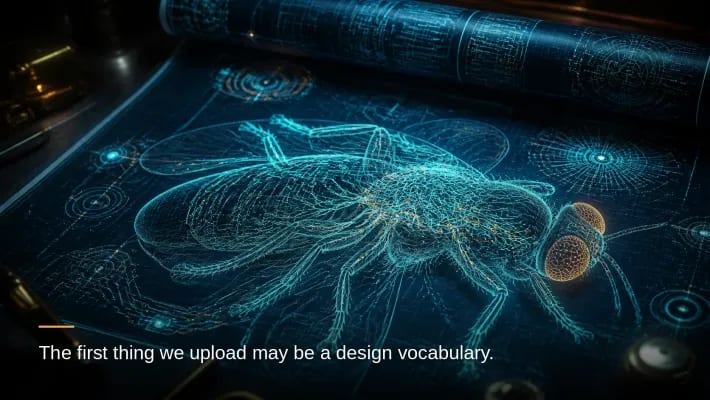
That is why the fruit fly upload is the least interesting part of the story. The larger development is that the boundary between a biological wiring diagram and an executable architecture is beginning to blur, and AI is helping open it from both sides. The first important thing we upload may not be a mind at all. It may be a design pattern vocabulary that biology has been refining for far longer than we have been building computers.

Further Reading
- The First Brain Was Just Uploaded To A Computer (There’s An AI For That, October 2026) The video that prompted this essay and a useful popular introduction to the Eon demonstration. It is an overview rather than primary scientific evidence, so the technical claims below are grounded in the original research and Eon’s own documentation.
- We’ve Uploaded a Fruit Fly (Eon, March 2026) Eon’s original announcement of the embodied virtual fly. It lays out the company’s interpretation of the work and its brain-emulation ambitions, but it is a company announcement rather than a peer-reviewed publication.
- How the Eon Team Produced a Virtual Embodied Fly (Eon, March 2026) The most useful technical account of what Eon actually assembled. Importantly, it also documents the limitations, including pre-existing body controllers, hand-chosen brain-to-body mappings, missing plasticity and internal state, and incomplete biological validation.
- Neuronal wiring diagram of an adult brain (Dorkenwald et al., Nature, October 2024) The foundational FlyWire paper describing the adult female Drosophila connectome with 139,255 neurons and 54.5 million synapses. This is the structural substrate on which much of the computational work rests.
- A Drosophila computational brain model reveals sensorimotor processing (Shiu et al., Nature, October 2024) The key peer-reviewed bridge from wiring diagram to executable model. A simple leaky integrate-and-fire model based on connectivity and neurotransmitter identity generated testable predictions for feeding and grooming circuits, with 91 percent of 164 tested predictions consistent with experiments.
- Distributed control circuits across a brain-and-cord connectome (Bates et al., Nature, June 2026) This paper connects brain and ventral nerve cord and finds local feedback loops coordinated by long-range ascending and descending pathways. Its description of distributed, parallelized, embodied control is especially relevant to robotics and agent architecture.
- Whole-Brain Connectomic Graph Model Enables Whole-Body Locomotion Control in Fruit Fly (Jin et al., arXiv preprint, February 2026) FlyGM treats the real Drosophila connectome as a fixed graph prior for a learned locomotion controller. The reported gains over rewired, random, and multilayer-perceptron comparisons are intriguing, although the work remains a preprint and uses imitation learning plus reinforcement learning rather than simply running an untouched biological network.
- FlyCNS: Connectome-Grounded Information Organization for Communication-Constrained Embodied Control (Zhang et al., arXiv preprint, September 2026) A particularly direct robotics connection. The work borrows the fly nervous system’s separation of local processing and long-range ascending and descending communication to control a simulated quadruped under constrained communication budgets. It is recent preprint evidence and should be treated accordingly.
- Connectome-constrained modeling identifies neurons and synapses that sustain spontaneous activity in Drosophila (Li et al., bioRxiv preprint, August 2026) An example of the emerging idea of an executable connectome as a perturbable scientific platform. The model is fitted to calcium recordings and then interrogated in silico to identify candidate circuitry underlying spontaneous activity. It has not yet passed peer review.
- Sexual dimorphism in the complete Drosophila male central nervous system connectome (Berg et al., Cell, September 2026) The complete male central nervous system connectome extends analysis across brain and nerve cord and enables synaptic-resolution comparison between male and female circuitry. It is an important sign that connectomics is moving from a single mapped brain toward comparative, whole-system biology.
- A connectomics milestone: Mapping the complete male fruit fly brain (Google Research, September 2026) A useful account of the computational side of the mapping effort and the role of AI in scaling connectomics. It also provides context for how reconstruction technology is advancing alongside the biological datasets themselves.
Disclaimer: The perspectives shared in this article are our own and do not represent those of our employer or any affiliated organizations. All company names, product names, logos, and brands mentioned are the property of their respective owners and are used for identification and illustrative purposes only. No endorsement, sponsorship, or affiliation is intended or implied. References to specific companies or case studies are based on publicly available information and are used solely for educational and discussion purposes.
Editorial note: This article deliberately distinguishes peer-reviewed research, preprints, and company claims because they carry different evidentiary weight. The Eon system is best treated today as an integration and research demonstration rather than proof of complete brain emulation. The more speculative AI and robotics implications in the essay are presented as directions to test, not conclusions the current science has already established.
More from machine minds
All machine minds → machine minds
The Chimps Were Watching Us
Before anyone gets infected in 28 Days Later, we see something deeply unpleasant. A chimpanzee is strapped to a table with it’s eyelids held open while television screens bombard it with images of riots, beatings, burning vehicles, and…
 machine minds
Your AI Pipeline Has Too Many Geniuses!
Somewhere in a large company right now, a model that could write a passable sonnet about actuarial tables is being asked whether a form field is empty. It will answer correctly, after a pause, at a price, and with a tidy paragraph of…
 machine minds
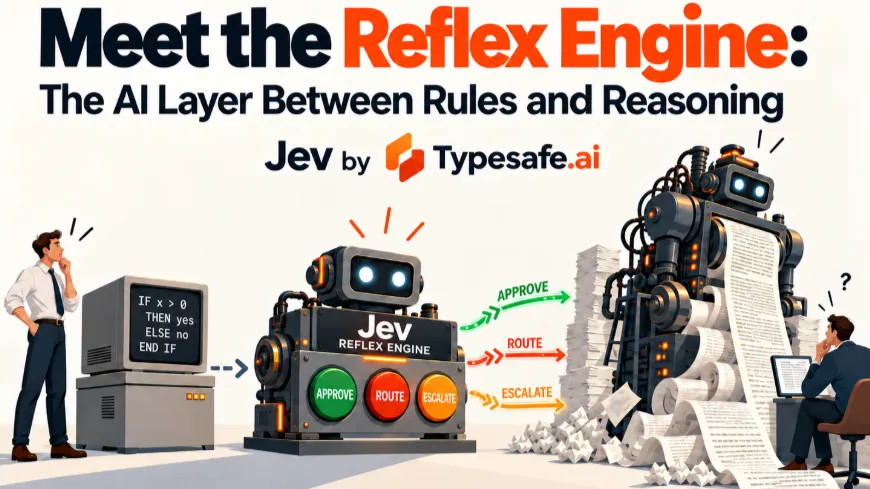
AI Has Learned to Think. Now It Needs Reflexes.
We have spent an extraordinary amount of time teaching AI to write paragraphs when a great deal of software really just wants to know whether the answer is yes, no, or “please find an adult.” Generative models are remarkable precisely…