AI Has Learned to Think. Now It Needs Reflexes.
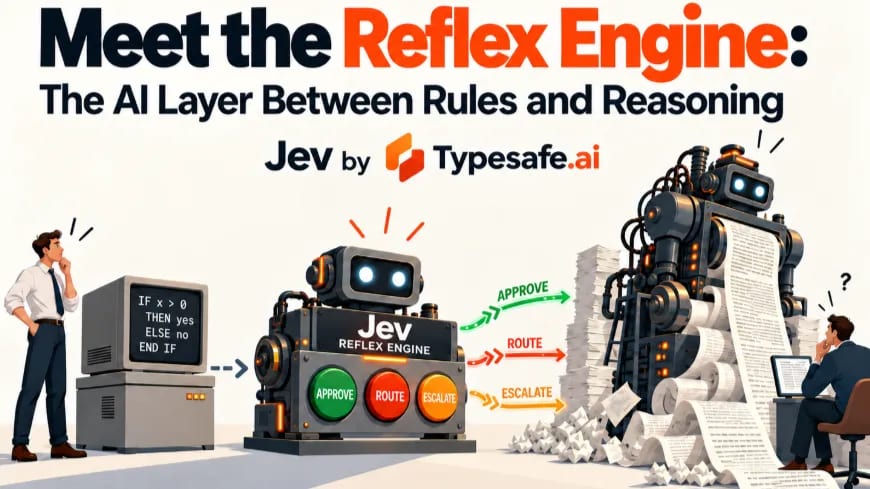
We have spent an extraordinary amount of time teaching AI to write paragraphs when a great deal of software really just wants to know whether the answer is yes, no, or “please find an adult.” Generative models are remarkable precisely because they can say almost anything, but that flexibility becomes awkward when software needs a fast, bounded decision it can act on immediately. Somewhere between the brittle if statement and the model that would like 800 tokens to explain itself, there may be room for something else.
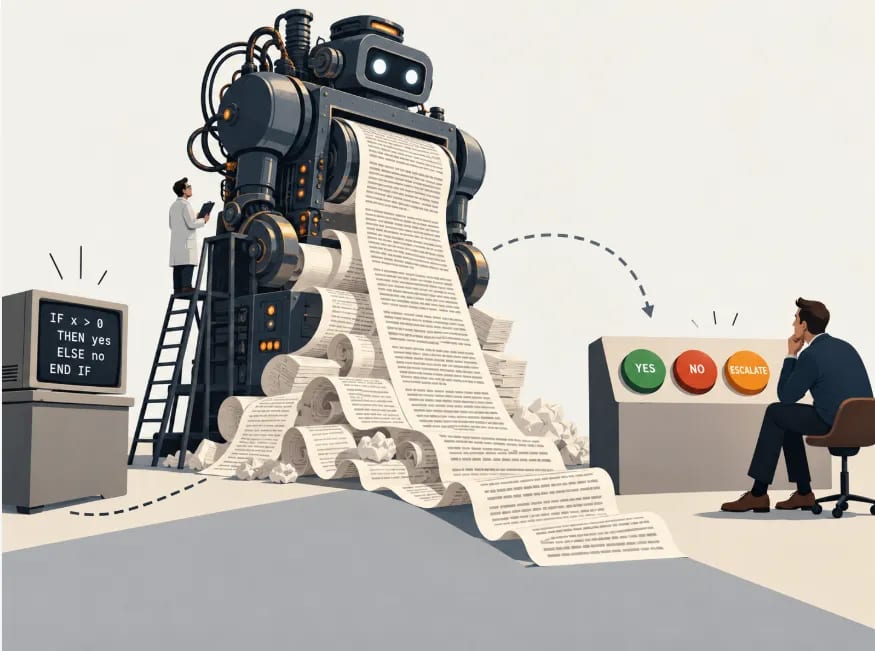
TypeSafe AI calls that something a System One Model, and its first public model, Jev, is an interesting example. Instead of generating free-form text, Jev takes state plus a set of predefined questions and returns typed probabilistic decisions: approve or reject, route A or B, true or false, perhaps escalate to a human. The software already knows what kinds of answers can come back, which changes the relationship between AI and code rather dramatically. TypeSafe describes it as “unstructured state in, typed probabilistic decisions out,” and reports response times measured in tens to hundreds of milliseconds for the kinds of workflows it designed Jev to handle. As it is described on their website, Jev is neither small nor an LLM.

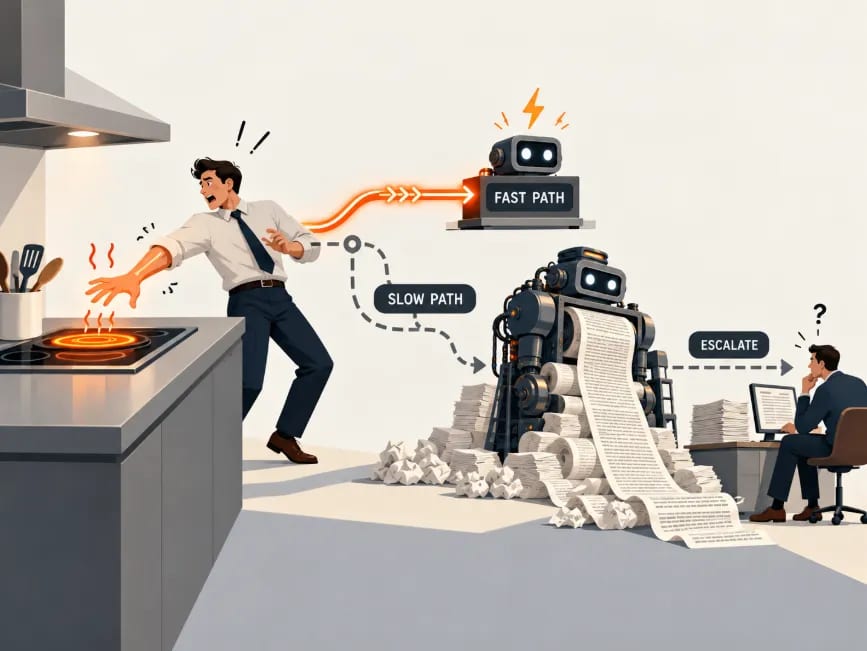
I think of this as an AI reflex engine. A reflex does not write an essay before pulling your hand away from a hot stove. A reflex layer could classify, route, score, guardrail, retry, approve, reject, or escalate while reserving expensive generative reasoning for the cases that genuinely require it. That creates a useful fast path / slow path architecture: bounded decisions move quickly, ambiguity moves upward, and humans or larger reasoning models enter only when the confidence or consequences justify the expense.
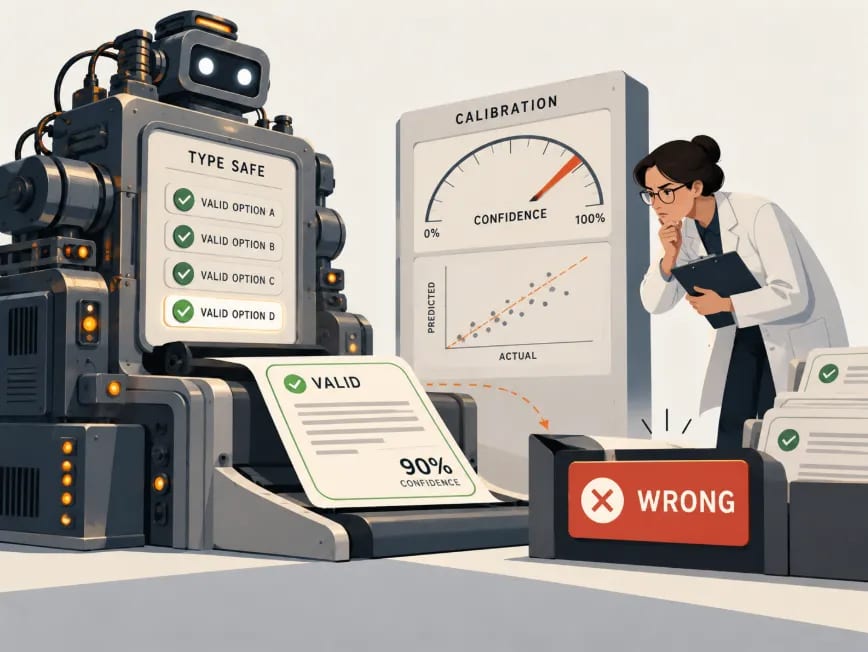
There is, however, a distinction worth keeping tattooed somewhere near the architecture diagram: type safety is not truth safety. Jev can be constrained to return only valid choices, but a perfectly valid choice can still be wrong, and a probability is useful only if it is well calibrated for the task in front of it. Early evidence is encouraging according to a September 2026 arxiv.org preprint. The study compared Jev’s decisions with 2,416 judgments made independently by people and found that the model performed very strongly against those human assessments. More importantly, the researchers also tested whether Jev’s confidence matched reality. If a system says it is 90% confident, you want testing to show that decisions at that confidence level are actually correct about 90% of the time. The researchers found that this relationship could be improved through calibration, which matters because a confidence number is only useful if experience shows that you can trust it.
The larger idea may be more important than Jev itself. We have mostly treated AI architecture as a contest to find increasingly capable models and then ask those models to do everything, including jobs that amount to “very sophisticated if statements”.
A reflex layer suggests a different design principle: use intelligence at the resolution the decision requires, and escalate only when the situation deserves deliberation.
AI has become very good at thinking out loud. The next useful trick may be knowing when not to. Jev points toward a compelling middle layer: faster, cheaper, more predictable decisions for the many cases that do not need a full generative model, with the added benefit of bounded outputs and measurable confidence. But that same simplicity makes discipline more important, not less; before trusting a reflex in production, I look forward to seeing how well it performs on the specific decisions that matter, how accurately its confidence matches reality, and how gracefully it hands uncertainty off to a larger model or a human. The potential is real, but so is the case for watching the evidence accumulate before wiring the reflex directly into anything consequential.

Further Reading
- Introducing System One Models & Jev - Diogo Almeida / TypeSafe AI, September 2026. TypeSafe’s primary description of Jev, including its architecture, workflow evaluations, speed and cost claims, typed outputs, calibration approach, and the limitations the company itself places around those claims. It is the vendor’s own evaluation, so the results are best read as promising evidence rather than independent validation. Read the TypeSafe AI article
- Calibrated Decisions at Scale: Converting Police Crash Narratives into Probabilistic Crash Variables with a System One Model (Jev) - Amir Rafe and Subasish Das, September 2026. An early independent application of Jev at substantial scale, including comparison with blinded human judgments and analysis of calibration. The results are encouraging, but this is an arXiv preprint rather than settled evidence across a broad range of production domains.
- Causal Evidence That Language Models Use Confidence to Drive Behaviour - Kumaran et al., Nature Machine Intelligence, September 2026 Particularly relevant to the “reflex engine” idea because the researchers found causal evidence that model confidence can govern whether a model commits to an answer or abstains. That supports the broader architectural idea of using confidence thresholds to decide when software should act and when it should defer, although the study examines conventional LLMs rather than Jev specifically.
- Calibration-Aware Uncertainty Cascades for Efficient Heterogeneous Model Collaboration - Zhang et al., arXiv preprint, September 2026 A very close conceptual companion to the article: calibrated confidence determines whether to accept an early answer, invoke a stronger model, or combine results. Across six language benchmarks, the researchers report avoiding roughly 47% of calls to the stronger model while maintaining or improving performance, making this a useful independent foundation for the fast-path/slow-path architecture described in the Jev piece. It remains a preprint under review.
Disclaimer: The perspectives shared in this article are our own and do not represent those of our employer or any affiliated organizations. All company names, product names, logos, and brands mentioned are the property of their respective owners and are used for identification and illustrative purposes only. No endorsement, sponsorship, or affiliation is intended or implied. References to specific companies or case studies are based on publicly available information and are used solely for educational and discussion purposes.
More from machine minds
All machine minds → machine minds
Your AI Pipeline Has Too Many Geniuses!
Somewhere in a large company right now, a model that could write a passable sonnet about actuarial tables is being asked whether a form field is empty. It will answer correctly, after a pause, at a price, and with a tidy paragraph of…
 machine minds
The Collection of Models Is the Model
Benchmark tables have a blind spot big enough to hold an entire product category. They tell us which model scored highest, what it costs, how quickly it answers, and whether this quarter's champion gained three points on last quarter's…
 machine minds
I Think, Therefore I Might Be True
A few days ago I was studying an AI-generated image, one of those dense collages crowded with references to companies, systems, and the general machinery of the moment. In one corner, occupying maybe five percent of the frame, stood a…