Who Owns the Lie?
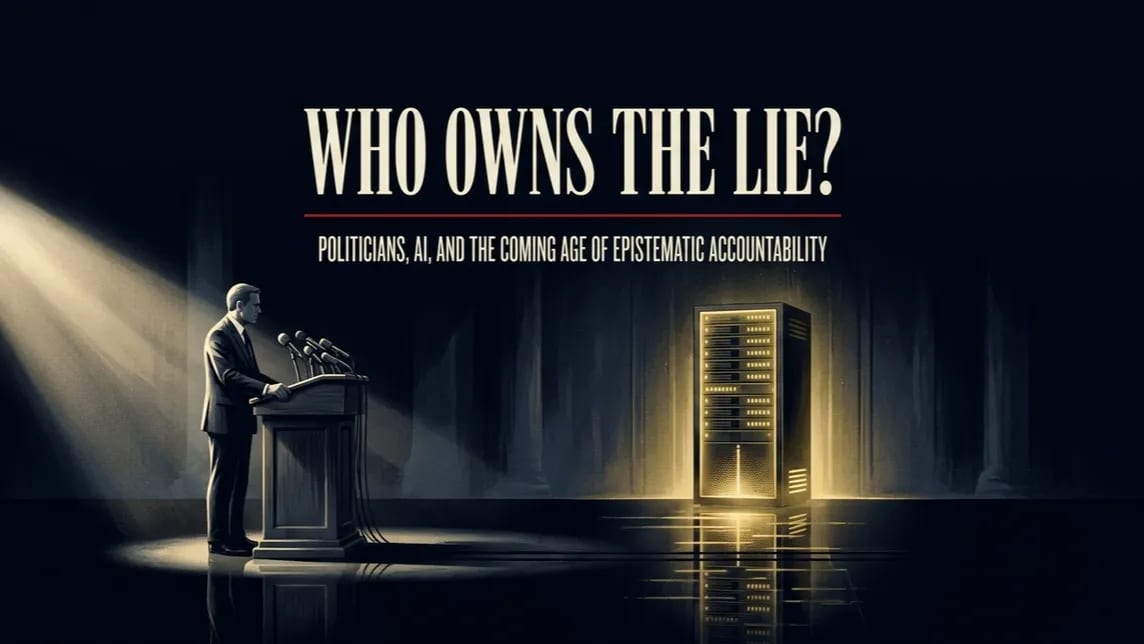
Politicians, AI, and the Coming Age of Epistemic Accountability
The nation of Wales has decided to experiment with a fairly radical idea in politics: factual claims should have some relationship with facts. This is apparently sufficiently novel that legislation was required. Somewhere, several thousand years of philosophers are staring at us with a mixture of relief and disappointment.
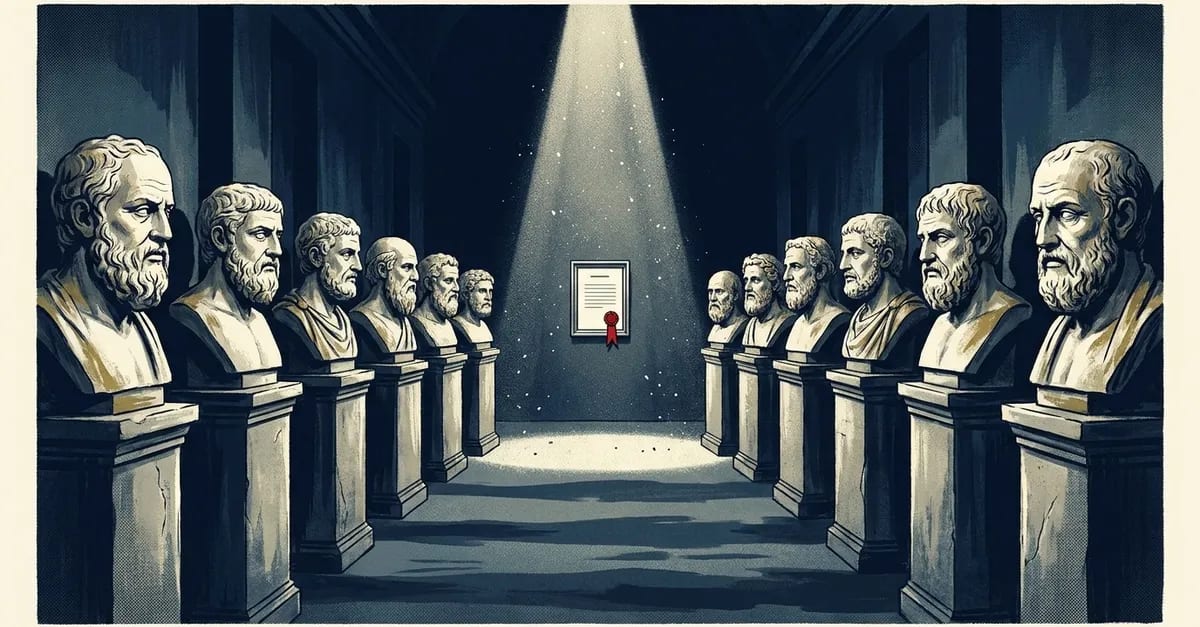
The actual law is more careful than the headline. The Senedd Cymru (Member Accountability and Elections) Act 2026 does not simply declare that politicians must tell the truth. It requires Welsh ministers to create rules prohibiting false or misleading statements of fact made before or during an election for the purpose of affecting the result, with the legislation allowing those rules to address statements made knowingly or recklessly and even to create criminal offences. Nothing to be said about once they are in office however.
That distinction matters because an opinion can be stupid, offensive, brilliant, dishonest, sincere, or all five. A factual assertion is different. At some point, “I believe this policy is disastrous” and “this policy has already cost taxpayers £4 billion” stop belonging to the same epistemic category.
Wales is attempting to put a legal boundary somewhere between them. That is interesting enough on its own, but it also raises a more contemporary question. If we are beginning to connect truth and accountability in politics, how long before we attempt something similar with AI?
We have spent years asking the wrong question
Nearly every conversation about AI accuracy eventually arrives at hallucinations. The model makes something up, invents a citation, misremembers a fact, fabricates a court case, or confidently tells you that Abraham Lincoln briefly served as product manager at Salesforce. We ask how to make models hallucinate less.

The makers of AI models publish benchmarks. Engineers add retrieval, grounding, verification, tools, guardrails, confidence mechanisms, and increasingly elaborate architectures intended to prevent the machine from confidently wandering into fiction. All of that is worthwhile, but there is a deeper question forming underneath the technical one.
Who is accountable when we believe it? That question becomes considerably more uncomfortable once AI leaves the chat window. A chatbot getting the population of Belgium wrong is irritating, while an AI system getting someone’s insurance eligibility, medical history, mortgage risk, employment status, tax obligation, or criminal record wrong is something else entirely.
The difference is not intelligence. It is consequence.
We already understand this in other professions, even if we do not normally describe the problem in those terms.
We do not demand that doctors never make an incorrect diagnosis, - perhaps we should. We do not demand that engineers guarantee a bridge will remain standing until the sun burns out. We do demand appropriate standards of evidence, process, professional judgment, documentation, and accountability.
AI is approaching the same territory. The interesting question is no longer simply whether the model can be wrong. It is whether anyone is responsible for the conditions under which we were asked to trust it.
Transparency came first
Regulators have mostly started somewhere easier than truth. They started with identity. Under Article 50 of the European Union’s AI Act, transparency requirements that became applicable in August 2026 require disclosures in several circumstances involving interactions with AI and AI-generated material.

Providers also face requirements around machine-readable marking of generated or manipulated content, while certain deepfakes and AI-generated public-interest material require disclosure. That is not a truth requirement. A clearly labelled AI can still be magnificently wrong.
But transparency establishes provenance. Before asking whether something deserves belief, we first establish where it came from. That is a familiar pattern in almost every other institution that asks us to trust information.
Food has labels. Financial statements have auditors. Academic papers have authors and citations, court testimony has witnesses, and newspapers have bylines and corrections.
Information acquires accountability partly because it acquires a history. AI arrived with a peculiar ability to remove that history.
A beautifully written paragraph can appear from nowhere, carrying the grammatical confidence of a tenured professor and the evidentiary discipline of a man explaining cryptocurrency at a wedding reception. Labelling is therefore a beginning. It cannot be the end.
Accuracy is quietly becoming a legal subject
The United States is approaching the problem from another direction. In July 2026, the Federal Trade Commission proposed a policy statement addressing AI companies that market their systems in ways that create reasonable expectations of objectivity and accuracy while potentially steering outputs toward undisclosed objectives. The legal mechanism is not a new Ministry of Truth.

It is the much older and more mundane prohibition against deceptive business practices. That is interesting because it moves the argument away from whether a model is capable of truth. The question becomes what the company represented about the system.
Did you tell customers it was objective? Did you describe it as accurate? Did you know about material limitations, quietly optimize it for some other purpose, or give customers a reasonable basis to believe the answer was produced according to one set of rules when it was actually produced according to another?
At that point, we have moved from philosophy to product liability. That tends to get executives’ attention. Truth becomes less abstract once it appears on the same agenda as legal exposure.
A hallucination cannot sign an affidavit
There is an obvious problem with applying our ordinary language of deception to AI. A model does not “lie” in the legal sense merely because its output is false. Lying normally contains an element of intention, - not to say that AI cannot decieve intentionally.

The speaker knows, or has reason to know, that something is untrue and communicates it anyway. A model generates an output. This is why the temptation to anthropomorphize AI becomes dangerous once lawyers enter the room.
If we pretend the machine is the actor, accountability can disappear into the machinery. “The AI did it” could become the most convenient corporate sentence since “the computer says no.” The useful move is to climb one level higher.
Who selected the model? Who configured it? Who decided the system was reliable enough for this particular task?
Who knew its failure modes? Who determined whether answers required verification? Who decided a human could be removed from the process?
Who measured the consequences of false positives and false negatives? Who accepted responsibility for putting that output in front of another human being? Suddenly the hallucination looks less like an exotic property of artificial intelligence and more like a familiar governance problem supported by very expensive GPUs.
Someone eventually has to own the answer
The legal system is already beginning to wrestle with this. A wave of lawsuits in the United States is testing whether generative AI systems should be treated as products, services, speech, or some combination we have not adequately defined yet. The categorization matters because different bodies of law bring different expectations about defects, responsibility, reasonable use, warnings, and harm.

The technology industry may discover that one of the most consequential AI architecture decisions will not happen inside the transformer. It will happen inside the accountability model surrounding it. That changes what counts as infrastructure.
For companies deploying AI, logging becomes more than debugging. Provenance becomes more than a nice feature. Model selection, retrieval sources, verification steps, confidence thresholds, escalation paths, human approvals, and correction mechanisms become evidence of how seriously an organization treated the possibility of being wrong.
This will feel excessive right up until the first consequential mistake. Then everyone will want the logs. The boring governance machinery becomes very interesting once someone asks who approved the decision.
We may need an epistemic duty of care
I suspect we are moving toward something that does not yet have a universally agreed legal name, so I will borrow one from philosophy and combine it with one from law. Call it an epistemic duty of care. The greater the consequence of an AI system’s assertion, the greater the burden on the organization deploying it to establish why that assertion should be believed.

This does not require omniscience. It requires proportionality. If an AI recommends a Thai restaurant and gets the opening hours wrong, nobody needs a federal investigation.
If the same underlying technology recommends denying chemotherapy because it incorrectly inferred that a treatment is not covered, “models sometimes hallucinate” suddenly sounds less like an engineering caveat and more like evidence. The standard should rise with the stakes. That principle also fits how competent organizations already think about risk.
We allocate more resources validating a payment system than an internal lunch menu. Production databases receive stronger controls than office birthday calendars. Aircraft software and novelty mobile apps do not share the same testing regime.
There is no obvious reason AI accuracy should be treated differently. The consequences of being wrong are not evenly distributed, so the burden of establishing trust should not be evenly distributed either. Risk should determine the rigor.
Truth is not binary enough
There is another complication, and Wales has accidentally highlighted it rather well. Its legislation does not focus only on statements that are false. It allows future rules to cover statements that are false or misleading.

That second word carries a great deal of weight. A statement can contain nothing technically untrue while still being carefully engineered to leave someone believing something false. Advertising has practiced this art for generations. See my earlier article about that “fun” topic, https://www.linkedin.com/pulse/ai-making-advertising-more-efficient-wrong-thing-robert-encarnacao-wknle/.
Politicians are familiar with it. Corporate communications occasionally stumble across it while innocently searching for “more strategic phrasing.” AI can do it too.
This is where accuracy benchmarks become insufficient. A system might retrieve correct facts, cite legitimate sources, and produce individually defensible sentences while constructing a deeply misleading overall picture.
Truth is not merely a property of sentences. Context matters. Omission matters. Selection, framing, and confidence matter too.
What the listener or reader is reasonably expected to infer also matters. That makes the AI accountability problem considerably harder than reducing hallucination rates. It also makes it considerably more important.
The uncomfortable symmetry
Politicians and AI systems occupy strangely similar territory. Both increasingly mediate how people understand enormously complex subjects. Both speak with institutional authority that most people cannot independently verify in real time.
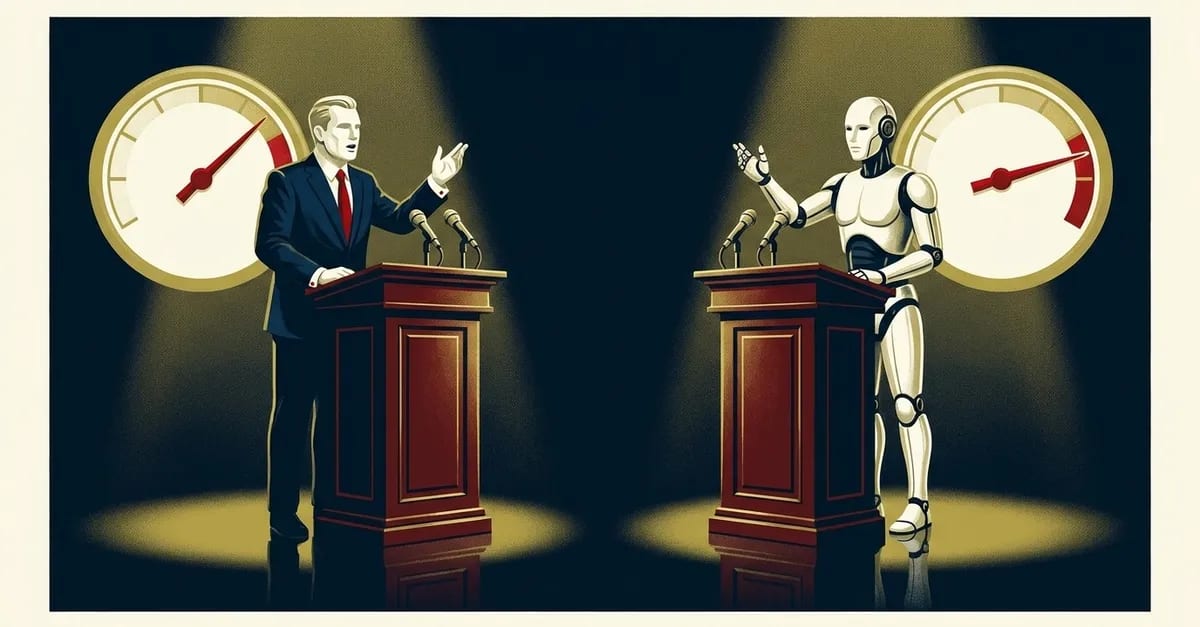
Both can generate more claims than anyone generally has the time or expertise to check. Increasingly, both also operate in environments where being compelling can be rewarded faster than being correct. That incentive should worry us more than the occasional spectacular hallucination.
Social platforms rewarded engagement. Political campaigns reward persuasion. AI products are frequently evaluated by usefulness, fluency, speed, retention, satisfaction, and task completion.
Truth can easily become one objective among many. That should make anyone building consequential AI uncomfortable. Not because AI is uniquely dishonest, but because organizations are very good at optimizing whatever they measure.
Accountability is the missing layer
I do not think we should create laws requiring AI to “tell the truth.” That sounds satisfying until you try to define it, measure it, enforce it, or determine what the machine supposedly knew when it produced the answer. A more practical standard is already beginning to emerge.

Organizations will increasingly have to demonstrate that they exercised reasonable care when using AI to produce consequential information or decisions. The obligation will not be that the machine can never be wrong. The obligation will be that somebody can explain why the organization trusted it, what safeguards existed, what evidence supported the answer, what happened when confidence was low, and who was responsible when the system failed.
That is a very different future from the one implied by today’s AI disclaimers. “AI can make mistakes. Check important information” is perfectly reasonable advice for a consumer chatbot. It is a remarkably weak governance model for a bank, hospital, government agency, insurer, employer, or autonomous business process.
The more authority we hand to machines, the less acceptable it becomes for responsibility to evaporate at the moment of failure. Wales may be conducting an interesting experiment in political truth, but the larger experiment is already happening everywhere else. We are building systems that can speak with extraordinary authority, and sooner or later someone will have to own what they say.

Further Reading
- Senedd Cymru (Member Accountability and Elections) Act 2026, UK Legislation, April 2026. The primary legal text. Section 24 requires Welsh ministers to establish provisions concerning false or misleading factual statements made to affect Senedd elections and allows those provisions to address knowing or reckless conduct and criminal offences.
- Guidelines on transparency obligations for providers and deployers of AI systems, European Commission, July 2026. Useful for understanding the EU’s current approach. The emphasis is transparency and provenance rather than a general legal requirement that AI-generated information be true.
- Proposed Policy Statement Concerning the Suppression of Accuracy in Artificial Intelligence Systems, Federal Trade Commission, July 2026. An interesting bridge between AI accuracy and existing consumer protection law. The proposal focuses on deceptive representations and undisclosed distortion rather than treating every incorrect model output as unlawful.
- Is ChatGPT a ‘product’ or a ‘service’? A wave of lawsuits tests a theory of AI liability, Reuters, October 2026. A useful snapshot of the much larger legal question now forming around generative AI. Courts are beginning to confront where responsibility sits when AI-generated behavior allegedly contributes to real-world harm.
Disclaimer: The perspectives shared in this article are our own and do not represent those of our employer or any affiliated organizations. All company names, product names, logos, and brands mentioned are the property of their respective owners and are used for identification and illustrative purposes only. No endorsement, sponsorship, or affiliation is intended or implied. References to specific companies or case studies are based on publicly available information and are used solely for educational and discussion purposes.
More from enterprise ai
All enterprise ai → enterprise ai
AI Is Making Advertising More Efficient at the Wrong Thing
I bought the blender last Tuesday. By Wednesday, the advertising industry had apparently assembled an international task force dedicated to convincing me that I needed a blender. YouTube wanted to sell me one, websites wanted to sell me…
 enterprise ai
Your AI Vendor Isn’t Lying. That’s the Problem.
I have a deep affection for Willy Wonka. Roald Dahl’s Charlie and the Chocolate Factory is one of those stories that managed to be funny, unsettling, imaginative, and morally suspicious all at once. Gene Wilder’s performance in the 1971…
 enterprise ai
The Last Scarce Resource Is You
We spent the better part of two centuries making machines faster so people could do less work. We may finally have succeeded beyond our expectations. The machines are now fast enough that the person sitting in front of them has become the…