Your AI Vendor Isn’t Lying. That’s the Problem.

AI has a paltering problem, and the distance between what a product can do and what the sales deck makes you believe may be larger than we want to admit.
I have a deep affection for Willy Wonka. Roald Dahl’s Charlie and the Chocolate Factory is one of those stories that managed to be funny, unsettling, imaginative, and morally suspicious all at once. Gene Wilder’s performance in the 1971 film remains, for me, the definitive Wonka: charming enough to make you follow him into the factory, strange enough that you probably should have reconsidered.

So I approached Netflix’s Wonka’s The Golden Ticket with more goodwill than I bring to most reality television. While I genuinely despise reality TV shows, the production is genuinely impressive. It treats the old material with affection, reconstructs familiar spaces rather than merely borrowing the logo, and even brings Gene Wilder’s Wonka back as the disembodied voice of the factory.
That last part is especially interesting for an article about AI. Wilder died in 2016, but his voice was recreated for the series with the cooperation of his widow and estate, using archival recordings. Reporting on the production says ElevenLabs was involved in creating the AI-generated voice. Noted. Whatever broader questions one may have about synthetic performers, this appears to have been an unusually thoughtful use of the technology: permission obtained, provenance respected, and considerable attention paid to reproducing the character rather than merely exploiting a dead celebrity.
And then there is the prize, which is where my affection for the production ran into a rather less whimsical piece of arithmetic.
Three million dollars. Eventually.
Throughout the series, the grand prize is presented as $3 million. That is an impressive number, and television understands numbers the way Las Vegas understands lighting. That is that they are supposed to glow.
Except the winner does not simply receive $3 million. And this irked me deeply.
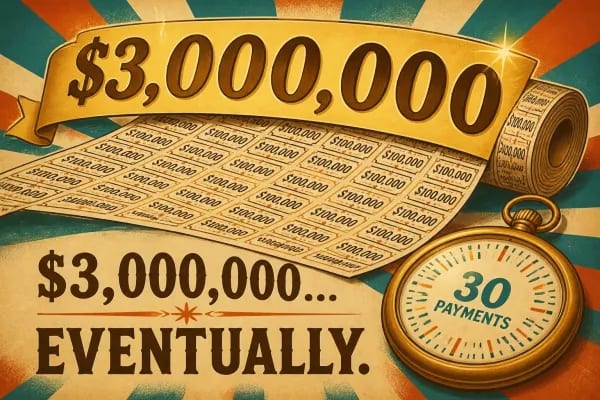
Netflix’s own Tudum FAQ describes the prize as a “lifetime supply of money” that “translates to $3 million,” provided as a six-figure annuity for 30 years. In practical terms, that means $100,000 a year for 30 years. Netflix then adds the rather wonderful line: “Best to read Wonka’s extremely fine print though, just to be safe.”
Cute. Very Wonka. It is also the entire problem.
One hundred thousand dollars multiplied by 30 does indeed equal $3 million. The arithmetic is impeccable. But $100,000 paid every year for three decades is not economically equivalent to possessing $3 million today, any more than promising to pay for half of your groceries this afternoon and the other half sometime during the next presidential administration constitutes payment in full. Try it with the cashier and you’ll quickly find out.
Reverse the transaction and the absurdity becomes obvious. Imagine buying something for $3 million, handing the seller $100,000, and reassuring them that you absolutely intend to pay the remainder in 29 convenient annual installments. I suspect the seller would suddenly develop a sophisticated appreciation for the time value of money.
Yet nothing about “$3 million” is literally false. That distinction matters, because there is a word for communicating in exactly that territory between truth and deception.
Meet paltering
Harvard researchers Todd Rogers, Richard Zeckhauser, Francesca Gino, Michael Norton, and Maurice Schweitzer use the term paltering to describe “the active use of truthful statements to convey a misleading impression.” Their research separates it from lying by omission, where information is simply withheld, and lying by commission, where someone says something factually false.
Paltering occupies the more interesting and generally deceptive territory between them. Every brick may be genuine, while the building constructed from those bricks is a fiction. The person doing it gets to retreat to the comforting defense that nothing they actually said was untrue.

The research also found an important asymmetry. People doing the paltering tend to focus on the truthfulness of their individual statements. The people on the receiving end focus on the fact that they were intentionally led to the wrong conclusion, and they tend to judge the behavior much more harshly.
I suspect most engineers who have spent enough time around go-to-market organizations have encountered this phenomenon without knowing it had a name. I certainly have, and the language around it is often remarkably polished.
Open the aperture
There are wonderfully creative phrases that appear when technical reality enters the gravitational field of sales. None of them is inherently nefarious, at least outwardly, and in the right context they can be entirely reasonable:
- “We need to paint this with a broader brush.”
- “We should open the aperture.”
- “We don’t want to be too restrictive.”
- “We need to speak to where the market is going.”
A product strategy should describe a direction. A sales organization should help customers imagine what becomes possible. No company could introduce anything genuinely new if every conversation were restricted to functionality already documented in version 7.3.2 of the administrator’s guide.

But something peculiar can happen as an idea travels from engineering to product to marketing to sales. The language begins to shed its conditions, and small changes in tense or scope can create very large changes in meaning:
- “We built a prototype that demonstrates this” becomes “we support this”.
- “We can integrate with that system” becomes “we integrate with that system”.
- “Professional services could build this” becomes “our platform does this”.
- “It works reliably under these conditions” becomes “it works”.
- “A human reviews the difficult cases” becomes “autonomous”.
- “It is on the roadmap” develops an alarming tendency to change grammatical tense.
At no single moment does someone necessarily sit in a dark conference room and announce, “Today, we shall lie to the customer.” Reality is usually much less theatrical. That is to say, the lights are usually on bright. A qualifier disappears here, a verb strengthens there, a prototype acquires the dignity of a product feature, and a capability demonstrated against one carefully curated workflow wanders onto a slide describing an enterprise platform.
Nobody owns the lie because, technically, nobody told one. That is what makes paltering so useful, and AI may be the finest paltering machine the technology industry has ever accidentally invented.
AI comes with unusually stretchy words
Every technology cycle produces vocabulary that marketing eventually stretches until the words become translucent. Cloud gave us cloud-native. Big data gave us real-time. Digital transformation managed the remarkable feat of turning almost any IT expenditure into a strategic initiative.
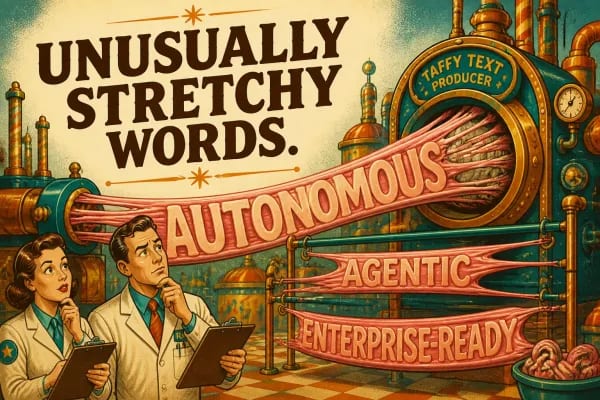
AI has produced an especially fertile vocabulary: agentic, autonomous, reasoning, enterprise-ready, self-healing, human-level, end-to-end, AI-powered. Each can describe something real. Each can also conceal an astonishing range of implementation details.
Consider the word autonomous. Does an autonomous AI agent receive a goal and complete the workflow without assistance? Does it stop twice for human approval? Does a person inspect every output before anything irreversible happens? Does the agent handle 80 percent of cases while exceptions quietly disappear into an operations queue staffed by six people?
Those are not minor implementation details. They describe completely different operating models, cost structures, risk profiles, and staffing assumptions.
Or take integration. A vendor says its product “integrates with Epic.” That might mean a mature, supported integration used by dozens of customers, or it might mean the product communicates through standards-based APIs. It might also mean a partner built something once, or that an engineer looked at the documentation and concluded, quite reasonably, that integration should be possible or even easy.
All four interpretations can sound defensible in conversation. They also describe four dramatically different purchasing decisions.
AI compounds the problem because its capabilities are inherently conditional. Performance changes with the model, prompt, context, data quality, retrieval strategy, tools, orchestration, guardrails, evaluation criteria, and the distribution of inputs encountered in production. An AI system can therefore perform spectacularly in a demonstration and disappoint spectacularly in deployment without either demonstration being fake.
That should make us more precise about AI claims. Instead, the commercial incentive is often to remove the conditions.
When the adjectives reach production
This is where paltering stops being merely a question of marketing ethics. Someone eventually has to build what the customer believes was sold.
The customer architects around an automation rate that existed only in a controlled demonstration. Security discovers that the autonomous agent needs broader credentials than anyone discussed. Integration work appears that was somehow absent from the proposal, and human review re-enters the architecture after the business case assumed it had disappeared.
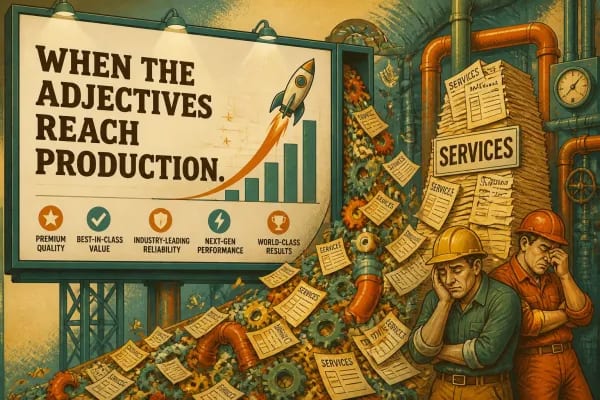
Professional services then arrives to construct something everyone thought had already been purchased. The exaggeration does not disappear. It moves downstream.
And downstream is usually populated by engineers, implementation teams, customer success organizations, operators, and increasingly irritated customers. Marketing language has a funny way of becoming somebody else’s backlog.
This is why I think the conventional discussion of “AI washing” does not quite capture the whole problem. Regulators have already begun pursuing the obvious cases. The SEC has brought actions against investment advisers for false and misleading statements concerning their use of AI, while the FTC has pursued companies over unsupported claims about AI product capabilities. None of which I think is enough.
One FTC case is particularly instructive. Workado marketed an AI-content detector with a claimed accuracy of 98 percent. According to the FTC, independent testing on general-purpose content produced accuracy of about 53 percent. Quite the discrepancy.
That is not a subtle philosophical disagreement over the meaning of agentic. It is a measurable claim running into measurable reality.
But the more common enterprise problem may exist well before we reach claims that regulators would consider demonstrably false. The harder problem is the statement that survives fact-checking while failing the reasonable-person test.
The pattern often looks something like this:
- The feature exists, just not quite the way you thought.
- The integration works, after six weeks of services.
- The agent is autonomous, except where it is not.
- The benchmark is impressive, against the benchmark.
Every claim has an escape hatch. The accumulated impression is still stronger than the underlying product.
The biggest hallucination may be in the sales deck
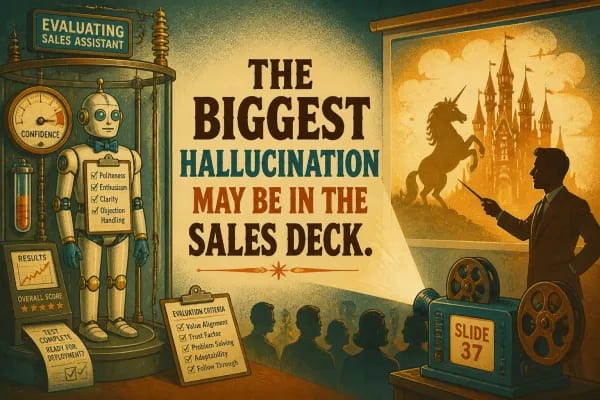
We build evaluation frameworks for models, test outputs, create confidence thresholds, add provenance controls, insert human-review stages, and design audit trails because we understand that an answer can sound convincing while being wrong.
There is a certain irony in an industry obsessed with preventing models from hallucinating while tolerating surprisingly imaginative behavior from the creative humans selling them.
Perhaps AI product claims deserve something resembling the discipline we already apply to AI systems themselves. For any substantial capability claim, I would want four questions answered:
- Does it exist? Is it generally available, in preview, demonstrated as a prototype, available through professional services, or sitting cheerfully on a roadmap?
- Under what conditions does it work? Which models, data sources, integrations, workflow constraints, approval steps, and human interventions make the result possible?
- How do we know? What was actually measured, against what population, using what criteria, and when?
- Who closes the gap? If the customer’s requirement extends beyond current product capability, is the gap filled by the vendor, a partner, professional services, the customer’s engineering team, or a human operator who quietly prevents the automation from embarrassing everyone?
Those questions are not anti-sales. They are pro-sale because a serious enterprise customer is not helped by buying an imaginary product, and a serious vendor is not helped by winning a deal whose economics depend on capabilities its delivery organization then has to invent under deadline.
There is a software-engineering analogy here that I find difficult to ignore. We would never accept an interface specification that amounted to doEverything(input) → success. Yet its linguistic equivalent appears in AI marketing every day: “Our autonomous AI agents orchestrate complex end-to-end enterprise workflows.”
That sentence may even be true. But if you want me to architect around it, now show me the contract.
Truth deserves better engineering
This is also why I do not want to make Netflix the villain of this story. I enjoyed Wonka’s The Golden Ticket. I admire the care that went into reconstructing the factory, and I especially appreciate that the production sought the Wilder estate’s cooperation before using technology to recreate a voice inseparable from one of cinema’s most beloved performances.
And the prize really does add up to $3 million. Eventually. That is precisely why the example works.

Paltering does not require a moustache-twirling liar. It requires a communicator who understands the impression an audience will form, prefers that impression to the messier reality, and knows there is enough literal truth underneath it to survive a challenge.
Technology companies should be particularly wary of that temptation right now. AI is genuinely remarkable. We are watching capabilities emerge that would have sounded implausible a few years ago, and there is no shortage of legitimate reasons for executives to pay attention.
We do not need to fictionalize those capabilities to make them interesting. If a customer walks away believing your AI product can reliably do something that you know it cannot yet reliably do, pointing to the technically defensible sentence on slide 17 is not transparency.
We already have a word for it: paltering.
It is a carefully engineered misunderstanding and perhaps there should be consequences. What do you think?

Further Reading
- Artful Paltering: The Risks and Rewards of Using Truthful Statements to Mislead Others - Rogers, Zeckhauser, Gino, Norton & Schweitzer, March 2017 The foundational research behind the article’s central concept. It defines paltering as actively using truthful statements to create a misleading impression and examines why the person making the claim and the person receiving it often judge the ethics very differently.
- Is the Chocolate River Real? Answers to Your Wonka’s The Golden Ticket Questions - Netflix Tudum, September 2026 Netflix’s own behind-the-scenes account explains both the recreation of Gene Wilder’s voice with the cooperation of his widow and the prize structure: a six-figure annuity for 30 years that Netflix describes as translating to $3 million.
- 9 Easter Eggs in Wonka’s the Golden Ticket You Probably Missed - PEOPLE, September 2026 Useful contemporaneous reporting on the production, including the Wilder estate’s collaboration with ElevenLabs on the AI-generated Wonka voice. It provides additional context beyond Netflix’s own description of the voice-recreation process.
- SEC Charges Two Investment Advisers with Making False and Misleading Statements About Their Use of Artificial Intelligence - U.S. Securities and Exchange Commission, March 2024 One of the clearest early enforcement examples of what regulators began calling “AI washing.” These cases involve investment advisers rather than ordinary enterprise software sales, so their legal context is narrower than the argument in this article, but the underlying warning about unsupported AI claims is directly relevant.
- FTC Order Requires Workado to Back Up Artificial Intelligence Detection Claims - Federal Trade Commission, April 2025 A useful example from the more extreme end of the spectrum: the FTC alleged that an AI detector marketed as 98 percent accurate achieved roughly 53 percent accuracy on general-purpose content in independent testing. The case illustrates what happens when elastic AI marketing moves beyond implication into measurable product claims.
- FTC Order Requires Online Marketer to Pay $1 Million for Deceptive Claims that its AI Product Could Make Websites Compliant with Accessibility Guidelines - Federal Trade Commission, January 2025 The accessiBe action offers another concrete example of regulators challenging claims that automated AI functionality could deliver a broader outcome than the evidence supported. It is particularly relevant to enterprise software because the disputed promise concerned not whether the technology existed, but whether it could reliably achieve the business outcome being marketed.
Disclaimer: The perspectives shared in this article are our own and do not represent those of our employer or any affiliated organizations. All company names, product names, logos, and brands mentioned are the property of their respective owners and are used for identification and illustrative purposes only. No endorsement, sponsorship, or affiliation is intended or implied. References to specific companies or case studies are based on publicly available information and are used solely for educational and discussion purposes.
More from enterprise ai
All enterprise ai → enterprise ai
AI Is Making Advertising More Efficient at the Wrong Thing
I bought the blender last Tuesday. By Wednesday, the advertising industry had apparently assembled an international task force dedicated to convincing me that I needed a blender. YouTube wanted to sell me one, websites wanted to sell me…
 enterprise ai
The IVR Is a Legacy System. Modernize It Like One.
“Please listen carefully, as our menu options have changed.” They have not changed. You know it, I know it, and somewhere in a data center a recording that has survived three generations of infrastructure strategy knows it too. Greetings…
 enterprise ai
When the Vendor Only Gets Paid for Outcomes, the Demo Changes!
There is a moment in every enterprise software demo that both sides politely agree not to notice. The sales engineer clicks through a workflow rehearsed until it cannot fail, supposedly. The prospect nods at a dashboard populated with…