When the Vendor Only Gets Paid for Outcomes, the Demo Changes!
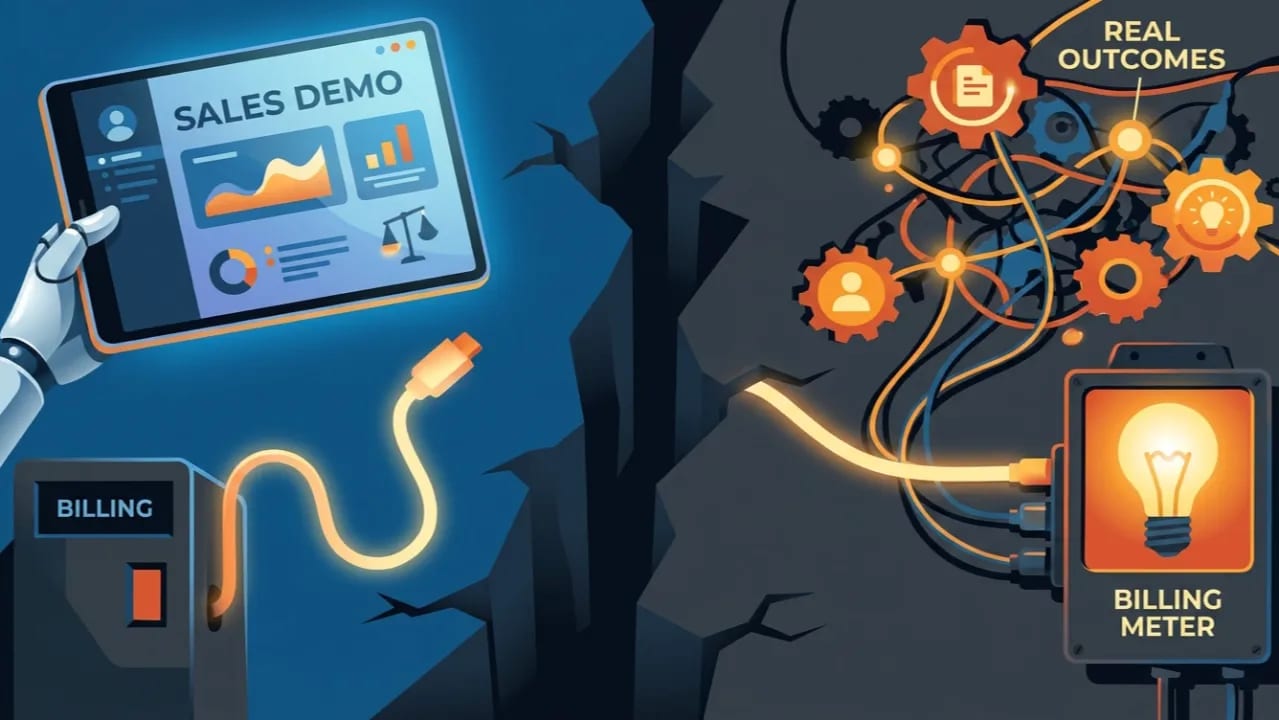
There is a moment in every enterprise software demo that both sides politely agree not to notice. The sales engineer clicks through a workflow rehearsed until it cannot fail, supposedly. The prospect nods at a dashboard populated with suspiciously cooperative data. And everyone in the room quietly consents to treat a performance as evidence. Nobody is lying, exactly. It is closer to theater with a signature page at the end.

Anyone who has spent a career around enterprise software knows the choreography, from either side of the table. The demo environment where nothing ever breaks. The happy path rehearsed until it shines. The question “can it do X?” answered with “absolutely,” followed by a carefully staged click. For decades, the sales engineer’s job description across the industry has carried an unspoken first line: make the software look good. Buyers have always assumed the demo was the best case, procurement discounted the claims accordingly, and everyone found out the truth after go-live, when the invoices were already flowing.
None of this made anyone a villain. Seat-based pricing made the theater rational. If the vendor gets paid whether or not the software delivers, the demo’s job is persuasion. The economics reward confidence, and confidence is easiest to manufacture in an environment you control. The demo was never really a test of the product. It was a test of the vendor’s stagecraft, and both sides knew it, which is why the whole ritual survived for decades without anyone feeling especially guilty about it.
Then a wave of AI companies started charging for results instead of access, and quietly broke the game.
The invoice that only arrives when something works
Look at what has happened to pricing in customer service AI, because it is the clearest early case. Intercom charges $0.99 for every conversation its Fin agent actually resolves. If the customer’s problem isn’t solved, no charge. Zendesk followed with outcome-based pricing of its own, around $1.50 per automated resolution on committed volume. Sierra, the company founded by Bret Taylor, built its entire commercial model this way from the start: it bills for completed outcomes, whether that’s a resolved support conversation, a prevented cancellation, or an upsell, with the criteria negotiated upfront. An escalation to a human typically costs the customer nothing.

The pattern extends well beyond support tickets. Chargeflow, which automates chargeback disputes for e-commerce companies, takes a success fee of roughly 25% of the money it actually recovers, and recovers nothing means charges nothing. Riskified, in fraud prevention, gets paid on the transactions it approves and backs its judgment with a chargeback guarantee: if it approves a fraudulent order, the loss is Riskified’s problem, not yours.
If this sounds like a radical new invention, it isn’t. Rolls-Royce started selling “Power by the Hour” in 1962, charging aircraft operators a fixed rate per flying hour instead of billing for engines, parts, and repairs. The airline paid for thrust that actually happened. An engine sitting in a maintenance shop earned Rolls-Royce nothing, which did wonders for how seriously Rolls-Royce took reliability. The idea that vendors should eat their own delivery risk is older than software.
What’s new is that software can finally do it. Outcome pricing requires the product to measure its own success, transaction by transaction, in a way both parties trust. Traditional software couldn’t observe whether it delivered value; it could only observe whether you logged in. An AI agent that handles a conversation end to end generates a verifiable record of what happened and how it ended. The telemetry that makes the product work is the same telemetry that makes the billing model possible.
So the interesting question isn’t whether outcome pricing spreads. Follow the incentives and it clearly will, anywhere outcomes can be cleanly attributed. The interesting question is what it does to everything upstream of the contract. Because when the vendor only earns money when the customer’s problem actually gets solved, something profound happens to the sales process.
The demo stops being an argument and becomes an underwriting exercise.
The vendor asks harder questions now
Under seat pricing, discovery asks: what features do you need, and how many users? It is a sizing exercise, conducted with roughly the rigor of a shoe fitting.

Under outcome pricing, the vendor is about to take on delivery risk, and suddenly discovery looks less like sales and more like insurance. Before Sierra or Intercom can price a resolution, someone has to establish the baseline: contact volume by type, current resolution rate, cost per contact, and the deceptively hard question of what “resolved” even means in this particular business. Does a customer who gives up and stops replying count as resolved? Does a refund issued to end an argument? You cannot price an outcome you haven’t defined, and you cannot define it without understanding the customer’s operation at a level of detail the old model never required.
This is the part buyers should savor. The vendor now has to understand your business before the contract, with the seriousness an insurer brings to a policy. Vague discovery isn’t lazy anymore. It’s financially reckless. A vendor who skips the hard questions isn’t being easygoing. They’re either inexperienced or not actually carrying the risk they claim to carry.
The happy path is now worthless
A scripted flow proves nothing about a system that will face a million unscripted customers. Everyone always knew this, the way everyone knows the model apartment won’t look like that once you move in. Under seat pricing it didn’t matter, because the demo’s job was persuasion, and persuasion loves a controlled environment.
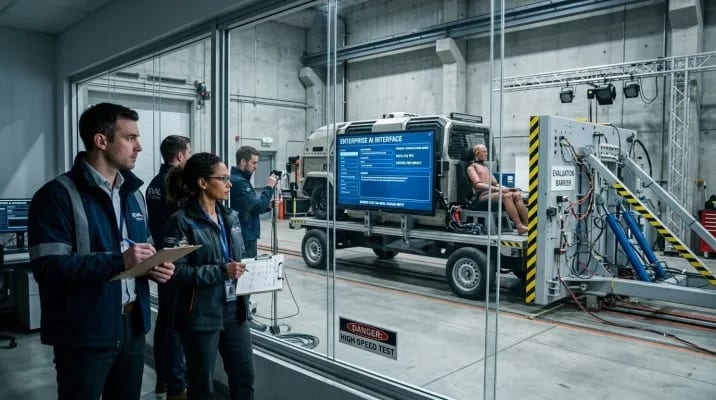
Under outcome pricing, the controlled environment actively works against the vendor. If the demo flatters the product, the vendor prices the deal against a fiction and pays for the gap in production, resolution by unearned resolution. So the demo shifts from watch it work to watch it survive: run the agent on the buyer’s real policies, real knowledge base, real edge cases. The most credible demo a sales engineer can now give is one where the buyer’s team tries to break the agent and sees exactly how it behaves when they succeed.
This inverts decades of pre-sales instinct. The old demo hid the hard cases. The new demo hunts for them, because the vendor’s revenue depends on knowing where they are before the price gets set. When your income arrives per resolution, you want the ugly ten percent of traffic surfaced in week one, not discovered in month six by your CFO.
The proof-of-concept transforms the same way. POCs under seat pricing were theater with a deadline: assemble stakeholders, run the scripted scenarios, gather smiles, proceed to commercials. Under outcome pricing, the pilot becomes a joint measurement exercise. Agree on the baseline. Agree on metric definitions. Run real traffic. Read the numbers together. The exit question is no longer “did the stakeholders like it?” It is “did resolution actually move, and do we trust the measurement?” That second clause matters more than it looks, because the same measurement that graduates the pilot will drive every invoice for the life of the contract.
“It can’t do that” becomes a selling tool
Here is the strangest shift, and my favorite. Under seat pricing, admitting a limitation costs you the deal. Every sales engineer has felt the small internal flinch when a prospect asks about the one workflow the product handles badly, followed by the practiced pivot to something it handles well.

Under outcome pricing, overpromising costs you money instead. Deploy against a use case you can’t resolve and you’ll do the integration work, carry the compute, and earn nothing. Suddenly the sales engineer has a hard commercial incentive to say: “That workflow isn’t a fit yet. Start with these three, where the volume is high and the resolution potential is real.” The vendor declining work is no longer a red flag. It’s the sound of someone spending their own risk budget carefully.
Buyers can feel the difference between a vendor performing confidence and a vendor placing a bet. Honesty stops being a virtue and becomes the strategy.
And the honesty has a long tail, because under this model the sales engineer’s promises survive go-live. Under seat pricing, pre-sales ends at signature; delivery is someone else’s problem, ideally in a different building. Under outcome pricing, every claim made in the sales cycle gets audited by production data, forever. The scoping assumptions, the resolution estimates, the integration plan: all of it flows directly into whether the deployment earns anything. Pre-sales and post-sales stop being different departments with conveniently different truths.
The fine print grows new teeth
Before anyone gets misty-eyed about incentive alignment, it’s worth saying plainly: outcome pricing doesn’t end the games. It relocates them.

The old game was played in the demo. The new game is played in the metric definition. If a vendor gets paid per “resolution,” the entire commercial relationship balances on that word, and words are negotiable in ways that seat counts never were. A generously defined resolution — the customer stopped replying, the bot declared victory, nobody checked — pays exactly as well as a real one, right up until the customer notices. Any metric that becomes a price will attract creativity. Goodhart’s law does not take a holiday just because the pricing model improved.
There’s a subtler distortion too. A vendor paid per outcome gravitates toward the outcomes that are easiest to earn: high-volume, low-ambiguity, well-documented cases. The gnarly tail of your support traffic, the stuff that actually torments your customers, may be quietly scoped out of the deal. That can be the right call, and an honest vendor will say so out loud. But buyers should notice what was left off the table and ask why.
None of this is an argument against the model. It’s an argument for reading it correctly. Outcome pricing doesn’t replace trust with math. It moves the trust to a specific place, the measurement, where at least both parties can stare at it together.
What buyers should demand now
If your AI vendor prices on outcomes, use the alignment. It’s the most leverage a buyer has had in decades.

- Insist the pilot run on your data and your policies, measured against your baseline, not the vendor’s benchmark.
- Nail down metric definitions in the contract. “Resolution” is where outcome pricing lives or dies. Define it, including the failure cases, before anyone invoices against it.
- Ask the sales engineer what the product is bad at. Under this model, a vendor with no answer is either green or not actually carrying the risk.
- Ask what traffic was scoped out of the outcome definition, and whether the exclusions track difficulty or just convenience.
- Treat the pilot’s measurement plan as a preview of the relationship. A vendor who is sloppy about measuring the pilot will be sloppy about measuring your invoices.
The craft, upgraded
Some of my colleagues in pre-sales find this shift threatening, and I understand why. A career’s worth of stagecraft is depreciating quickly.

But look at what replaces it. But look at what replaces it. Outcome pricing rewards a particular set of skills: scoping a business problem honestly, building on real data, defining success in measurable terms, telling a customer a hard truth before the contract instead of after. The best sales engineers always had those skills. The old model just never priced them. The theater is losing value. The underwriting judgment is gaining it. For the people who were always better at the second thing than the first, this is the best trade the profession has been offered since the live demo.
Rolls-Royce learned in 1962 that when you only get paid for engines that run, you get very serious about engines that run. Software is about to learn the same lesson, one resolved conversation at a time. The demo used to be where the truth got postponed. Now it’s where the truth gets rehearsed.
That’s a better job. It’s also a better industry. Enterprise software has spent decades insisting that it sells value, not seats. Now, at last, the invoice agrees.

Further Reading
- Outcome-based pricing for AI agents — Sierra (Elliot Greenwald), December 2024 Sierra’s own articulation of its commercial model: charging only for completed outcomes such as resolutions, prevented cancellations, and upsells, with criteria agreed upfront.
- Understanding outcome-based pricing: A results-driven framework — Zendesk Zendesk’s framing of its move to per-resolution pricing for AI agents.
- AI agent pricing comparison — Intercom/Fin Documents Fin’s $0.99-per-resolution model and compares it with Zendesk’s and Salesforce’s approaches.
- Chargeflow pricing Chargeflow’s success-fee model: a percentage of recovered chargeback revenue, backed by an ROI guarantee.
- Origins of “Power by the Hour” — Rolls-Royce, 1962 The historical precedent: fixed-rate-per-flying-hour engine service that tied the manufacturer’s revenue to engine reliability and uptime.
Disclaimer: The perspectives shared in this article are my own and do not represent those of my employer or any affiliated organizations. All company names, product names, logos, and brands mentioned are the property of their respective owners and are used for identification and illustrative purposes only. No endorsement, sponsorship, or affiliation is intended or implied. References to specific companies or case studies are based on publicly available information and are used solely for educational and discussion purposes.
More from enterprise ai
All enterprise ai → enterprise ai
The Fastest AI Rollouts Are Usually the Most Human
There is a particular kind of executive meeting now happening in perfectly serious companies everywhere. Someone shows a dazzling AI demo. The room nods. A few people look delighted in the way people do when they’ve just seen a magic trick…
 enterprise ai
The IVR Is a Legacy System. Modernize It Like One.
“Please listen carefully, as our menu options have changed.” They have not changed. You know it, I know it, and somewhere in a data center a recording that has survived three generations of infrastructure strategy knows it too. Greetings…
 enterprise ai
Closing the AI Velocity Gap: Your AI is ready, but your org chart is still loading.
Many are asking the same question: How are companies like Anthropic, OpenAI, and many others are shipping major updates weekly while the rest of us take months to push a minor feature?