Closing the AI Velocity Gap: Your AI is ready, but your org chart is still loading.
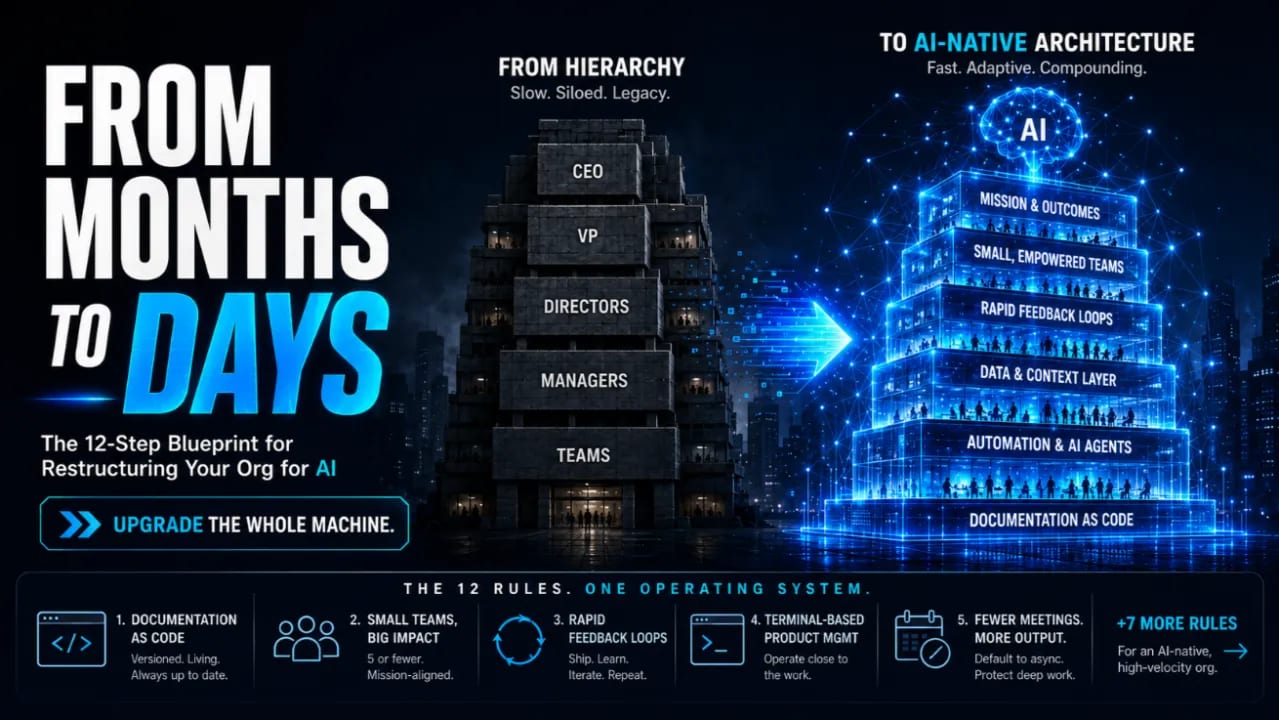
Many are asking the same question: How are companies like Anthropic, OpenAI, and many others are shipping major updates weekly while the rest of us take months to push a minor feature?
The secret isn’t that they have better AI. It’s that they have a completely different operating system for human coordination.
AI has driven the cost of building software to “near” zero, or better yet, “zero-adjacent”. When execution is cheap, the bottleneck shifts. The bottleneck is no longer engineering capacity. - it is human decision-making. If every decision has to be re-explained in a meeting, humans become the rate limit on your business.
To compete, you have to move repeatable human coordination into code. Here are the 12 new rules of the road for AI-native velocity:
1. Protect the Learning Loop at All Costs Speed isn’t about working harder; it’s about shortening the distance between an idea and customer feedback. If a process, meeting, or approval step doesn’t directly shorten that loop or catch a fatal risk, kill it.
2. Kill the Traditional Roadmap In the time it takes to find a free hour on everyone’s calendar for a roadmap planning meeting, an AI-empowered team can already have a working prototype in front of a user. Stop predicting. Start making.
3. Product Managers Must Live in the Terminal You can no longer direct engineering through Jira tickets from afar. Product must sit with engineering daily, making judgment calls in real-time as the code is being written.
4. Design Beyond the Screen Designers who only mock up screens are designing the lobby while the building gets built without them. Design must move into SDKs, error fallbacks, and agent permission boundaries.
5. Cap All Meetings at 30 Minutes Long meetings are a crutch for poor writing. Capping meetings forces your team to communicate intent through rigorous documentation before you ever sit down in a room.
6. Purge the Monthly Status Meeting Execution time has never been more valuable because one hour of building yields exponentially more than it did two years ago. Reclaim your calendar.
7. Treat Documentation as Code Agents don’t read minds; they read documents. Your docs now supply the standard, the permissions, and the definition of done for AI agents. Ambiguous writing doesn’t just confuse your team anymore—it generates “AI slop.”
8. Stop Complaining, Start Compiling With today’s tools, no one has an excuse to just point out a problem. Regardless of your title, if you see a flaw, use AI to build and propose a complete, working solution.
9. Obsess Over One Delightful Experience When you remove heavy management processes, you need a North Star to keep everyone aligned. Make the ultimate customer experience the sole arbiter of what gets built.
10. Small Teams > Solo Founders AI makes individual output cheap, but it doesn’t automatically generate human taste, domain expertise, or brand alignment. Enduring products still require the healthy friction of a tight-knit team catching each other’s blind spots.
11. Adapt Like Water You will be communicating in writing more than ever. Assume best intent, stay flexible, and don’t let bruised egos slow down the pace of innovation.
12. The Teaching Mandate You only move as fast as your slowest collaborator. Those moving at AI-speed have an obligation to mentor those who are adjusting, both inside the company and out.
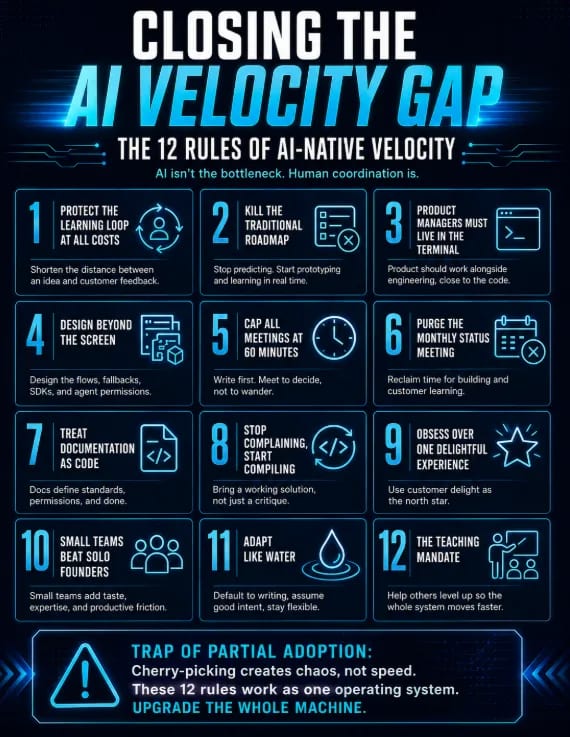
⚠️ The Trap of Partial Adoption
The biggest failure mode is cherry-picking. Remove roadmaps without bringing Product into the build process, and you do not create speed, - you create confusion. Cut meetings without strengthening documentation, and decisions simply disappear into the gaps.
These 12 rules are not independent tactics. They are one interconnected operating system. AI-native velocity does not come from upgrading a few processes around the edges. It comes from redesigning how the entire organization decides, builds, learns, and adapts.
Speed is not a tool you add. It is a system you build.
Further Readings
-
From adoption to impact: Three horizons of AI transformation (McKinsey & Company, July 2026) This deep dive outlines why individual AI adoption is soaring among employees, while institutional readiness lags behind. It provides a blueprint for shifting from simple task-automation to an enterprise-wide agentic operating model that captures true bottom-line value.
-
The operating model advantage: Why AI winners are rewiring their organizations (McKinsey & Company, 2025) This report zeroes in on the exact core of the post: AI targets the coordination layer of a business. It argues that the ultimate competitive moat isn’t the technology, but rewiring workflow complexities to slash human coordination bottlenecks.
-
The Fluid Future of Work: Rethinking Roles in the Age of Intelligent Machines (Harvard Business Publishing – 2025/2026) This piece outlines how AI is transitioning from an assistant to an autonomous agent orchestrating end-to-end corporate workflows. It explores the critical need for fluid organizational roles and dynamic leadership to survive nonlinear shifts in execution speed.
-
2026 Global Human Capital Trends (Deloitte Insights – 2026) A look at the shift toward real-time capability orchestration over static org charts. It directly covers the reality that execution speed now outpaces legacy scale, and details why traditional management frameworks aren’t moving fast enough to keep up.
Disclaimer: The perspectives shared in this article are my own and do not represent those of my employer or any affiliated organizations. All company names, product names, logos, and brands mentioned are the property of their respective owners and are used for identification and illustrative purposes only. No endorsement, sponsorship, or affiliation is intended or implied. References to specific companies or case studies are based on publicly available information and are used solely for educational and discussion purposes.
More from enterprise ai
All enterprise ai → enterprise ai
The Fastest AI Rollouts Are Usually the Most Human
There is a particular kind of executive meeting now happening in perfectly serious companies everywhere. Someone shows a dazzling AI demo. The room nods. A few people look delighted in the way people do when they’ve just seen a magic trick…
 enterprise ai
When the Vendor Only Gets Paid for Outcomes, the Demo Changes!
There is a moment in every enterprise software demo that both sides politely agree not to notice. The sales engineer clicks through a workflow rehearsed until it cannot fail, supposedly. The prospect nods at a dashboard populated with…
 enterprise ai
Build AI Like You Expect the Ground to Move
Thesis for enterprise leaders: the strongest AI strategy is not choosing local, cloud, or on-prem in isolation. It is building once with enough discipline to optimize locally, scale economically in the cloud, and increasingly ground…