Build AI Like You Expect the Ground to Move
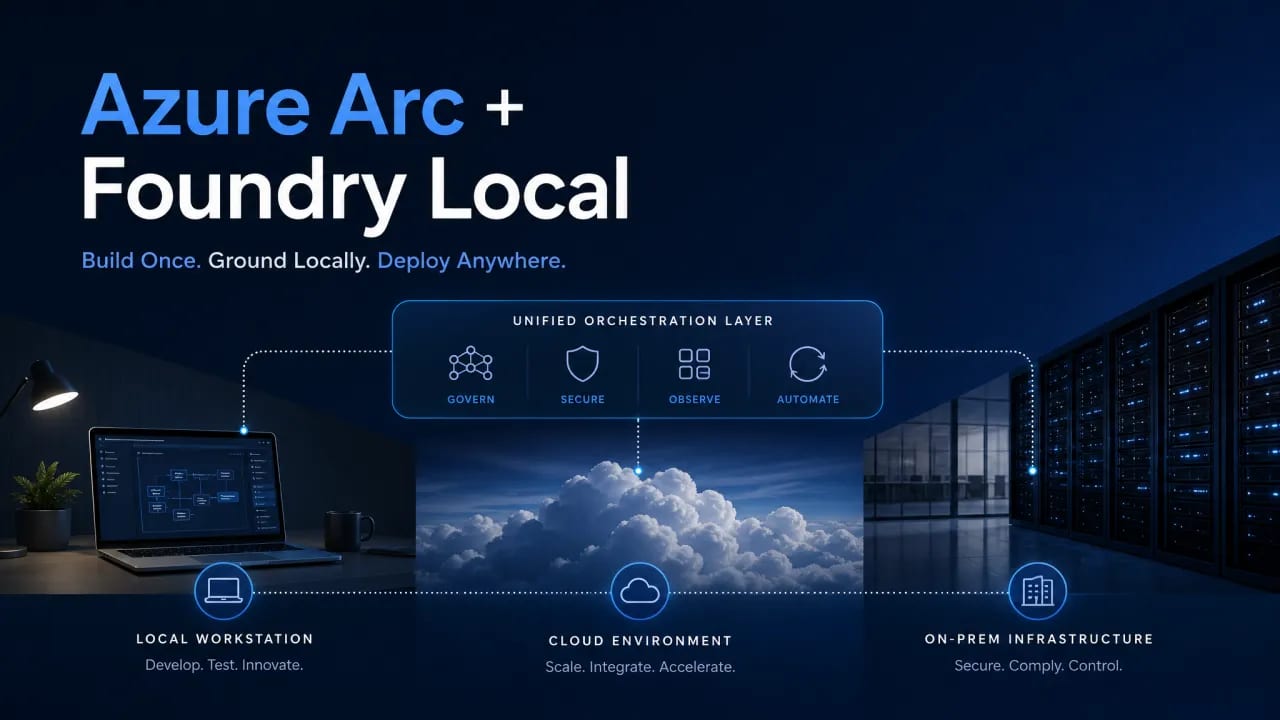
Build Once. Ground Locally. Deploy Anywhere.
Thesis for enterprise leaders: the strongest AI strategy is not choosing local, cloud, or on-prem in isolation. It is building once with enough discipline to optimize locally, scale economically in the cloud, and increasingly ground inference, retrieval, and agentic workflows near sensitive data through Azure Arc and Foundry Local capabilities.
-
Local-first orchestration improves cost discipline early by exposing waste before cloud scale turns inefficiency into recurring spend.
-
Azure Arc provides the management consistency that lets organizations extend one architecture across environments instead of rebuilding for each one.
-
Foundry Local and Arc-enabled agentic retrieval patterns expand hybrid AI from a deployment story into a data-residency story, allowing more intelligence to run where the data already lives.

Most enterprise AI programs still begin with a familiar act of optimism. A team assembles a compelling demo. An executive sponsor sees enough promise to approve budget. The cloud environment appears, immaculate and elastic, like a five-star hotel for technical ambition. And then the organization does the contemporary thing: it scales before it has learned restraint. The results are often impressive in meetings and mildly distressing in finance reviews.
There is a better way to build. Start locally. Build the orchestration layer on a capable workstation or a serious virtual appliance. Make the system live under constraints early, when bad habits are easier to spot and much cheaper to remove. Let every redundant model call feel expensive, every unnecessary hop feel slow, and every overcomplicated agent flow feel slightly embarrassing. That is not a penalty. That is design education arriving on time.
The old thesis for local-first AI was already strong: it reduces cloud waste and prevents costly rework later. The updated thesis is stronger. With Azure Arc and the expanding Foundry Local direction, the question is no longer only where you optimize. It is increasingly where intelligence itself can live. Retrieval, knowledge processing, local indexing, and local agent execution can now run closer to the data in certain Arc-enabled deployments, which changes both the economics and the politics of enterprise AI.
That is the real strategic shift. The future hybrid conversation is no longer just about moving workloads between environments. It is about designing once, grounding locally when needed, and choosing where intelligence lives without rebuilding the architecture every time reality intrudes.
The smartest hybrid strategy is not cloud versus on-prem. It is deciding which parts of intelligence must travel and which parts should stay put.
1. Start Local, Learn Discipline
A local environment is wonderfully unsentimental. It does not flatter bloated prompt chains or politely absorb gratuitous tool calls behind someone else’s hyperscale balance sheet. It makes waste visible. Teams discover very quickly whether they truly need a heavyweight model for every step, whether their context windows are swollen with laziness, and whether their orchestration logic is elegant or merely elaborate. Is history repeating itself?
That is why local orchestration matters. When teams build workflows close to real resource boundaries, they become sharper. They decide more deliberately when to route to a larger model and when to keep work on a smaller one. They improve retrieval strategy. They think about caching, fallback behavior, tool invocation, and observability before the system sprawls across environments and departments. In short, they develop judgment before they develop scale.
This is also where good architecture learns manners. Agents, tools, memory, knowledge sources, and model routing all behave better when they are forced to justify themselves in a bounded environment. What looked sophisticated on a whiteboard can look faintly ridiculous on a constrained box. That moment of early embarrassment is cheaper than discovering the same truth after the workload has gone enterprise-wide.
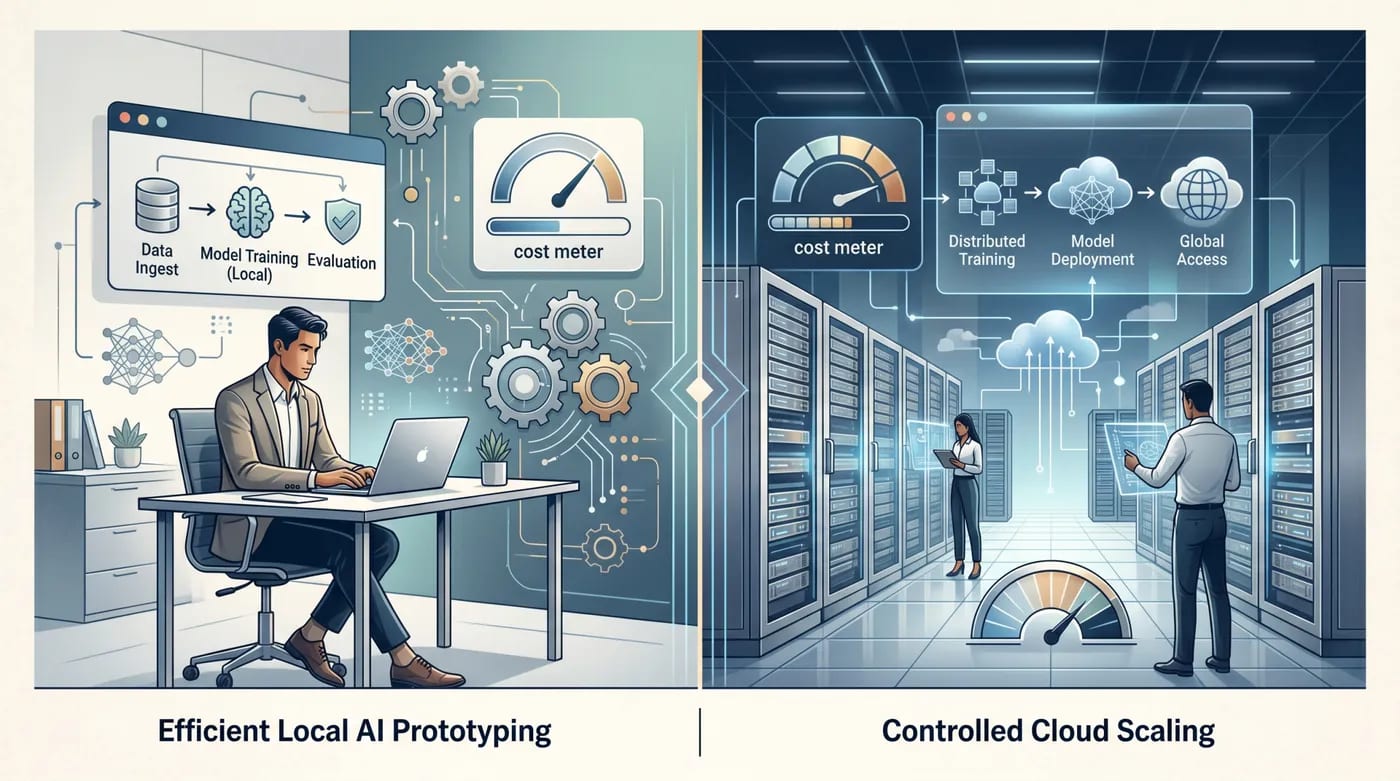
2. The Cheapest Optimization Happens Before the First Big Invoice
Cloud elasticity is enormously valuable, but it is still only an amplifier. If the underlying orchestration is messy, the cloud does not fix that. It industrializes it. When teams optimize locally first, they scale a leaner, more deliberate pattern. That keeps cloud costs in check not because the cloud became charitable, but because the workload arriving there already learned some discipline.
This matters because many AI pilots fail economically before they fail technically. A workflow that seems tolerable at small volume becomes absurdly expensive at real usage. Token consumption balloons. Retrieval is chatty. Model selection remains lazy. The same content gets reprocessed because nobody thought about state. Suddenly the architecture is not just a technical problem. It is a budget line with an attitude.
Local-first development changes the order of discovery. The awkward lessons happen while the blast radius is small. Teams learn what belongs in memory, what belongs in storage, what should be cached, and what should never be sent to an expensive model twice. By the time the system reaches the cloud, the business is not funding an experiment in public. It is scaling a design that has already earned the right to become expensive in the useful ways.
It also prevents one of the least glamorous but most expensive outcomes in enterprise AI: rework. Rework is what happens when a prototype was mistaken for a platform. Interfaces change. Security gets retrofitted. Monitoring gets rebuilt. Deployment assumptions collapse. Entire quarters vanish into the effort of making a once-convenient design portable. That is not innovation. That is deferred thinking with a larger invoice attached.
Source grounding: Microsoft describes Azure Arc as a consistent multi-cloud and on-premises management platform, while Foundry Local documentation increasingly frames local inference, local retrieval, and Arc-enabled operational consistency as complementary parts of a hybrid AI strategy.
3. Azure Arc: Consistency Instead of Environmental Drama
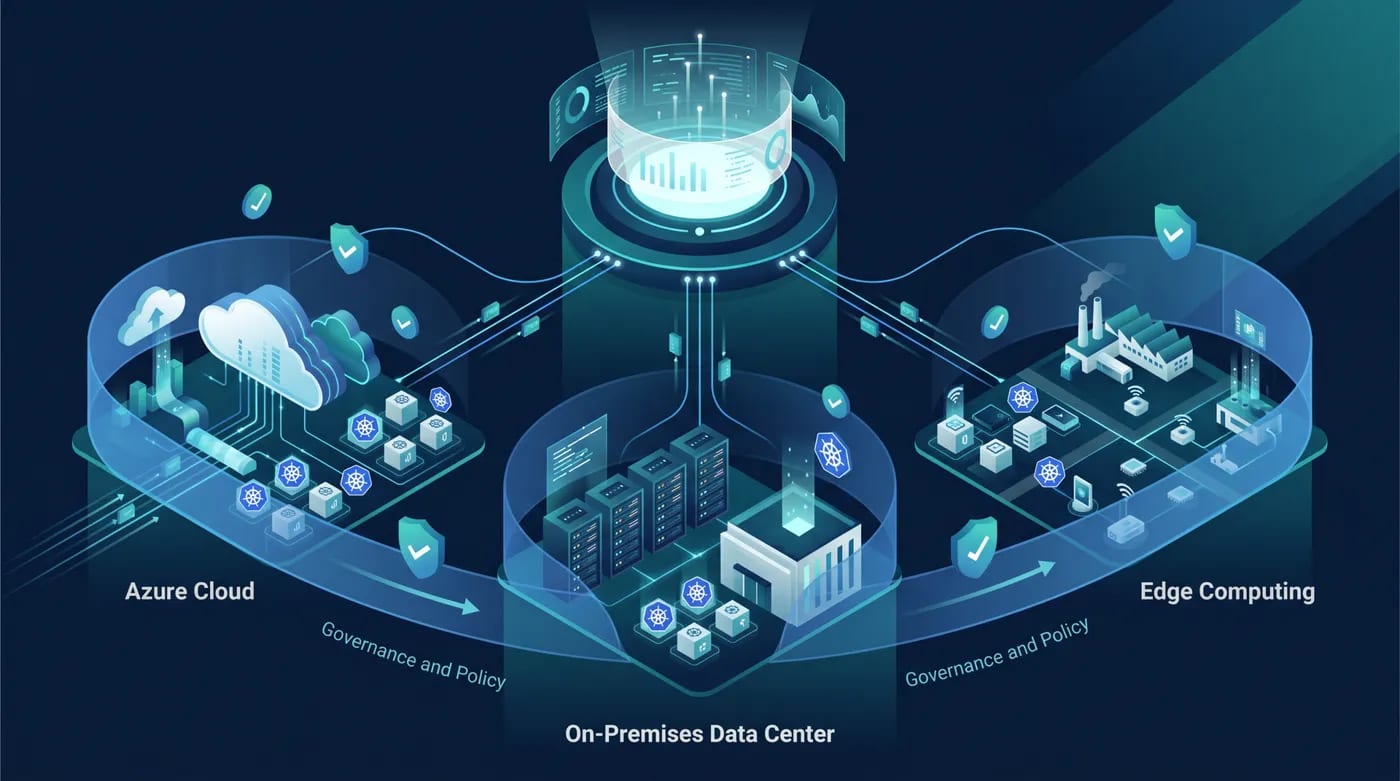
This is where the strategic conversation becomes more interesting. The point is not merely to have local AI and cloud AI coexisting in polite tension. The point is architectural continuity. You want one design logic that can move across environments without requiring a ritual sacrifice every time the business changes its mind, a regulator tightens expectations, or a customer decides their data should stay much closer to home.
Azure Arc matters because Microsoft positions it as a consistent multi-cloud and on-premises management platform. In plainer language, it gives organizations a centralized way to manage resources across environments with familiar Azure capabilities. Virtual machines, Kubernetes clusters, and other resources outside Azure can still be managed through a common control plane and policy posture. That sounds operational, but the business consequence is significant: it reduces the friction that usually turns hybrid strategy into hybrid improvisation.
Anyone who has watched an enterprise architecture spread knows the pattern. A model endpoint appears in one place. Retrieval appears somewhere else. Governance arrives later with a clipboard and a disappointed expression. Azure Arc does not remove complexity from the world, but it does give organizations a better chance of governing that complexity before it matures into a permanent cultural condition.
For executives, that consistency is not a nice-to-have. It is optionality. Optionality is what lets a company respond when latency matters, when sovereignty matters, when an acquisition adds new infrastructure, or when a cloud-only assumption suddenly becomes politically inconvenient.
4. The Next Evolution: Agentic AI Without Data Movement
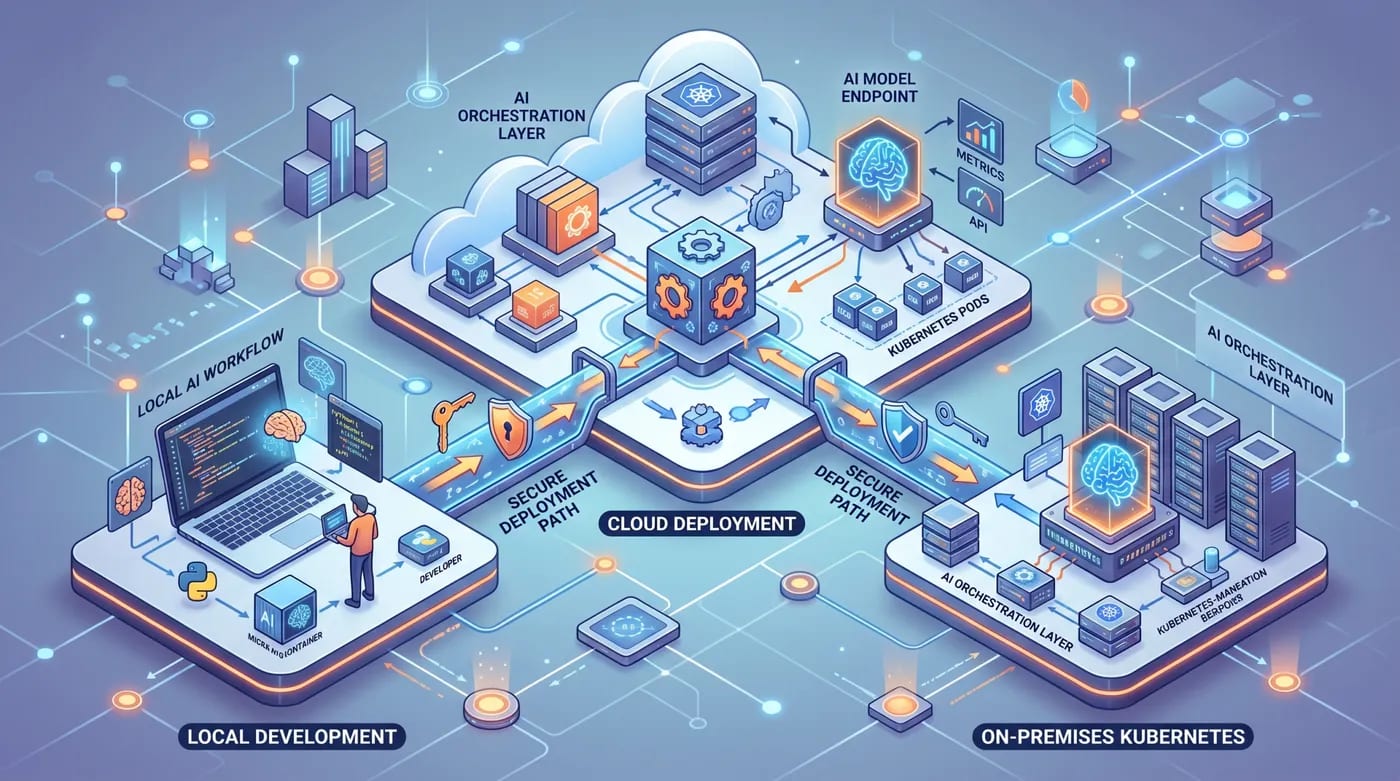
The next leap in this story is not simply that Azure Arc helps manage infrastructure consistently. It is that an increasing subset of Microsoft’s agentic AI stack can now operate locally in Arc-enabled deployments, which changes the enterprise argument from avoid rework later to design once and choose where intelligence lives. That is a more consequential claim, and it needs to be stated carefully.
According to Microsoft Learn, Agentic Retrieval in Foundry Local is an Azure Arc-enabled Kubernetes extension at the core of the Agents and Tools with Foundry Local platform. It provides an agentic Retrieval-Augmented Generation platform on-premises, combining a knowledge layer for document ingestion, embedding, and vector search with an agentic layer for AI agents, knowledge orchestration, MCP-based tool access, and multistep assistant behavior grounded in private local data.
That means the hybrid conversation now includes more than model inference. In supported Arc-enabled scenarios, organizations can process, index, search, and analyze sensitive or locally generated data without moving customer content into the public cloud. Microsoft explicitly describes the local data plane as including both customer data and the language model hosted locally, and says customer content such as ingested documents, embeddings, agent configurations, and conversation threads remains on-premises within customer-defined network boundaries.
This is the sort of detail executives should care about because it changes what a hybrid architecture can credibly promise. The system is no longer just portable. It can increasingly be grounded where the data already lives. That matters in manufacturing environments, regional banking, healthcare, government, defense, and any other setting where data movement is not just a network choice but a policy, trust, or continuity issue.
There is, however, an important accuracy line to keep bright. This does not mean all Azure AI Foundry capabilities are magically available offline or that every service in Microsoft’s AI stack now runs everywhere. The responsible claim is narrower and stronger: an increasing subset of Foundry Local capabilities for local inference and agentic retrieval is becoming available through Arc-enabled deployments, enabling real on-premises RAG and agent workflows for specific scenarios without requiring customer content to leave local infrastructure.
5. The Arc + Foundry Direction Changes the Cost of Moving
Viewed together, Azure Arc, Foundry Local on Azure Local, and the newer Agents and Tools with Foundry Local documentation suggest a meaningful directional shift. Enterprises are not only being given a way to manage distributed AI estates more coherently. They are increasingly being given a way to keep more of the retrieval-and-reasoning stack near the data while preserving a cloud-consistent operational model.
That is what makes this more than an infrastructure convenience. In older enterprise programs, on-prem deployment often arrived as a sequel nobody wanted. The prototype worked in the cloud. Then sovereignty, latency, or local operations made on-prem necessary. The team discovered it had to rethink deployment, data flows, search, serving, governance, and sometimes the application itself. With Arc-enabled patterns and Foundry Local capabilities, the ambition is more mature: use the same broad architectural logic across environments so moving the workload does not mean reinventing the workload.
This also reframes the original value proposition. Yes, local-first orchestration reduces waste. Yes, it reduces rework. But now the thesis is larger. If the architecture is designed correctly, the business can decide not only where to deploy the application, but where to ground the knowledge layer, where to keep the indexed content, and where the agent experience should reason over that content. That is a different class of flexibility.
6. A Concrete Scenario: Optimize Here, Ground Here, Scale There

Imagine a product engineering team building a field operations assistant for a manufacturer. They begin locally, on a serious workstation and a shared virtual appliance. They wire together retrieval, orchestration, evaluation, caching, prompt control, and model routing. They learn quickly that the flashiest agent chain in the room is not the most useful one. They simplify. They reduce unnecessary steps. They make the retrieval layer behave like a system rather than a collection of optimistic guesses.
Demand grows, so they scale in the cloud where elasticity and broader integration make sense. Because the team already refined the orchestration locally, the cloud does not multiply chaos. It multiplies a relatively lean architecture. Costs remain visible rather than theatrical. Observability still means something because it was designed before the estate became complicated. The team has not solved everything, but it has at least avoided the common sport of paying hyperscale rates to discover preventable inefficiencies.
Then the requirement changes. A regulated business unit wants the same assistant grounded in local plant documents, maintenance records, and operating procedures, with sensitive customer and operational content staying on-premises. In many organizations, this is the part where the project becomes a committee. Here, the response is calmer. Azure Arc already provides the management consistency. Foundry Local on Azure Local already supports local inference patterns. And the Agentic Retrieval in Foundry Local extension adds a local knowledge layer and agentic layer for ingesting documents, creating embeddings, indexing collections, searching them, and maintaining agent state locally.
So the team does not redesign from scratch. It does not send customer content on a compulsory holiday to the public cloud. It grounds the assistant locally, preserves the architecture, and deploys according to the needs of the business unit. That is the difference between migration and continuity. The former is a recovery exercise. The latter is a design choice made early enough to matter.
7. Why This Matters More to Executives Than It First Appears
The next generation of successful AI leaders will not necessarily be the ones with the most extravagant diagrams or the loudest claims about agents. They will be the ones whose systems can survive contact with budgets, regulation, latency, sovereignty, and changing deployment requirements without collapsing into a re-architecture program.
A cloud-only strategy can be right for some workloads, but it can lock in assumptions too early. An on-prem-only posture can deliver control, but it can also limit agility if applied everywhere by reflex. A poorly designed hybrid strategy can become a museum of duplicated tooling and contradictory operations. The balanced alternative is to build once, ground locally when needed, and deploy anywhere the business requires with as little reinvention as possible.
That is not merely technical maturity. It is institutional maturity. Teams that expect their systems to run across environments tend to document interfaces better, think earlier about policy and RBAC, and avoid magical dependence on one environment’s defaults. They design like adults, which is rarer than it should be and more valuable than most strategy decks admit.
If the strategic tradeoffs still feel abstract, the simplest way to see the logic is to compare the operating models side by side. Each has real strengths. The question is not which one wins every category. The question is which one gives the business the best blend of cost discipline, control, and room to grow.
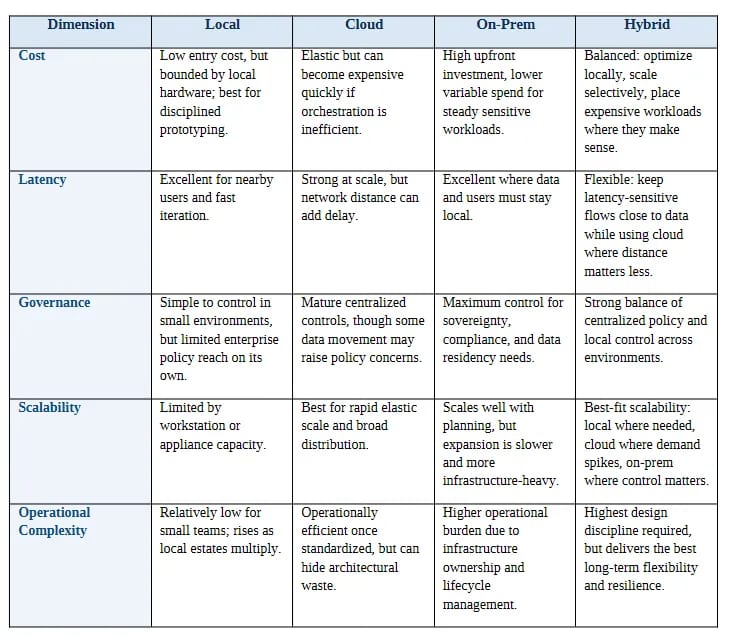
Executive takeaway: local sharpens discipline, cloud delivers elastic reach, on-prem maximizes control, and hybrid is the model that lets organizations combine those strengths deliberately rather than choose one at the expense of the others.

8. Build for the Next Environment, Not Just the Current One
So the modern case is straightforward, even if the execution still requires rigor. Build orchestration locally first, where constraints force clarity. Scale in the cloud when elasticity genuinely adds value. Use Azure Arc to preserve management consistency across environments. And where the scenario supports it, use Foundry Local capabilities and Arc-enabled agentic retrieval patterns to keep more of the knowledge and agent stack close to the data itself.
That is why the thesis now deserves a sharper ending than avoid rework. The better formulation is this: build once, ground locally, deploy anywhere. Local-first development still helps teams control cost and expose bad architecture early. But the bigger prize is optionality over where intelligence lives, where customer content is processed, and where agentic systems can reason over sensitive data without unnecessary movement.
Organizations should be able to deploy AI on their terms: in the cloud when reach matters, on-prem when control matters, and in hybrid form when the world refuses to be simple. Investing in that balanced approach pays off in the three currencies executives care about most: flexibility, cost savings, and control. Flexibility, because the workload and its knowledge layer can move or stay put by design. Cost savings, because the cloud is scaling a disciplined architecture instead of subsidizing chaos. Control, because local data and local reasoning are not afterthoughts but first-class strategic choices.
The goal is not simply to prove that AI can run somewhere. The goal is to ensure it can run where the business needs it next and, increasingly, stay grounded where the data already resides. The teams that understand this will not spend the next few years re-architecting under pressure. They will spend them deploying with confidence.
9. Three Practical Recommendations for Enterprise Leaders
For leaders deciding where each AI workload belongs, the practical question is not which environment is fashionable. It is which environment best matches the economics, governance needs, and operational realities of the use case in front of you.
-
Use local AI first when the priority is rapid learning, cost discipline, and architecture refinement. If the team is still discovering the right orchestration pattern, local development is the best place to expose waste before cloud scale makes it expensive.
-
Use cloud AI when the workload needs elastic scale, broad integration, and fast distribution across regions or business units. Cloud is the right accelerator once the design is disciplined enough to deserve that reach.
-
Use on-prem or hybrid AI when data residency, latency, sovereignty, or operational continuity are decisive. If sensitive content must stay close to the source, or if agentic retrieval and local reasoning need to remain inside customer-controlled boundaries, Azure Arc and Foundry Local patterns make hybrid the strategic choice rather than the fallback choice.

Further Readings
The items below are included for follow-up and factual grounding. Publication months reflect the source metadata available from the referenced pages.
-
Agentic Retrieval and Agents and Tools with Foundry Local Overview (https://learn.microsoft.com/en-us/azure/azure-arc/agents-tools-foundry-local/overview) (Microsoft Learn - May 2026). Explains the Azure Arc-enabled Kubernetes extension that enables local agentic RAG with document ingestion, embeddings, vector search, agent orchestration, MCP-based tool access, and locally hosted customer content and conversation state.
-
What is Foundry Local on Azure Local? (https://learn.microsoft.com/en-us/azure/azure-sovereign-clouds/private/foundry-local/overview) (Microsoft Learn - June 2026). Outlines how Foundry Local on Azure Local supports on-premises AI inference on Arc-enabled Kubernetes with Kubernetes-native operations, secure endpoints, and connected or disconnected deployment patterns.
-
Azure Arc overview (https://learn.microsoft.com/en-us/azure/azure-arc/overview) (Microsoft Learn - August 2025). Provides Microsoft’s overview of Azure Arc as a consistent multi-cloud and on-premises management platform for managing resources across environments with familiar Azure capabilities.
-
Azure AI Foundry: Your AI App and agent factory (https://azure.microsoft.com/en-us/blog/azure-ai-foundry-your-ai-app-and-agent-factory/) (Microsoft Azure Blog - May 2025). Introduces Microsoft’s Foundry direction and notes the planned Azure Arc integration for managing and updating on-device AI deployments centrally.
Factual grounding used in this revision: Azure Arc overview, Foundry Local on Azure Local overview, Agentic Retrieval and Agents and Tools with Foundry Local overview, and Azure AI Foundry: Your AI App and agent factory. Accuracy note: this article intentionally describes an increasing subset of Foundry Local capabilities for local inference and agentic retrieval, not the full Azure AI Foundry feature set as universally available offline.
Disclaimer: The perspectives shared in this article are my own and do not represent those of my employer or any affiliated organizations. All company names, product names, logos, and brands mentioned are the property of their respective owners and are used for identification and illustrative purposes only. No endorsement, sponsorship, or affiliation is intended or implied. References to specific companies or case studies are based on publicly available information and are used solely for educational and discussion purposes.
More from enterprise ai
All enterprise ai → enterprise ai
Breaking the Idea Trap in the Age of AI
Somewhere right now, one of your best engineers is sitting at a kitchen table at 11 p.m., building something extraordinary with an AI assistant. She is not stealing company secrets. She is not moonlighting for a competitor. She is solving a…
 enterprise ai
Closing the AI Velocity Gap: Your AI is ready, but your org chart is still loading.
Many are asking the same question: How are companies like Anthropic, OpenAI, and many others are shipping major updates weekly while the rest of us take months to push a minor feature?
 enterprise ai
The Fastest AI Rollouts Are Usually the Most Human
There is a particular kind of executive meeting now happening in perfectly serious companies everywhere. Someone shows a dazzling AI demo. The room nods. A few people look delighted in the way people do when they’ve just seen a magic trick…