The Fastest AI Rollouts Are Usually the Most Human

Why short feedback loops, honest leadership, and trust matter more than another impressive demo
There is a particular kind of executive meeting now happening in perfectly serious companies everywhere. Someone shows a dazzling AI demo. The room nods. A few people look delighted in the way people do when they’ve just seen a magic trick and are already pricing the rabbit. Someone says the organization needs to move quickly. Someone else says the competitors are already doing it. A pilot is proposed. A task force is formed. A deck appears. Then, quietly and with professional-grade politeness, the actual builders begin to drag their feet.
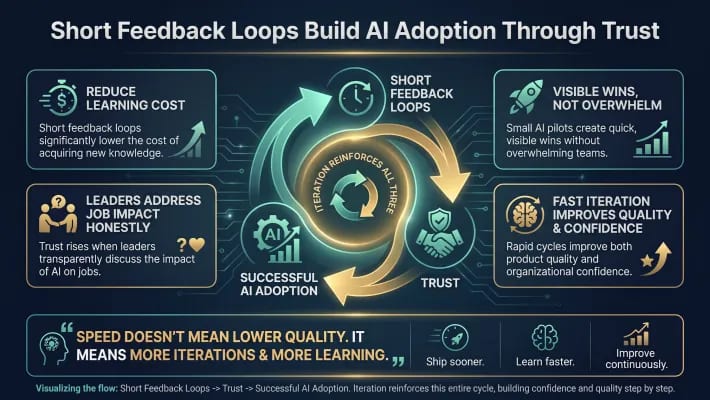
Not because they are stupid, lazy, or allergic to progress. And not because they “fear change,” that wonderfully lazy management phrase usually deployed when leaders would rather psychoanalyze a team than examine their own incentives. They drag their feet because they can smell an incoherent bargain. The company is asking for speed, experimentation, and enthusiastic adoption of a technology that may alter roles, workflows, status, and headcount logic, while saying almost nothing honest about what changes for the humans involved. This is usually described as a communication gap. More often, it is a trust gap wearing a communication costume.

That distinction matters because, in software, we already know where quality comes from. It does not emerge from waiting heroically for a perfect first release. It comes from short feedback loops: ship something smaller, sooner, and closer to reality; learn what broke, what confused people, what mattered, and what didn’t, and then improve. That is not recklessness. It is disciplined humility. It is the simple recognition that reality is usually better at informing design than conference-room certainty.
Oddly, many organizations forget this the moment AI enters the building. They become strangely theological. Everything they know about iteration evaporates, and transformation is treated as though it must arrive fully formed, carrying tablets from the mountain. But a sensible AI rollout should look less like a moon landing and more like a competent product team with good habits: a small release, fast learning, visible adjustment, and then another pass.
Short feedback loops reduce more than technical risk
The interesting thing is that short feedback loops are not just a product principle. They are also a social one. In engineering, they reduce the cost of being wrong. In AI adoption, they do the same. When the first move is narrow, concrete, and survivable, people can evaluate reality instead of reacting to mythology. A small pilot says something reassuring without ever putting it on a poster: we are not betting the company on a slide, and we are not pretending certainty we do not have. We are testing a workflow, watching what happens, and reserving the right to learn in public.
That changes the emotional temperature more than most leaders realize. Teams do not panic nearly as much when the ask is specific: improve this support workflow, accelerate this internal reporting cycle, reduce the time spent on this tedious first draft. A bounded experiment is legible. “We are becoming an AI-first company” is not a strategy. It is a mood board.
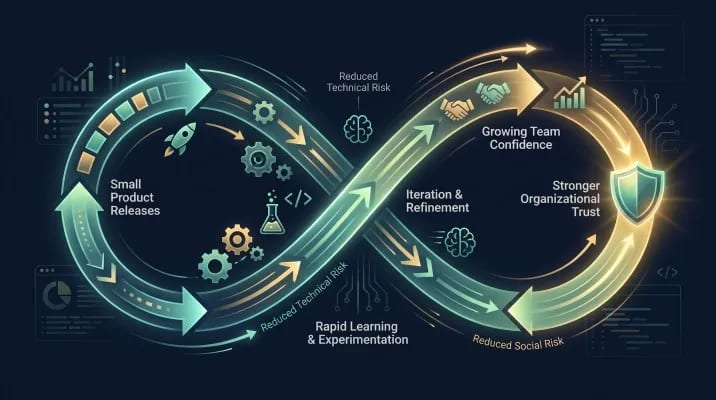
Still, even a smart pilot can fail if the surrounding narrative is dishonest. If people suspect that “productivity” is merely the polite corporate synonym for “we are figuring out which floor to empty,” then every efficiency gain becomes politically radioactive. Employees are not irrational for noticing this. In fact, it would be odd if they didn’t. This is why trust becomes the hidden dependency in the entire system.
By trust, I do not mean the soft-focus poster version with stock photography and suspiciously white teeth. I mean operational trust: the kind that allows people to participate in change without feeling they are rehearsing their own redundancy. It is built when leadership addresses job impact directly, names uncertainty without melodrama, and explains what the organization is trying to preserve as well as what it hopes to improve.
The real omission in most AI strategies
This is where many AI strategies wander into a ditch. Leaders talk at length about capability and almost not at all about consequence. They explain what the models can do and remain oddly vague about what the humans are for. That omission is not minor. It is the whole plot.
Once AI starts accelerating first drafts, code generation, analysis, synthesis, and routine decision support, the bottleneck does not disappear. It moves upward and outward into judgment, prioritization, evaluation, exception handling, risk appetite, and organizational design. In plain English, the machine makes more things possible, faster, and the humans become more responsible for deciding which of those things are sensible, safe, worth shipping, and worth owning.
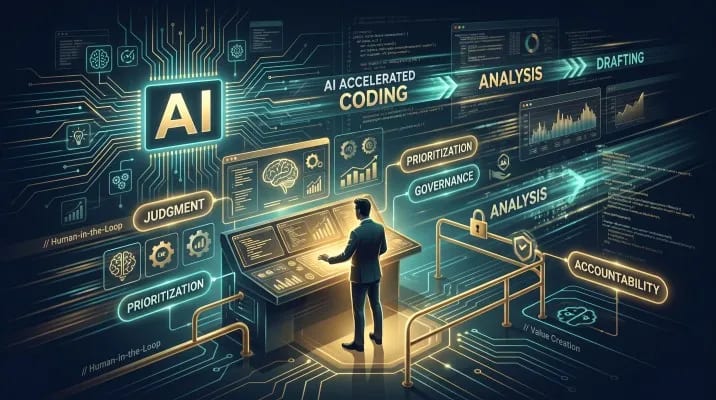
That is not a smaller role. It is a sharper one. The companies that handle this well understand that AI does not merely compress execution time, but it rearranges where value lives. When production gets cheaper, discernment becomes more expensive. When drafting becomes abundant, taste matters more. When code arrives faster, the ability to evaluate systems, define guardrails, and connect technical output to business reality becomes disproportionately important.
This is why the old software truth still holds: iteration beats perfection. In AI, though, the meaning expands. Iteration is not only how you improve the product or tooling. It is how you earn the right to scale it. A short feedback loop tells the organization that learning is allowed. A trustworthy leadership posture tells the organization that learning is safe. Put those two together and adoption stops feeling like enforcement and starts feeling like participation.
What leaders tend to get wrong
That is the inflection point many firms miss. They think the challenge is convincing people that AI is useful. Usually, the harder challenge is convincing people that the organization has a believable theory of human value on the other side of usefulness. Without that, every rollout becomes a strange performance: executives praise innovation, managers quietly worry about control, engineers question quality, security, and incentives, and everyone says the word “transformation” with with the expression of someone eating an egg salad sandwich they found in the communal fridge.
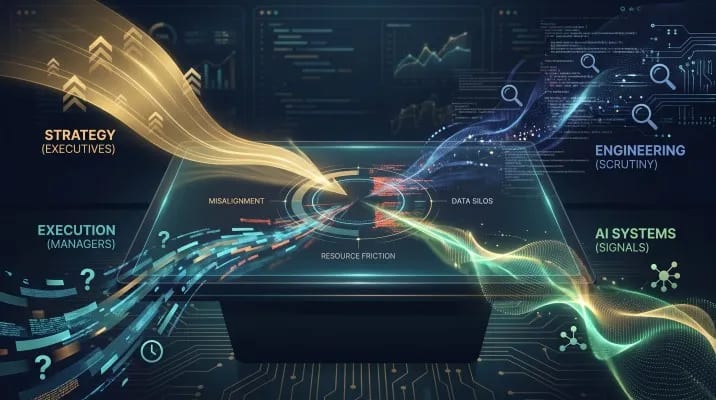
With trust, however, the pattern changes. Teams engage earlier. Managers volunteer better use cases. Technical objections become more precise and therefore more useful. Resistance, when it appears, becomes diagnostic rather than emotional or political. You can learn from it. The organization begins acting like an mature system instead of a nervous rumor mill.
That is why the real goal is not speed for its own sake. The cult of speed is every bit as silly as the cult of caution. The point is to learn fast enough that reality stays in the room. A short feedback loop is simply a mechanism for keeping reality involved before ideology takes over. In product development, that produces better software. In AI adoption, it produces something even rarer: momentum without self-deception.
Final thought
So if an AI product rollout is stalling, I would look less at the models and more at the loop. How long does it take to test a real use case? How honestly does leadership talk about role change? How quickly can the organization turn concern into information, and information into adjustment? How visible is the human contribution that remains when the machine gets faster?

Those questions are less glamorous than the demo, but they are the ones that determine whether the demo becomes a business capability or a corporate ghost story. The companies that benefit most from AI will not necessarily be the ones with the flashiest tools. They will be the ones that learn quickly, explain honestly, and build trust at the same speed they build systems. That turns out to be the same lesson good engineers learned years ago: perfection is slow theater, while iteration is how organizations become believable to their people again.

Further Readings
- State of AI trust in 2026: Shifting to the agentic era – McKinsey, March 25, 2026. This article explores how trust, governance, accountability, and human confidence become decisive as AI moves from experimentation into broader enterprise use.
- AI Transformation Is a Workforce Transformation – BCG, 2026. This piece argues that the real value of AI does not come primarily from the models themselves, but from how organizations redesign work, involve managers, and build the learning structures that let people use AI well.
- Enterprise AI adoption in 2026: Why 79% face challenges despite high use – Writer, April 7, 2026. This article focuses on the gap between enthusiasm and execution in enterprise AI adoption. It addresses resistance, inconsistent leadership, unclear rollout strategy, and the messy reality of trying to turn broad AI excitement into practical organizational change.
- State of AI in the Enterprise – Deloitte, 2026. Deloitte’s 2026 AI report examines what happens when companies try to move from pilots to production at scale. It covers worker trust and engagement, governance, skills gaps, and the operational barriers that separate AI ambition from durable execution.
- AI Will Reshape More Jobs Than It Replaces – BCG, 2026. This article looks at how AI changes the shape of human work more often than it simply eliminates it. It distinguishes between substitution and augmentation, and argues that future advantage will come from redesigning roles, upskilling talent, and shifting human effort toward higher-order judgment and orchestration.
Disclaimer: The perspectives shared in this article are my own and do not represent those of my employer or any affiliated organizations. All company names, product names, logos, and brands mentioned are the property of their respective owners and are used for identification and illustrative purposes only. No endorsement, sponsorship, or affiliation is intended or implied. References to specific companies or case studies are based on publicly available information and are used solely for educational and discussion purposes.
More from enterprise ai
All enterprise ai → enterprise ai
When the Vendor Only Gets Paid for Outcomes, the Demo Changes!
There is a moment in every enterprise software demo that both sides politely agree not to notice. The sales engineer clicks through a workflow rehearsed until it cannot fail, supposedly. The prospect nods at a dashboard populated with…
 enterprise ai
The IVR Is a Legacy System. Modernize It Like One.
“Please listen carefully, as our menu options have changed.” They have not changed. You know it, I know it, and somewhere in a data center a recording that has survived three generations of infrastructure strategy knows it too. Greetings…
 enterprise ai
Closing the AI Velocity Gap: Your AI is ready, but your org chart is still loading.
Many are asking the same question: How are companies like Anthropic, OpenAI, and many others are shipping major updates weekly while the rest of us take months to push a minor feature?