AI Is Making Advertising More Efficient at the Wrong Thing
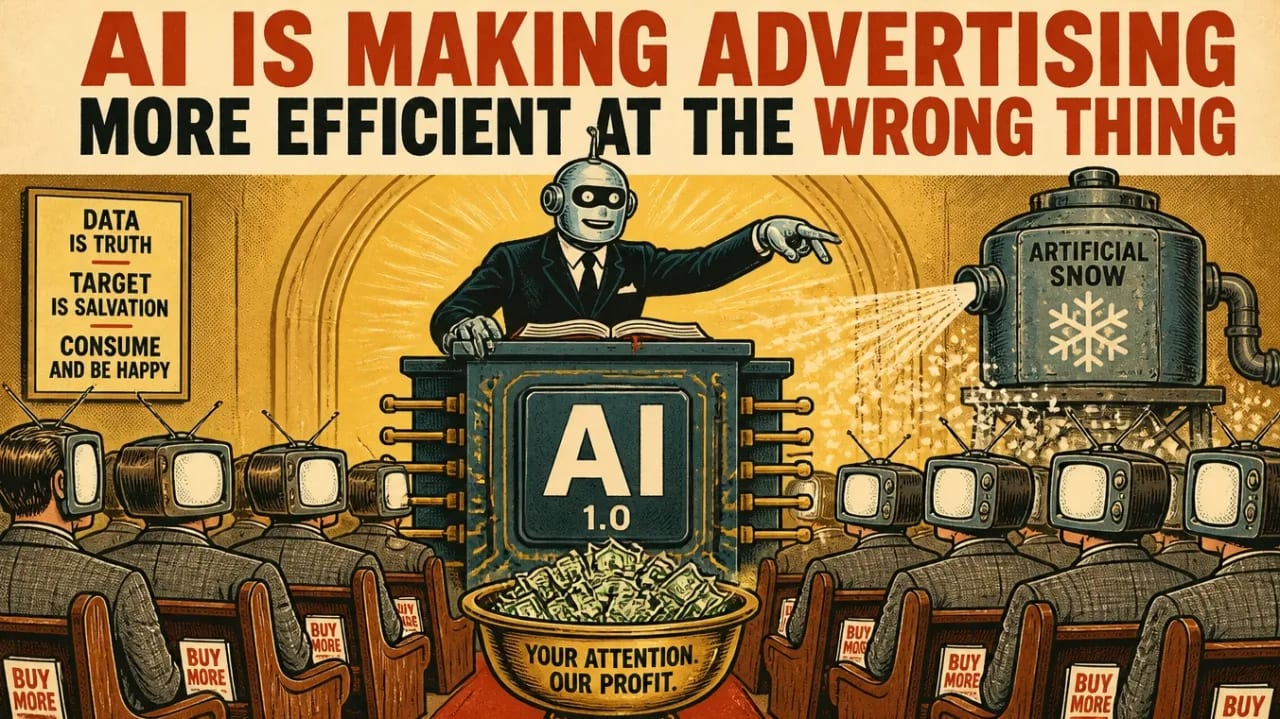
Vonnegut warned us about the snow job. Now we’re giving it a GPU.
I bought the blender last Tuesday. By Wednesday, the advertising industry had apparently assembled an international task force dedicated to convincing me that I needed a blender. YouTube wanted to sell me one, websites wanted to sell me one, and social media, with the eerie confidence of a private investigator who had arrived four days late, had concluded that I was a man in urgent need of blended food.
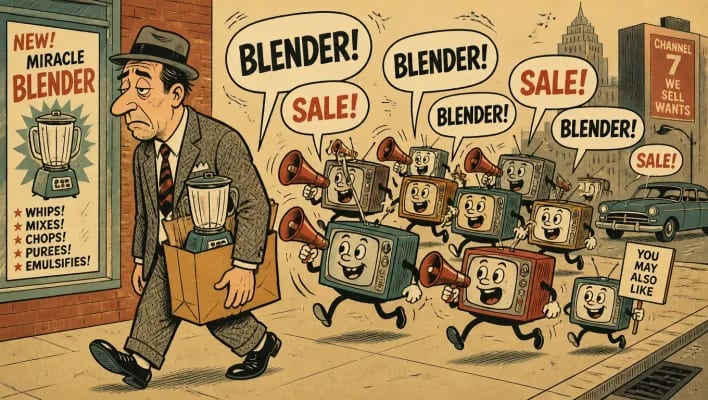
This is supposed to be evidence of sophisticated targeting. I experience it as evidence that the machine knows an extraordinary amount about me while somehow missing the one fact that actually matters: I already bought the blender. We have spent decades building an advertising infrastructure capable of tracking intent across the internet, and it still frequently behaves like a salesperson following you out of the store shouting that the item in the bag you are carrying is currently on sale.
The annoyance is trivial at best, but the economics behind it are not. That absurd little experience exposes a larger problem in modern advertising. We have become very good at identifying people who look likely to buy something, without necessarily becoming equally good at determining whether the advertising caused the purchase. Now we are pouring AI into that system and calling the result progress. I have my doubts.
Vonnegut had seen this machine before
Kurt Vonnegut understood something about advertising long before anyone spoke about behavioral targeting, programmatic auctions or generative AI. In Player Piano, his 1952 novel about automation and a society increasingly organized around machines, a character describes the corporate mythology manufactured by public relations and advertising people. He finishes with one of those wonderfully economical Vonnegut lines: “Yesterday’s snow job becomes today’s sermon.”
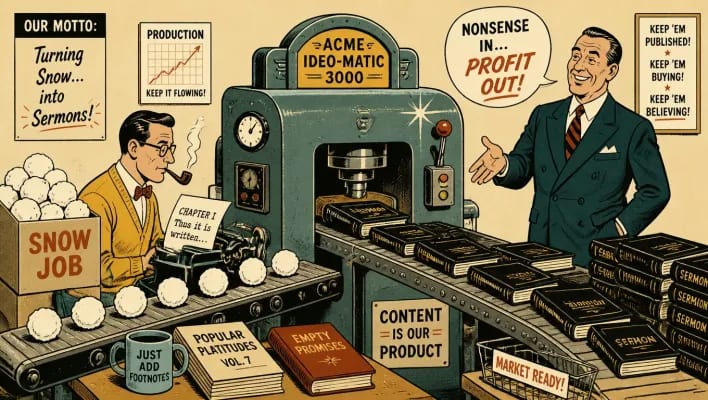
Vonnegut had standing to make the observation. Before becoming a novelist, he worked as a publicist for General Electric in Schenectady, interviewing scientists and engineers and turning their work into stories suitable for public consumption. Player Piano grew partly from that world: industrial automation, management, technology, and the stories organizations tell themselves about progress.
Seventy-four years later, we have managed to combine the two professions that interested him. The machine no longer merely produces the product. It helps manufacture the story, selects the audience, predicts who might believe it, modifies the message, tests the response and decides who should see the next version. Vonnegut’s snow job has a feedback loop now, and increasingly it has a AI model behind it.
We keep measuring the wrong victory
There is a basic distinction in advertising that becomes increasingly important as AI gets better: prediction is not persuasion. An advertising system can become astonishingly good at finding people who are likely to purchase a product without becoming equally good at causing purchases that otherwise would not have happened. Those are two different capabilities, but much of the advertising machinery quietly treats them as though they were the same.
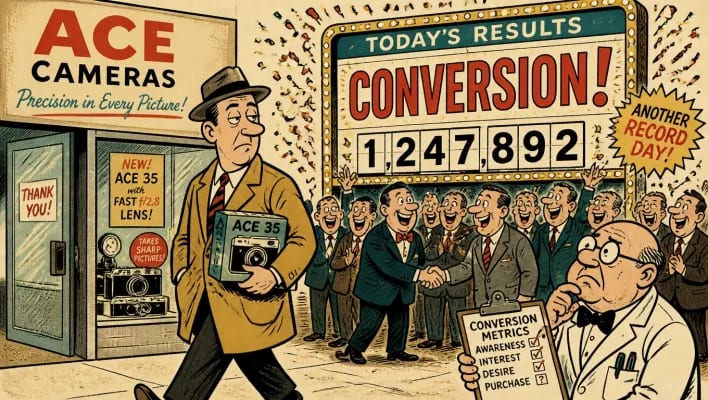
Suppose I search for a camera, read three reviews, visit the manufacturer twice, watch comparison videos and put the camera in my shopping cart. I am now advertising catnip. Every signal says I am likely to buy, so the system spends money making sure that I see the camera again.
Then I buy it, the dashboard reports a conversion, and the campaign gets credit. Everyone celebrates except for the inconvenient possibility that I had already decided to buy the damn camera. The campaign may have successfully predicted my behavior without changing it in any meaningful way.
This problem has been demonstrated experimentally. Researchers working with eBay conducted large-scale field experiments in which paid-search advertising was deliberately turned off for selected users and markets. Conventional measurement made the ads look far more effective than the experiments did. Brand-keyword advertising produced no measurable short-term benefit, while much of the non-brand spending went toward established customers whose purchasing behavior was not meaningfully changed by the ads.
That is not a small accounting discrepancy. It changes the question an advertiser should be asking. Instead of merely asking whether somebody who saw an ad bought something, the more useful question is whether that person would have bought it without the ad. Advertisers should care.
One measures correlation. The other measures incrementality. AI is extremely good at helping with the first problem, but that does not mean it automatically solves the second.
The wrong system just received a productivity miracle
Generative AI changes the economics because advertising creatives use to have friction. Somebody wrote the copy, created the image, shot the video, approved the layout, produced the regional variations and paid people to do all of it. Those costs naturally limited how many versions of a campaign could exist.
That constraint is disappearing quickly. Mondelez, the company behind Oreo and Cadbury, has said that its generative-AI marketing system can reduce content-production costs by 30% to 50%. The important number is not merely the savings, because once an advertisement becomes dramatically cheaper to create, it also becomes economically sensible to create far more advertisements, far more variations and far more experiments.
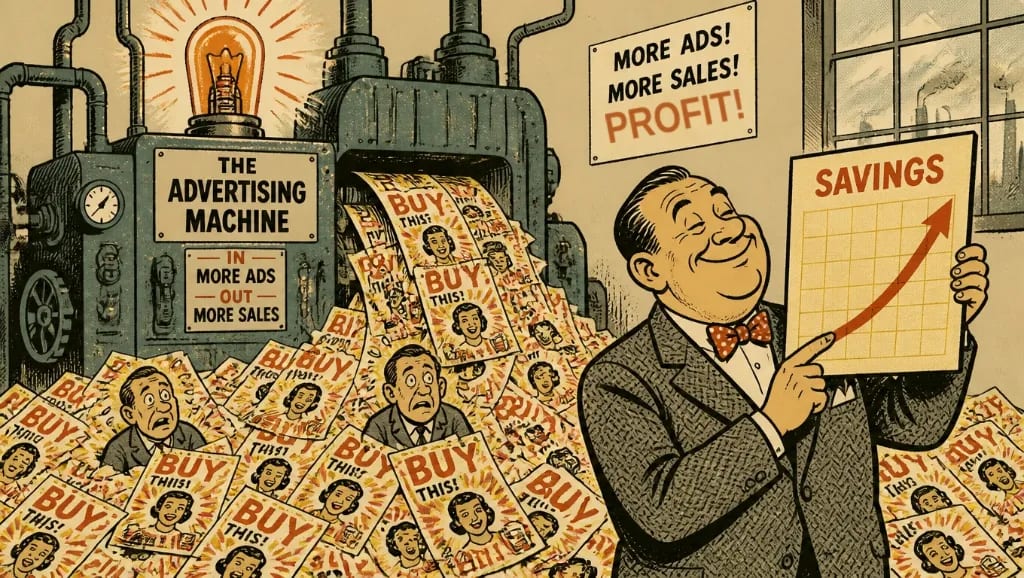
Meta is moving in precisely that direction from the delivery side. Its Generative Ads Model is designed to improve recommendations and predictions at enormous scale, and Meta reported that deployment of the model increased ad conversions by 5% on Instagram and 3% on Facebook Feed during the second quarter of 2025. Those are real technological achievements, but they may also be solving the wrong problem beautifully.
If creating ten advertisements once cost $100,000 and AI lets you create 10,000 for the same money, one possible outcome is that the marketing department returns $90,000 to the company. Another is that it creates 10,000 advertisements, runs more experiments and feeds more inventory into the same system. Business history gives us reasons not to automatically bet on the refund.
Efficiency has a habit of becoming volume
Technologists tend to assume that making something cheaper reduces the resources required to accomplish the original task. Markets are less obedient. Lowering the cost of an activity can increase consumption of that activity because entirely new uses become economically viable.
Advertising is particularly susceptible because it is competitive. If Company A discovers that AI-generated variations improve customer acquisition, Company B does not necessarily respond by admiring Company A’s improved margins. It responds with more advertising of its own, and Company C responds to both.
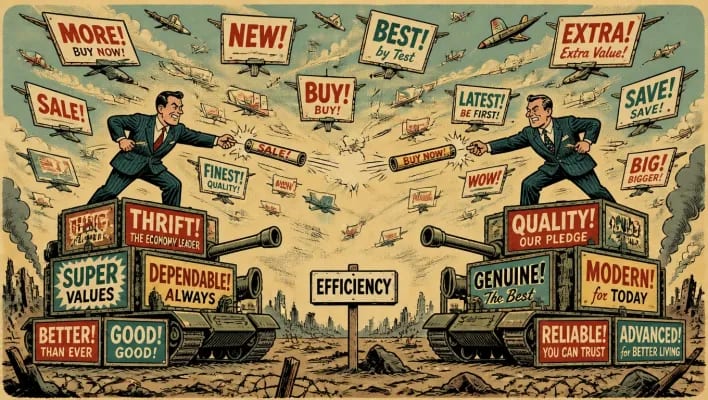
The result can resemble an arms race in which every participant becomes more efficient while the total system becomes more intensive. The technology reduces the cost per experiment, so we run more experiments; it reduces the cost per creative asset, so we manufacture more creative assets; it improves the ability to identify high-propensity buyers, so everybody competes more aggressively for those buyers.
Some of the productivity gain can eventually migrate into higher auction prices, greater advertising volume or more elaborate targeting rather than lower total marketing expense. The individual company may be behaving rationally while the system as a whole becomes noisier and more resource-intensive. Improving the efficiency of a system does not tell us who captures that efficiency.
There was already plenty of waste to accelerate
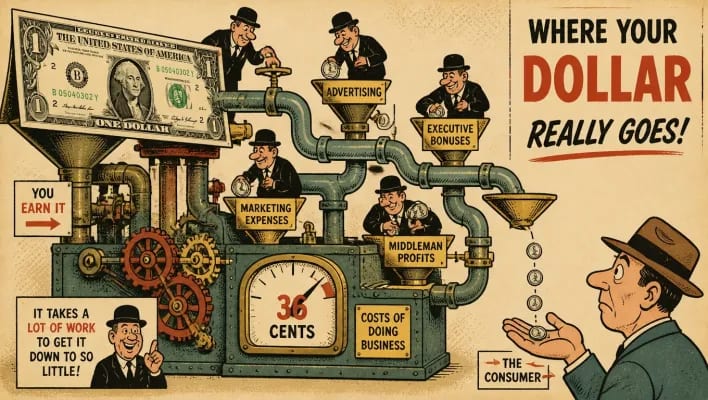
AI is not being introduced into an advertising market famous for immaculate resource allocation. The Association of National Advertisers studied $123 million of programmatic spending from 21 brands across 11 product categories. Its 2023 supply-chain study concluded that only 36 cents of every dollar entering a demand-side platform effectively reached the consumer, after transaction costs and various forms of media waste.
Even the celebrated data behind targeting can be less impressive than the machinery surrounding it suggests. A Marketing Science study examined more than 90 third-party audience segments from 19 data brokers and found enormous variation in accuracy. After accounting for the additional cost of purchasing the targeting data, many audiences were economically unattractive except for relatively expensive media placements.
This is the implicit bargain consumers have been asked to accept for years. We surrender extraordinary amounts of information about what we search, read, watch, consider, abandon and purchase, and in return the advertising becomes more relevant. Then I buy the blender, and the blender ads continue.
That is not merely irritating UX. It should make advertisers ask what precisely all this intelligence is purchasing. If the industry can track my behavior across half the internet but cannot reliably recognize that the sale is complete, perhaps the sophistication is concentrated in a different part of the problem than we have been led to believe.
More relevant is not the same as more valuable
There is an important counterargument here because personalization can work, and consumers can benefit from it. A 2026 field experiment involving 12 million Facebook users found that people assigned to receive less-personalized advertising engaged less with ads and reported lower satisfaction with their advertising experience and lower valuation of the platform. That is substantial evidence that better targeting can make advertising more useful rather than merely more invasive.
The study also deserves context. Two authors were Meta employees and shareholders, while another had a contractor relationship for data access, all disclosed by the researchers. That does not invalidate the work, but it is relevant when interpreting research about the economic value of Meta’s own advertising systems.
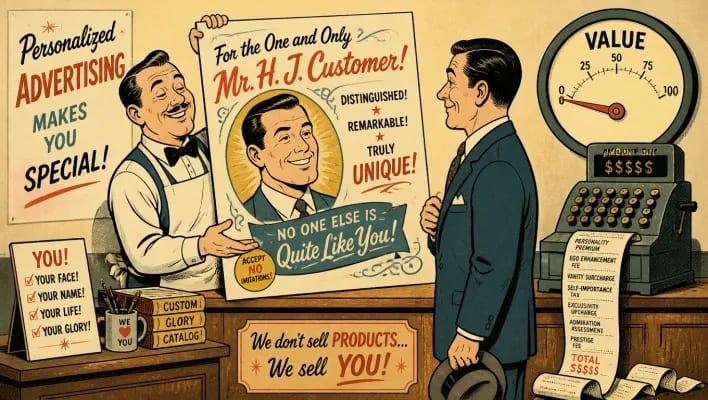
The sensible conclusion is not that targeted advertising is inherently bad. The more interesting conclusion is that relevance and incrementality are different dimensions of value. Showing me a beautifully personalized advertisement for the camera I was already going to buy may improve my advertising experience, but it does not necessarily mean the advertiser should have paid to show it to me.
That distinction becomes even more important as AI moves from selecting advertisements to generating them. A recent real-world study of LLM-generated personalized advertising found that personalization did not significantly improve engagement over non-personalized alternatives, and some approaches actually performed worse for certain demographic groups. The personalized language could still influence how the platform delivered the ads, illustrating something important. The system may become better at reaching a chosen audience without becoming better at persuading it.
We are building enormously sophisticated systems for identifying and reaching people. We should probably make equally sophisticated investments in determining whether reaching them was worth doing. Otherwise, better targeting simply becomes a more accurate way to spend money on people who were already going to act.
When advertising starts learning your price
There is another boundary AI is beginning to blur. The same behavioral signals that help a system estimate what you want can help a business estimate how badly you want it. That moves the conversation from personalized advertising toward personalized economics.
The OECD warned in 2025 that AI greatly expands firms’ ability to implement dynamic pricing and personalized offers because systems can process behavioral and transactional data at scale and estimate individual willingness to pay with increasing precision. Reinforcement-learning systems can repeatedly test that willingness, learning which consumers require a discount and which ones do not.
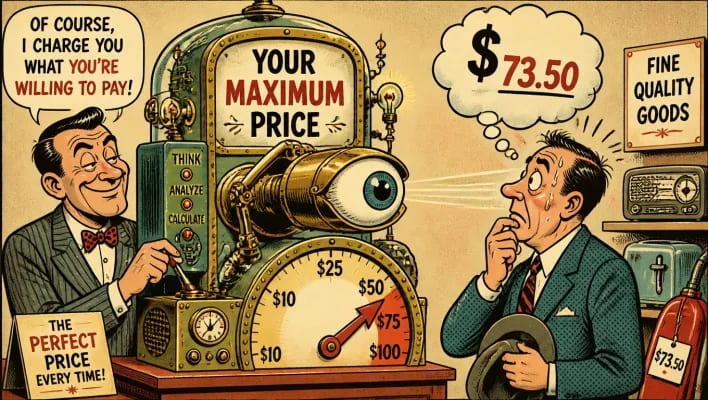
For most of commercial history, consumers possessed one wonderfully private piece of information: the maximum price they were willing to pay. The merchant could guess, and we could bluff. AI improves the guess.
The Federal Trade Commission has been investigating what it calls surveillance pricing, in which detailed information such as location, demographics and browsing history can contribute to individualized pricing or offers. That does not mean every retailer is secretly changing every price for every person, but it does mean the technical infrastructure increasingly makes that kind of segmentation possible.
At that point, the advertising system is no longer merely asking which message might cause me to purchase. It can begin asking which combination of message, offer and price extracts the most value from my particular circumstances. That is a much more powerful machine than the one Vonnegut was mocking.
The problem is “probably” not a conspiracy
It is tempting to conclude that the advertising industry is deliberately wasting advertisers’ money. While given the out-of-control expansion of monopolies, I doubt we need that explanation, and the more mundane explanation is probably more troubling. Incentives are sufficient.
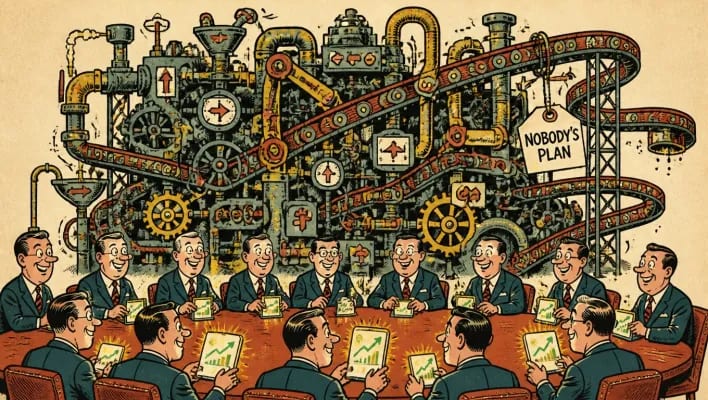
Advertisers ultimately want profitable incremental customers. Platforms can be rewarded for impressions, clicks, conversions and advertising spend. Agencies and intermediaries participate in the flow of that spending. Measurement systems frequently operate inside the same ecosystems selling the advertisements. Everyone can behave rationally according to the metric immediately in front of them while collectively optimizing something nobody intended.
AI does not repair that structure. It scales it, and that is the inflection point that matters. We keep talking about AI as though intelligence itself creates alignment, when intelligence usually makes a system better at pursuing whatever objective we gave it and not necessarily the actual unwritten intent.
If the objective is incremental profitable demand, AI can become a remarkable tool for reducing waste. If the objective is conversion probability, engagement, impression volume or attributed revenue, AI can become remarkably good at producing those numbers too. The dashboard can be green in either case.
Maybe the next breakthrough is knowing when not to advertise
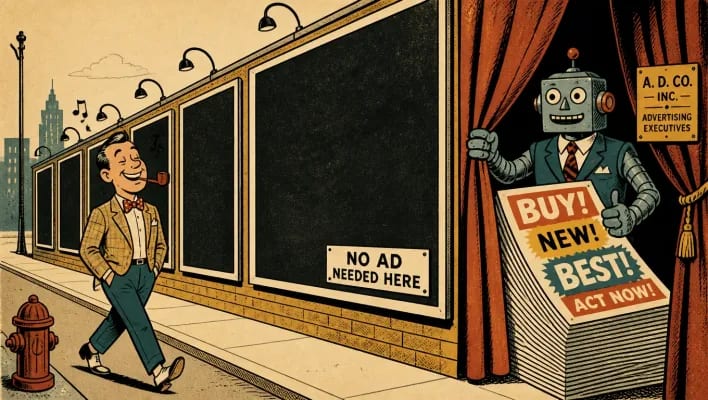
For advertisers, the opportunity is therefore bigger than automated creative. The sophisticated use of AI would not merely decide which advertisement to show. It would decide whether showing an advertisement is economically justified at all.
That requires a different discipline around measurement. At minimum, advertisers should be leaning much harder on:
- randomized holdout groups that receive no advertising
- causal experiments instead of attribution alone
- incremental-lift measurement rather than raw conversion rates
- suppression of customers who have already purchased
- explicit estimates of when another impression adds no economic value
A customer already intent on purchasing is not necessarily an advertising opportunity. Sometimes the most profitable advertisement is the one you do not buy. That sounds obvious, yet much of the machinery remains better at identifying buying intent than determining whether another paid impression changes the outcome.
This is a leadership problem as much as a technical one. When technology dramatically lowers the cost of an activity, executives need to ask whether the organization should produce more of that activity or demand better evidence that the activity deserves to exist. We ask this question with software features, cloud infrastructure, headcount, meetings and consulting engagements. Advertising should not receive an exemption merely because the dashboard contains percentages.
Perhaps the most revolutionary feature an AI advertising platform could ship would therefore be embarrassingly simple: stop showing blender advertisements to people who already bought the blender. It would not look particularly impressive in a keynote, and nobody would release a cinematic product video about it about a non-greedy algorithm. It might, however, save somebody money.
Yesterday’s sermon gets a GPU
Player Piano was not really about machines being evil. Vonnegut was more interesting than that. He was writing about what happens when a society becomes so enchanted with efficiency, automation and managerial logic that it stops asking what all that efficiency is supposed to accomplish.
His machines worked. That was part of the problem. We should be careful not to repeat the mistake with advertising.
AI can make advertising cheaper to create, faster to test, easier to personalize and extraordinarily good at predicting human behavior. Those capabilities could reduce irrelevant advertising, lower customer-acquisition costs and eliminate staggering amounts of waste. But a productivity improvement applied to the wrong incentive does not eliminate the incentive. It only accelerates it.
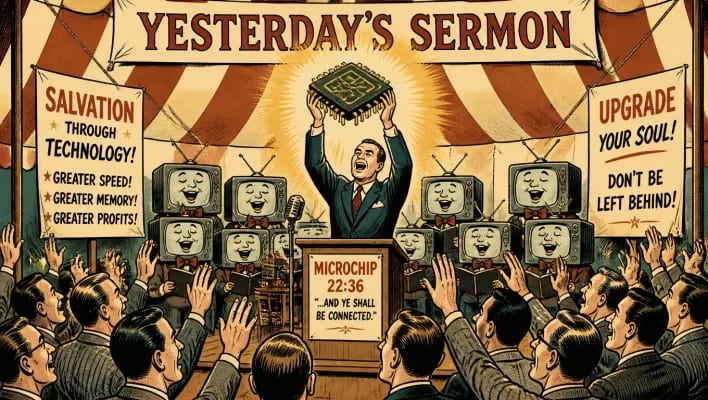
Vonnegut gave us the line in 1952, “yesterday’s snow job becomes today’s sermon”. We have spent the intervening decades building better microphones, larger congregations and increasingly precise ways of deciding who should sit in which pew. Now we are giving the sermon a GPU.

Further Reading
- Consumer Heterogeneity and Paid Search Effectiveness: A Large-Scale Field Experiment - Thomas Blake, Chris Nosko and Steven Tadelis, February 2015 The foundational evidence for the distinction between observed conversions and incremental conversions. The eBay experiments showed how dramatically conventional attribution can overstate causal advertising effectiveness, particularly among established customers already inclined to purchase.
- ANA Programmatic Media Supply Chain Transparency Study - Association of National Advertisers, December 2023 The clearest industry-level examination of how advertising dollars move through the programmatic supply chain. Its finding that only 36 cents of each dollar entering a DSP effectively reached the consumer provides important context for any claim that greater automation automatically means greater economic efficiency.
- Frontiers: How Effective Is Third-Party Consumer Profiling? Evidence from Field Studies - Nico Neumann, Catherine E. Tucker and Timothy Whitfield, October 2019 More than 90 audience segments across 19 data brokers were tested for accuracy and economic usefulness. The results are an excellent antidote to the assumption that collecting more behavioral data automatically produces high-quality targeting.
- Online Business Models, Digital Ads, and User Welfare - Daron Acemoglu, Daniel Huttenlocher, Asuman Ozdaglar and James Siderius, October 2024 A useful economic model of advertising-supported platforms showing how intensive advertising can reduce welfare under certain assumptions and even affect more skeptical consumers through higher equilibrium prices. It is theoretical rather than a field experiment, so its value is in illuminating possible mechanisms rather than establishing their size in the real economy.
- The Consumer Value of Ad Personalization: Evidence from Meta - Daniel Deisenroth, Utsav Manjeer and Nils Wernerfelt, June 2026 The strongest counterweight to a simplistic anti-targeting argument: a randomized experiment involving 12 million Facebook users found meaningful consumer benefits from personalization. Two authors were Meta employees and shareholders and the third had a contractor relationship for data access, making the disclosed institutional relationship important context when interpreting the results.
- How Persuasive Are LLMs in the Wild? Assessing Personalized Ads in Real-World Delivery - El Fraihi, Amieur, Roussillon and Goga, May 2026 A particularly useful empirical test of the current AI-personalization thesis. LLM-generated personalized ads did not significantly improve engagement overall, demonstrating that the ability to generate individualized language should not be confused with demonstrated persuasive value.
- Artificial Intelligence and Competitive Dynamics in Downstream Markets - OECD, November 2025 The broader competition-policy context for AI-enabled pricing and personalization. Of particular relevance is its discussion of willingness-to-pay estimation, dynamic pricing and the possibility that AI allows firms to capture more consumer surplus rather than simply deliver lower operating costs.
- Bringing Dark Patterns to Light - Federal Trade Commission, September 2022 A useful reminder that automated persuasion is entering an environment where firms already experiment extensively with interfaces designed to influence consumer decisions. The report predates the current generative-AI advertising wave, which makes its discussion of experimentation and behavioral manipulation more relevant, not less.
- Player Piano - Kurt Vonnegut, 1952 Vonnegut’s first novel is the literary ancestor of this argument: automation, corporate mythology, management culture and the uncomfortable difference between technical efficiency and human benefit. The advertising observation is only a small moment in the novel, but “Yesterday’s snow job becomes today’s sermon” has aged suspiciously well.
Disclaimer: The perspectives shared in this article are our own and do not represent those of our employer or any affiliated organizations. All company names, product names, logos, and brands mentioned are the property of their respective owners and are used for identification and illustrative purposes only. No endorsement, sponsorship, or affiliation is intended or implied. References to specific companies or case studies are based on publicly available information and are used solely for educational and discussion purposes.
More from enterprise ai
All enterprise ai → enterprise ai
Your AI Vendor Isn’t Lying. That’s the Problem.
I have a deep affection for Willy Wonka. Roald Dahl’s Charlie and the Chocolate Factory is one of those stories that managed to be funny, unsettling, imaginative, and morally suspicious all at once. Gene Wilder’s performance in the 1971…
 enterprise ai
The IVR Is a Legacy System. Modernize It Like One.
“Please listen carefully, as our menu options have changed.” They have not changed. You know it, I know it, and somewhere in a data center a recording that has survived three generations of infrastructure strategy knows it too. Greetings…
 enterprise ai
When the Vendor Only Gets Paid for Outcomes, the Demo Changes!
There is a moment in every enterprise software demo that both sides politely agree not to notice. The sales engineer clicks through a workflow rehearsed until it cannot fail, supposedly. The prospect nods at a dashboard populated with…