How Google Solved the Impossible: Making Smart Search Actually Fast

🔊 Listen to the Podcast version here. 🔊
Picture this: It’s 2024, and somewhere in the gleaming halls of Google Research, a team of engineers just casually solved one of computing’s most stubborn problems, - making multi-vector search as fast as single-vector search. They called it MUVERA, and if you haven’t heard of it yet, well, that’s about to change. Because this isn’t just another incremental improvement to make your search bar 3% snappier. This is the kind of breakthrough that makes every other search architecture look like they’re still using dial-up modems in a fiber optic world.

Let’s be honest about where we’ve been living. Traditional search, - the kind your enterprise probably runs on, operates like that friend who only remembers the gist of what you said. Single-vector embeddings capture semantic similarity about as well as a tweet captures the nuance of Shakespeare. Meanwhile, multi-vector approaches have been sitting in the corner like the brilliant but socially awkward genius who knows everything but takes forever to answer questions. They understand context, relationships, and nuance, but they’re enough to make your CFO break out in hives.

The Mathematical Magic Trick That Changes Everything
Here’s where MUVERA gets interesting, - and by interesting, I mean it pulls off what amounts to a mathematical magic trick. The team created something called Fixed Dimensional Encodings (FDEs), which essentially compress complex multi-vector representations into single vectors that still preserve the essential similarity relationships. Think of it as taking a symphony and somehow fitting it into a single note that still contains all the harmonies, melodies, and emotional depth of the original piece (Google Research Blog).
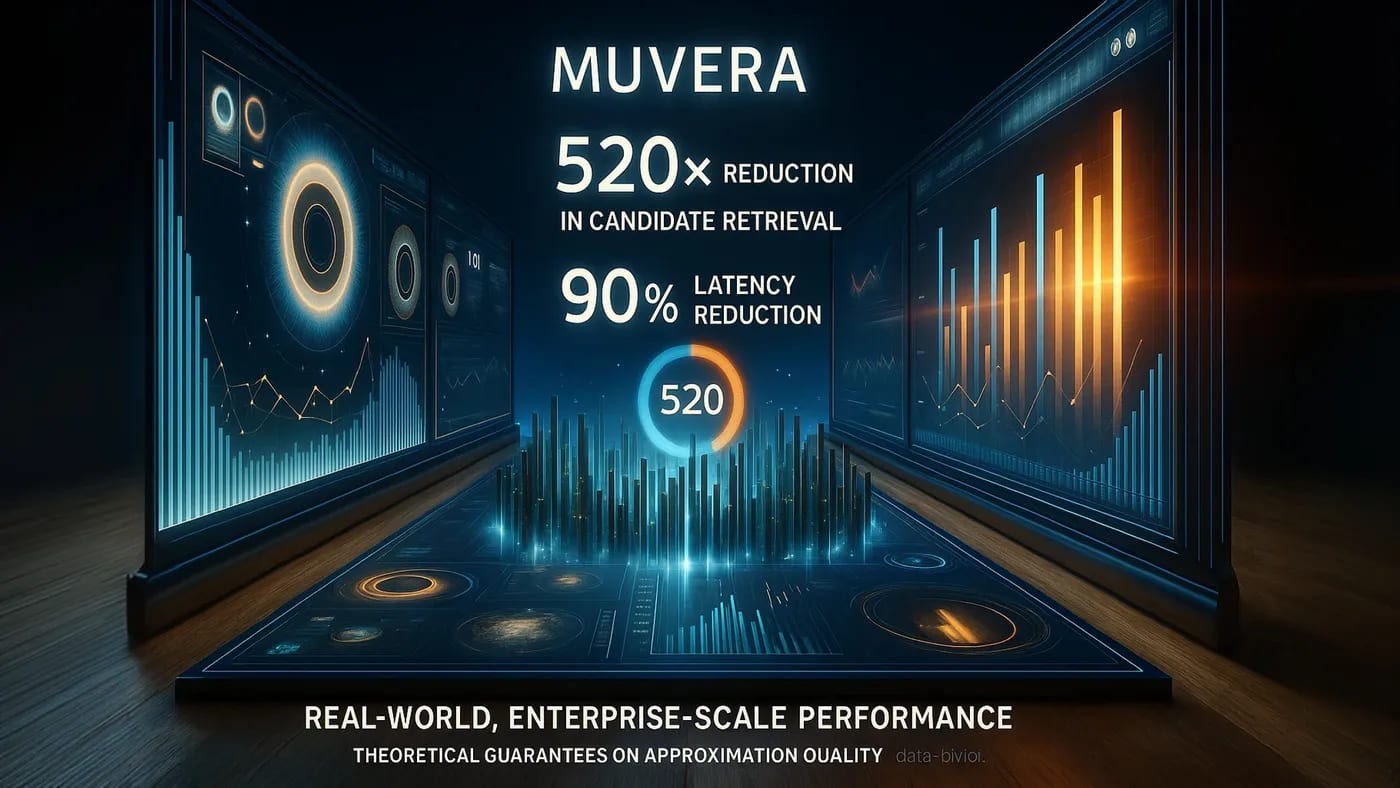
The performance numbers read like someone made a typo: 520x reduction in candidate retrieval, 90% latency reduction, and 10% improved recall compared to the previous state-of-the-art. But here’s the kicker, - these aren’t just lab benchmarks. This is real-world, enterprise-scale performance that maintains theoretical guarantees about approximation quality. The system is also data-oblivious, meaning it adapts to changing data distributions without requiring retraining. Your information landscape shifts, regulatory frameworks evolve, product portfolios change, - MUVERA just keeps working (arXiv).
Why Your Enterprise Search Probably Just Became Obsolete
Let’s talk about what this means for your actual business, not just your tech stack. Right now, your customer service representatives are probably playing twenty questions with your search system. They know the customer has a complex issue involving product specs, warranty terms, compatibility requirements, and billing history, but they’re stuck synthesizing connections manually across multiple systems. It’s like trying to conduct an orchestra where each musician is in a different building and can only communicate through smoke signals.

MUVERA flips this dynamic entirely. Instead of forcing humans to be the connective tissue between disparate information sources, the system understands contextual relationships automatically. Your AI assistants can now access and reason over much richer information contexts without the latency penalties that previously made such approaches about as practical as commuting by hot air balloon. We’re talking about real-time complex reasoning over vast datasets that was previously computationally prohibitive.
The Architecture Revolution Nobody Saw Coming
This isn’t just about making search faster, - it’s about enabling entirely new categories of enterprise intelligence. Consider the modern challenge of regulatory compliance. Your legal team needs to cross-reference product documentation, manufacturing processes, regulatory frameworks, customer communications, and competitive analysis, - not as separate analytical silos, but as integrated, contextual understanding that evolves in real-time. Traditional single-vector search handles this about as well as a bicycle handles space travel.

The architectural implications are profound. We’re moving from ‘search and filter’ to ‘understand and deliver.’ Enterprise systems can now anticipate information needs, provide contextually appropriate responses, and reason over complex relationships without extensive user guidance. This is particularly compelling when combined with current developments in retrieval-augmented generation (RAG) and large language models, which have been desperately waiting for retrieval systems that can match their sophistication.
The Competitive Reality Check
Here’s where things get interesting from a strategic perspective. MUVERA isn’t operating in a vacuum, - it’s competing with approaches like ColBERT’s late interaction mechanisms and ColPali’s vision-language integration. Each represents different philosophical approaches to multi-vector retrieval, and choosing wrong could be like betting on Betamax in a VHS world. The data-oblivious nature of MUVERA’s FDEs provides particular advantages for enterprises dealing with sensitive information or operating in regulatory environments.

But here’s the uncomfortable truth: while you’re evaluating options, your competitors might already be experimenting. The organizations that figure out how to leverage sophisticated contextual search first will have advantages that compound over time. They’ll deliver better customer experiences, make faster decisions, and operate with information architectures that adapt rather than break when business conditions change.
The Implementation Reality (It’s Not All Rainbows)
Before you start planning your MUVERA migration party, let’s acknowledge some realities. Transitioning from single-vector to multi-vector thinking requires more than just swapping out search engines, - it demands fundamental reconsideration of information architecture. Legacy systems built around keyword matching and simple similarity scoring may require substantial evolution to leverage these capabilities effectively.

The technical sophistication also raises questions about transparency and explainability. While MUVERA provides theoretical guarantees about approximation quality, enterprise leaders must consider how to maintain audit trails when search results depend on complex multi-dimensional calculations rather than straightforward keyword matches. Plus, the effectiveness depends heavily on the quality of underlying embeddings, which means investing in sophisticated content preprocessing and quality assurance processes.
The Future is Already Here (It’s Just Unevenly Distributed)
As William Gibson noted, the future is already here, - it’s just unevenly distributed. MUVERA represents that future becoming available to enterprises willing to rethink their approach to information. The question isn’t whether multi-vector retrieval will become standard. Instead, it’s how quickly organizations can adapt their information architectures to leverage these capabilities competitively.
The ultimate vision extends beyond search optimization to fundamental transformation in how enterprises capture, organize, and act upon knowledge. With MUVERA enabling real-time complex reasoning over vast, heterogeneous datasets, we approach the possibility of truly intelligent enterprise systems, - ones that don’t just store and retrieve information, but understand context, anticipate needs, and provide insights previously accessible only through extensive human analysis.

So here’s the bottom line for technology leaders: MUVERA doesn’t just make existing processes faster—it makes previously impossible processes routine. The limitation is no longer access to information, but the imagination to use it intelligently. The enterprises that figure this out first will operate in a fundamentally different reality than those still debugging their keyword search algorithms.

Further Readings
-
MUVERA: Making multi-vector retrieval as fast as single-vector search (Google Research Team, May 2024) Google’s official announcement of the MUVERA breakthrough, explaining Fixed Dimensional Encodings and their revolutionary impact on search performance.
-
MUVERA: Multi-Vector Retrieval via Fixed Dimensional Encodings (Jayaram et al., May 2024) The complete research paper detailing the mathematical foundations, theoretical guarantees, and experimental validation of MUVERA’s approach.
-
More efficient multi-vector embeddings with MUVERA (Weaviate Team, November 2024) Practical implementation insights and performance analysis from one of the leading vector database platforms.
-
2024: The State of Generative AI in the Enterprise (Menlo Ventures, November 2024) Comprehensive analysis of enterprise AI adoption trends, including the role of advanced retrieval systems in RAG architectures.
Disclaimer: The perspectives shared in this article are my own and do not represent those of my employer or any affiliated organizations. All company names, product names, logos, and brands mentioned are the property of their respective owners and are used for identification and illustrative purposes only. No endorsement, sponsorship, or affiliation is intended or implied. References to specific companies or case studies are based on publicly available information and are used solely for educational and discussion purposes.
More from silicon & systems
All silicon & systems → silicon & systems
IT SEES, IT CLICKS, IT WORKS: The Operating System Built for AI - Not You
When a digital employee shows up for work, it doesn’t need a desk or a coffee mug. In fact, it doesn’t even need sleep. Instead, it lives in the cloud, clicking through Slack messages and Salesforce forms at 3 AM while you’re asleep. This…
 silicon & systems
Why Generative GUIs May Be the Most Disruptive OS Shift Since Windows 95
Late at night in a corner office, a CTO sits before the gentle glow of a computer screen. The interface staring back is familiar, - rows of icons, tidy menus, the same static layout that’s greeted us for decades. It’s comforting in its…
 silicon & systems
From "Mainframe Intelligence" to "Thin Client Thinking"
It's 8:00 AM and a high school teacher is staring at a stack of suspiciously flawless essays. Across town, a manager in a boardroom slyly taps on ChatGPT under the table to craft a quick strategy memo. Two very different scenes share an…