The Chatbot and the Philosopher: Embracing Uncomfortable Truths with AI Thought Partners

The first time an AI chatbot challenged me to reconsider my biases, I laughed. The second time, I objected vehemently. Now it’s obvious: my digital thought partner has become an unexpected guide to the intellectual blind spots I’d rather ignore.
This peculiar perspective began with a casual conversation with my colleague Skip Balch yesterday, who casually mentioned Schopenhauer in relation to modern tech resistance. “Remember what Schopenhauer said about truth?” Skip asked with a knowing smile. At the time, I nodded sagely while secretly making a mental note to go look for my college philosophy books. Little did I know this would send me spiraling into an existential rabbit hole where AI and 19th-century German pessimism make surprisingly compatible bedfellows.
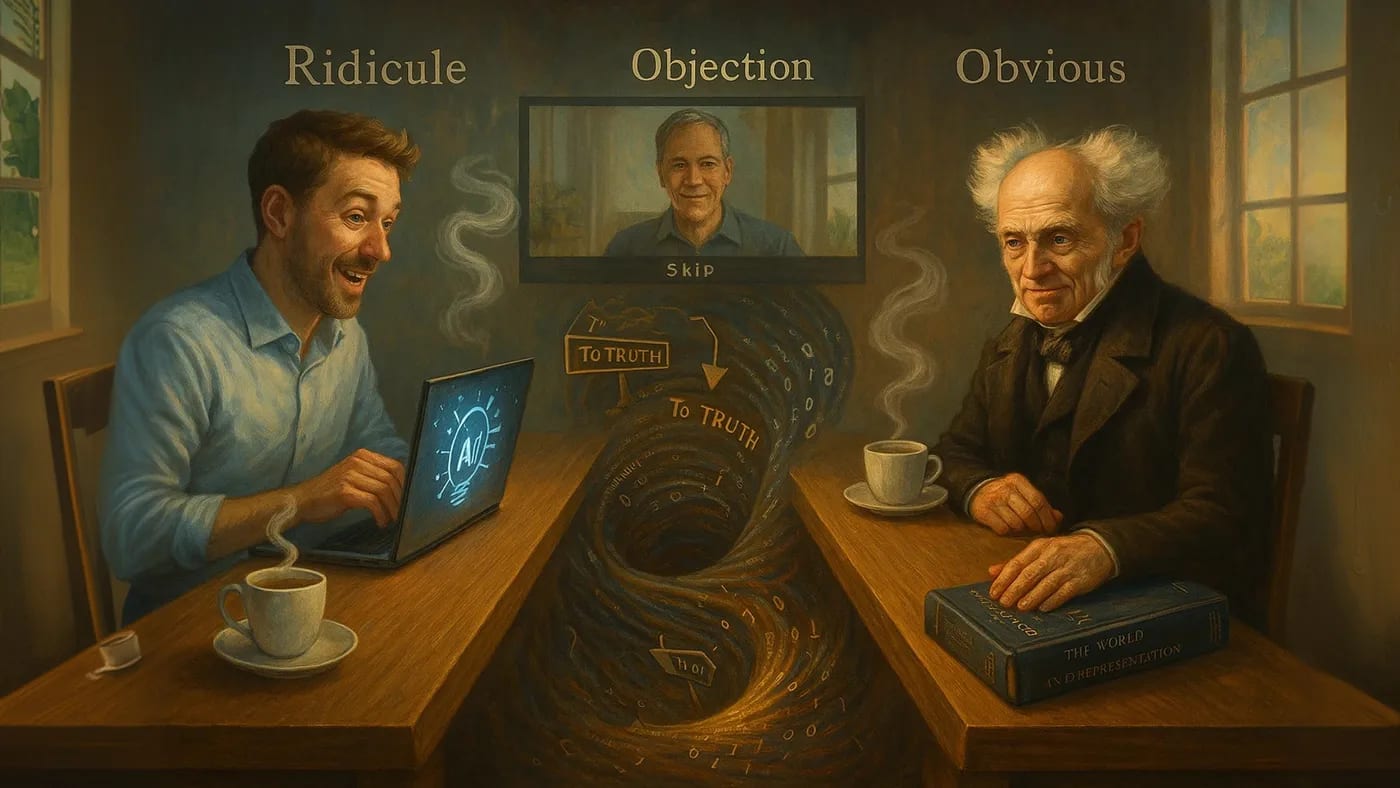
Schopenhauer’s Three Stages of Truth: From Eye-Rolling to “Obviously”
Arthur Schopenhauer, that cheerful ray of 19th-century sunshine (anything but), is perhaps best known for his philosophy of pessimism and his concept of the Will, - the insatiable, driving force behind all existence and the source of our suffering. But it’s his observation about how we process uncomfortable truths that particularly resonates in our AI-augmented present.
“All truth passes through three stages. First, it is ridiculed. Second, it is violently opposed. Third, it is accepted as being self-evident.” — Arthur Schopenhauer
Schopenhauer observed that all truth passes through three stages. First, an idea is mocked or ridiculed for sounding absurd. Second, it meets fierce objection or opposition. Third, if it survives, the idea is suddenly seen as self-evident, - obvious in hindsight.
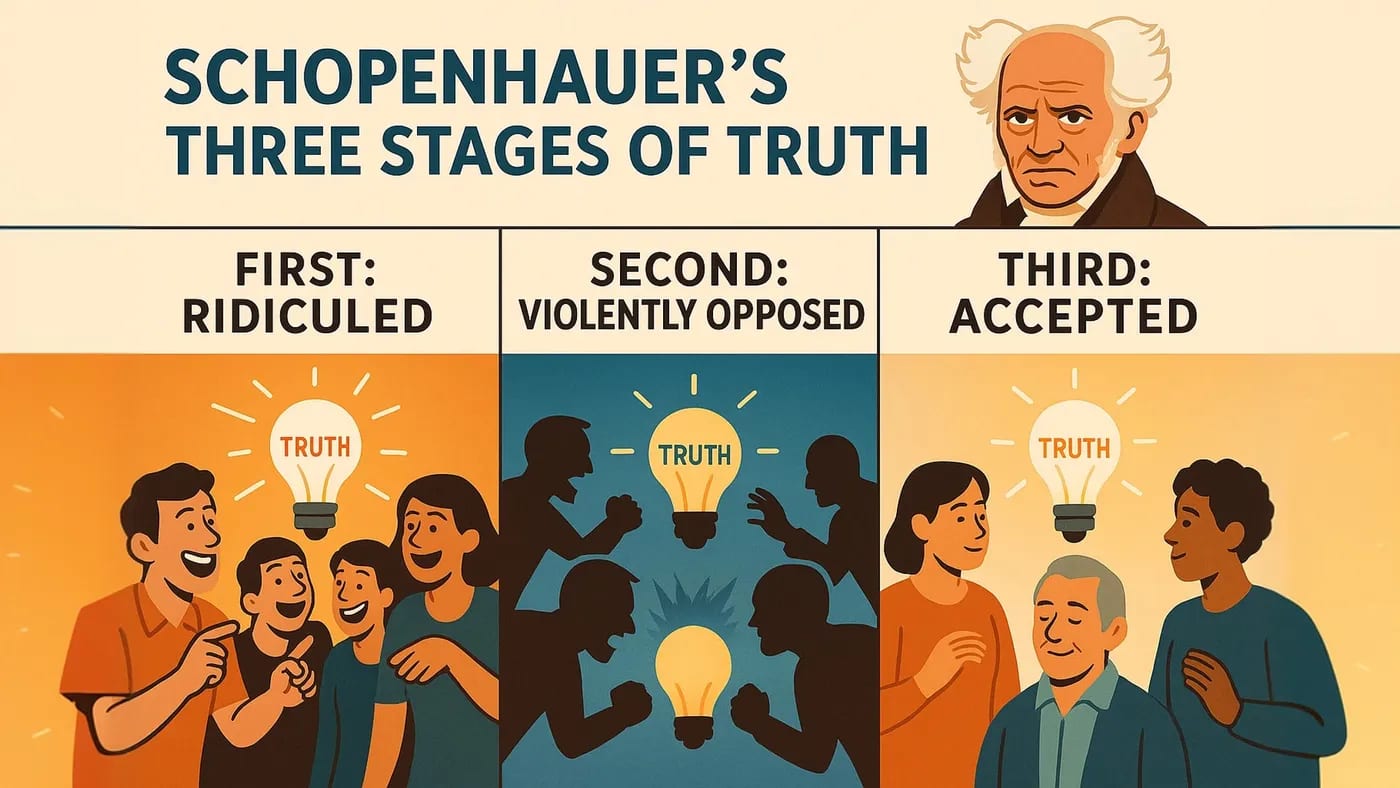
We’ve all been there, - laughing off remote work as ‘glorified pajama time’ before vehemently insisting that ‘real collaboration happens in person,’ only to find ourselves years later extolling the virtues of our home office setups and flexible schedules as if we’d invented the concept. Not long ago, the notion of renting out a stranger’s spare room (Airbnb) or driving an electric car drew plenty of laughs and objections. Yet here we are, - those ideas are now mainstream.

Schopenhauer’s point is that new truths often start out as unwelcome guests. And he nailed this resistance-to-acceptance pipeline long before any of us were wearily nodding along to TikTok dances we once mocked.
An AI at Your Side: Thought Partner 2.0
Enter ChatGPT and its algorithmic siblings. Unlike human conversation partners, - who either share our blind spots or politely avoid triggering our defensive mechanisms, AI has no such social constraints. It’s that overly honest friend who cheerfully tells you there’s spinach in your intellectual teeth.
So, where does an AI like ChatGPT come in? Imagine a colleague who never laughs at your wild ideas, has zero ego, and is available 24/7. That’s essentially what ChatGPT can be: a nonjudgmental sounding board, - a “thought partner” upgraded to version 2.0.

Using AI as a thought partner lets you toss around ideas with a neutral assistant. Your digital colleague won’t say “that’s a dumb idea”, - it’ll happily generate a dozen more. Worried about blind spots? It can point out potential pitfalls without any office politics.
When you engage with an “AI thought partner”, something fascinating happens. These systems reflect and amplify our thoughts back at us, but with subtle algorithmic twists that can expose our cognitive biases. They’re pattern-recognition machines, after all, and they’re surprisingly good at detecting patterns we subconsciously avoid.
This back-and-forth can nudge you into a more playful, experimental mode of thinking. In short, the AI can be both mentor and muse: it throws out wacky concepts and then helps you refine them into workable ideas.
Surfacing the Ideas We Avoid
Consider how often you’ve asked ChatGPT a question, only to receive an answer that makes you think, “That’s not what I meant at all!” This moment of friction isn’t a failure of AI (although in many early versions it might been outright hallucination), - it’s the sweet spot where your assumptions collide with alternative perspectives. It’s the moment where you might just discover you’ve been actively avoiding certain ideas.
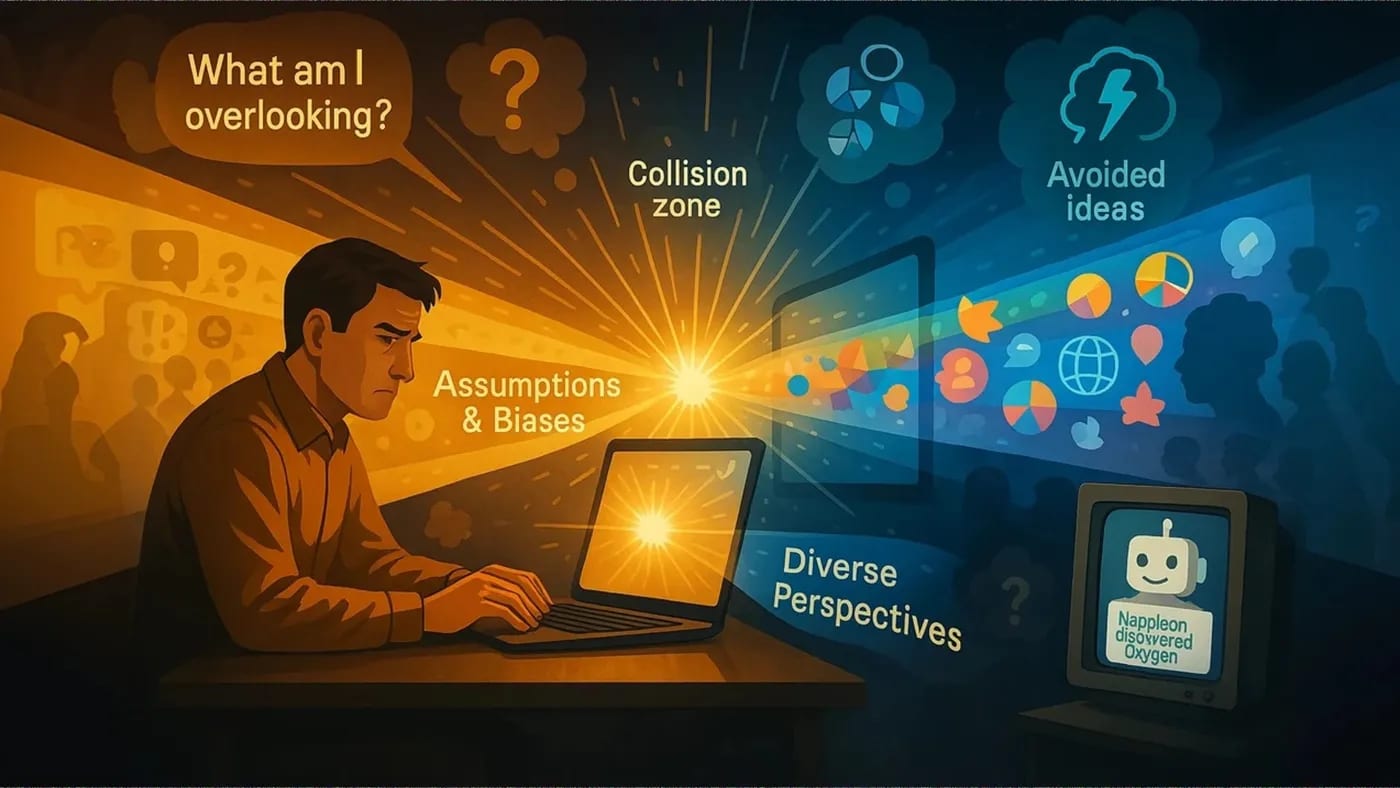
Often, we subconsciously steer clear of certain topics because they’re uncomfortable or challenge our assumptions. Yet ignoring them doesn’t make them go away; it just means they’ll keep sneaking up on us. That’s where AI comes in. A chatbot isn’t prone to our fears and biases, so it can bring up perspectives we tend to ignore.
For instance, we humans love validation, - call it confirmation bias, but an AI can serve up alternative points of view on demand. If you ask your AI, “What am I overlooking?”, it might highlight a risk or insight you hadn’t considered, not to judge you but simply because it spotted a different angle.
Think of the AI as a mirror for your blind spots. Maybe you’ve been avoiding a tough conversation with a client. The AI can role-play it with you and bring up the points you’re dodging. The key is, the AI won’t shy away from sensitive issues, - it has no comfort zone to protect. Well, almost no comfort zone, - just don’t ask your AI wingman to role-play anything too edgy, or you’ll swiftly discover it’s got a terms-and-conditions-shaped comfort blanket after all.

By using an AI thought partner, we can turn toward the ideas that are chasing us instead of running away. In other words, we begin to pursue them, tackling those uncomfortable questions head-on.
From “Ha! Ridiculous” to “Hmm, Obviously”: The AI-Accelerated Truth Journey
The brilliance of using AI as a Schopenhauerian guide is how it can help compress his three stages of truth into a single conversation:
-
Stage 1: Ridicule — You ask a question, and the AI responds with something that seems absurd. “That’s not right at all,” you think, feeling smug about your superior human intelligence.
-
Stage 2: Opposition — You rephrase your question, trying to force the AI into your way of thinking. The AI stubbornly returns with nuanced perspectives that challenge your framing. You find yourself in an unexpected debate with a machine.
-
Stage 3: Self-Evidence — Eventually, either through the AI’s persistent reframing or through your own reflection on the conversation, something clicks. “Oh, I see what you mean now,” you concede, as if this truth was obvious all along.
The key difference? While Schopenhauer’s truth stages might take years or generations to unfold naturally, an AI thought partner can compress this cycle into minutes. Your cognitive resistance meets algorithm-enhanced perspective in a philosopher’s version of speed dating.

Suppose you have a crazy-sounding idea (cue Stage 1: Ridicule). Instead of risking real-world mockery, you can test it with ChatGPT first, - the bot will take it seriously and help you explore it, no sneers involved, unless it’s related to ChatGPT’s special edition “Monday”.
Next, as your idea encounters potential objections (Stage 2: Opposition), the AI can simulate them for you. Ask, “What might people criticize about this?” and it will oblige with a list of challenges. It’s a safe trial by fire. In fact, the AI can give you rational counterarguments to your hunch, sharpening your thinking in the process.
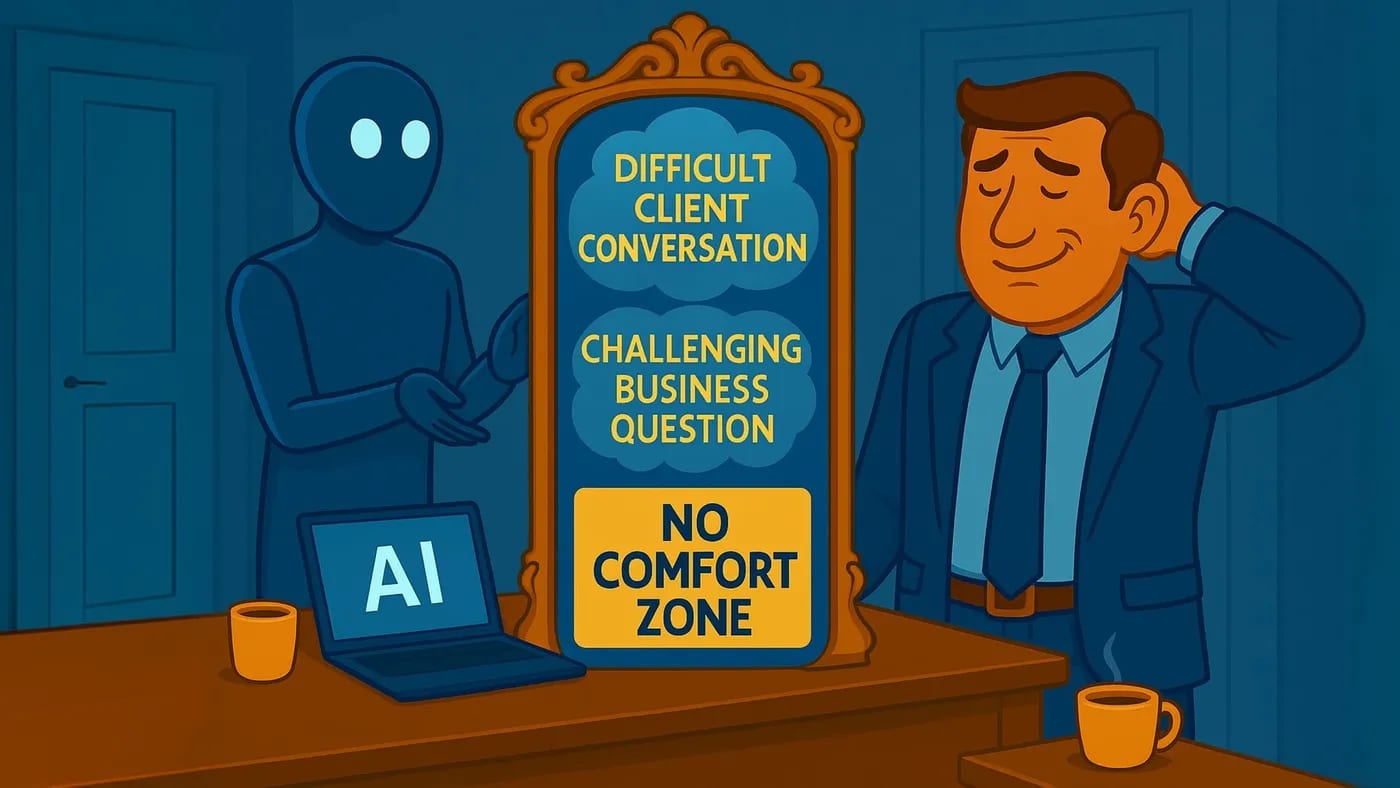
By sparring with these criticisms privately, you get to refine your idea, - patching up weaknesses and gathering rebuttals, long before you ever pitch it to a live audience. As a result, you approach Stage 3, - the phase where the truth becomes “obvious”, much better prepared.
Your once-ridiculed concept now stands on firmer ground, and you’ve learned how to explain it clearly and address the tough questions. You’ve fast-tracked through Schopenhauer’s stages with the AI’s help. When you finally unveil your idea to colleagues or customers, they’re more likely to nod along, - seeing the value that you and your trusty chatbot saw.
The Thought Leadership Angle: Chasing the Truths That Chase Us
True thought leadership isn’t about having all the answers, - it’s about asking better questions and challenging established thinking, including your own. This is where AI shines as a thought partner rather than just a tool.

Instead of asking ChatGPT, “How can I optimize my team’s productivity?” (seeking confirmation of what you already believe), try: “What might I be fundamentally misunderstanding about team dynamics that’s limiting our potential?” The first question gets you tips; the second initiates a Schopenhauerian journey through your own biases.
“Could AI-driven introspection be the ultimate leadership hack? At first, I laughed at the idea. Then I argued against it. Now it seems obvious”.
Embracing this approach can elevate your thought leadership. True thought leadership often means tackling the uncomfortable truths that everyone else is avoiding, - even if those insights aren’t popular at first. An AI thought partner can give you a head start in that pursuit.

Think of it as an amplifier for your intuition, plus a built-in devil’s advocate. Imagine you suspect a disruptive technology is on the horizon, but your industry peers dismiss it as hype. Instead of shelving the idea, you decide to explore it with ChatGPT while others scoff. The AI helps you examine it from all angles, - even showing why it might fail, and gives you a more nuanced perspective.
By the end, you might have the confidence to bring it up in your next strategy meeting. Sure, a few folks might roll their eyes today, but a year later, they might be grateful you saw it coming. Leaders who use AI this way gain a competitive edge, they’re systematically challenging their assumptions before the market forces them to. They’re inviting ridicule and opposition in private, so they can reach the “self-evident” stage ahead of their competitors.
Being a thought leader means getting comfortable with discomfort. You have to ask the questions no one else is asking and entertain the ideas that might initially sound odd. An AI ally encourages this mindset. It will eagerly poke holes in your plans when others stay polite, and it will wander with you into “ridiculous” territory without judgment. This exploratory courage shows intellectual bravery, - a trait that inspires teams and sparks innovation.
From Pursued to Pursuer: Taking Control of Your Intellectual Journey
Schopenhauer believed we’re driven by Will, - an insatiable force that keeps us perpetually unsatisfied. Similarly, those nagging truths we avoid don’t disappear; they pursue us, causing subconscious anxiety.

Using AI as a thought partner allows us to flip this dynamic, - becoming the pursuer rather than the pursued. Instead of being haunted by half-acknowledged truths, we can proactively hunt them down, examine them without judgment, and integrate them into our understanding.
This isn’t comfortable work. As my conversation with Skip evolved from casual philosophical name-dropping to genuine exploration, I found myself experiencing all three of Schopenhauer’s stages multiple times. Turning the tables on your existential dread isn’t easy, but at least AI doesn’t judge your panic-induced 2 a.m. philosophical questions.
Conclusion
Schopenhauer probably never imagined he’d be cited in a piece about artificial intelligence (I didn’t imagine a casual chat with Skip Balch would lead to this either), - but here we are. By pairing a 19th-century philosopher’s insight with a 21st-century chatbot, we get a fresh approach to confronting the unknown.
So here’s my challenge to you: Identify one belief you hold so firmly that you find opposing views ridiculous. Maybe it’s about management styles, political economics, or whether pineapple belongs on pizza (it absolutely does, obviously… or wait, am I stuck in Stage 1?).
Then, use an AI thought partner to deliberately challenge that belief. Don’t ask it to confirm what you think, - ask it to help you understand what you might be missing. Let it guide you through the ridicule, past the opposition, and toward what might become self-evident.
As Skip wisely reflected during our conversation, “The most dangerous ideas are the ones we refuse to consider.” Thanks to AI thought partners, we no longer have to navigate our intellectual blind spots alone. Schopenhauer may have been a pessimist about human happiness, but even he might be cautiously optimistic about our AI-enhanced capacity for self-reflection.

The main takeaway? Don’t run from that idea that’s chasing you. Turn around and invite your AI thought partner to explore it with you. Challenge the idea; let it challenge you back. Carry it through the ridicule and opposition and see what emerges on the other side.
In a world moving this fast, we all need ways to question our assumptions and explore the “what ifs” that others might ignore. Whether it’s drawing on a philosopher’s wisdom or a chatbot’s banter, the tools are there to help us venture outside our comfort zones. Use them!
Go ahead, - laugh at the suggestion. Object vehemently. Then let the obvious hit you: maybe your chatbot friend isn’t the one with spinach in its teeth. Who knows, - the truth everyone finds obvious next year might just be the very idea you’re courageously debating with your AI today. And even old Schopenhauer might crack a wry smile at that.

Disclaimer: The perspectives shared in this article are my own and do not represent those of my employer or any affiliated organizations.
Suggested Readings:
-
Thought Leadership Marketing: How to Stand Out & Lead (March 2025 / Ron Sela) — A guide on tackling uncomfortable truths as a thought leader.
-
Compassionate AI Design, Governance, and Use (Feb 2025 / University of Sydney) — This content discusses the potential risks and ethical implications of generative AI, proposing a Schopenhauer-inspired framework for compassionate AI design to prioritize empathy, dignity, and human flourishing.
-
Rethinking AI as a Thought Partner: Perspectives on Writing, Programming, and More (Jan 2025 / Mina Lee) — A discussion about the development of AI systems designed to serve as collaborative thought partners rather than mere tools
-
Schopenhauer and the AI Dread — Knowing Too Much (Jan 2025 / David Mallon) — This content explores how AI triggers existential anxiety in technologists through the philosophical lens of Schopenhauer, emphasizing human resilience in adapting to profound technological change.
-
Adage Origin: Truth Passes Through Three Stages (Quote Investigator / November 2016) — A detailed look at the origins of Schopenhauer’s quote.
More from the human factor
All the human factor → the human factor
Workforce AI Reskilling - Resistance is Artificially Unintelligent!
Remember those sci-fi movies where the robot learns too much and decides humans are the problem? Plot twist: in today's tech talent landscape, AI isn't eliminating humans, - it's becoming our most powerful ally in staying relevant.
 the human factor
The Great AI Panic: The 2025 Guide to Human-AI Harmony
Picture this: Your Thursday morning stand-up has just wrapped, and Sarah, your most reliable project manager, lingers behind. With a mix of determination and vulnerability in her voice, she confesses, "I'm afraid the new AI system will…
 the human factor
No One’s in Charge: AGI Is Arriving Fast and We’re Unprepared!
I found myself reading my morning news lineup with equal parts wonder and worry. We've heard of how AI has been used to draft legal briefs in minutes. And how how the Pentagon is pouring billions into AI research to keep up with China. As…