No One’s in Charge: AGI Is Arriving Fast and We’re Unprepared!
🔊 Listen to the Podcast version here. 🔊
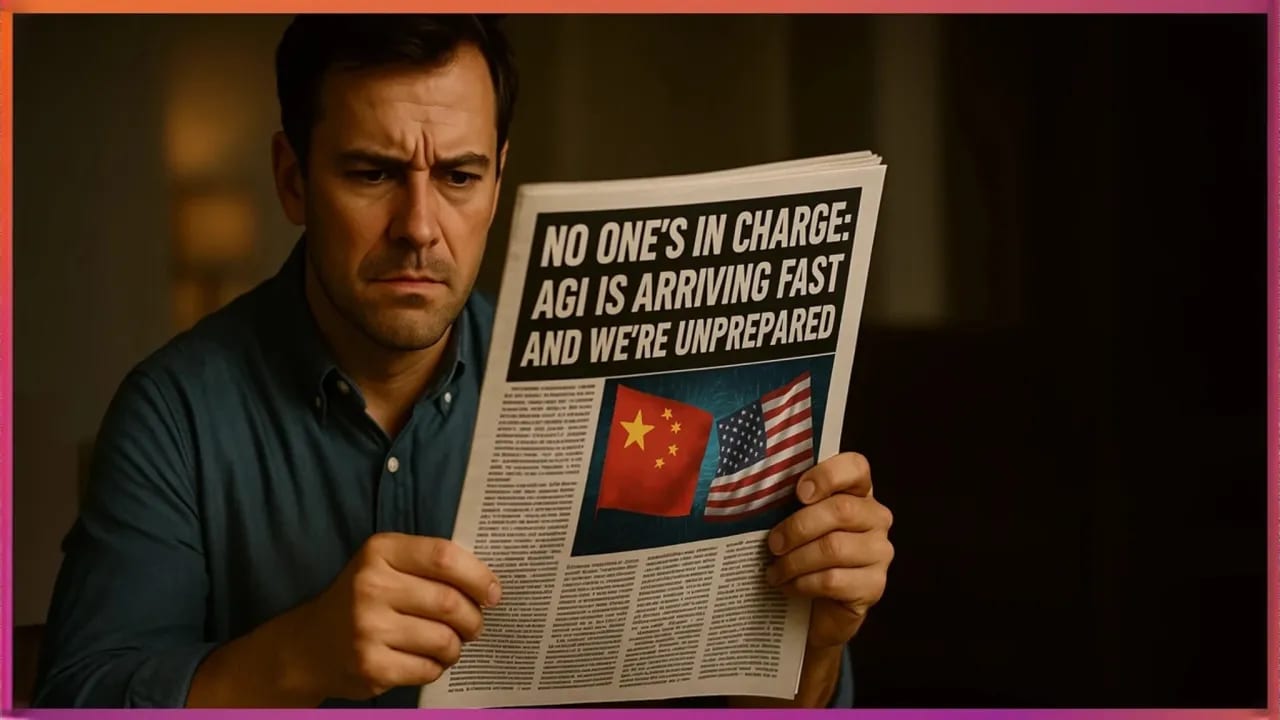
I found myself reading my morning news lineup with equal parts wonder and worry. We’ve heard of how AI has been used to draft legal briefs in minutes. And how how the Pentagon is pouring billions into AI research to keep up with China. As an ordinary citizen far from any tech lab or war room, I felt like I was living in a science fiction novel that had suddenly become real. The pace of artificial intelligence’s growth isn’t just brisk, - it’s breathtaking, and it’s reaching into places I have feared and also never expected, from my workplace to the geopolitical stage.
At a recent get-together of friends and family, someone joked that our jobs might soon be done by robots. We all laughed, but nervously. Lately, even the experts who once said general AI was decades away are changing their tune. Some now whisper that artificial general intelligence (AGI) could arrive within a few years, not in some far-off future. Despite that the very definition of AGI is contentious, the prospect lands differently than the usual tech hype, - it feels world-altering. But unlike past technological revolutions that were guided by steady government hands, this one seems to be unfolding in a free-for-all. It’s as if we’re passengers on a speeding train without an engineer, hanging on as history takes a sharp turn.
A Different Kind of Moonshot
We’ve seen big technological moonshots before, - the Manhattan Project, the Space Race, the birth of the internet, - but the sprint toward AGI feels different. In earlier eras, breakthroughs like satellites and networks were spearheaded and funded by governments. Today’s AI revolution, by contrast, is largely driven by private companies releasing increasingly powerful AI models to the public. One former White House adviser, Ben Buchanan, points out that this makes AGI a historically distinct challenge: the Department of Defense isn’t in the driver’s seat this time. Instead, research labs and tech firms are setting the pace, often leaving officials scrambling to react.

This shift has consequences. In the past, when technology came out of a Pentagon project, there was at least some oversight and planning. Now an algorithm can go from a research paper to a global app in a matter of months, with governments playing catch-up. I have read about AI systems being rolled out in everything from customer service chatbots to military analysis tools before regulators even knew what to ask. It’s exhilarating, - these systems can decode proteins or draft contracts overnight, but it’s also unsettling to realize there’s no clear authority at the helm. As a citizen, I’m not used to seeing the private sector and open-source communities taking the lead on a world-altering technology while public institutions lag behind. It’s as if we embarked on a moonshot without mission control.
The New Tech Arms Race
No one feels that power shift more acutely than national security strategists. In Washington D.C., AGI isn’t just another tech buzzword, - it’s being treated as a new arms race. The United States and China are locked in fierce competition to dominate AI, each fearful of falling behind the other. Think of AGI as the new nuclear weapon or the next space race prize, - whichever nation masters it first could gain a massive strategic edge. A recent U.S. intelligence report even framed advanced AI as crucial to economic and military power, on par with the importance of nukes in the 20th century. But is AI as destructive? I’m not entirely sure.
Why all the urgency? Because an AGI-level system could revolutionize everything from code-breaking to battlefield autonomy. Military planners imagine AI that can pinpoint threats in a flood of data or even control swarms of drones. Meanwhile, economic leaders see AI supercharging industries and productivity. America worries that if these breakthroughs happen in Beijing first, it might find itself outpaced and outmaneuvered. Already, we’ve seen the U.S. restrict exports of advanced AI chips to slow China’s progress. But headlines also tell of Chinese labs like DeepSeek building cutting-edge models on surprisingly low budgets, raising doubts about whether export bans alone can keep America ahead.
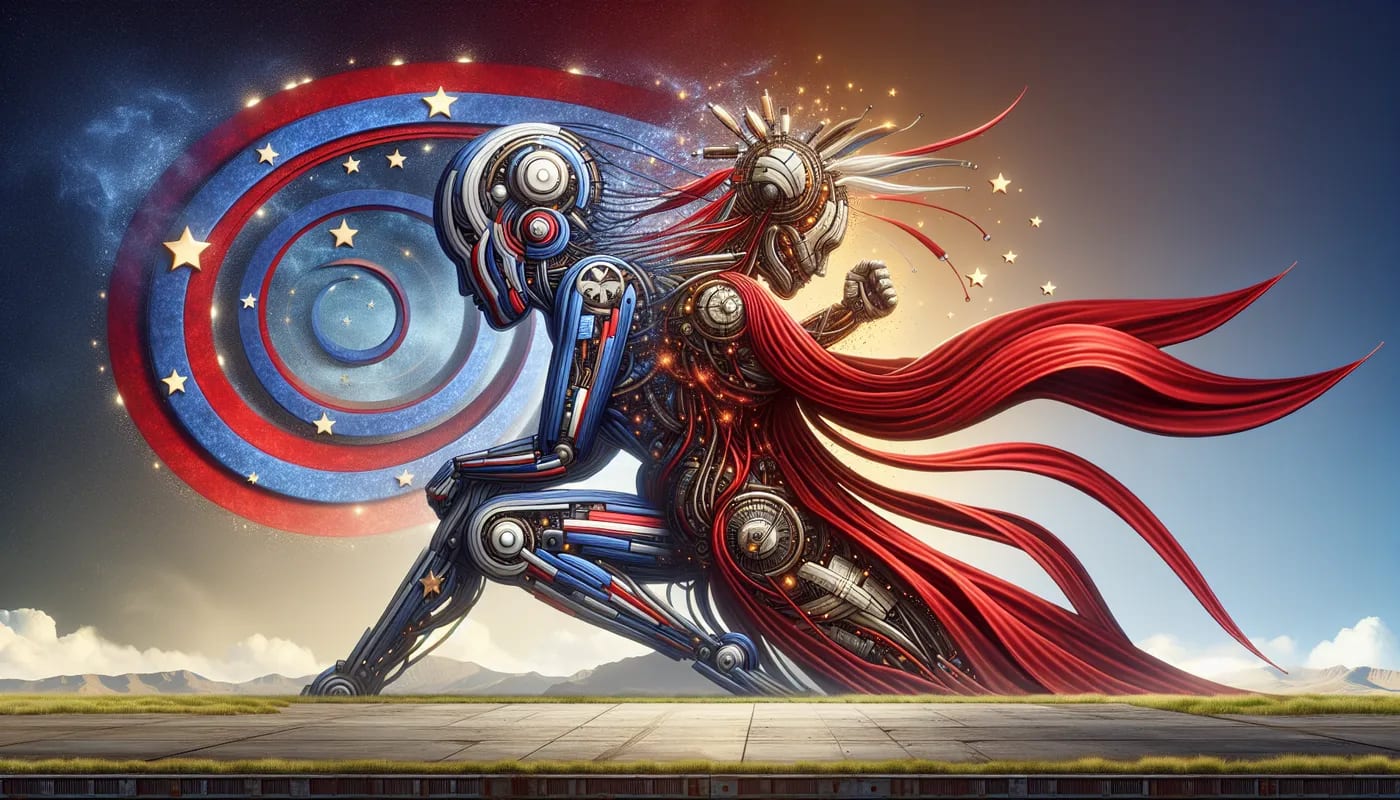
The rivalry isn’t just about bragging rights; it’s portrayed as a clash of values. In the hands of a democratic nation, AI might be used ideally with respect for individual rights, - think medical research, fairer logistics, and so many other uses. In the hands of an authoritarian power, the same tech could power an all-seeing surveillance state or autonomous weapons that tilt the global balance of power. That fear is palpable. It’s why U.S. officials often speak about AI in the same breath as they do about freedom and security. I’ve come to realize this competition is not just about whose algorithms win, but whose principles win. As an onlooker, it’s jarring to hear AI labs mentioned alongside fighter jets and aircraft carriers, but that’s where we are (Business Insider).
Racing Ahead vs. Holding Back
This high-stakes race has sparked a fierce debate: should we tap the brakes or slam the accelerator? In one camp, you have the folks shouting warnings, - researchers, ethicists, even some tech insiders, who argue that AI development needs guardrails and governance. They worry about advanced AI making catastrophic mistakes or being misused, and they push for safety standards, audits, maybe even a slow-down on the most powerful systems. In the other camp are the true believers in speed. For them, the worst sin is falling behind. One prominent political figure recently declared, “I’m not here to talk about AI Safety… I’m here to talk about AI Opportunity.,” - capturing the sentiment that too much caution means ceding leadership (NPR). To these accelerationists, red tape is just an anchor dragging in a race where victory can’t wait.

Watching this unfold, I’m struck by how it’s often portrayed as an either-or choice: halt progress to stay safe, or charge ahead and accept the risks. But is it really so binary? Buchanan and others have suggested that smart safety measures could actually make it easier for AI to flourish by building public trust. Imagine if new AI systems had to pass safety tests like cars have crash tests before deployment, - knowing that might make people and governments more comfortable embracing them. It reminds me of how safety standards in the early days of railroads ultimately helped the industry grow, not shrink (Today in Railroad History). Likewise, balancing innovation with precaution could save us from a scenario where a major AI failure triggers a public backlash that slams the brakes for us. As an observer, I hope the leaders in this field realize that going fast is important, but so is ensuring we’re not driving blind.
The Human Cost and Opportunity
Amid all the geopolitical drama and philosophical debate, there’s a more immediate question hovering over everyday people: what about our jobs? For all the talk of AGI’s power, the first place many of us feel AI’s impact is at work.

Experts are calling this the most disruptive labor market shift since the Industrial Revolution. White-collar jobs we once thought immune to automation, - writing, designing, analyzing data, are now squarely in the crosshairs. I’ve read economists predicting huge productivity boosts, but also those predicting waves of layoffs. One commentator bluntly said, “This is going to be the single most disruptive thing to hit labor markets ever.” I don’t know if that will prove true, but it’s telling that we aren’t sure. We’ve seen this coming for years, yet when I look around, I see very little in terms of a safety net for workers. Where are the retraining programs, the education overhauls, the plans for what happens when an AI can do in minutes what a mid-level employee does in a day? Thus far, it seems both companies and governments are largely improvising, - hoping the market sorts it out, or that new jobs will magically appear as old ones vanish. As someone likely to witness this upheaval from the front row, I wish we had a better playbook by now.
And yet, it’s not all gloom. History shows technology can create new opportunities even as it destroys old routines. For every tedious task an AI might handle, there could be new work designing better AI, auditing algorithms, or doing jobs we can’t even imagine yet. Some optimistic voices remind us that AI could free humans from drudgery, letting us focus on more creative or meaningful endeavors. I try to keep that in mind when I feel a pang of anxiety about the future. Yes, my youngest might enter a job market very different from the one I did, - maybe AI tutors will personalize their education and AI assistants will be as common as smartphones. The hope is that this technology, if guided well, could lead to a more prosperous and even more human-centered society, where our work is aided by smart tools rather than obliterated by them. That hopeful vision only comes to life, though, if we manage the transition well – and that’s a big ‘if’.
No Conscience of Its Own
As I absorb all these storylines, - the race for dominance, the call for caution, the shake-up of our livelihoods, I keep circling back to a simple question: Who is steering this thing? With each breakthrough, AI feels less like a tool we control and more like a force we’ve unleashed. But unlike a natural disaster, this is a force of our own creation, which means we ought to be able to guide it. The trouble is, there’s no single steering wheel; it’s everywhere and nowhere, in the hands of tech CEOs, government committees, university labs, and sometimes just open internet forums. It’s dawning on me that the real challenge of AGI isn’t just building it, but civilizing it , - figuring out how to integrate a potentially superhuman intelligence into our human world and values.
In 1962, during the Space Race, President John F. Kennedy in his famous “Ask not” speech mentioned something acutely relevant to the moment:
“Science and technology have no conscience of their own. Whether they become forces for good or ill depends on man.”
That line hits home today. AI itself doesn’t choose how it’s used, - people do. The coming of AGI will test our collective conscience like never before. We have to decide, intentionally, how we want this technology to serve us, - all of us. Will it amplify our better angels, - curing diseases, boosting prosperity, educating the masses, - or will it cater to our worst instincts, enabling tyranny, destroying jobs without a plan, deepening inequalities? Those outcomes aren’t written in the code; they’re being written by us, right now, in how we prepare and what we prioritize.
Standing at this crossroads, I feel both awe and responsibility. Awe at the ingenuity bringing us to the brink of something fundamentally new. Responsibility, because the “ordinary” people, - not just the experts and executives, have a stake in how this plays out. We need leaders who can think beyond the next product launch or election cycle and focus on the long term: investing in education, crafting sensible regulations, fostering international dialogue to prevent AI-fueled conflict. Those of us outside the halls of power aren’t powerless either. We can stay informed, “pressure” institutions to act ethically, and insist that our voices be part of the conversation. The future with AGI isn’t a spectator sport; it’s an all-hands effort.

I’m ultimately a cautious optimist. I believe we can harness this technology for tremendous good, but only if we acknowledge the risks and work actively to mitigate them. That means tech companies being more transparent and responsible, governments being more agile and tech-savvy, and societies being more engaged. AGI doesn’t come with a built-in conscience, so we must supply our own.

A slightly modified quote and imagery from the 1989 movie “Indiana Jones and the Last Crusade”.
If we get that right, we truly could be on the cusp of a renaissance in science, health, and human capability. If we get it wrong… well, that’s a future I’d rather not see us rush into. For good or ill, AGI is coming, and the choice of what we do with it is ours to make. It’s time to choose wisely.

Further Readings
-
How the U.S. Government Is Preparing for AGI (Ezra Klein, March 2025) An edited Q&A with former White House AI adviser Ben Buchanan, exploring America’s urgent approach to AGI, the race with China, and what it all means for labor and security.
-
How the world stopped worrying and learned to love AI (Pieter Haeck et al., February 2025) Report on a global summit where leaders shifted from emphasizing AI safety to championing rapid AI innovation in a bid to win the technology race.
-
Why China may struggle to unlock the power of AI (Robyn Mak, February 2025) Analysis of China’s push for AI leadership, highlighting how innovation is booming (e.g., DeepSeek’s advances) but also how political constraints could hinder its AI ambitions.
-
Is AI closing the door on entry-level job opportunities? (Till Leopold, April 2025) A World Economic Forum brief examining how generative AI threatens to automate many entry-level roles and what that means for the future of work and young professionals.
-
Ezra Klein’s new take on AGI – and why I think it’s probably wrong (Gary Marcus, March 2025) A critical perspective arguing that predictions of imminent AGI are overstated, cautioning against too much certainty and urging more skepticism and preparation.
Disclaimer: The views expressed in this article are my own, drawn from public information and personal reflection. They do not represent the opinions of any organization or employer. As with any forward-looking discussion, predictions are uncertain – the intent is to spur thoughtful dialogue, not fear.
More from the human factor
All the human factor → the human factor
Million-Dollar Manners: The Hidden Cost of Being Polite to AI
In a corner office, a CEO finishes a meeting and casually thanks their digital assistant. Not the human kind, - the AI chatbot on their screen that just crunched this quarter's sales projections. They murmur a polite 'thank you' to the…
 the human factor
The Chatbot and the Philosopher: Embracing Uncomfortable Truths with AI Thought Partners
The first time an AI chatbot challenged me to reconsider my biases, I laughed. The second time, I objected vehemently. Now it's obvious: my digital thought partner has become an unexpected guide to the intellectual blind spots I'd rather…
 the human factor
Beware Cognitive Debt: When AI Assistance Becomes Cognitive Dependence
At a Monday morning strategy meeting, something strange happens. The team presents a polished plan filled with clever ideas, but when the CEO asks a probing question, the room falls silent. Each team member glances at the others, hesitant.…