Yes, No, Maybe: The New Logic of Innovation Beyond Binary
🔊 Listen to the Podcast version here. 🔊
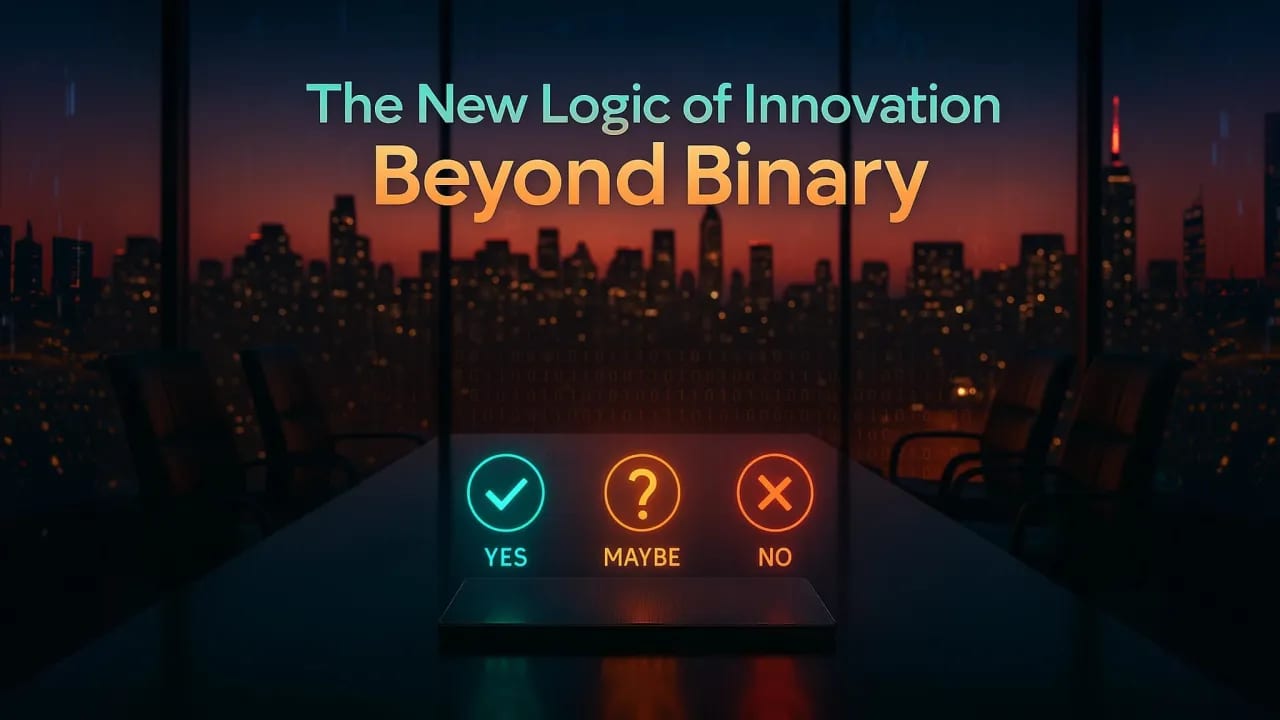
A CEO stares at two proposals on the boardroom table, - Option A or Option B, a yes-or-no decision with millions on the line. Outside the window, city lights paint the night in more than just black and white, as if to remind her that not everything in life fits a binary choice. For decades, our computers have been the ultimate “yes-men”: every switch On (1) or Off (0), no Maybes allowed. In a high-stakes moment, she wonders, - must every decision, and every computation, really boil down to 0 or 1?

That mental image isn’t far from reality. Modern computing has long been stuck in a two-party system of ones and zeros, a binary straitjacket inherited from the earliest days of electronics where technologic science exclaimed victory and stopped moving forward.
Chips have become faster, bigger, and even smarter, but they have not really evolved where it matters most!
We’ve done amazing things with it, - mapping the human genome, powering AI, connecting the globe, all by breaking information into countless tiny yes/no questions. The binary code under the hood of our digital world is so ingrained that we seldom question it.

It’s as if the tech industry made a pact generations ago: everything shall be encoded in bits, every voltage either High or Low, True or False. This simplicity has been strength and weakness. It’s reliable and straightforward, yes, but it also forces a kind of digital absolutism. Not everything in the real world is absolute, - and our binary-only computers sometimes struggle to capture that nuance. Enter MVL, Multi-Value Logic processors***.***
For a vivid example, consider an often-forgotten chapter in computing history. In 1958, deep behind the Iron Curtain, Soviet scientists built a computer named Setun that didn’t think in ones and zeros at all – it thought in ones, zeros, and negative (wikipedia.org). This ternary computer was an oddball: while Western designs clicked away in binary, Setun processed information in three states. Remarkably, it worked, - and in some ways, it worked better. Early reports bragged that Setun used less power and simpler circuitry than its Western binary (wikipedia.org). Yet, despite its advantages, ternary computing was shelved and forgotten, a Cold War relic, as the world standardized on binary for the next half-century. One might say Setun was ahead of its time, - a flash of “maybe” thinking in an era of yes/no machines.
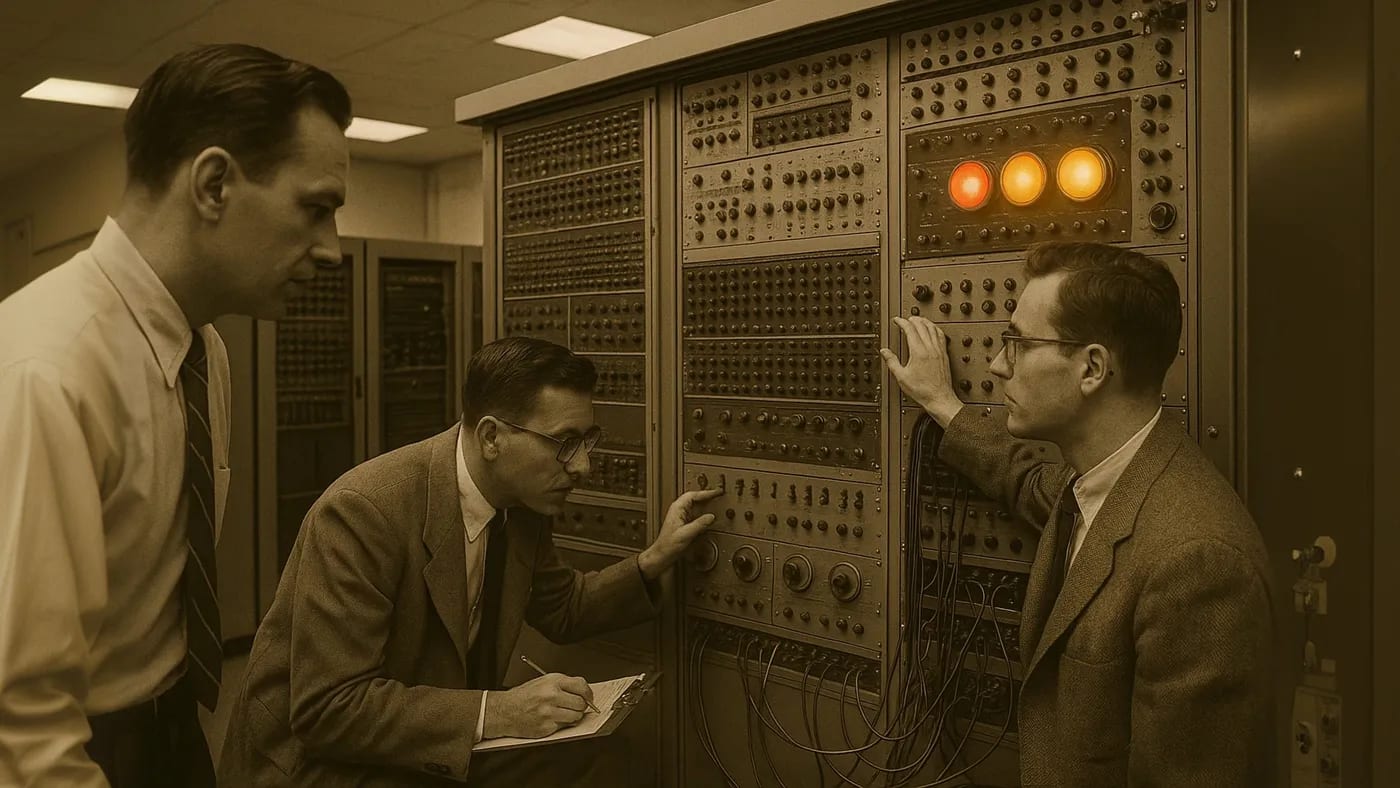
Fast-forward to today, and the limitations of our beloved ones and zeros are starting to show. The insatiable demand for computing power has driven us to pack billions of binary transistors onto a chip, but each added “yes/no” switch yields diminishing returns. The industry has hit a point where simply adding more binary transistors is running up against physics and economics. Chips now contain staggering complexity, - tens of billions of transistors woven together by over 60 miles of microscopic copper (wiringventurebeat.com). We’re literally running out of room and energy with the all-binary approach. Did you know that data center electricity bills keeps rising, even though chips are supposed to be more efficient? It’s partly because coordinating an army of billions of 0/1 switches burns power in heat and communication overhead. In short, binary logic is hitting a wall*, -* the “more bits, more speed” mantra is straining under the cost of complexity and power.

Here’s where our story finds its inflection point. In March 2025, an unassuming patent filing crossed the desks of the global tech community, - and it sent a ripple of excitement through semiconductor (meta-quantum.today). Huawei, the Chinese tech giant, had quietly submitted a patent for a new kind of logic circuit, one that operates not on two states but on three. In essence, Huawei claimed to have cracked a practical design for ternary logic gates.
This development was more than just academic musings; it was a potential paradigm shift. Moving beyond binary 0s and 1s to a ternary system (say, -1/0/+1) promised dramatic leaps in computational processing. Suddenly, the old idea of multi-valued logic wasn’t so old anymore, - it was front-page news in the R&D world. The tension in that patent is almost palpable: a major company betting that “maybe” has a place in the digital lexicon of tomorrow.

What’s so groundbreaking about a ternary chip design in 2025? Efficiency, for one. Huawei’s engineers report that their prototype ternary logic gates could cut transistor counts by over 30% and reduce power consumption to one-third of equivalent binary. Imagine that: one of the world’s most advanced chipmakers essentially saying:
“We found a way to do the same computing work with one-third the energy.”
For power-hungry sectors like AI and big data, that’s a game-changer. NVIDIA’s CEO (no stranger to pushing chip tech) even acknowledged that this patent touches on fundamental design principles, hinting that higher efficiency with fewer resources is within. In an industry obsessed with performance-per-watt, that’s pure gold. If this ternary architecture reaches production, it could restructure energy standards for everything from smartphones to cloud. Data centers might finally see a leveling off of those electricity bills, and battery-powered devices could last far longer. It’s as if the binary “on/off” has been joined by a smart “standby” state, a middle gear that saves energy and time. But that’s not it at all!

Huawei’s move is part of a larger pattern that’s been emerging, mostly unnoticed, over the past few years. Across universities and labs worldwide, multi-valued logic has quietly been gaining momentum. New materials and devices are resolving the challenges that sidelined ternary computing in the past. For example, researchers at City University of Hong Kong recently demonstrated mixed-dimensional transistors that naturally support multiple logic states, using nanowires and 2D materials to implement so-called anti-ambipolar (techxplore.com). In plainer terms, they built a transistor that can seamlessly toggle through more than two levels, simplifying circuits and slashing power usage. Likewise, a team in China unveiled a molybdenum-sulfide optoelectronic device in April 2025 designed for multivalued logic, aiming to break through the traditional von Neumann architecture that separates memory and processing. And it’s not just one-off experiments, - the research community has exploded with interest. Between 2020 and 2024, over a thousand papers were published on carbon-nanotube and novel device approaches to ternary logic. This flurry of activity suggests a critical mass of know-how is building. We now have the ingredients – from exotic nanomaterials to new circuit designs – to make multi-valued logic viable at scale*.* The old obstacles (unstable states, noise margins, lack of design tools) are being solved one by one, and the path to “beyond binary” hardware is clearer than ever.

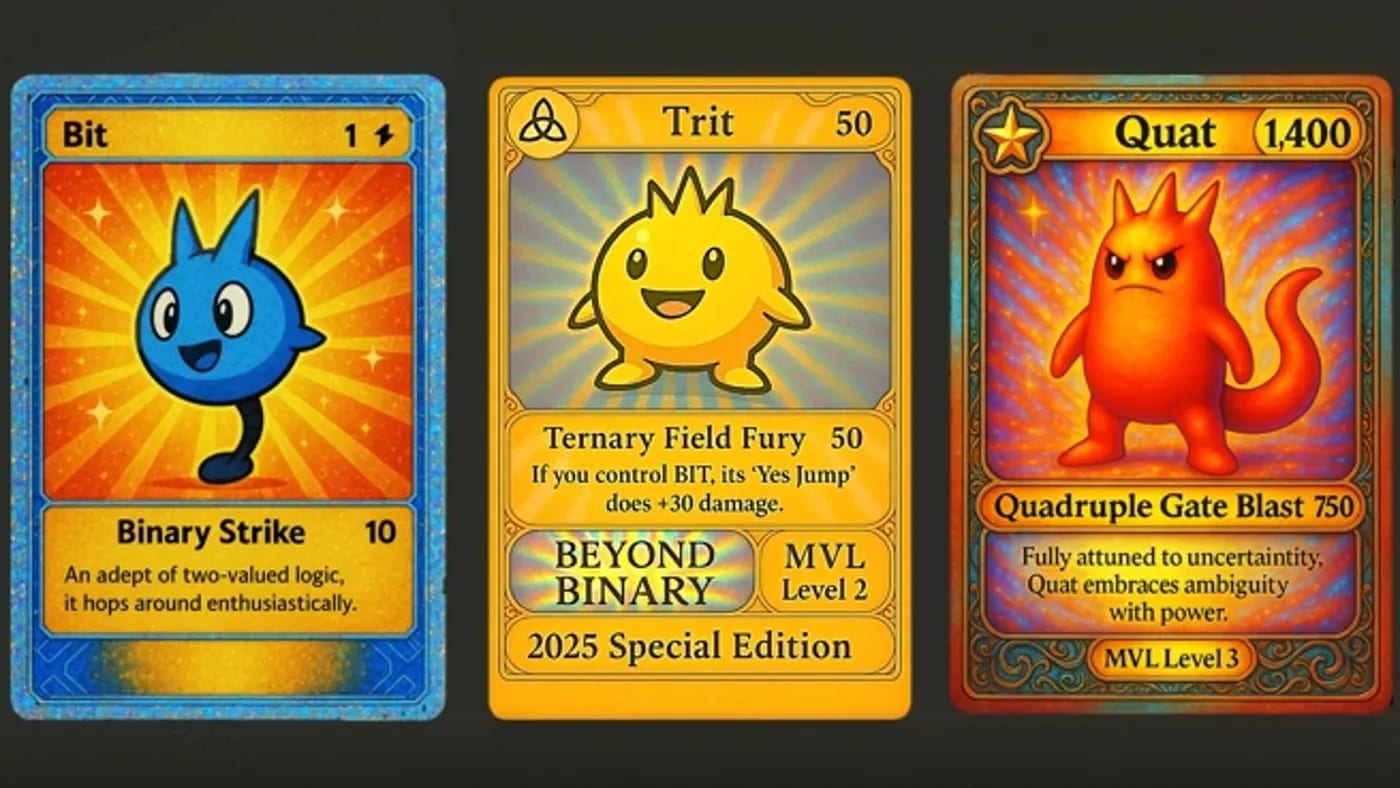
This inflection point forces us to rethink some long-held assumptions. The very language of computing is expanding, and with it, the possibilities for innovation. A three-valued logic isn’t just an engineering tweak; it’s a different mindset. In binary, a wire can be either on or off, nothing else, - like a light switch. In multi-valued logic, that wire can be low, medium, or high, carrying logarithmically more information per signal. In fact, a balanced ternary digit (sometimes called a trit) can encode information more efficiently than a bit, - fewer trits are needed to represent the same number than bits.
It’s as if we discovered a more expressive alphabet after writing with only two letters for ages.
This challenges the deeply entrenched notion that binary is always optimal. It turns out that base-3 (ternary) is mathematically more efficient for certain computations and representations. Even the legendary computer scientist Donald Knuth once argued that ternary logic’s elegance and efficiency would eventually bring it back into the fold (en.wikipedia.org). Now we’re seeing that prediction start to come true. For product and innovation leaders, this is a moment to pause and consider: what new assumptions will we have to question in a world where computing isn’t confined to 0 and 1?

The implications of multi-valued logic are vast and exciting. Oddly enough, no one seems to be asking quaternary, quinary, senary, and so on. Perhaps because there’s a tangible business impact in terms of performance and energy regardless. Think of data centers, - those warehouses of servers that underpin our digital economy. They guzzle electricity in part because billions of transistors are furiously flipping between 0 and 1, generating heat with every switch. If ternary or all multi-valued chips can do the same work with far fewer transitions and components, the performance-per-watt gains are enormous.
We could see AI training runs that use a fraction of the power, or edge devices that suddenly become capable of sophisticated computation without draining their batteries. Lower power consumption isn’t just a cost saver; it’s increasingly a competitive differentiator as sustainability moves up the corporate agenda. Multi-valued logic offers a rare win-win: faster computing that’s also greener. For executives looking to trim its carbon footprint while accelerating AI capabilities, this technology beckons as a strategic opportunity. It’s not often you get to boost output and cut costs/energy by an order of magnitude, - MVL (Multi-Valued Logic) teases just that kind of prize.

Beyond the raw specs, multi-valued logic could spur a new wave of architectural innovation. It invites us to revisit everything from processor design to software algorithms. Imagine new processor architectures with ternary arithmetic units, memory that stores data in more than binary, and interconnects carrying richer signals. Entire software stacks would eventually be re-optimized to leverage more expressive basic operations. This won’t happen overnight, - ecosystems take time to rebuild, but the first movers will have an edge. The race to dominate this space has just begun*.* Companies that start experimenting with ternary algorithms and hardware could own key patents and know-how, much like the early days of parallel computing or quantum computing. Moreover, MVL might play nicely with analog and quantum technologies, but who knows where that will end up. MVL will take the scene far sooner than any quantum pipe dreams. Some experts speculate that ternary logic could act as a bridge to quantum computing. At the very least, being comfortable with more than two states might smooth the conceptual jump to qubits down the road. Even in the here and now, analog AI chips (which compute on continuous values) and neuromorphic chips (inspired by brain signals) stand to benefit from design principles emerging in multi-valued logic. The assumption that digital = binary is being dismantled, and that opens up a design space we’ve barely explored. For forward-thinking product leaders, the message is clear: it’s time to start learning the new playbook of a post-binary digital world.
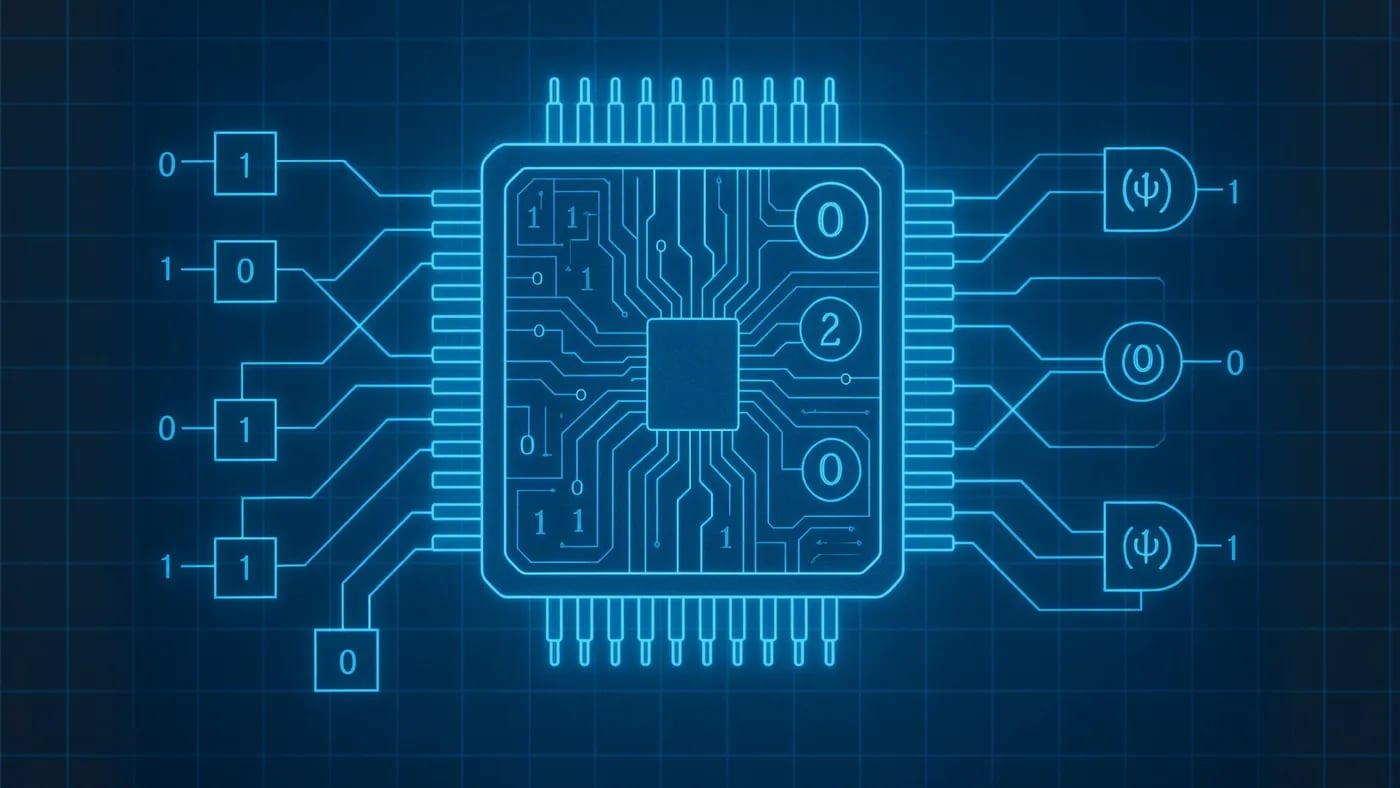
There’s a philosophical shift unfolding here—one that insightful leaders will recognize and appreciate. Our technology is beginning to mirror the complexity of the world around us, becoming capable of nuance. Human decisions are seldom strictly binary; they involve consideration, uncertainty, and subtle gradations. Until now, we’ve constrained our software and hardware to simplify intricate realities into rigid yes-or-no outcomes. Multi-valued logic introduces a valuable “maybe” state, - a computational acknowledgment of nuance and uncertainty. Of course, this idea of “nuance” and the “maybe” state remains an anthropomorphic interpretation, yet for businesses designing AI solutions that operate in the unpredictable real world, embracing multi-valued logic can mean fewer mistakes and greater user trust. Moreover, integrating nuanced logic into technology may inspire a parallel shift in corporate strategies, encouraging leaders to move beyond oversimplified metrics and binary choices that often limit innovation.

The era of multi-valued logic is dawning, but realizing its full potential will require bold action from today’s technology leaders. This is the call-to-action: Lead Beyond Binary!

Encourage your R&D teams to experiment with ternary logic circuits or quaternary data encoding. Initiate pilot projects or partnerships with academia to explore how multi-valued computing could enhance your products. Start thinking about talent and tools, - do your engineers know how to design and program for more than two states? If not, perhaps it’s time to build that capacity. Be prepared to challenge the dogma that has ruled since the mid-20th century. It won’t be easy; entire industries are built on binary, and they won’t flip to ternary overnight. But the writing is on the wall (in trinary script) for those who look closely. The companies that benefit most from the multi-valued revolution will be those that anticipate its impact and lead its development*, rather than playing catch-up* once the paradigm has shifted.

In the end, it’s almost poetic: computing began as an attempt to mirror logic and reason in its simplest form, - yes or no, true or false. Today, decades of innovation compel us to expand that foundational simplicity into something richer and more powerful. Multi-valued logic isn’t merely about introducing a third state or some type of nuance, - it’s about fundamentally reshaping how efficiently and expressively we encode information and solve complex problems. The next wave of breakthroughs won’t just come from refining existing binary models, but from transcending them entirely. As our technology evolves beyond the constraints of binary, we open entirely new realms of possibility, - ushering in a future of computing that’s not only more efficient, but profoundly transformative.

Further Readings
-
Huawei Patents Ternary Logic to Develop Energy-Efficient AI Chips (Emiko Matsui, April 4, 2025) Overview of Huawei’s patent application for ternary logic circuits aimed at enhancing AI chip efficiency.
-
High-Performance Ternary Logic Circuits and Neural Networks Based on Carbon Nanotube Source-Gating Transistors (Xuehao Zhu et al., January 2025) Science Advances paper demonstrating advanced ternary circuits using carbon nanotube transistors for improved performance.
-
Molybdenum-Sulfide-Based Optoelectronic Device for Multivalued Logic (Kang’an Jiang et al., April 16, 2025) Research on MoS₂-based optoelectronic devices enabling multivalued logic operations.
-
Artificial Non-Monotonic Neurons Based on Nonvolatile Anti-Ambipolar Transistors (Yue Pang et al., April 2025) Nature Communications article introducing non-monotonic neurons utilizing anti-ambipolar transistors for neuromorphic computing.
-
Triadic Logic and Self-Aware AI: Exploring the Future of Machine Intelligence (Prashant Thomas, September 26, 2024) LinkedIn article discussing the potential of triadic logic in advancing AI towards more nuanced decision-making.
Disclaimer: The perspectives shared in this article are my own and do not represent those of my employer or any affiliated organizations. All company names, product names, logos, and brands mentioned are the property of their respective owners and are used for identification and illustrative purposes only. No endorsement, sponsorship, or affiliation is intended or implied. References to specific companies or case studies are based on publicly available information and are used solely for educational and discussion purposes.
More from machine minds
All machine minds → machine minds
No AI is an Island: Why 2025’s Smartest AIs Work Together
Imagine a lone chef trying to cook a seven-course banquet singlehandedly. Pots boil over as they dash from appetizer to dessert, doing an admirable job but inevitably missing a flavor here, a timing there. Now picture a coordinated kitchen…
 machine minds
From Mendeleev to Machine Learning: How a "Periodic Table" Could Spark an AI Revolution
Imagine telling Dmitri Mendeleev in 1869 that his revolutionary idea, the periodic table of elements, would inspire an AI breakthrough over 150 years later. And to think how I’ve cherished the version that I acquired in college and never…
 machine minds
The Art of AI Daydreaming: Why Contextual Thinking is the Next Frontier
Let’s just image for a moment that your most advanced AI is on the clock, - and it’s daydreaming. At first, you might panic: the machine that cost a fortune in R&D is seemingly staring off into space instead of crunching data.