No AI is an Island: Why 2025’s Smartest AIs Work Together
🔊 Listen to the Podcast version here. 🔊
Imagine a lone chef trying to cook a seven-course banquet singlehandedly. Pots boil over as they dash from appetizer to dessert, doing an admirable job but inevitably missing a flavor here, a timing there. Now picture a coordinated kitchen brigade: each cook mastering one station, moving in sync to create a flawless feast. For years, the AI industry chased the lone chef model, - enormous all-in-one systems expected to handle every task.

We marveled at these “one-man-band algorithms” and their ever-growing skills. But behind the scenes, many of us felt a familiar tension: could even the biggest AI really do it all, or were we setting it up to drop the pan?

This tension has only grown as AI models got bigger. We’ve watched hype cycles declare each year as “the year of AI” with almost satirical frequency. Not long ago, pundits crowned 2024 the year of the metaverse; then generative AI took the throne*.* Now, in 2025, the buzzwords have shifted again. Executives swap stories about “autonomous agents” over coffee, and suddenly it seems every tech forecast proclaims the rise of AI agents. It’s easy to roll our eyes, - we’ve all seen fad concepts flare up and fizzle out. But something feels different this time. The focus is shifting from monolithic AI to many AIs working in concert. And intriguingly, this shift is not just marketing spin; it’s emerging from the latest research and real deployments. We might just be witnessing a fundamentally new approach to how intelligent systems are built and what they can do.
From One-Man Band to AI Orchestra
In technical terms, that “one big chef” approach corresponds to giant generalist AI models, - think of a large language model handling everything from legal queries to writing code. The new approach is what researchers are calling agentic AI: multiple specialized AI agents collaborating, each with a defined role (ar5iv.org).

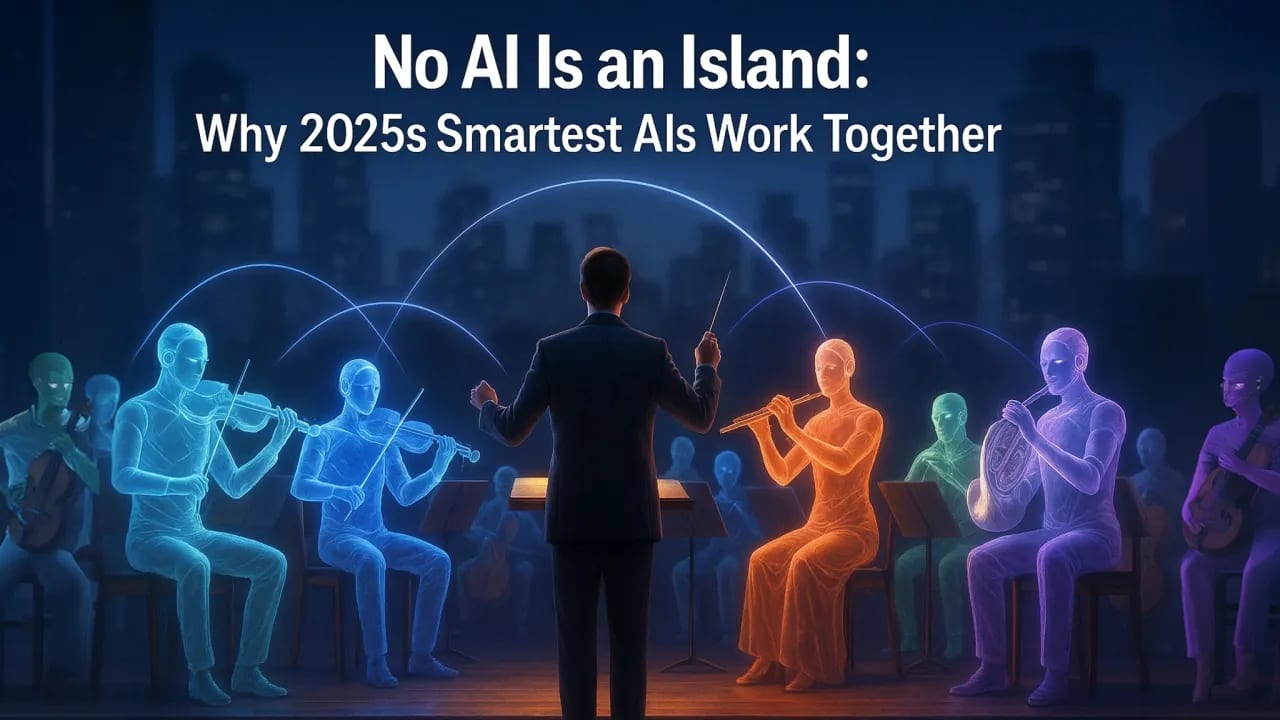
One recent study draws a sharp line between the two paradigms. Traditional AI agents (in today’s terms) are modular systems usually driven by a large model plus some tools, - powerful, yes, but fundamentally narrow and scripted (ar5iv.org). In contrast, “Agentic AI” represents a paradigmatic shift: think multi-agent teams with dynamic task allocation, memory, and true autonomy. If a single AI agent is a skilled soloist, an agentic system is an entire orchestra improvising a symphony. And like any good orchestra, the result can be greater than the sum of its parts.

This year, researchers have started proving the orchestra’s merit. In one experiment, AI scientists tackled a medical challenge – generating detailed radiology reports from X-rays. The traditional solo approach (one model generating the report end-to-end) tended to stumble, sometimes hallucinating clinical details or producing disorganized text. So the researchers tried something new: they gave the job to a relay team of specialized AI agents (arxiv.org). One agent retrieved relevant patient data; another described the X-ray image; a third drafted the report; yet another reviewed and refined the text. The outcome was striking. The multi-agent framework produced more accurate, structured, and interpretable reports than a single model working alone. Even more telling, doctors found these AI-generated reports easier to trust, because each step in the workflow mirrored a human doctor’s reasoning. The experiment highlighted a simple but powerful idea: when AI agents emulate the way experts collaborate, the results become both better and more explainable.

Another illustration comes from the financial domain. A team of researchers asked: what if, instead of one algorithm trying to beat the stock market, we unleash a whole team of AI agents on the problem? They developed a multi-agent investment simulator where each agent could pursue different strategies, share signals, and collectively optimize a portfolio. The approach, aptly named MASS (Multi-Agent Simulation Scaling), did more than just work, - it consistently outperformed traditional single-algorithm trading strategies (arxiv.org). By “progressively increasing the number of agents*”* and letting them each specialize, the system gained a richer understanding of market dynamics and achieved stable returns that beat six state-of-the-art baselines across multiple stock pools. In plain English, a swarm of smaller AIs working together made more money than some of the fanciest finance AI out there. The researchers expect this paradigm to expand to other tasks with similar complexity (arxiv.org). It’s as if we’ve discovered that two (or two hundred) heads can be better than one, even when one of those heads is a super-smart algorithm.
An Unexpected Crescendo of Insight
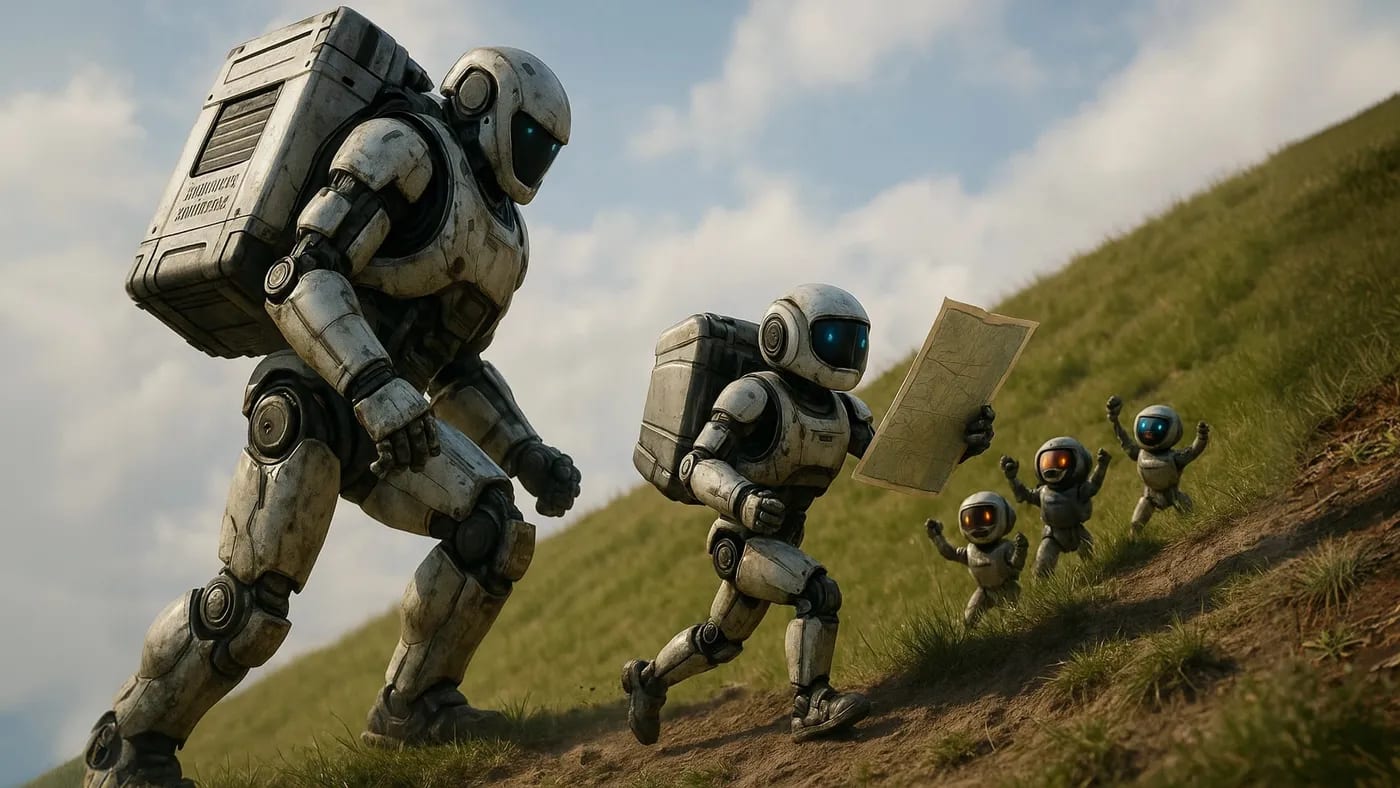
Here’s where things get interesting – and a bit counterintuitive. In the AI field, we’re conditioned to believe that bigger is better. If Model X has 100 billion parameters, and Model Y has 10 billion, surely X will trounce Y in any contest of wits. Surprise: that’s not always true anymore. Researchers recently demonstrated a scenario that would have been hard to imagine a year ago. Using a technique called “Pre-Act,” they taught a relatively small 70-billion-parameter model to plan its actions in multiple steps, essentially breaking a complex job into chunks and solving it step by step (arxiv.org). The result? This fine-tuned 70B model outperformed even GPT-4 (one of the most advanced large models today) on a challenging set of tasks (arxiv.org). By reasoning and acting in a structured, iterative way, the smaller model achieved a 69.5% improvement in action accuracy and a 28% higher goal completion rate than GPT-4 on an unfamiliar test scenario (arxiv.org). David didn’t just beat Goliath; David thought of a better game to play.
It gets better (or more uncomfortable, if you’ve bet big on the biggest models). Another study took a hard look at “commonsense” intelligence in AI, – things like understanding everyday situations. They compared a range of AI models, from small open-source ones to the largest proprietary giants, not by standard tests with fixed answers, but by how well the models’ judgments matched the variation in human opinions (arxiv.org). The findings were eye-opening: smaller, openly available models were surprisingly competitive with – and sometimes even more consistent than – larger closed models (arxiv.org). In other words, when success was defined as “agreeing with a diverse human population” rather than “matching an answer key,” size alone mattered less.
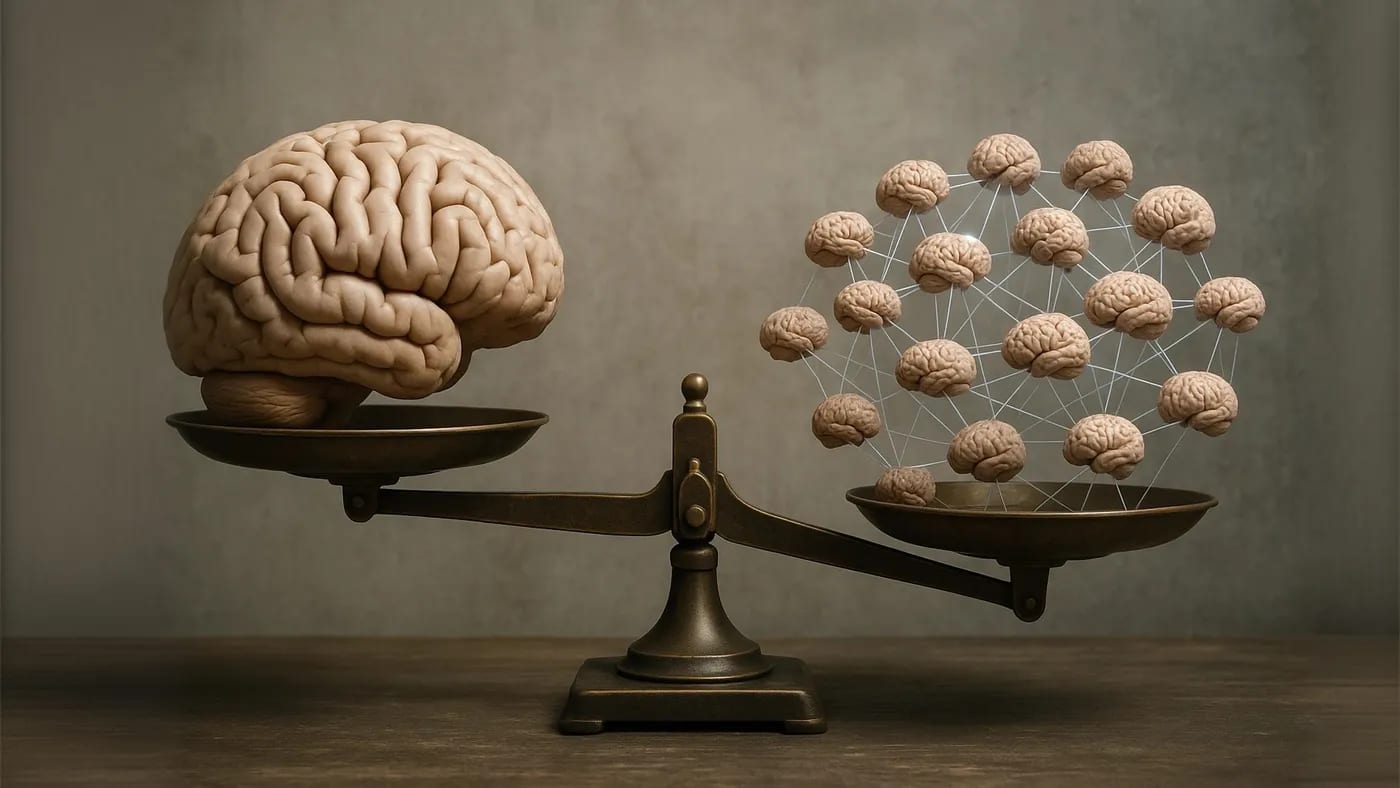
The researchers suggest this is a wake-up call that bigger isn’t automatically smarter if it fails to reflect the breadth of human perspectives. For an industry that has treated “scale” as a magic bullet, this is a crucial insight. It hints that the future of AI might hinge not just on raw power, but on strategy, context, and how intelligently we marshal our resources. Sometimes teaching a group of smaller AIs to think together beats relying on one behemoth to think deeply.
Synthesis: Orchestrating the Future of AI (and Business)
Taken together, these developments sketch a new vision for how AI will impact our world, – and every industry. Instead of deploying a single uber-model and hoping it can juggle all our needs, forward-thinking companies are starting to build ensembles of specialized AI agents, each with a clear mandate, that together handle complex workflows. Think of an insurance company where one AI agent analyzes claims, another flags potential fraud, and a third communicates with customers, - all coordinating their actions. Or a manufacturing firm using a fleet of AI agents: one optimizes supply chain logistics while another fine-tunes machine settings on the factory floor. This isn’t sci-fi, - it’s the logical extension of what we’re seeing in the lab. No wonder a recent Deloitte analysis found that 25% of companies using generative AI will pilot agentic AI in 2025, rising to 50% by 2027 (Dev Community). The age of the “AI orchestra” is dawning, and every section of the enterprise stands to hear the difference.

Crucially, this shift changes how we win with AI. If every competitor has access to similar large models (many are open source or offered via API now), the playing field evens out (CIO). Competitive advantage will come from how cleverly and reliably you wield these models in combination, rather than simply having the “most powerful” model. It’s akin to the shift from raw computing power to cloud architecture: everyone could rent more CPUs, but not everyone knew how to design a scalable system. Likewise, assembling effective AI agent ecosystems will become a differentiator.

Companies that learn to choreograph multiple Ais, - and integrate them into their human workflows, – will sail ahead, while those waiting for a single silver-bullet AI may find themselves stuck in neutral. Even the tech giants are acknowledging this. Microsoft recently embraced an open protocol for AI interoperability, noting that “the best agents won’t live in one app or cloud; they’ll operate… spanning models, domains, and ecosystems.” (TechCrunch). In other words, openness and collaboration are set to beat siloed supremacy. That’s as much a cultural shift as a technical one, and it plays to the strengths of organizations that foster cross-functional innovation.

Before we declare victory, let’s address the elephant (or rather, the swarm of smaller elephants) in the room: complexity. Moving from one AI system to a constellation of them isn’t easy. Coordination failures, emergent misbehavior, and compounded errors are real risks (ar5iv.org). In a multi-agent world, you might not have a single point of failure, - you could have fifty points of failure. The research community is well aware of these challenges: the same taxonomy study that champions agentic AI also flags pitfalls like hallucination feedback loops and brittle coordination, suggesting solutions from better orchestration layers to fail-safes like causal modeling. For industry, the lesson is clear: adopting AI agents must go hand-in-hand with robust engineering and governance. That means instrumenting these agents with monitoring, - so they log what decisions they make and why. It means sandboxing critical operations, - so one rogue agent can’t email all your customers or execute trades unchecked. And it means starting small: pilot projects that let you study how multiple agents interact in your specific environment, before scaling up. The path to the AI orchestra needs a steady conductor’s hand; with thoughtful design, we can enjoy the rich harmonies without the chaos.
Interestingly, this multi-agent approach can make AI more transparent and controllable in some ways. When each agent has a specific role, it’s easier to audit their knowledge and rules. You can demand explanations at each step (“why did the planning agent schedule production this way?”) and often get a meaningful answer, rather than probing a black-box behemoth and receiving a shrug. Early evidence suggests human experts prefer this clarity. In the medical AI study, domain experts validated that the new system’s concept-level explanations aligned better with their reasoning than conventional one-shot explanations (arxiv.org). Likewise, having separate agents handle retrieval of facts versus drawing conclusions means we can verify each stage, - catching errors or biases at the source. In enterprise terms, this modularity is gold. It lets us place guardrails exactly where needed*,* - e.g. limit what data the finance optimization agent can access or require the HR recruiting agent to get human sign-off before final decisions. We’re essentially injecting more points of human oversight into the process, without giving up automation benefits. The result is AI that acts with both competence and accountability, which is exactly what businesses, - and regulators, are calling for.
Call to Action: Conducting Your AI Symphony
As fellow leaders and innovators, we should view this evolution with a mix of excitement and pragmatism. Excitement, because the research breakthroughs of today are the competitive advantages of tomorrow. The idea that we can deploy swarms of specialized AI workers, - tireless, ultra-fast, and increasingly knowledgeable, to tackle our gnarliest problems is genuinely thrilling. Pragmatism, because steering this swarm will test our organization’s agility and wisdom. How do we retrain our teams to design and manage AI-driven processes rather than individual models? How do we ensure security and ethics when decisions are made autonomously at light speed? These are not rhetorical questions. They’re the new chess moves we must master.

The good news: we don’t have to start from scratch. Begin by identifying one or two high-impact projects where a multi-agent approach makes sense, - perhaps where tasks are well-defined but span different domains or require intermediate reasoning steps. Form a small “AI ensemble” task force mixing your data scientists, engineers, and business analysts. Treat it as an R&D skunkworks, with leadership air cover to experiment and fail safely. The goal is to learn how to orchestrate AI, not just to get a quick ROI.

Remember, no AI is an island, - and neither are we. The success of this new paradigm will rely on close partnership between humans and AI agents. Our role as leaders is evolving from directing human teams to also configuring and guiding AI teams. We’ll define the goals, set the guardrails, and cultivate the environments in which these agents operate. In essence, we become conductors of a hybrid orchestra, where humans play the creative, strategic melodies and AIs fill in the complex, data-driven harmonies. The companies that flourish in this era will be those that embrace a culture of collaborative intelligence, where human insight and AI autonomy reinforce each other. So ask yourself and your leadership: Are we ready to conduct an AI symphony, or are we still trying to make a single AI play all the instruments? It’s time to break the old paradigm. The sheet music is in front of us, fresh from the research labs, humming with potential. With a clever strategy and a respectful nod to the challenges, we can turn that potential into performance. In the end, the winners of the next decade won’t be those with the loudest solo, but those who compose the richest ensemble.

Further Readings
-
AI Agents in 2025: What Enterprise Leaders Need To Know (Lutz Finger - January 2025) Predicts that 2025 will be the year of the AI agent, transforming workflows across industries without one single “killer app” dominating.
-
AI agents in 2025: Expectations vs. Reality (Ivan Belcic and Cole Stryker - March 2025) IBM experts cut through the hype around autonomous AI agents and discuss what we can realistically expect from agentic AI in enterprise settings this year.
-
The Rise of AI Agents in 2025 (Aniruddha Adak - May 2025) Overview of how autonomous AI agents have emerged as transformative tools for business automation, including stats on enterprise adoption and the technological advances enabling multi-agent systems.
-
State of AI Agents in 2025: A Technical Analysis (Carl Rannaberg - January 2025) Breaks down the spectrum of AI autonomy and examines how different industries leverage agent capabilities in practice, from simple tool-using models to fully autonomous multi-agent systems.
-
Multi-AI Agents in 2025: Key Insights, Examples, and Challenges (Serhii Uspenskyi - February 2025) Explores how multi-agent AI systems work, their core components and real-world examples, as well as the benefits and challenges of leveraging multiple cooperating AI agents across various sectors.
-
Microsoft adopts Google’s standard for linking up AI agents (Kyle Wiggers - May 2025) News of Microsoft supporting Google’s Agent2Agent protocol to enable AI agents from different platforms to interoperate, highlighting an industry push toward shared standards for collaborative AI agents.
-
AI Agents: The Next Frontier in 2025 (Anukool Chaturvedi - January 2025) Discusses the shift from basic GPT-based tools to sophisticated AI agent workflows and how autonomous AI agents are poised to revolutionize key industries by automating tasks and improving decision-making.
Disclaimer: The perspectives shared in this article are my own and do not represent those of my employer or any affiliated organizations. All company names, product names, logos, and brands mentioned are the property of their respective owners and are used for identification and illustrative purposes only. No endorsement, sponsorship, or affiliation is intended or implied. References to specific companies or case studies are based on publicly available information and are used solely for educational and discussion purposes.
More from machine minds
All machine minds → machine minds
From Mendeleev to Machine Learning: How a "Periodic Table" Could Spark an AI Revolution
Imagine telling Dmitri Mendeleev in 1869 that his revolutionary idea, the periodic table of elements, would inspire an AI breakthrough over 150 years later. And to think how I’ve cherished the version that I acquired in college and never…
 machine minds
Yes, No, Maybe: The New Logic of Innovation Beyond Binary
A CEO stares at two proposals on the boardroom table, - Option A or Option B, a yes-or-no decision with millions on the line. Outside the window, city lights paint the night in more than just black and white, as if to remind her that not…
 machine minds
The Art of AI Daydreaming: Why Contextual Thinking is the Next Frontier
Let’s just image for a moment that your most advanced AI is on the clock, - and it’s daydreaming. At first, you might panic: the machine that cost a fortune in R&D is seemingly staring off into space instead of crunching data.