MAY AGILITY BE WITH YOU: How AI, Hybrids, and Pragmatism are Rewriting the Rules in 2025
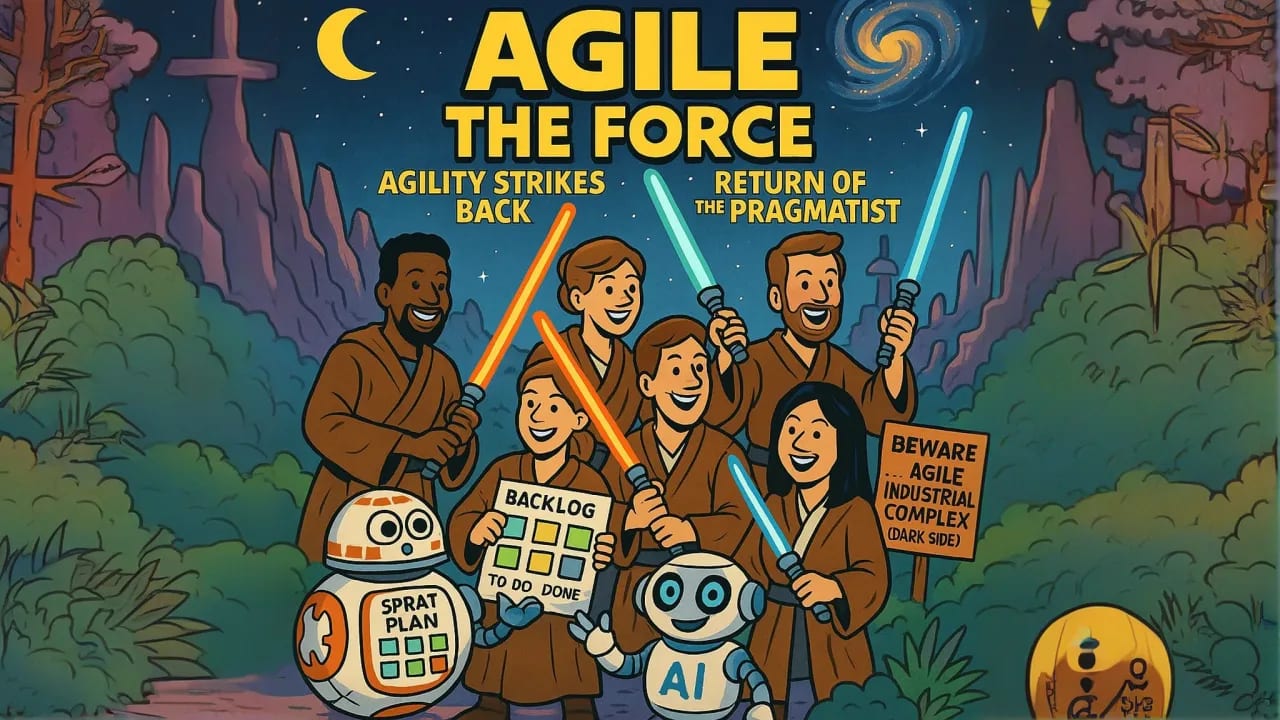
Every few years, someone declares “Agile is dead.” Yet here we are today, and agility is not only alive, - it’s evolving. In fact, a recent global survey found 95% of professionals still affirm Agile’s critical importance, itbrief.in. So why the persistent rumors of its demise? This article takes a hard look at Agile’s journey, - the ups, the critiques, and the surprising new chapter being written with AI and hybrid approaches. We’ll explore how today’s tech leaders are blending old and new, drawing lessons from pioneers like Microsoft, ING, Spotify, and Toyota. (Spoiler: Agility isn’t a relic of the past – it’s a strategic imperative for the future.)
The Never-Ending “Agile Is Dead” Saga – And Why It’s Misguided
“Agile is dead!” – It’s a headline that resurfaces with clockwork regularity. Ever since the first “Agile is dead” blog posts in the mid-2010s, this narrative has been the tech world’s version of a zombie movie sequel. Critics point to Agile’s age (the Manifesto turns 24 this year), its overuse of jargon, or horror stories of “failed” Agile projects as evidence that the approach has outlived its usefulness. Even one of Agile’s founders, Dave Thomas, lamented that the term “agile” had been subverted into something meaningless, hijacked by consultants hawking services, - unfix.com. With Agile conferences shrinking and social media filled with gripes about “Agile fatigue,” it’s easy to believe we’re attending agility’s funeral.
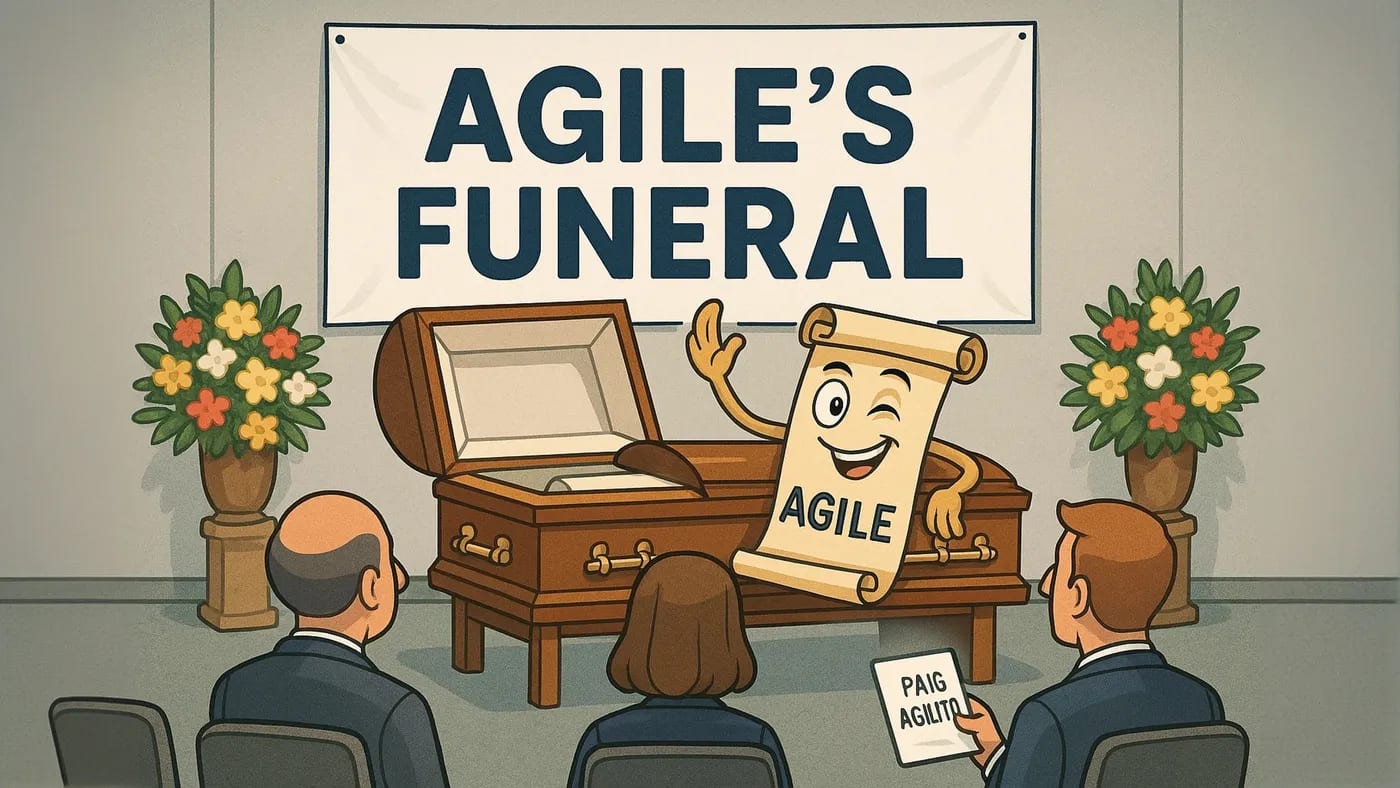
But let’s not mistake evolution for extinction. In reality, the cries of “Agile is dead” are less obituary and more growing pains. The practices that were once shiny and new have become so commonplace as to be unremarkable, - a sign of ubiquity, not obsolescence. As some coaches quip, Agile today is like power steering in cars: you don’t notice it until it’s gone, - improving.com. What’s actually “dead” is the hype around Agile as a trendy novelty. Agile has quietly matured into the default way modern teams work – the de facto operating system for development. Far from fading, it’s embedded itself so deeply that some take it for granted. To paraphrase Mark Twain: the rumors of Agile’s death are greatly exaggerated.
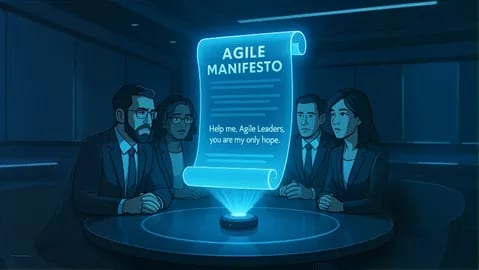
And the data backs this up. A 2025 Forrester report found Agile practices remain a “unshakable foundation” for organizations adapting to the digital era, - itbrief.in. An overwhelming majority of companies credit Agile for helping them deliver customer value and respond to change, - even as they adopt AI and cloud at scale. In other words, agility is still what makes the business world go round. The real story is not an ending, but a new chapter.
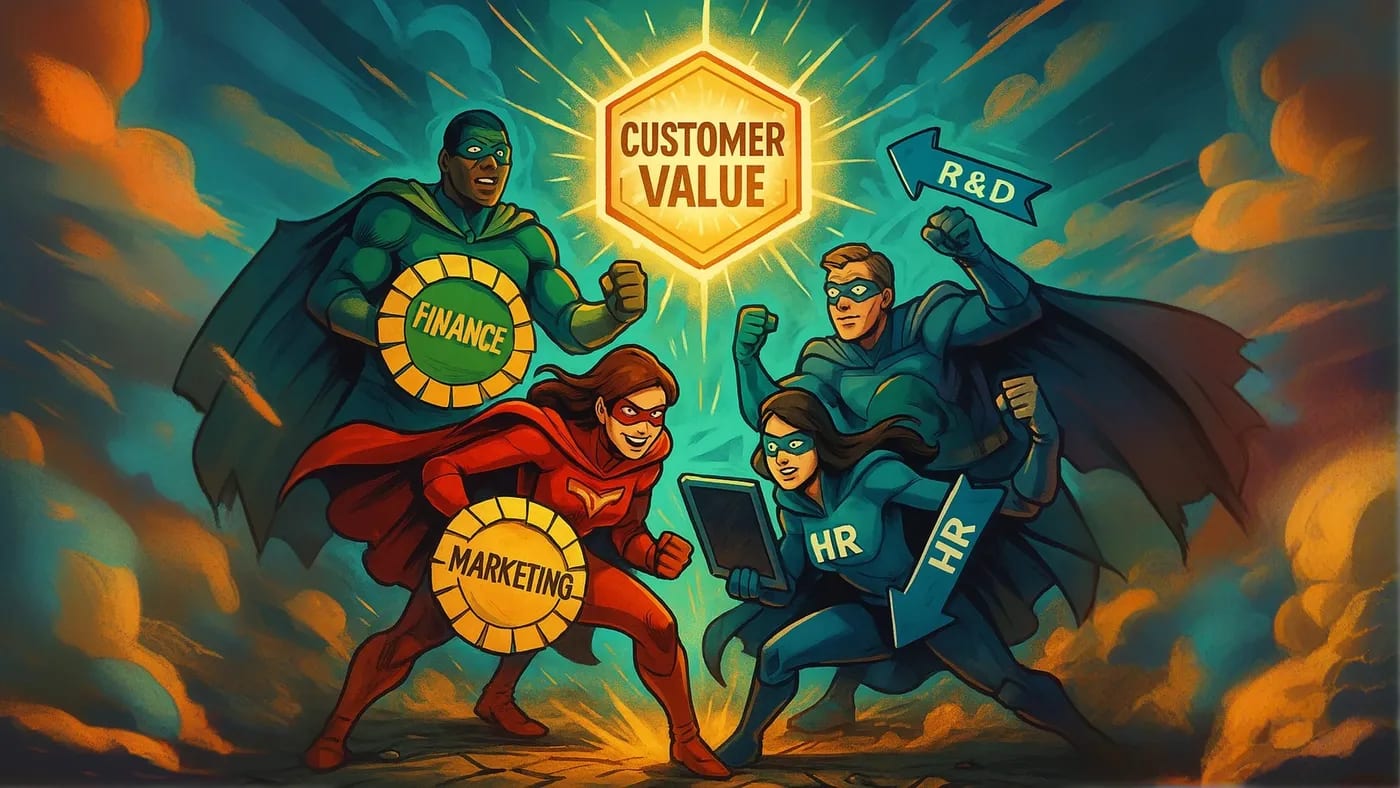
From Manifesto to Mainstream: A Quick Tour of Agile’s Evolution
To understand how we got here, let’s rewind. Agile began as a bold rebellion against 1990s bureaucracy. In 2001, seventeen mavericks met at the Snowbird ski resort in the Wasatch mountains of Utah and penned the Agile Manifesto, - a brief declaration favoring “individuals and interactions over processes and tools” and “responding to change over following a plan”, - atlassian.com. It was a rallying cry against heavyweight processes that made software development slow and inflexible. In the early days, Agile was the upstart: small teams embracing Scrum and XP to outmaneuver their waterfall-wedded “competitors”.
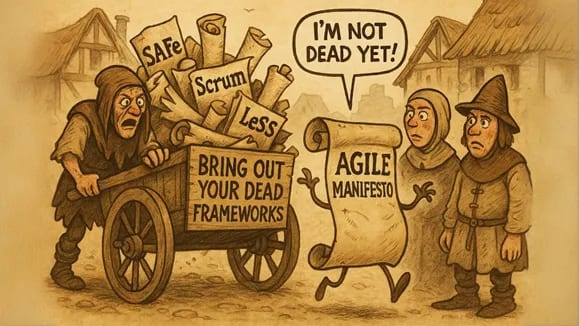
Fast forward a decade: Agile went mainstream. It broke out of software development and into corporate vernacular. By the 2010s, methodologies like Scrum, Kanban, and later scaled frameworks (SAFe, LeSS, and a veritable alphabet soup) proliferated, - unfix.com. What started as a grassroots movement became the buzzword in boardrooms. Agile was no longer a niche mindset. It had become practically a business religion. Enterprises sent managers to certification courses en masse. Scrum Master became a job title at Fortune 500 firms. And even non-tech teams (marketing, HR) dabbled in stand-ups and sprints. In a twist of fate, the revolution became the establishment. As one mocking commentator noted, “every great cause begins as a movement, becomes a business, and eventually degenerates into a racket.”
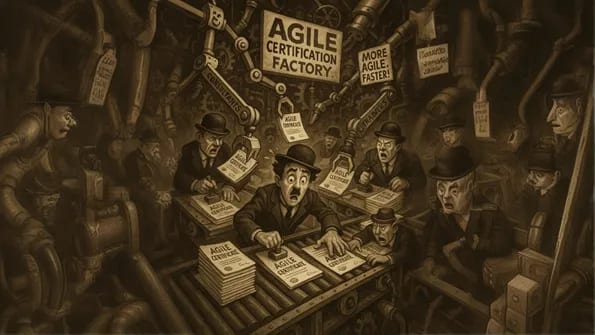
By the late 2010s, cracks began to show. The Agile Industrial Complex, a term critics use to describe the cottage industry of training, coaching, and consulting, was in full swing. Agile was being packaged and sold like diet pills. Many organizations implemented it by the book, focusing on mechanics over mindset. This led to a phenomenon of “cargo cult Agile,” where teams go through the motions (stand-ups, post-it notes, Jira tickets) without understanding why. The result? Plenty of Agile in name only, - teams checking the Agile box but not reaping results. It became common to see companies brag about their “Agile transformation” while still delivering zero value faster than ever. It’s no wonder cynics had a field day.

Yet, through each phase, - from rebellious upstart, to mass adoption, to disillusionment, the core ideals of Agile proved resilient. Even as traditional Agile practices hit bumps, the need for agility only grew. The world didn’t slow down; if anything, disruption accelerated. Organizations learned (sometimes the hard way) that simply rebranding your project managers as “Scrum Masters” changes nothing if you cling to old habits. The next era of agility wouldn’t be about doing Agile, - it would be about being agile in whatever form makes sense.
Rigid Agile, AINO, and Other Cautionary Tales (Why the Critics Have a Point)
Before we talk about Agile’s renaissance, it’s worth acknowledging the critics weren’t entirely wrong. Traditional Agile hit some self-inflicted snags:
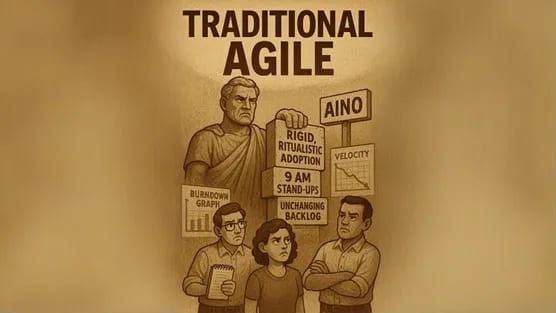
- Rigid, Ritualistic Adoption: Many teams treated Agile like a strict rulebook: thou must have 15-minute stand-ups at 9 AM sharp, thou shalt not change the sprint backlog, etc. The irony? By following Agile “by the letter,” they abandoned agility in spirit. Agile was meant to be flexible, but in some places it ossified into dogma. One Agile veteran joked that some implementations had achieved “bureaucratic behemoth” status, Agile in form, waterfall in function. When teams spend more time obsessing over velocity charts and burndown graphs than delighting customers, something has gone off the rails.
-
Agile In Name Only (AINO): This is the epidemic of talking the talk without walking the walk. Companies slap on the Agile label but change very little internally. Maybe they relabel phases as “sprints” or use Jira instead of Excel, but the command-and-control culture never budges. It’s faux agile, what Atlassian calls “dark agile” or “fake agile”. Symptoms include endless “ceremonies” with no real outcome, teams that are busy but not productive, and a lot of Agile jargon masking old-school behaviors. In such cases, Agile becomes theater. As Jurgen Appelo observed: “In many organizations, Agile has devolved into a mere checkbox exercise… teams spend more time performing Agile ceremonies… than delivering actual value”, - (unfix.com). When activity replaces impact, the agile essence is lost.
-
The Agile Industrial Complex: Along with popularity came commercialization. Framework peddlers and certifying bodies turned Agile into big business. There was a time in the 2010s when every week brought a new framework or trademarked process promising to fix all your problems, for a fee. This over-commercialization led to what Martin Fowler and others warned as a focus on imposing cookie-cutter processes on teams, rather than fostering true agility, - martinfowler.com. Consultant-led transformations often pushed one-size-fits-all solutions (often whatever was trendy that year) and left a trail of cynicism when they under-delivered. Daniel Mezick coined “Agile Industrial Complex” to describe this web of trainers and consultancies monetizing Agile while sometimes forgetting its humanistic roots, - linkedin.com. The end result? A backlash from practitioners who felt Agile had been co-opted by money interests, losing the innovative spark that made it work.
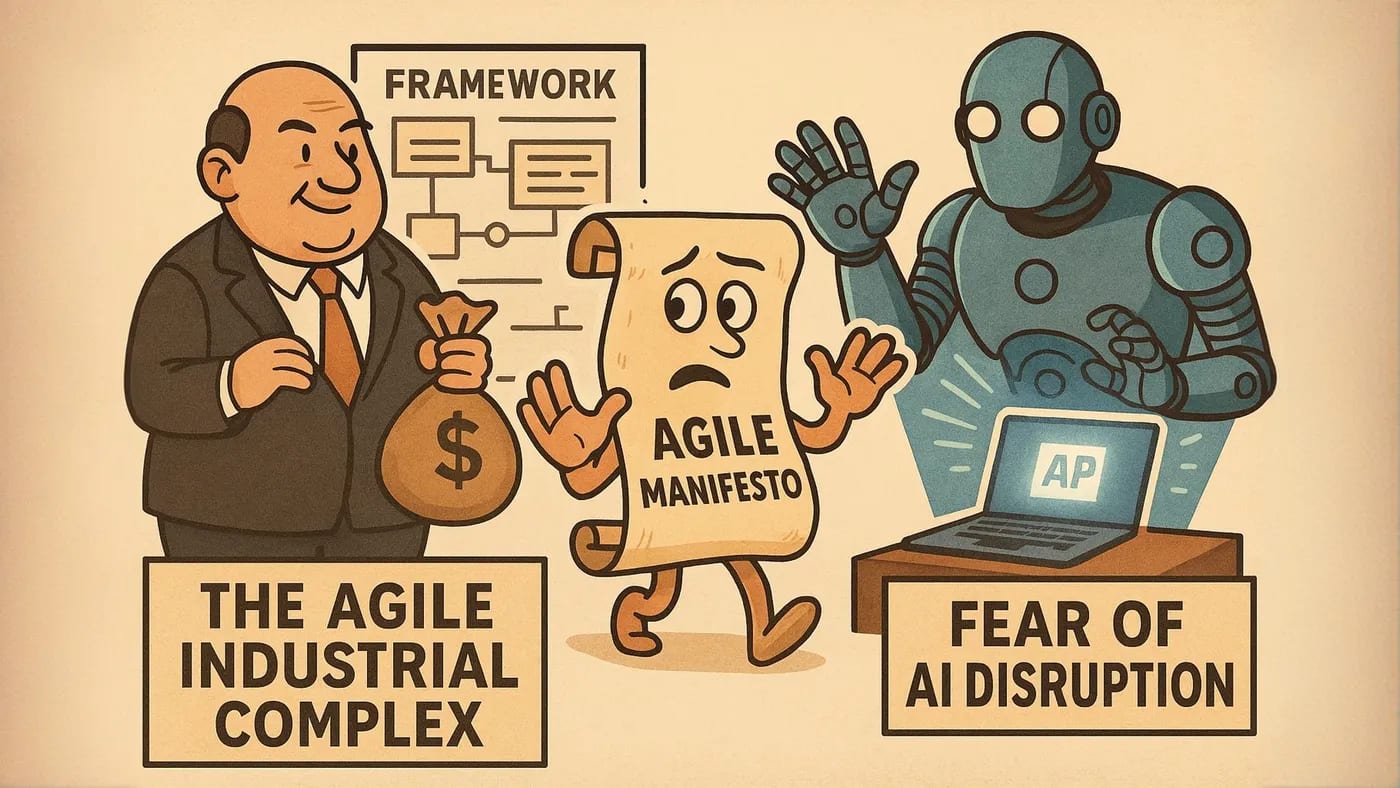
- Fear of AI Disruption: More recently, a new critique emerged: Will AI make Agile irrelevant? With artificial intelligence writing code, managing tasks, even making decisions – do we still need stand-ups and sprints? Some provocateurs have hinted that AI-driven development could disrupt the Agile model itself. If an AI can auto-generate software or re-plan projects on the fly, where do human-centric Agile rituals fit? While this is more speculation than reality (at least for now), it added fuel to the “Agile is over” fire in some circles. We’ll explore this in a moment – spoiler: rather than killing Agile, AI is actually supercharging it.
In sum, Agile’s mid-life crisis was real. The methodology accumulated scars: misapplications, misinterpretations, and misuses that made it seem like Agile had “failed.” But here’s the key: Agile didn’t fail – our rigid or superficial use of it did. Each critique above is less a condemnation of Agile’s values and more a warning against losing sight of them. And that sets the stage for how Agile is reinventing itself for the future.
Agile 2.0? How AI Is Augmenting Agility, Not Replacing It
If the first two decades of Agile were about human collaboration, the next decade adds a new collaborator to the mix: Artificial Intelligence. Rather than rendering Agile obsolete, AI is reshaping how Agile teams work – in many cases, making them more agile than ever.
Modern teams are increasingly leveraging AI tools as “team members.” Developers pair with AI copilots that can generate code or catch bugs. Project managers use AI assistants to analyze backlogs and predict risks. Chatbots help facilitate retrospectives or stand-ups by gathering input asynchronously. Far from eliminating the need for Agile rituals, these tools free humans from drudgery so they can focus on creative, value-add work.

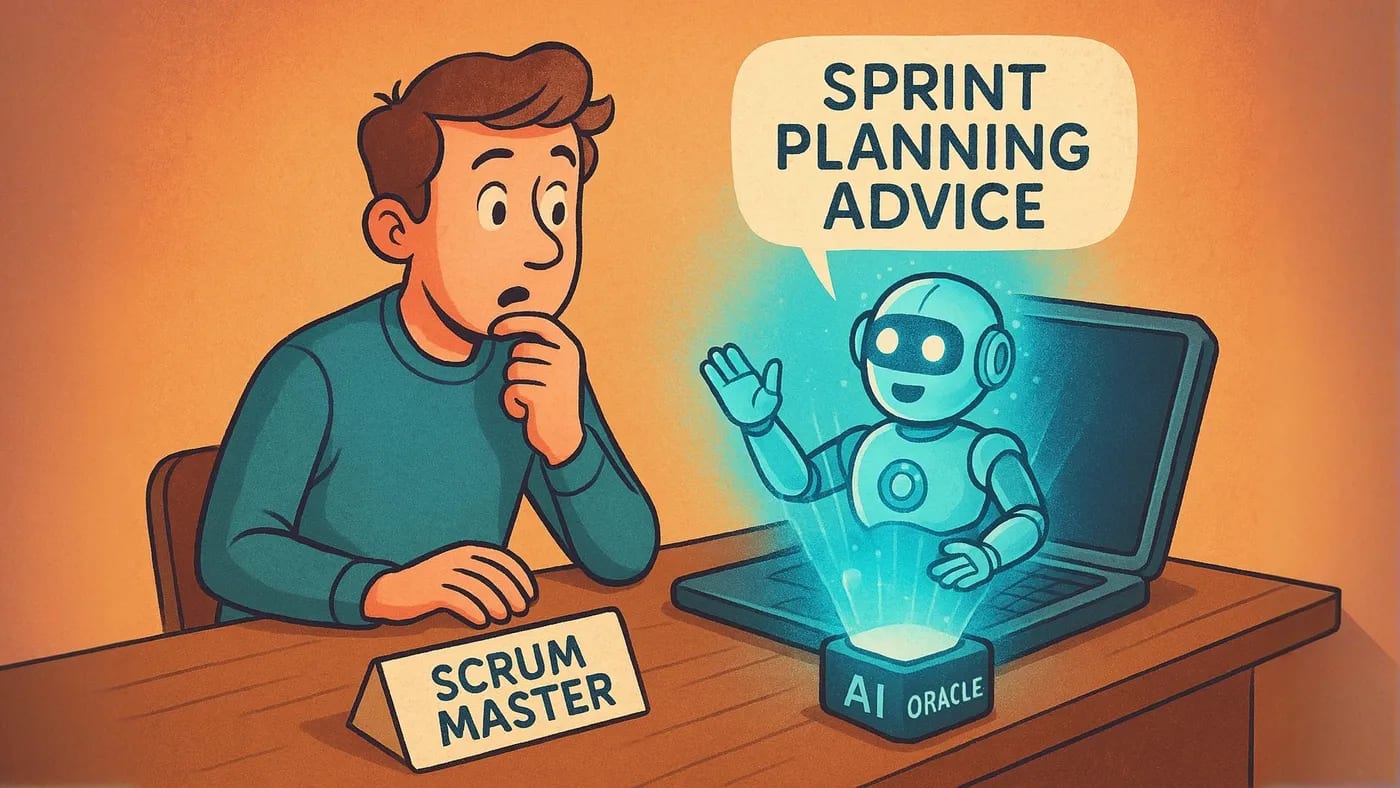
Consider software development: AI coding assistants (like GPT-4 based tools or Microsoft’s GitHub Copilot) can draft chunks of code or unit tests. This doesn’t remove the need for iterative feedback, if anything, it accelerates the iteration cycle. Teams can prototype faster, get feedback sooner, and adapt continuously, which are very much Agile goals. The definition of “team” is evolving: your Scrum team might include a few humans and an AI pair programmer. The Scrum Master’s role might involve consulting an AI oracle for insights on improving team flow or estimating work. Agile’s core principle of adaptation pairs nicely with AI, which thrives on rapid learning from data.
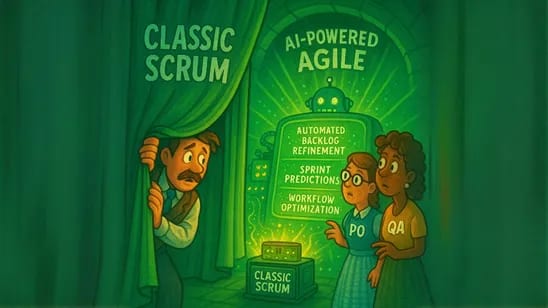
And organizations are noticing. The Forrester study mentioned earlier noted that nearly half of respondents are already integrating AI tools into their Agile processes, - itbrief.in. These AI (sometimes called “TuringBots”) are helping streamline workflows and automate repetitive tasks, - from auto-generating reports to suggesting optimal ways to slice user stories. The result is augmented agility: teams that can adjust and make decisions even faster, backed by data and AI-driven predictions.
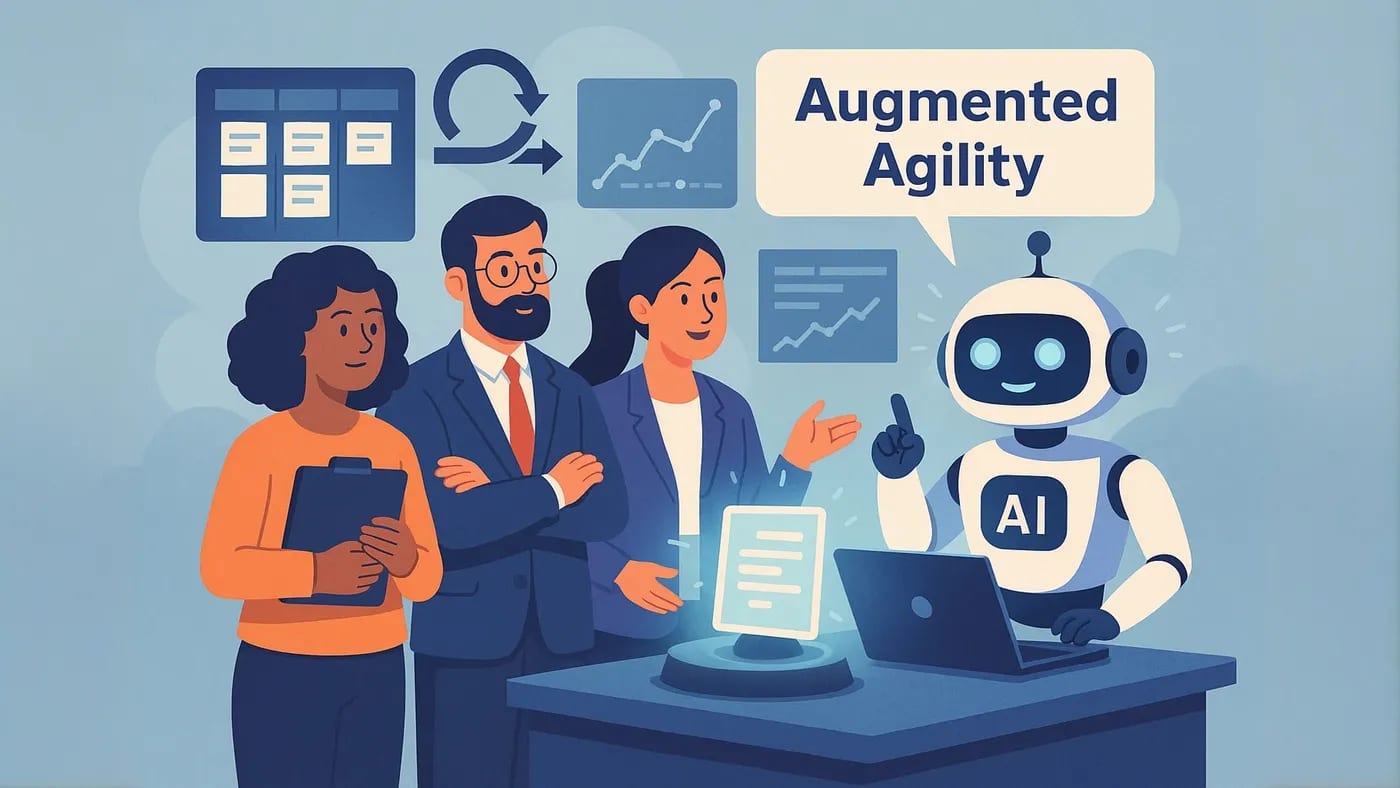
Does this mean Scrum Masters or Product Owners will be replaced by algorithms? Unlikely. Leadership, creativity, and strategic thinking remain human domains. AI can crunch numbers and propose solutions, but it takes human judgment to decide what problems are worth solving in the first place. Instead of replacement, think augmentation. An executive recently put it this way: AI won’t replace managers, but managers who use AI may replace those who don’t*.* The smartest leaders are treating AI as the new ally in their Agile toolkit. For example, teams now use AI to simulate market responses to a feature, effectively getting super-fast feedback to inform their next sprint planning. This turbo-charges the inspect-and-adapt cycle at the heart of agility.
In short, AI is not writing Agile’s epilogue, - it’s co-authoring the next chapter. The key is ensuring that we use AI to amplify Agile values (customer focus, responsiveness, team empowerment) rather than undermine them. A daily stand-up might be replaced by an AI-generated status summary, but the goal, - shared understanding and quick course-correction, remains. Agility isn’t about sticky notes or stand-ups. It’s about the ability to learn and respond. AI, when thoughtfully integrated, can make that learning faster and the responding smarter.
Hybrid Methodologies: When Agile Isn’t One-Size-Fits-All
One of the biggest lessons learned over the years is pragmatism. In the real world, few organizations succeed with “purity tests” or by following a single methodology dogmatically. Instead, the trend is towards hybrid approaches, - mixing Agile with other frameworks and even traditional techniques to fit the context. Agile in 2025 is less a religion and more a philosophy that can wear many outfits.
Remember those early Agile mantras like “co-location is essential” or “a team that codes together, stays together”? COVID-19 blew a hole in those, remote work proved you can collaborate from anywhere if you have the right mindset and tools. Similarly, the notion that every project must be broken into two-week sprints has softened. Some initiatives benefit from a bit of up-front planning (dare we say, waterfall-ish thinking), especially in regulated industries or hardware development. And that’s okay. Hybrid agility is about being Agile when it makes sense, and not being afraid to switch gears when needed.
Forward-looking teams now blend frameworks: a dash of Scrum here, a pinch of Kanban there, topped off with Lean Startup principles, DevOps automation, or even traditional stage-gates for certain milestones. The goal is outcomes, not adherence. As industry thought leader Jurgen Appelo notes, “Most organizations need hybrid strategies, blending Agile, Lean, and traditional methods and rejecting purist rhetoric.” Success comes from contextual solutions over rigid doctrine. In practice, this might mean using Scrum in development but Kanban in operations or running design thinking workshops before kicking off an Agile execution phase.
Even scaled frameworks like SAFe have essentially canonized a hybrid: Agile teams within, but with an overlay of synchronization at the program/portfolio level (which some purists would argue feels waterfall-esque). The takeaway? There is no single “true Agile” anymore. The new true Agile is whatever helps your organization be more adaptive and customer-centric. If that means a Gantt chart for long-term planning, go for it, - just don’t let it prevent you from changing course when feedback or market shifts demand it.
This pragmatic approach is a direct response to the failures of dogmatism. Companies that tried to shoehorn one framework everywhere found that one size fits none. The Agile 2.0 mindset is closer to “build your own agility.” Take the principles, - deliver value iteratively, collaborate closely with customers, empower teams, embrace change, and implement them in a way that meshes with your business reality. It’s Agile unboxed: mix-and-match agility.

One bank executive described their transformation as “putting together Agile Lego blocks” to construct a model that worked for each part of the business. In some areas, they run strict Scrum with sprints; in others, a continuous flow Kanban is better; and for strategy, they do quarterly OKR planning. This kind of tailored agility is becoming the norm. However, you need to be scientific about it. If you’re not careful, you might find yourself playing ‘Jenga’ instead of ‘Lego’, - a few letters of difference can turn your building blocks into a tumbling tower!

Beyond IT: Business Agility Takes Center Stage
One of the most exciting shifts in recent years is seeing agile escape the IT department. What started in software dev teams has blossomed into a broader movement of business agility, - applying Agile values and techniques across the whole organization. In 2025, agility is no longer just the CIO’s concern; it’s a top priority for the CEO.
At its heart, business agility means the ability of a company to rapidly respond to market changes and emerging opportunities with innovative, customer-focused solutions. It’s agile principles writ large. We see it in how companies structure themselves, how they plan, and even how they hire and budget. Cross-functional teams aren’t just a dev-team concept anymore, - now we have cross-functional business teams that might include a marketer, a data analyst, an engineer, and a product manager all working toward a common OKR (Objective and Key Result). Planning isn’t a rigid annual cycle but a rolling, iterative process across departments.
Many industries you wouldn’t associate with Agile are embracing it. Legacy energy companies have used Scrum to improve how they find new sources, bringing more transparency and speed to energy projects, - improving.com. HR teams use Kanban boards to streamline recruiting and onboarding. Supply chain groups experiment with hybrid Agile methods to navigate disruptions and optimize flow. The mindset of agility, - transparency, continuous improvement, empowered teams, is proving universal. As it’s been observed, Agile’s principles resonate because they boil down to effective project management and teamwork fundamentals that apply anywhere.
In fact, agility has become so integral to modern management that some executives don’t even label it “Agile” anymore, - it’s just how you run a company in a fast-moving world. The practices might differ outside of IT (a marketing team’s “iteration” might be a campaign draft rather than a software increment), but the ethos is similar. The silos are coming down, replaced by networks of teams.
Case in point: Dutch bank ING. In 2015, ING famously reorganized its entire operation around Agile principles, inspired by tech firms. They implemented small “squads” and larger “tribes” across business units, flattening hierarchy and fostering end-to-end ownership. The result? Faster time-to-market for new services and a more customer-centric culture, - contributing to ING being named Best Bank of the World in 2018, - bcg.com. What’s remarkable is that this wasn’t an IT project; it was a whole-business transformation. Executives recognized that to compete in digital banking, they had to behave like a digital product company. They even took a page from the Spotify model playbook (famous for its autonomous squads and tribes) to redesign their org chart. Today, ING’s Amsterdam headquarters offers tours to other companies curious about enterprise-wide agility, a sure sign that business agility has gone mainstream.
Another example: Microsoft. The tech giant’s revival in the past decade is often attributed to cloud strategy, but a big enabler was cultural and methodological agility. When CEO Satya Nadella took over in 2014, he shattered silos and championed a growth mindset, effectively injecting agility into the DNA of a very large, historically bureaucratic organization, - linkedin.com. Microsoft embraced Agile and DevOps practices across its product teams (from Windows to Office to Azure), moving away from infrequent big-bang releases to rapid, incremental delivery. Nadella pushed decisions down to teams, encouraged experimentation, and yes, had teams adopt Scrum where it made sense. The impact was dramatic – Microsoft became more innovative and responsive, regaining its edge and even outpacing competitors in some areas. It’s now a case study in how agile leadership at the very top can transform a company’s trajectory. As one LinkedIn case study noted, Microsoft’s internal culture shift toward collaboration and continuous improvement was key to its trillion-dollar success, linkedin.com.
A personal example: My HR manager had arranged a cross-company visit for me to MathWorks in 2003, and while my recollection has grown a bit hazy, one thing I haven’t forgotten is how ahead of the curve MathWorks was in their development approach. In many ways, they were already living the principles of agile engineering before “Agile” was a buzzword – I saw small teams intensely collaborating and iterating on designs rapidly, thanks to a model-centric workflow that let them test ideas early and often (Model-Based Design naturally supports this kind of fast iteration in development). The engineers described how they used a Simulink model as the single source of truth for each project, from initial design through validation, enabling continuous testing and refinement throughout the lifecycle. I was amazed to learn that they could even generate production code directly from these simulations at the push of a button, which meant they caught issues and addressed integration challenges long before anything hit real hardware. On top of that, MathWorks had an automated testing “pipeline” in place, - essentially an early continuous integration system, where every code submission triggered an array of build and test processes to verify nothing broke in their MATLAB/Simulink suite. The effect of these practices on team dynamics was tangible: everyone, developers, testers, and even technical writers, seemed to be working in sync (or at least that was the impression), largely because they all shared the same up-to-date model and results, fostering an environment of transparency and trust. Walking away from the Natick campus, I remember feeling genuinely inspired, having seen first-hand how MathWorks combined disciplined engineering, - simulation, automation, and early verification with a culture of collaboration to drive innovation even back in 2003.
Even companies that invented the precursors to Agile are reinventing themselves. Toyota, renowned for its Lean manufacturing system (which inspired many Agile practices), found itself needing more agility in software and product development. In a notable 2016 case, a major Toyota IT project was floundering under traditional management – delivering nothing after years of work. A small group of coaches introduced Scrum, broke the big program into smaller teams, and delivered working software in just 90 days, nigelthurlow.com. That success sparked a wider adoption of Agile across Toyota’s North America operations. It’s a great reminder that no one is immune to the need for agility; even the masters of efficiency saw benefits in blending their Lean heritage with Agile techniques to tackle new challenges.
And of course, Spotify itself deserves mention. The “Spotify Model” became famous not because the company set out to create a framework, but because they prioritized culture and autonomy as they scaled. Spotify showed that giving teams (squads) a high degree of freedom and linking them through informal guilds and strong culture could achieve both innovation and alignment, - atlassian.com. They didn’t stick to off-the-shelf Scrum or any single methodology – they mixed and matched to create something uniquely Spotify. This model (shared via a 2012 whitepaper) influenced countless others to rethink organizational structure. Ironically, Spotify itself warns against blindly copying it, since it was what worked for them at that time. The lesson is clear: be inspired by others, but craft agility to fit your own context.
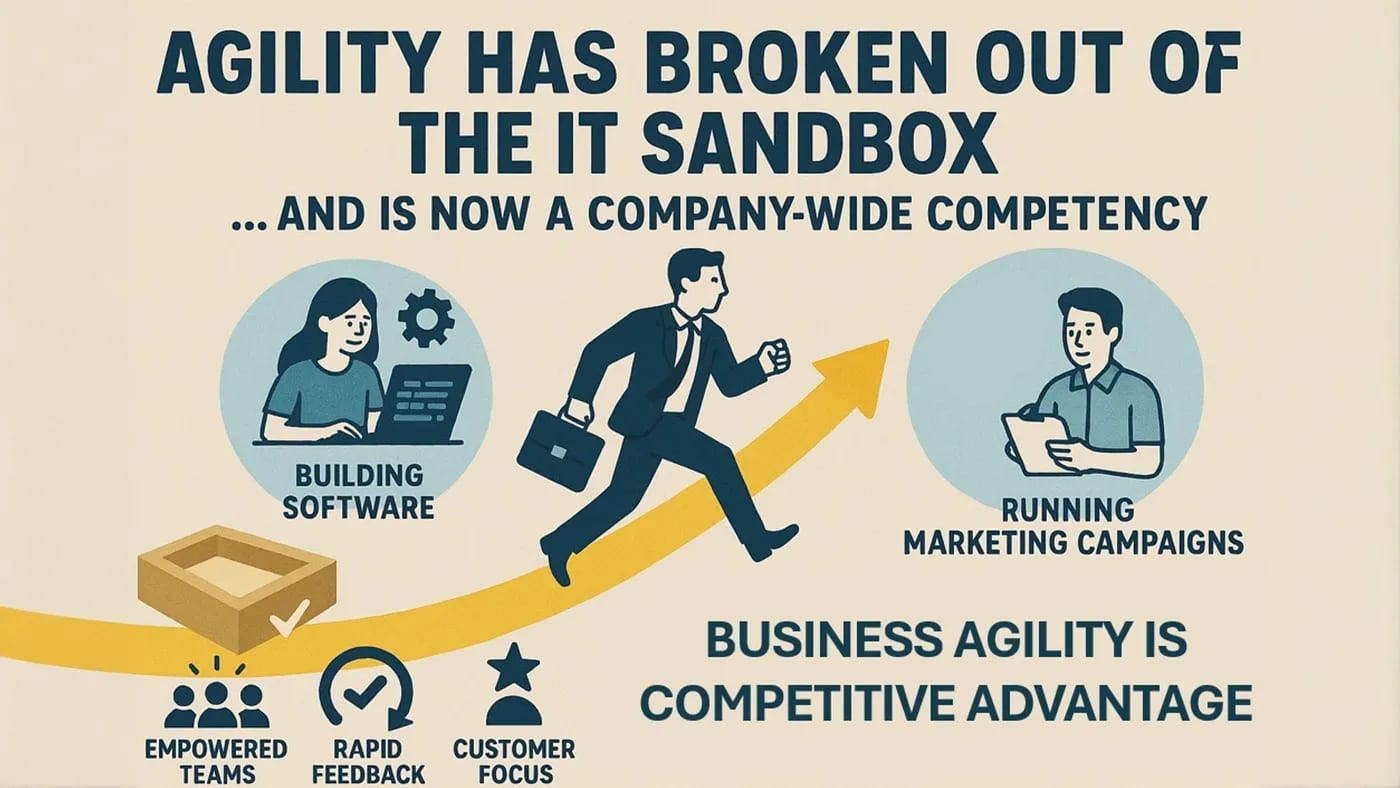
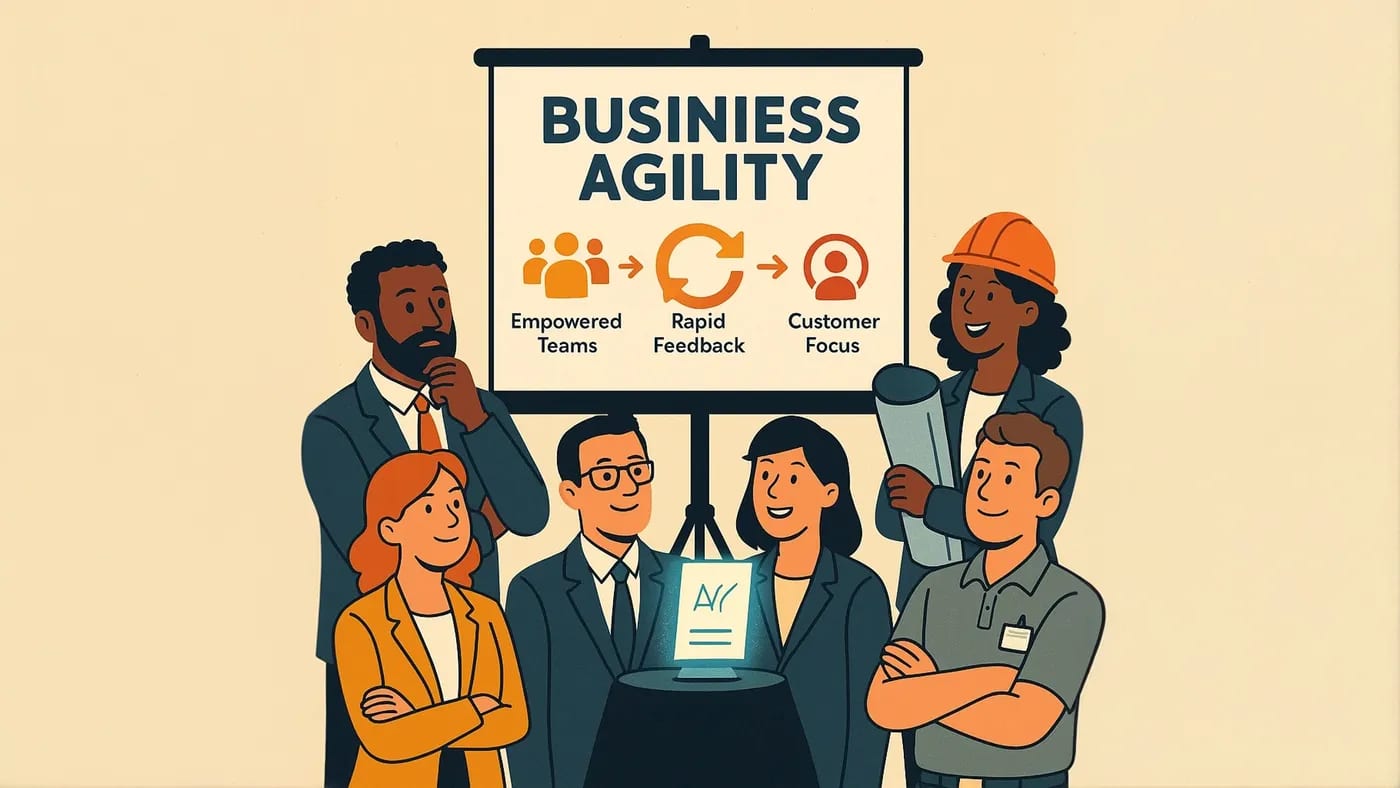
The big picture: agility has broken out of the IT sandbox and is now a company-wide competency. Whether you’re building software, running marketing campaigns, or designing cars, the ability to learn quickly and pivot is king. Agile’s core ideas, - empowered teams, rapid feedback, customer focus, are now guiding principles across industries. This trend will only grow as volatility and complexity in markets increase. In an era where your next competitor could emerge from anywhere, or any “realm”, business agility is the new competitive advantage.
Leading the Charge: Pragmatic Advice for the Agile (R)evolution
For executives and leaders, the writing on the wall is clear: agility (small “a”) is here to stay, but how you pursue it must evolve. Here are some strategic pointers for navigating this new landscape of AI-boosted, hybrid, business-wide agility:
-
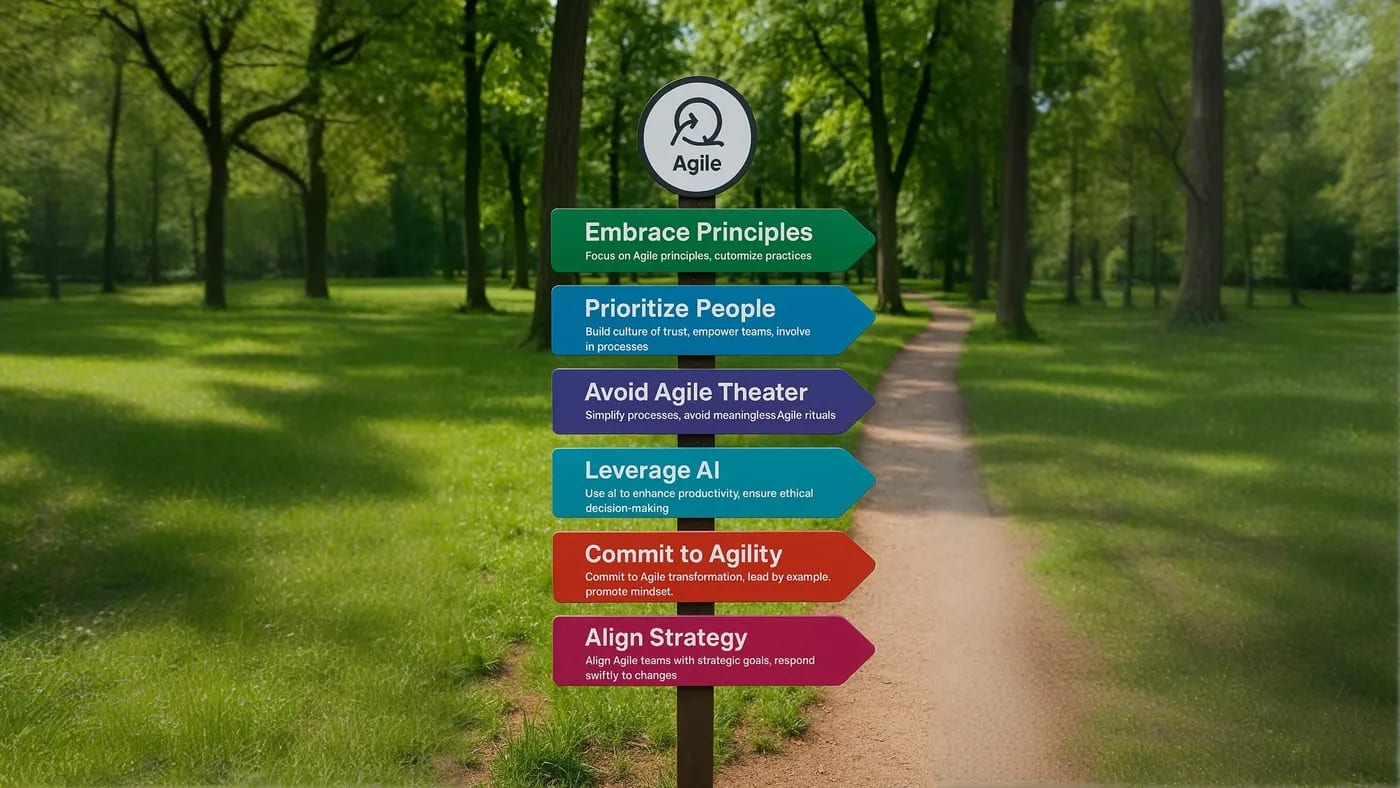
Bury the Dogma, Embrace the Principles: Let go of rigid adherence to any one framework. Instead, double down on Agile’s principles. Focus on outcomes over outputs, - it’s not about how many story points you burn, it’s about the value you deliver. Don’t worry if your process doesn’t look exactly like the textbook Scrum or if you mix Kanban and OKRs. If it works for your teams and customers, it is Agile. Be willing to customize and even reinvent practices. As we saw, the most successful organizations tailor agility to their context rather than follow a script.
-
People and Culture First: All the AI tools and fancy frameworks in the world won’t save you if your culture resists change. Invest in building a culture of trust, learning, and empowerment. Teams should feel safe to experiment and speak up. Leadership’s role is to set vision and guardrails, then get out of the teams’ way. Avoid the trap of top-down “agile by memo.” Instead, involve teams in designing how they work. Remember, agility is a mindset – and that starts with people. Even Daniel Mezick’s criticism of the Agile Industrial Complex centered on imposing Agile without team buy-in, - linkedin.com. Don’t be that executive.
-
Fight Agile Theater: Be vigilant against Agile-In-Name-Only symptoms. If your gut tells you a ceremony or artifact has become a meaningless ritual, call it out. Encourage teams to simplify processes whenever possible. Metrics like customer satisfaction, time to market, or business value delivered are more important than whether every team perfectly follows the same template. In leadership meetings, ask “Are we doing this for a real benefit, or just because Agile says so?” By stripping away performative Agile, you make space for true agility.
-
Leverage AI Wisely: As a leader, champion the use of AI to enhance your teams’ productivity and insight, but set clear guidelines. Provide tools and training so teams can experiment with AI (for coding, data analysis, customer support automation, etc.). However, also emphasize ethical and thoughtful use – AI should assist decision-making, not make critical decisions in a vacuum. Use AI to gather data and options, then apply human judgment. For instance, an AI might crunch customer usage data and suggest ten features; your product team still needs to pick the one that aligns with strategy. Leaders who foster this human-AI partnership will see their organizations accelerate. Those who ignore AI may find themselves outpaced.
-
Align Agility with Strategy: One pitfall in many early Agile adoptions was a disconnect between agile teams and top-level strategy. Avoid this by ensuring your strategic goals cascade into what agile teams work on. Techniques like quarterly business reviews, OKRs, and portfolio Kanban can tie together the C-suite and the scrum teams. When a disruptive market change hits, use your agile structure to respond at all levels, - pivot strategy and let that flow through to execution in weeks, not years. Agile isn’t just for IT projects; it’s a way to execute strategy in a turbulent environment. Your job is to make sure all parts of the company are rowing in the same direction, even as that direction shifts.
-
Commit and Enable: Finally, recognize that true agility requires commitment from the top. A Forrester study noted only 7% of companies consider themselves highly proficient in Agile at scale, largely due to leadership and cultural gaps, - itbrief.in. Don’t just sponsor an agile transformation and walk away, - actively participate. Remove organizational impediments (yes, that might mean reorganizing or changing outdated policies). Invest in coaching and training where needed, not just for teams but for middle management who often need to learn a new way of leading. Reward the behaviors you want to see, - collaboration, taking initiative, delivering value, rather than just hitting KPIs. In short, lead by example. When teams see leaders adopting an agile mindset (being transparent, adapting plans, focusing on customers), they’ll follow suit.
Conclusion: Agility’s Next Frontier
Agile’s obituary will have to wait. If the past two decades were about introducing and popularizing Agile, the coming years are about refining and reimagining it. Agility in 2025 is a rich tapestry: part historical wisdom, part cutting-edge innovation. It’s the scrappy startup ethos meeting the AI revolution; it’s tried-and-true Scrum meeting bespoke hybrids crafted for unique cultures. Above all, it’s a reminder that the heart of agility, learning and adapting fast, is more relevant than ever in a world where change is the only omnipresent constant and it’s accelerating.
For tech-savvy executives, the mandate is clear: reimagine agility in the context of your organization. Shed the baggage of buzzwords and buzzards (the consultants circling with yet another framework to sell). Reclaim the term “agile” to mean what it was always meant to: a responsive, value-driven, people-centered ways of working. Whether you call it Agile, adaptability, or just good business sense, the capability to pivot and evolve quickly will define the winners of tomorrow which is arriving soon.
So the next time someone confidently asserts “Agile is dead,” smile and send them the link to this article. Agility isn’t dying, it’s being reborn in forms that our Manifesto-writing predecessors couldn’t have dreamed of, yet would whole-heartedly applaud. The rules are being rewritten, yes, but they are being rewritten in Agile’s favor by a new generation of thinkers, both human and artificial, and doers who aren’t afraid to mix AI with Scrum, Lean, or any other framework, or to take agility beyond the code and into the boardroom.
In the end, “Agile” was never the goal – agility is. That nimbleness, that mindset, will never go out of style as long as we face complex challenges (read: indefinitely). As leaders, our charge is to keep that spirit alive, even as we adapt the practices to a new era. Agility has survived misinterpretations, hype cycles, and even its own “death” proclamations, - and it’s emerged stronger and more widespread. Now, with fresh tools and a more pragmatic outlook, it stands ready to help us tackle the next wave of disruption.
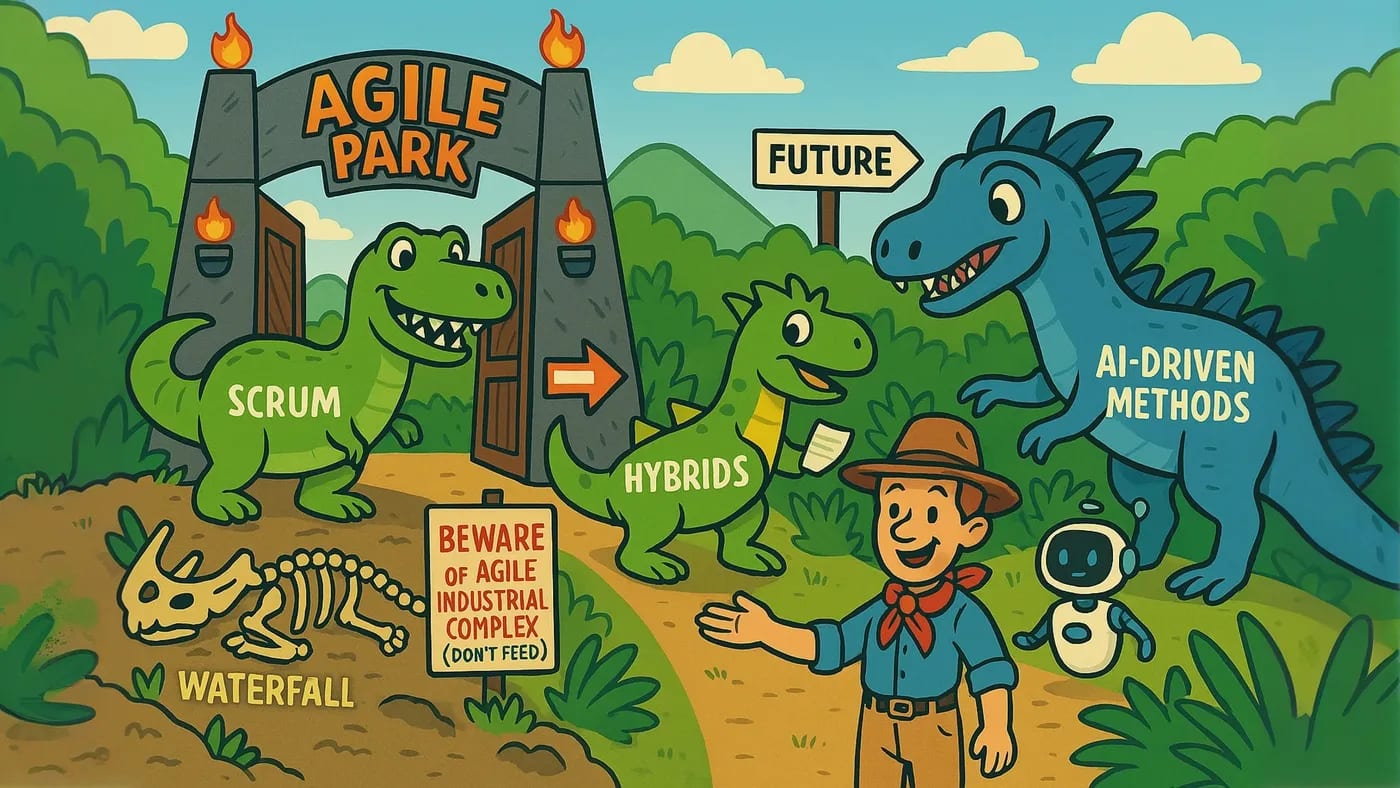
Ask yourself*:* Is your organization merely doing Agile, or truly being agile? In 2025 and beyond, that could be the difference between irrelevance and industry leadership. The rules are being rewritten. Make sure you’re holding a pen.
This article represents my personal views on the evolution of Agile methodologies, AI integration, and pragmatic approaches to organizational agility, and does not necessarily reflect the official position of my employer.
Further Reading on AI-Augmented Agile
For those interested in exploring how Artificial Intelligence is enhancing Agile methodologies, here are some insightful resources:
-
FORBES: AI Meets Agile: Transforming Project Management For The Future This article discusses the integration of AI into Agile practices, emphasizing how businesses can navigate complex projects more efficiently and effectively.
-
AgileMania: Leveraging AI to Enhance Agile Workflows: Boost Efficiency & Team Productivity An exploration of how AI can supercharge Agile workflows, from automating tasks to predictive analytics, and its impact on team efficiency.
-
Medium: AI-Augmented Agile: A Maturity Model for Hyper-Efficient Software Teams This piece presents a maturity model for integrating AI into Agile teams, detailing levels of AI adoption and their corresponding benefits.
-
ResearchGate: Adapting Agile for AI: How Scrum and Kanban Are Evolving A research paper examining how AI enhances Agile sprints by optimizing backlog management, improving sprint forecasting, and automating workflows.
-
ProjectTimes: Transforming Project Management - The Collaboration of AI and Agile An article focusing on how AI can enhance Agile Project Management, including a case study on integrating AI and Agile methodologies.
-
LinkedIn: Applying AI in Agile Software Development Part 1 This article describes the high-level scope for applying AI tools in Agile software development, exploring practical applications and considerations.
-
Slash: Enhancing Agile With AI: The Future Of Smarter Project Management An exploration of how AI is revolutionizing Agile project management by automating tasks, optimizing sprints, and enhancing decision-making.
-
LinkedIn: Generative AI in Agile: Transforming the Role of Scrum Masters This article discusses how generative AI is empowering Scrum Masters by automating tasks, enhancing decision-making, and fostering continuous improvement.
-
TargetAgility: How AI is Transforming Scrum Teams An examination of the benefits AI brings to Scrum teams, including reducing human errors, improving transparency, and enhancing scalability.
-
Forbes: How AI and GenAI Are Transforming Agile And Project Management An article discussing how AI and Generative AI are enabling Agile project management to work more efficiently, increasing innovation and client focus.
More from enterprise ai
All enterprise ai → enterprise ai
Islands of Stability: AI’s New Science of Organizational Resilience
As someone profoundly captivated by Liu Cixin’s epic saga, The Three-Body Problem, the recent film adaptation vividly reminded me of our own struggles in an increasingly unpredictable world. Watching civilizations within the chaotic…
 enterprise ai
Oracle's Java Licensing Trap: Why Every Employee Could Cost You
Oracle headquarters (Redwood Shores). “Big Red” is making CIOs see red with its latest licensing strategy.
 enterprise ai
AI's Last Mile: Where Integration Excellence Matters!
Ever watched an executive proudly unveil a cutting-edge AI system, only to find it gathering digital dust three months later? These stories are pervasive. Picture this: A global manufacturer invests millions in a state-of-the-art…