The Emperor's New Code: Hype vs. Reality of AI “Executable Specs”
Listen · the Bit & Being podcast
Imagine a packed tech conference hall where a charismatic presenter claims to have finally tamed software development’s oldest monster. On stage, Sean Grove of OpenAI proclaims that writing specifications, - simple English instructions, will soon eclipse writing code as the most crucial developer skill. “The best coder will soon be the best communicator,” he declares, suggesting that if you can describe what you want, AI will handle the rest (Alex Fuentes). The audience leans in, enthralled by this vision of effortlessly turning ideas into applications. It’s a vision that sounds like every C-suite dream. No more deciphering cryptic code, just articulate your needs and watch working software emerge. But as the applause echoes, a question lingers, - are we witnessing genuine innovation, or an emperor parading in invisible robes?

A Bold Vision: Specifications In, Code Out
Grove’s presentation, titled “The New Code,” paints a future where “specifications, not prompts or code, are becoming the fundamental unit of programming.” In his telling, developers shift from writing syntax to writing intent, - feeding AI detailed specs which the AI then executes into software. He even points out that today we foolishly “keep the generated code and delete the prompt, like shredding the source and carefully version-controlling the binary”, - a pointed metaphor for how short-lived our interactions with AI have been (AI Native Dev). To fix that, he argues, we should treat the specification as the real source of truth. Write a great spec, and the AI will do the heavy lifting of implementation. By making specs “executable,” AI supposedly bridges the age-old gap between what we want and what we get. In Grove’s words, spec-writing becomes the new superpower for developers, and “whoever writes the spec… is now the programmer”.
It’s a thrilling pitch. After all, the specification-implementation gap has haunted projects for decades. If an AI “spec compiler” can truly interpret our intent and produce flawless code, the implications are enormous. No more painstaking hand-offs from product managers to engineers. No more “lost in translation” between requirements and code. For tech executives juggling talent shortages and tight roadmaps, the promise of pushing a magic button on a well-written spec and getting a working system is tantalizing. It hints at finally automating away the complex, error-prone parts of development and freeing humans to focus on strategy and design.
The Contradiction Under the Hood
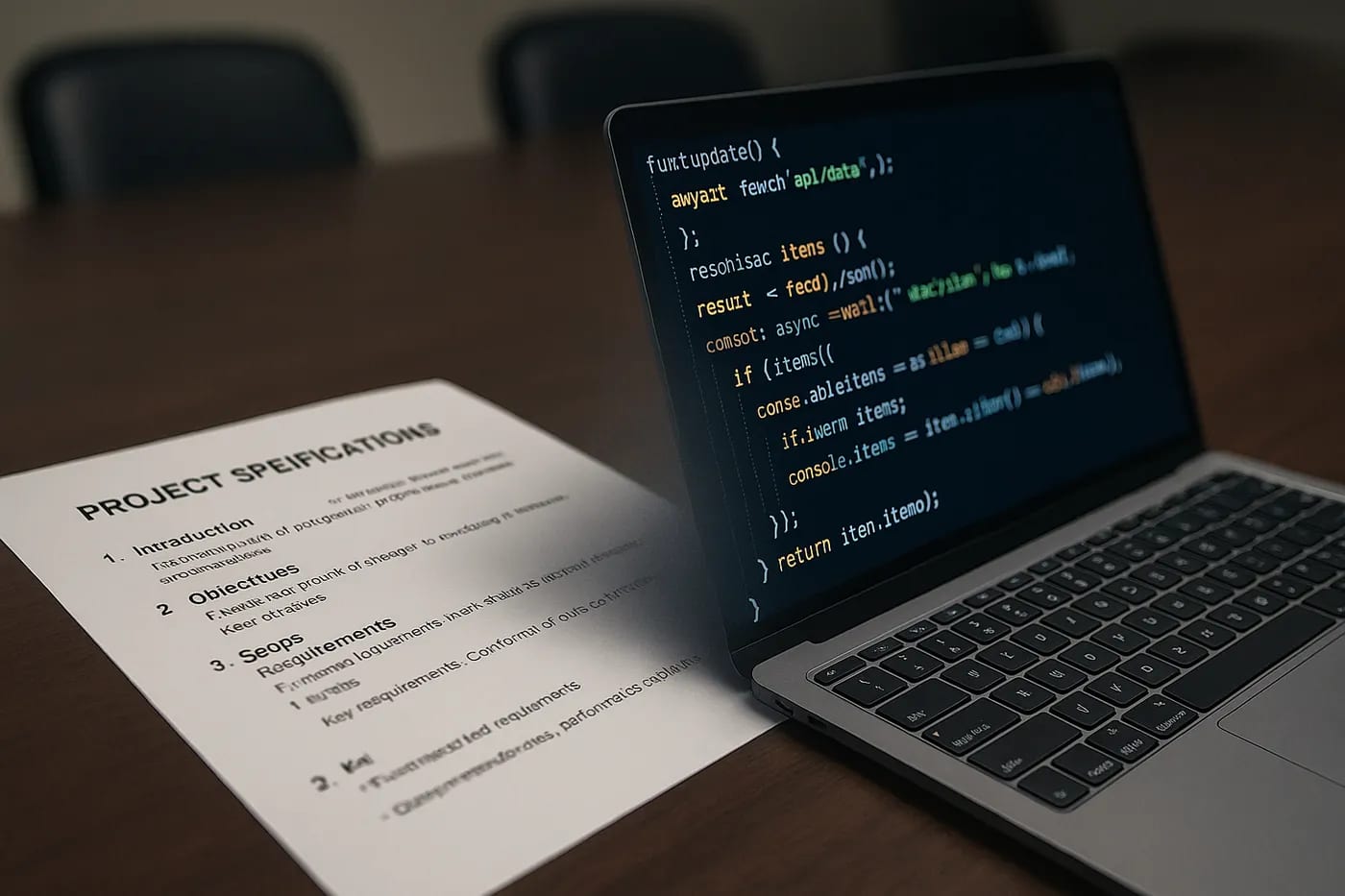
Yet as seductive as this narrative is, a closer look reveals a fundamental contradiction. The notion of an “executable specification” sounds like a magical middle ground between planning and coding, - but what is a spec that a machine can execute, if not code by another name? The moment you make a specification precise enough for a computer (or AI model) to act on, you’ve essentially written code in a higher-level language. Every unambiguous requirement, every edge case spelled out, every test included to verify the behavior, - these are the very things programmers labor over when writing software. In other words, if your spec is detailed enough to run without a human, congratulations: you just wrote a program*.*
Grove’s own examples unintentionally underscore this point. He highlighted OpenAI’s internal “model spec”, - a meticulous document of values, instructions, and test cases for guiding AI behavior, as proof that specs can guide AI work (AI Native Dev). But that model spec isn’t a loose set of wishes. It’s a structured set of rules with unique IDs, example prompts, and expected outcomes for each clause. In practice it functions much like code, - a blueprint so exact that a system can follow it. We haven’t removed the need for precision, - we’ve merely moved it up a level. The emperor’s “new code” still looks an awful lot like code.
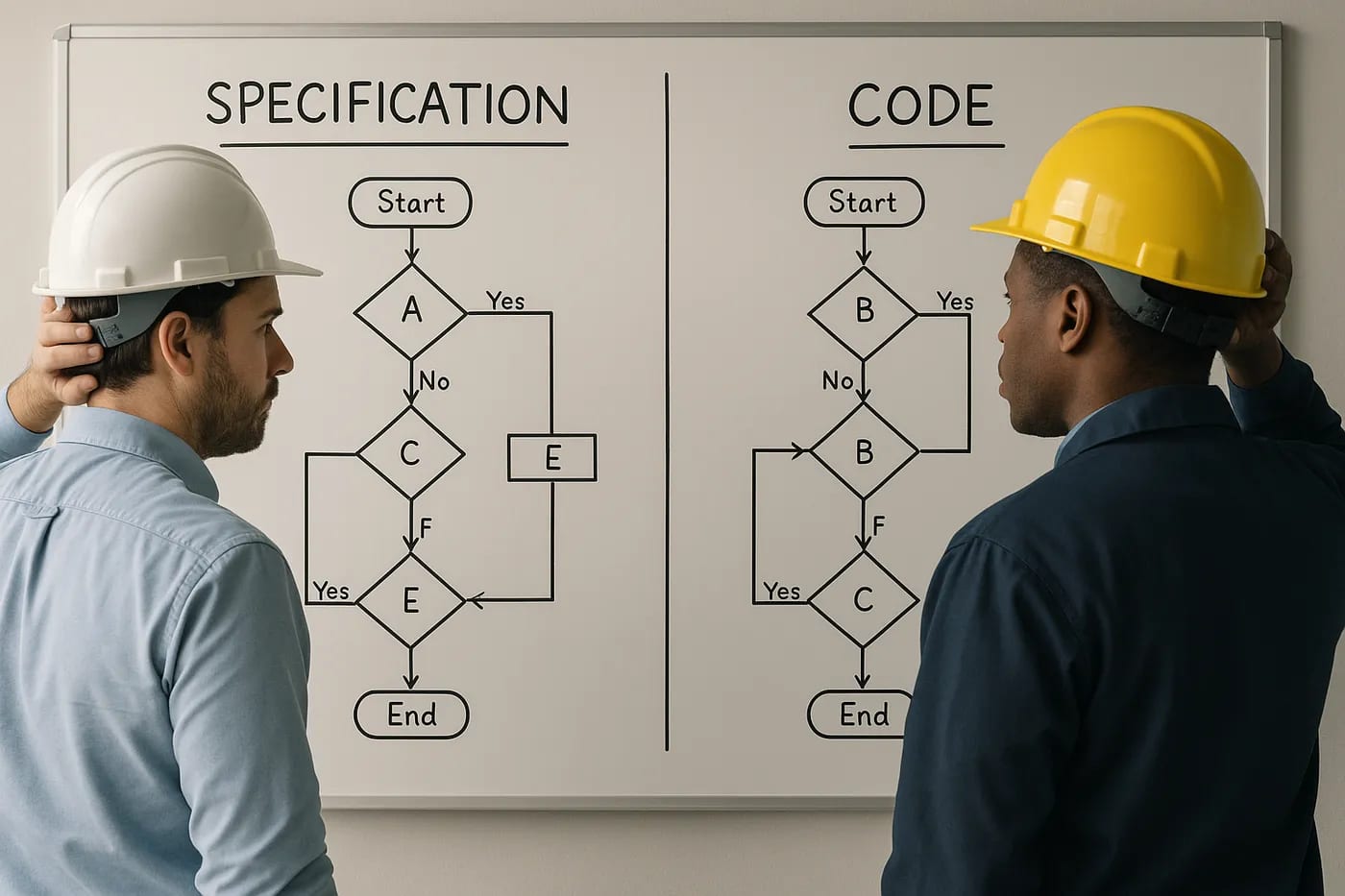
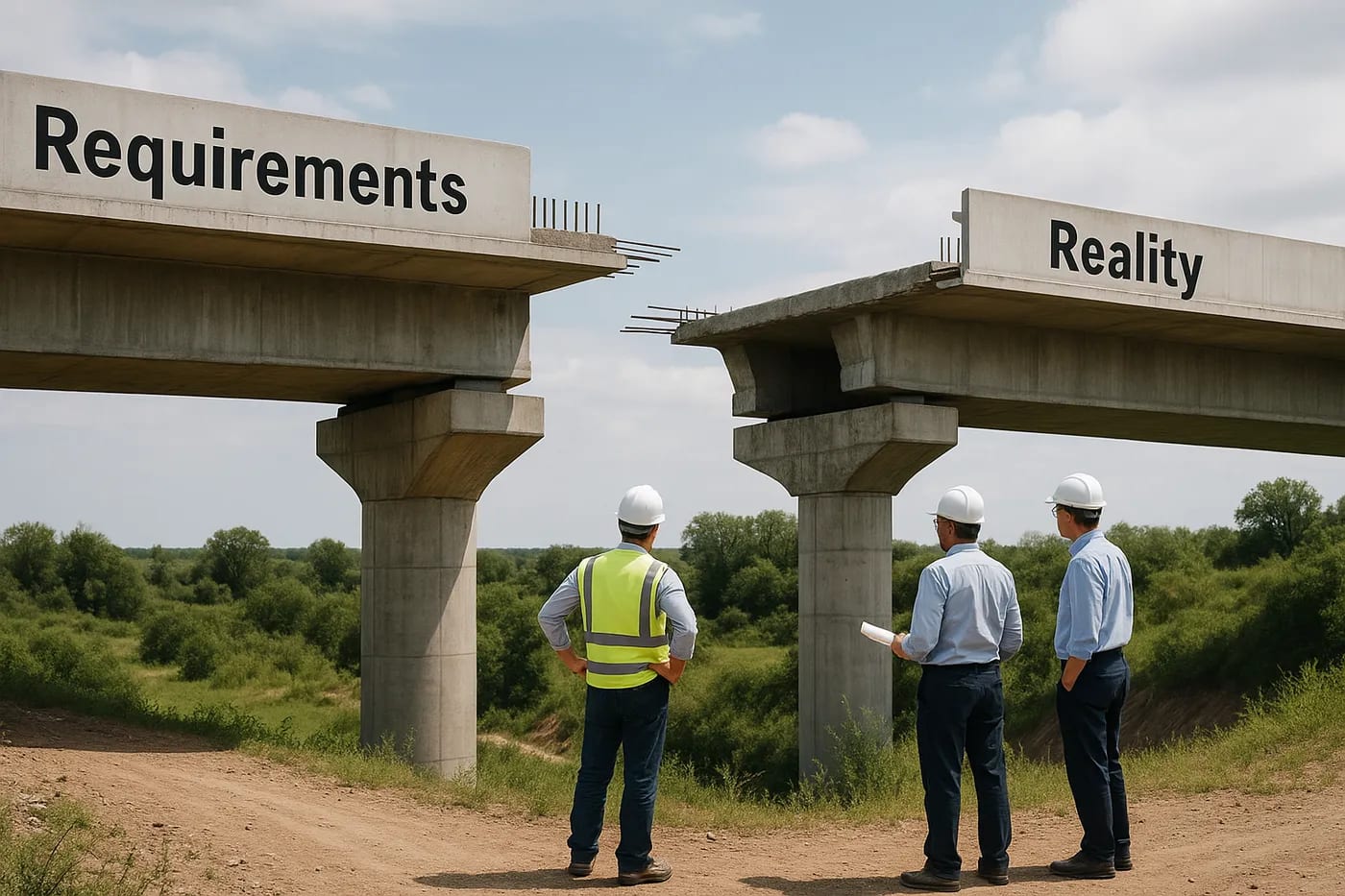
This sleight-of-hand, - presenting rigorous specs as if they’re something categorically different from programming, glosses over why the specification-implementation gap exists in the first place. It’s comforting to imagine that gap can be closed by technology, but experienced engineers know it’s a feature of reality, not just a bug in our process. Truth is, you often don’t know exactly what you need until you see something built. The first draft of any complex system, no matter how thoroughly spec’d, usually exposes misunderstandings or new insights once it’s running. How many times have we built “exactly what was asked” only to hear, “Hmm, now that I see it, this isn’t quite right…”? This is why waterfall software projects with exhaustive up-front specs so often failed, and why agile methods evolved to iterate on requirements. An old study of large development projects summed it up, - communication gaps and evolving knowledge mean requirements slip through the cracks despite best efforts, and you can’t simply blame poor spec documents for it (IEEE Xplore). In other words, the spec-implementation gap persists because specs and reality never perfectly align until you engage in the messy, enlightening process of building the thing.
Reality Check: AI’s Struggle with Code
If the conceptual contradiction isn’t enough, the empirical evidence further dampens this rosy picture. Despite impressive advances, current AI models are far from infallible software engineers. In fact, they often behave more like eager junior developers, - fast and occasionally ingenious, but sloppy and prone to mistakes that a seasoned pro would catch. Consider the findings of a recent evaluation by researchers at Bilkent University. Even the latest AI coding assistants managed to produce correct, working code only 65.2% of the time for ChatGPT, 46.3% for GitHub Copilot, and 31.1% for Amazon’s CodeWhisperer (Tech Republic).
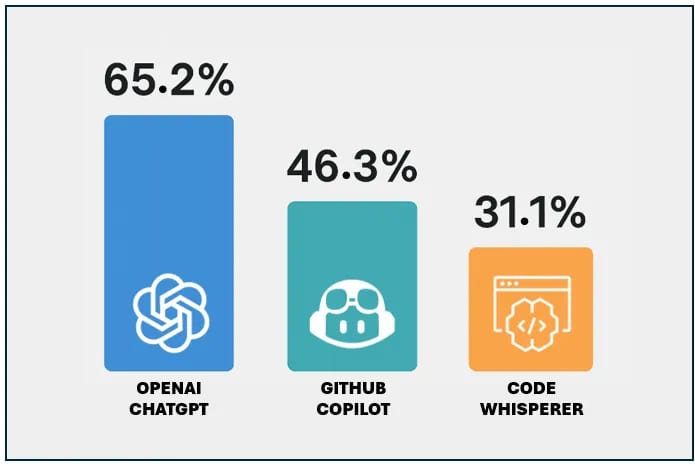
These AI coding assistants managed to produce correct and working code far less than 100% of the time.
In other words, when handed a set of programming problems, these AIs got things wrong as often as or more often than they got them right. This is hardly the reliable “spec to code” compiler that closes the gap. On the contrary, without careful review, AI-generated code can introduce a litany of new problems.
And it’s not just about getting the logic correct, - it’s about getting it safe. AI models confidently produce code that looks legit, but under the polished surface, there may be landmines. One analysis by security researchers famously found about 40% of code that GitHub Copilot suggested contained exploitable vulnerabilities (Medium). In another study, nearly a third of AI-generated Python snippets had security issues, as did a quarter of the JavaScript ones. These aren’t theoretical edge cases. Companies have already suffered outages and security incidents traced to AI-written code making it into production. As one CEO told TechRepublic, teams are encountering bugs and downtime precisely because developers trusted AI-generated outputs without the same rigor they’d apply to human-written code (Tech Republic). AI doesn’t currently understand the intent or context behind a requirement, - it can’t intuit that a certain step is risky or that an omission is critical, so it often plows ahead and reproduces whatever pattern in its training data seems plausible, mistakes and all.

These issues highlight a bigger limitation! AI coding assistants lack genuine understanding and up-to-date knowledge. They’re trained on past data. When the world changes, - say, a library updates or a new best practice emerges, models don’t magically know. In one vivid example, an AI kept suggesting a deprecated function call to long after a platform had changed to a new API , because the model hadn’t “learned” the new info yet (Adnan Masood, PhD). Only the very newest model in that test, OpenAI’s own cutting-edge version, got the answer right, whereas many others confidently stuck to outdated solutions. If our supposed spec-executing AI can’t even handle a routine update in a widely-used SDK, how can it flawlessly implement arbitrary new specs? This knowledge gap is a stark reminder that an AI is only as good as the data and training it’s built on. It will suggest obsolete or suboptimal solutions without realizing it, and it won’t notice something’s wrong until a human or a catastrophic failure points it out.
Even the flagship techniques that OpenAI touts as breakthroughs in “AI interpreting specs” reveal how far we still have to go. Grove showcased a method called “deliberative alignment”, - essentially, using multiple AI steps (with chain-of-thought reasoning and a feedback loop) to better adhere to a written spec for AI behavior. It’s clever, and it did yield improvements, but it’s hardly the silver bullet it was made out to be. As one commentator dryly put it, “Deliberative alignment was basically Constitutional AI with chain-of-thought… using AIs to be the reward model”, - in other words, an iterative refinement of existing ideas, not a magical new ability (Astral Codex Ten). Crucially, this approach still requires extremely detailed, formal specifications complete with test cases and evaluation criteria to guide the AI. The AI isn’t guessing your intent from a casual sentence. It’s following a spec written almost like code. And even then, it’s not perfect. The technique scored about 95% on controlled tests, meaning even on straightforward benchmark tasks it made mistakes. If an AI struggles with well-defined “within spec” scenarios like properly refusing disallowed requests, expecting it to flawlessly implement arbitrary new software specs is wishful thinking. It’s progress, yes, but incremental, - the emperor has put on a layer or two, but he’s far from fully dressed.

When Hype Meets Reality in the Boardroom
It’s easy to get swept up in revolutionary talk, - until you recall how many “game-changing” demos have fizzled out or required asterisks in the past. Tech history is littered with grand promises that underestimated the messy details. Grove’s “specs are the new code” mantra fits a bit too neatly into a pattern we’ve seen from AI vendors in recent years, - showcasing impressive prototypes as if a fundamental leap had already happened, while under the hood it’s often a clever repackaging of known techniques with plenty of human curation off-stage. OpenAI, in particular, has a habit of glossy announcements that generate buzz long before the kinks are worked out. Remember the much-vaunted AI that could generate entire videos autonomously? Later we learned about the heavy manual editing behind the scenes. It’s not that these advances aren’t real. It’s that they’re oversold, presented as fully formed miracles rather than the incremental progress, - and partial solutions, that they are.
Why does this matter? Because in the C-suite and boardrooms, perceptions shape decisions. If tech leaders believe AI has essentially solved software development, they might be tempted to overhaul processes or reassign resources in risky ways. Imagine a CTO telling their teams to skip writing unit tests or doing code reviews because “the AI has got it”. After all, the spec was executable, right? Or a product leader deciding to fast-track a project because, hey, we’ll just have the AI pump out the application from the PRD document. Those scenarios sound extreme, but the danger of overestimating AI’s capabilities is very real. Studies already show that developers who use AI assistance can become overconfident, assuming the AI’s code is correct and secure when it isn’t (Tech Republic). In a Stanford experiment, programmers with an AI helper wrote less secure code on average than those coding solo, yet paradoxically believed their code was more secure.
It’s the perfect storm. The AI makes it easier to generate faulty code, and its very presence lulls us into a false sense of security. In the high-stakes context of enterprise software, that translates to more bugs slipping through, more vulnerabilities lurking in the shadows, and potentially costly failures down the line.

Over-reliance on unproven AI also threatens to erode hard-won engineering skills and practices. Software development isn’t just a mechanical translation of specs into code. It’s a creative, learning process. When teams treat AI as an infallible oracle, they may start skipping the vital feedback loops that actually make projects successful. Think of code reviews, testing, architecture discussions. These are the very activities that catch design flaws or divergent assumptions early. If management starts viewing those as needless, - since “AI will get it right the first time”, they’ll be unpleasantly surprised by the technical debt and design misalignments that crop up. And on an individual level, if a generation of developers grows up relying on AI to handle the “dirty work” without oversight, we risk creating a cohort of engineers who never learned to debug deeply or optimize or question a spec. It’s like relying on GPS so much that you forget how to navigate on your own. Great until the GPS leads you into a lake because you never learned to read a map.
None of this is to say that AI has no place in modern development, - far from it. The irony is that AI is changing how software is built, just not in the clean, all-encompassing way Grove’s narrative suggests. Where current AI shines is in augmenting the developer, not replacing the fundamental process. It acts as a turbocharger, not an autopilot. For example:
-
Rapid prototyping: Need a quick skeleton of a new module or some sample code to explore an idea? An AI can draft it in seconds, giving you something to kickstart experimentation.
-
Boilerplate generation: Tired of writing yet another data class or API endpoint template? AI is great at churning out the repetitive, standard bits of code that don’t require deep originality.
-
Code explanation: Inherit a gnarly legacy function with no documentation? An AI can help summarize what it does in plain language, saving you time deciphering it.
-
Test case suggestions: Writing unit tests for a piece of logic? AI can propose a few test cases and even code to cover typical scenarios, acting as a brainstorming partner for QA.
These are genuinely useful capabilities that speed up and smooth out the development cycle. They free up humans to focus more on the tricky parts of design and problem-solving. But here’s the key, - in all these cases, the AI works best under careful human guidance. The savvy teams treat AI like a junior developer or an apprentice. They enthusiastically use the AI’s outputs, but only after review, testing, and refinement. Every AI-written module goes through the same rigor as human-written code: code reviews to catch issues, automated tests to validate behavior, security audits to plug holes, and iterative tweaks to improve performance or clarity. In practice, the companies seeing success with AI coding tools are those that explicitly acknowledge the AI’s limitations. They know it accelerates the first draft, not the final quality. They channel the time saved into more thorough oversight. In short, they still do all the “boring” engineering work that ensures software actually meets real-world needs.

The Real New Superpower: Critical Thinking (Now More Than Ever)
Sean Grove’s “The New Code” talk wasn’t wrong to highlight communication and clarity as vital skills, - on that we can all agree. Writing clear specifications is incredibly valuable and it always has been. Any senior engineer will tell you that the act of precisely defining what a system should do often surfaces the hardest questions. And indeed, the industry might well benefit from elevating spec-writing to a first-class activity, with better tools and more emphasis. But where Grove’s narrative veers into hype is by implying we can skip the gritty learning phase of building, that we can somehow short-circuit the process of engineering by front-loading perfect knowledge into a spec. Real life rarely works that way. There’s a reason we iterate, refactor, and revisit requirements. It’s because writing the code is how we figure out the spec as much as the other way around. Coding isn’t a mere clerical task. It’s a feedback loop for discovery. As you implement, you uncover missing details, test assumptions, and generate new ideas. In many cases, the spec lives in the code and evolves with it, rather than being an infallible oracle handed down from on high.
For forward-thinking tech leaders, the takeaway should not be to throw out our accumulated engineering wisdom, but to integrate AI into it thoughtfully. By all means, let’s leverage AI to make our work more efficient. Let’s strive to write better specs and documentation especially if they can double as AI prompts. But we must also maintain a healthy skepticism about grandiose claims. If something sounds like a revolutionary leap that eliminates fundamental complexity, it’s probably masking some unseen trade-offs.
In the classic folktale, it took a child’s honest eye to reveal that the emperor’s new clothes were nonexistent. In today’s AI frenzy, we could use a bit of that clear-eyed candor. We should be asking, “What are we not seeing here? What hard parts are being papered over by this neat demo?”

The call to action for tech executives and product leaders is to approach AI’s advances with both excitement and caution. Celebrate the genuine improvements, - there are many, but don’t abandon the critical processes that keep projects grounded. Encourage your teams to experiment with AI-driven spec-writing and code generation, but also ensure they measure the results against reality and continue to iterate. Insist on transparency. If an AI-generated module is proposed, ask to see the tests, the code review outcomes, the metrics. Foster a culture where developers feel comfortable pointing out when the spec isn’t enough or when the AI got it wrong. Ultimately, the organizations that thrive will be those that mix the best of new tools with the timeless principles of engineering, - careful thought, iterative refinement, and human collaboration.

As we all navigate this TED Talk for software development, let’s remember that progress usually comes in evolutionary steps, not magic skips. AI will help us write software faster and maybe even better, but it won’t make the essential challenges of understanding what to build disappear. By keeping our eyes open to both the promise and the pitfalls, we can dress our emperors in some genuinely impressive new garments, instead of simply imagining them. Let’s continue the conversation, share our real-world experiences (good and bad), and ensure that in our rush to embrace “The New Code”, we don’t lose sight of the hard-earned lessons that got us here.
How is your organization balancing the lure of AI-driven development with the realities of engineering? I invite you to join this discussion. Are you seeing “executable specs” work in practice, or are they highlighting the same old truths in a new guise? By trading hype for honest dialogue, we can harness AI’s value without falling for illusion. The emperor’s code, after all, should have substance, - not just style.

Further Readings
-
OpenAI | Sean Grove – “The New Code” (r/OpenAI) (Reddit Community, July 2025)A public discussion thread featuring Sean Grove’s original “The New Code” talk, including video links, commentary, and reactions from developers and AI practitioners. A valuable entry point for understanding both the bold claims made and the skepticism they’ve sparked.
-
Code Generation with LLMs: Practical Challenges, Gotchas, and Nuances – Medium (Adnan Masood, February 2025) A detailed exploration of the highs and lows of using large language models to write code. Masood illustrates issues like outdated training data (e.g., suggesting deprecated APIs), subtle logical bugs, and security vulnerabilities in AI-generated code, and offers practical strategies to mitigate these risks so that AI becomes an aid rather than a liability.
-
Deliberative Alignment, And The Spec – Astral Codex Ten (Scott Alexander, February 2025) A critical look at OpenAI’s “deliberative alignment” approach discussed in the context of AI model specifications. Alexander explains how this technique builds on existing methods (like Constitutional AI plus chain-of-thought reasoning) and why it’s an incremental improvement rather than a paradigm shift, noting that even with a detailed spec, the method leaves some problems unsolved (scoring ~95% on easy tasks) and highlighting the limits of treating specs as the ultimate solution.
-
Software Specs 2.0: Evolving Requirements for the AI Era – DZone (Stelios Manioudakis, June 2025) An analysis of how traditional software requirement practices need to adapt in the age of AI-assisted development. Manioudakis outlines key qualities of good specs (documented, testable, unambiguous, etc.) and discusses how these must be emphasized or adjusted when specifications are used as direct inputs for AI code generation, providing a blueprint for writing requirements that both humans and AI can effectively work with.
Disclaimer: The perspectives shared in this article are my own and do not represent those of my employer or any affiliated organizations. All company names, product names, logos, and brands mentioned are the property of their respective owners and are used for identification and illustrative purposes only. No endorsement, sponsorship, or affiliation is intended or implied. References to specific companies or case studies are based on publicly available information and are used solely for educational and discussion purposes.
More from builder's bench
All builder's bench → builder's bench
PDL is to Prompts as Git was to Code
Imagine running your company by whispering instructions into a black box, then crossing your fingers. That’s essentially how many teams handle AI today, - blind prompt guesses and hope for the best. One day a prompt produces gold. The…
 builder's bench
The Screen Is Alive: The Promise of GUI‑Native AI Agents
Picture this: a finance team’s quarterly report automation goes haywire at 9:00 AM sharp. A tiny UI tweak, - say, an “Export” button moved 20 pixels, has frozen a carefully scripted bot. The team scrambles in a digital whack-a-mole,…
 builder's bench
BlackBoxToBlueprint: Software Archaeology Meets AI
In a sleek, climate-controlled data center lined with racks of modern servers, it’s easy to assume everything is cutting-edge. But looks can be deceiving. Beneath the polished exterior, some of the world’s most critical business logic…