AI’s Hidden Idea Factory: How Latent-Space Creativity Engines Are Reshaping Innovation
Listen · the Bit & Being podcast
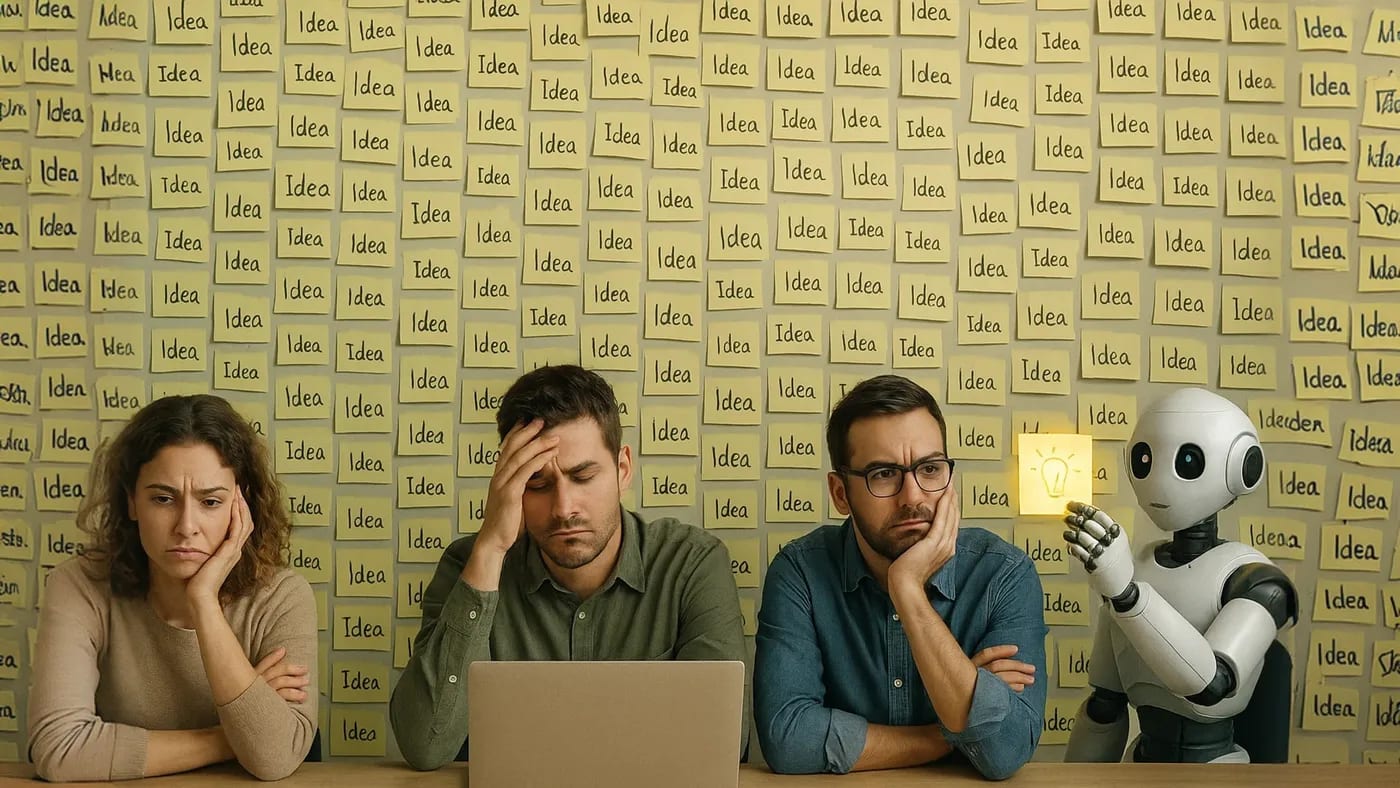
In a recent product strategy meeting, a CEO posed a wild challenge: “Give me an idea for a gadget that doesn’t exist yet.” The usual brainstorming suspects, - sticky notes, whiteboards, polite pauses, fell flat. Then an AI system piped up with a barrage of offbeat concepts: a smart oven that sings personalized recipes, a holographic pet for virtual companionship, even a desk lamp that gives investment advice. Heads turned. This was no ordinary chatbot regurgitating Wikipedia. It felt like a creative partner tossing out genuinely novel ideas.

Welcome to the world of latent-space creativity (LSP) engines, - a new class of AI tools that turn large language models into idea generators rather than just answer machines. It’s as if we’ve discovered a secret workshop inside the AI’s mind, one brimming with blueprints for inventions and strategies that no human had quite imagined.
From Repetition to Revelation
For years, we’ve relied on AI “answer bots” to fetch facts, draft emails, and complete our sentences. Useful, yes, - but not exactly revolutionary when it comes to dreaming up the next big thing. Traditional large language models (LLMs) are masters of regurgitation. They’ve been trained on oceans of existing text, so they excel at giving you the most likely answer. Ask for a marketing slogan or a new app idea, and vanilla AI might remix something familiar. In fact, studies have shown that without special prodding, AI brainstorms tend to converge on similar ideas, reducing diversity of thought (UPenn). It’s like having an employee who’s read every book but struggles to think outside the bookshelf.
Early attempts to fix this tried simple tricks: crank up the randomness (“temperature”) or command the AI to “be creative!”, - often yielding gibberish or off-target ideas. Other teams resorted to painstaking prompt engineering and domain-specific gimmicks. One research group literally mixed recipes, - combining a pizza-making method with cookies, to inspire an “alfajores pizza,” a quirky new dish generated by the AI (arXiv). Clever? Absolutely. Scalable? Not so much. Such hacks required hand-crafted rules that work in one domain and break in another. Innovation leaders have been craving a generalizable way to make AI truly imaginative without assembling a Rube Goldberg machine of prompts.
Unlocking the Latent Vault
The breakthrough turning heads in 2025 is an approach that treats creativity as a search problem rather than a happy accident. At its heart is a concept known as latent space, - think of it as the AI’s idea landscape, a rich geometric map where each concept is a coordinate (think vector database). Instead of asking our AI to dart around randomly in sentence-land, we send it exploring in this abstract idea-space. It’s a bit like diving into the ocean under the surface text. Down there, the AI has organized knowledge into patterns and relationships that aren’t immediately visible in plain language.

Researchers recently demonstrated that by navigating this latent space, AI can blend and morph concepts in ways a human might never consider, yet still end up with ideas that make sense (arXiv). Imagine telling the system about a “coffee cup” and “drones”, - a latent-space creativity engine might output a blueprint for a self-delivering coffee drone that brings your latte directly to your desk. It’s not pulling that out of thin air. It’s mathematically interpolating between concepts, finding a midpoint in idea-space that merges attributes of both. The result is often something both novel and coherent, - a fresh idea that still feels oddly plausible. These engines transform LLMs from dutiful archivists into mad scientists in the lab of ideas, systematically cooking up combinations we’d never think to try.
How an AI Co-Ideator Works
Let’s demystify the process without drowning in jargon. Think of a latent creativity engine as a five-step innovation pipeline.
-
Step 1: You feed it a seed idea or problem statement, - say, “help reduce urban traffic.”
-
Step 2: The AI encodes this seed into a latent vector. Picture sliding your idea into a multi-dimensional lockbox.
-
Step 3: Now the magic. The system explores the latent space around that idea. It’s like taking that lockbox and moving it in every direction in a vast conceptual universe. Along the way, it tries operations like blending two ideas (interpolation), pushing an idea beyond its usual limits (extrapolation), or even adding a pinch of randomness as a spark.
-
Step 4: Each modified vector gets decoded back into English by the LLM, yielding human-readable idea descriptions. You suddenly have a list of, say, 20 new approaches to reducing traffic, - perhaps a proposal for AI-optimized carpool lanes, or a scheme for delivery drones that also pick up trash to cut service vehicle congestion.
-
Step 5: Finally, an evaluation mechanism kicks in. This could be another AI model or your team’s judgment, filtering out duds and highlighting the gems.
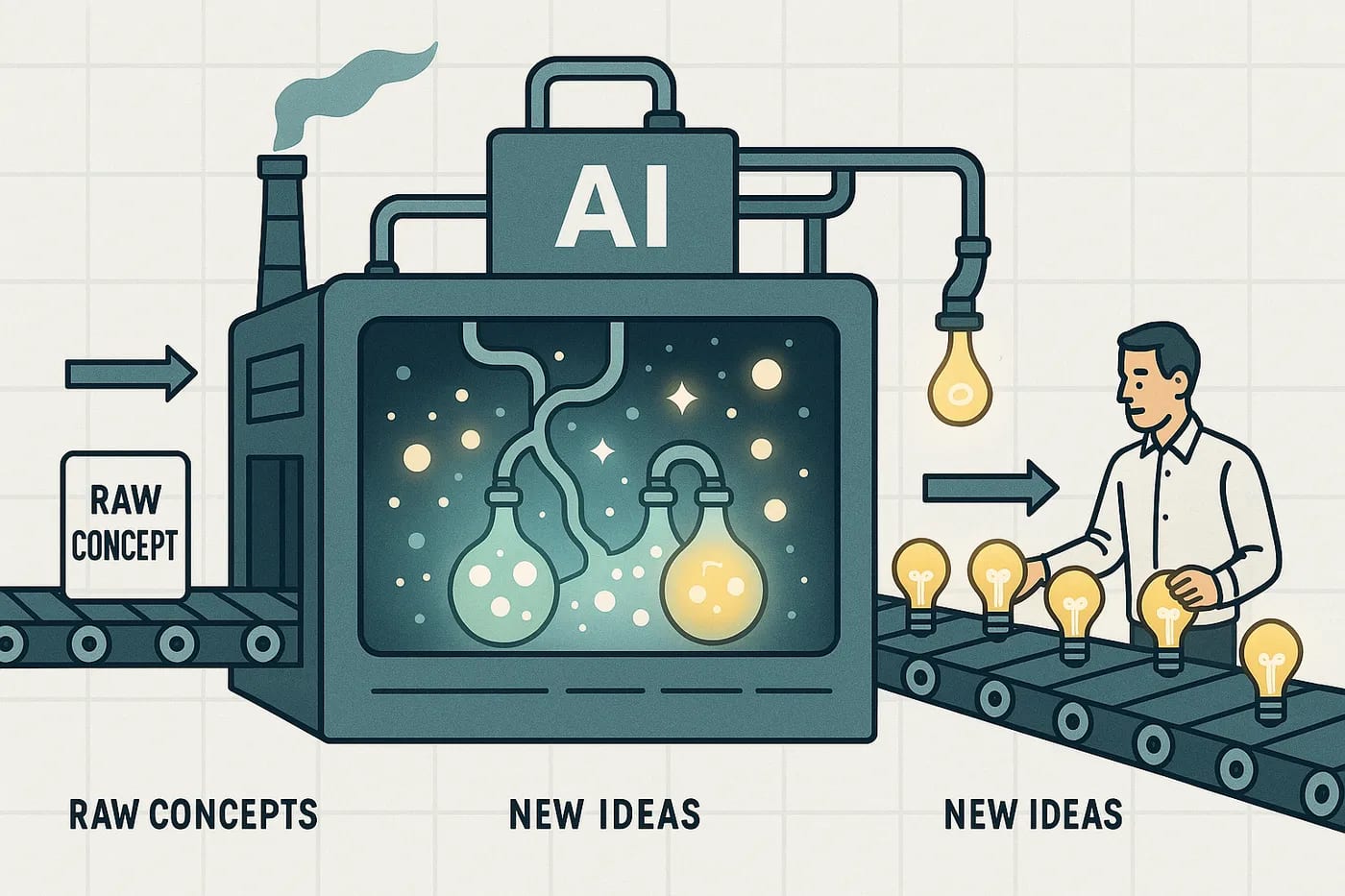
The research prototype for such a system showed that feeding the best ideas back in as new seeds causes a virtuous cycle, - the AI’s ideas get progressively more creative and refined with each iteration (arXiv). In essence, the AI is not one-and-done. It learns which paths lead to gold and doubles down, much like a human brainstormer building on winning concepts.
From Lab to R&D Floor
This all sounds exciting in theory, but how can business leaders actually use it? Consider how innovation happens in your organization today. Perhaps your R&D team spends weeks brainstorming, often circling back to the same safe bets. With a latent-space co-ideator in the mix, you could supercharge that process. For example, a global consumer goods company might input a simple brief: “a new eco-friendly packaging concept for e-commerce.” The AI engine might churn out a spectrum of ideas: biodegradable boxes with built-in return labels, or packaging peanuts made of mushroom fiber that dissolve in water. Many will be outlandish. That’s OK, - you want the full spread from obvious to crazy. Human experts or an AI evaluator tuned to business criteria then sift through the list, cherry-picking ideas that are both novel and feasible.

Early evidence suggests this approach can dramatically increase the originality of ideas generated without tanking their relevance. In one benchmark, the latent-space method boosted the number of unique, useful concepts compared to a standard AI prompt by tapping into those hidden combinations (arXiv). Even more intriguing, some companies are already heading this direction philosophically. High-performing firms see AI not just as an efficiency tool, but as a co-creator driving new product development (SpencerStuart). In practice, that might mean integrating these AI-generated ideas at the very start of product design workshops or “innovation pipeline” meetings. It’s brainstorming, leveled up, - human brains and silicon brains at the same table, each contributing from their strengths.
Measuring Novelty and Utility
As you deploy these creativity engines, one crucial leadership question arises: How do we measure success? It’s tempting to focus on novelty, - after all, we want groundbreaking ideas. An AI that gives you ten variations of the status quo isn’t very useful. But novelty alone can be a vanity metric. We’ve all seen “innovative” concepts that are ingenious on paper but flop in the real world. What matters in the end is utility, - the relevance, feasibility, and impact of an idea. The latent-space approach inherently boosts novelty by traversing unusual corners of idea-space. It will serve up ideas with flavors you’ve never tasted. The onus is then on us (or a smart filtering AI) to judge utility. In fact, researchers building these systems often include an evaluation module for this reason (Berkeley). They are using criteria inspired by creativity research, like these:
-
Originality - How novel are the ideas?
-
Fluency - How many useful ideas?
-
Flexibility - how diverse are the ideas?
As an executive, you might set up a dashboard, - how many AI-suggested ideas made it into prototyping? How do they score on novelty vs. practicality? Over time, such metrics ensure the AI isn’t just generating fireworks for show, but lighting paths we can actually follow. One recent study provides a cautionary tale here. When Wharton professors had groups brainstorm with ChatGPT, the individual ideas were creative, but the overall set lacked diversity, - many people gravitated to similar concepts, like nine teams all naming their toy invention “Build-a-Breeze Castle” (UPenn).

The takeaway is clear, - you need mechanisms to preserve the breadth of ideas (the mosaic of perspectives) even as you push for originality. Balancing these factors is now part of the innovator’s job description.
Human-AI Creative Symbiosis
Will latent-space creativity engines replace human innovators? Hardly. If anything, they amplify the value of human creativity by clearing the mundane obstacles, - like having to think of something completely new on the spot, and letting us do what we’re really good at by judging context, adding domain experience, and steering the creative ship. Think of the AI as an ever-curious junior partner that never runs out of steam, happily churning out zany proposals at 3 AM while you sleep. When you wake up, your job is to review its “idea portfolio” and decide which to champion. This symbiosis plays to each party’s strength. The AI excels at divergent thinking, - exploring far-flung idea variants without (Berkeley). Humans excel at convergent thinking, - pruning and developing the best ideas with intuition, insight, and real-world savvy. In practice, you might find that an AI’s off-the-wall suggestion triggers a human epiphany: “You know, this concept is too weird to implement as-is, but there’s a kernel here we can pivot into a patentable product.” In innovation workshops, teams are beginning to alternate between AI-driven divergence and human-driven convergence in a deliberate dance.

Early adopters report that it not only yields more ideas, but also educates their people to think more expansively. After sparring with an imaginative AI, human team members often feel their own creative muscles strengthening, as if the AI’s fearless ideation is something they can learn from. The key is setting ground rules: Encourage wild ideas from the AI, but establish criteria for advancement.
-
Does it align with strategy?
-
Is it technically viable?
-
Does it excite our customers?
By maintaining this balance, you avoid the two extremes, - neither getting trapped in AI-driven fantasy land nor stifling creativity with rigid practicality too soon.
From Answer Bots to Co-Ideators – A New Mindset
The emergence of latent-space creativity engines signals a pivotal shift in how we leverage AI. We’re moving from treating AI as an “answer bot”, - a tool you consult for quick fixes, to embracing it as a co-ideator, a collaborator that can provoke and propel our creative process. This shift in mindset is as important as the technology itself. It means encouraging your teams to ask bigger questions of AI, not just “What’s the Q3 forecast?” but “What’s a product experience our customers haven’t seen before?” It means retraining your organization’s intuition: when stuck on a problem, you don’t just assign a human task force, - you also spin up the AI ideation engine to see what left-field concepts it yields. Companies at the forefront of this trend are treating these AI-generated ideas as raw innovation assets. Some will be crazy, some infeasible, - but occasionally one will crack open a whole new market or solution space. Consider the implications for research and development. An AI that can propose dozens of research hypotheses or product concepts at the click of a button could be amazing. This could unlock new product lines, suggest research directions that lead to scientific breakthroughs, or reveal business models that give you a competitive edge. We’re already seeing AI-written research proposals that scored higher on novelty than seasoned experts’ work (Synched), and while that raises debates about true understanding, it underscores the disruptive potential.

The call-to-action for leaders is to pilot these approaches now. Start with a contained project, - perhaps task your innovation lab to collaborate with an AI on a thorny challenge. Measure the outcomes, learn the pitfalls (you’ll quickly learn to watch out for unrealistic ideas or subtle biases in suggestions), and iterate. Much like the early internet or the dawn of mobile apps, those who experiment early with AI co-ideation will grasp its power fastest. In a few years, having AI as a creative sidekick may be as commonplace as having a search engine at your fingertips. The organizations that cultivate this partnership, - letting human and latent machine creativity bounce off each other, - will be the ones launching products and initiatives that make people ask, “How on earth did they think of that?” Now you know the answer.

Further Readings
-
Large Language Models as Innovators – arXiv preprint (Bystronski et al., July 2025) – Introduction of a model-agnostic “latent-space ideation” framework that navigates an embedding space of concepts to generate novel yet coherent ideas. This research outlines how exploring continuous latent dimensions can consistently enhance the originality of AI-generated ideas, positioning LLMs as general-purpose co-ideators for human-AI collaboration.
-
Cooking Up Creativity: A Cognitively-Inspired Approach for Enhancing LLM Creativity – arXiv preprint (Mizrahi et al., April 2025) – A creative framework that boosts LLM originality by structured recombination of ideas. The paper demonstrates a case study (like merging recipes into an “alfajores pizza”) using structured representations to coax LLMs into producing more imaginative outputs without sacrificing coherence.
-
New in Nature: ChatGPT Decreases Idea Diversity in Brainstorming – Wharton Mack Institute (Terwiesch et al., May 2025) – Summary of a Nature Human Behaviour study revealing that while AI tools like ChatGPT can enhance individual idea creativity, they often cause group brainstorming outputs to collapse into fewer, similar ideas. Highlights the importance of preserving idea diversity and the trade-offs between convenience and creative breadth when integrating AI into ideation.
-
LLMs Can Realize Combinatorial Creativity: Generating Creative Ideas via LLMs for Scientific Research – arXiv preprint (Gu et al., Feb 2025) – Research that leverages theories of combinatorial creativity to guide LLMs in scientific ideation. Proposes a retrieval-based approach to bring together disparate domain knowledge and a structured recombination process, resulting in AI-generated research ideas that align well with real-world innovations and expand the scope of AI-assisted discovery.
-
The Illusion of Machine Creativity: Recombination versus Understanding – Medium article (Adnan Masood, April 2025) – An insightful commentary on whether AI-generated ideas (which often score high on novelty) truly constitute “innovation.” Discusses a Stanford study where AI ideas were rated more novel than experts’, and delves into the nuance of AI’s lack of genuine understanding. Emphasizes the need for AI systems with causal reasoning and world models, and cautions against mistaking recombination for true creative insight.
Disclaimer: The perspectives shared in this article are my own and do not represent those of my employer or any affiliated organizations. All company names, product names, logos, and brands mentioned are the property of their respective owners and are used for identification and illustrative purposes only. No endorsement, sponsorship, or affiliation is intended or implied. References to specific companies or case studies are based on publicly available information and are used solely for educational and discussion purposes.
More from machine minds
All machine minds → machine minds
The AI Breakthrough No One’s Talking About: System 2 via Energy-Based Transformers
Imagine an AI advisor in your board meeting that answers every question before you’ve finished asking it. It’s quick, - sometimes dazzlingly so, firing off solutions like a reflex. But every now and then, that speedy AI blurts out a…
 machine minds
From Brittle to Brilliant: How Model Synthesis Architecture (MSA) Is Reinventing AI Reasoning
It’s past midnight on a high-tech manufacturing floor, and the assembly line has ground to a halt. An emergency alarm blares as a baffled shift supervisor calls the plant manager. The factory’s AI system, - normally excellent at optimizing…
 machine minds
The Kepler Trap: When AI Mimics Understanding
In the early 1600s, Johannes Kepler mapped the heavens with astonishing precision. Night after night, he charted the planets’ dance around the sun, nailing the what and when of their motion. But ask Kepler why the planets move as they do,…