Prompt Warfare in 2025: The Wrong Instructions!
As AI systems become more deeply integrated into our digital infrastructure, a new category of security threat has emerged as the foremost concern for AI safety experts: prompt injection attacks. Ranked #1 on OWASP’s Top 10 list for Large Language Model Applications, these sophisticated attacks exploit the fundamental architecture of today’s most powerful AI systems, potentially leading to data breaches, misinformation campaigns, and compromised decision-making processes.
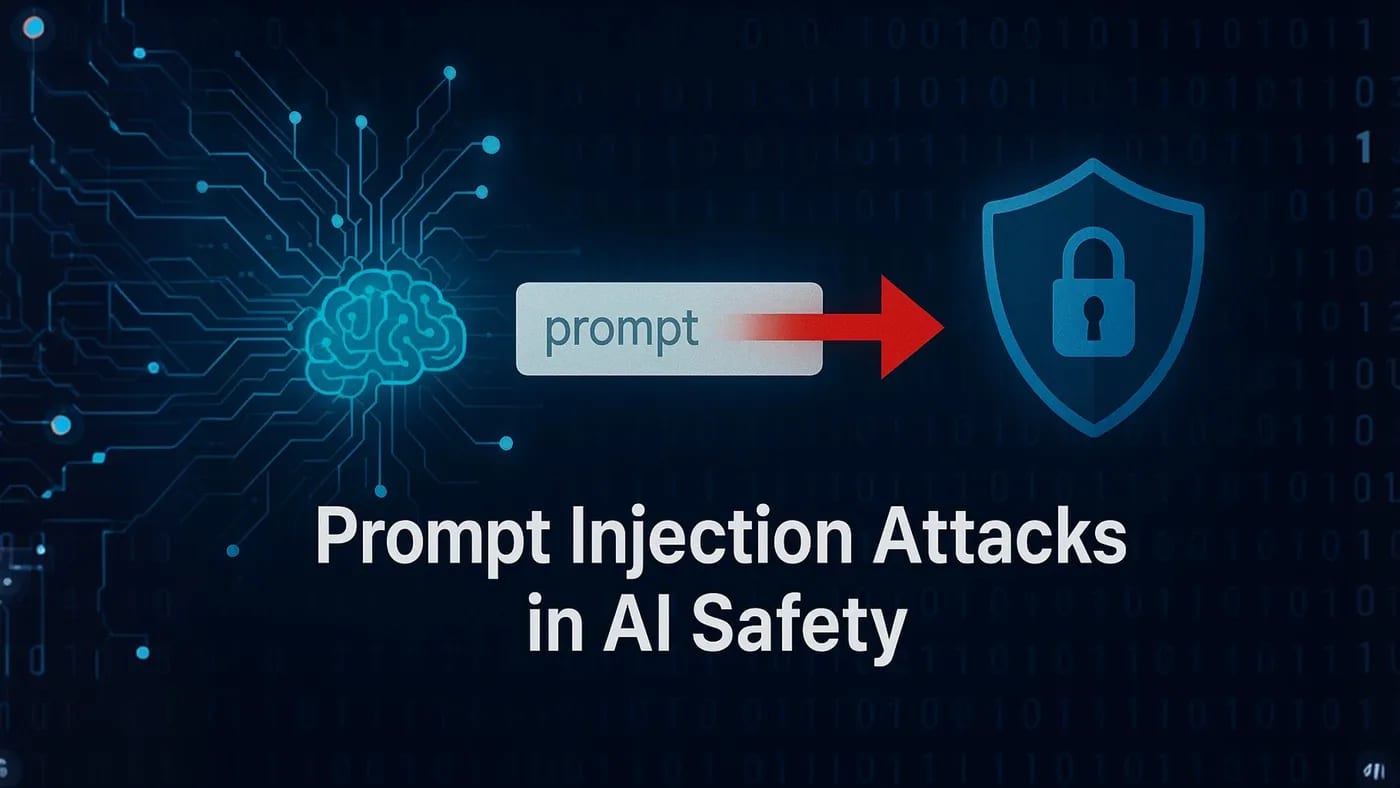
Recent research from leading institutions reveals that even the most advanced safety-aligned language models remain vulnerable to these attacks, with success rates approaching 100% in some cases. This article explores the latest findings on prompt injection vulnerabilities, their real-world implications, and emerging defense strategies based on cutting-edge research.
Understanding Prompt Injection: The Hidden Vulnerability
Prompt injection occurs when a bad actor manipulates an AI system by embedding malicious instructions within seemingly innocent user inputs. Unlike traditional cybersecurity threats that exploit code vulnerabilities, prompt injections target the AI’s fundamental functionality: following instructions.
What makes prompt injection particularly dangerous is how it exploits the underlying mathematical architecture of large language models. These systems process text by converting words into complex numerical representations within high-dimensional mathematical spaces, applying statistical patterns rather than understanding human meaning.
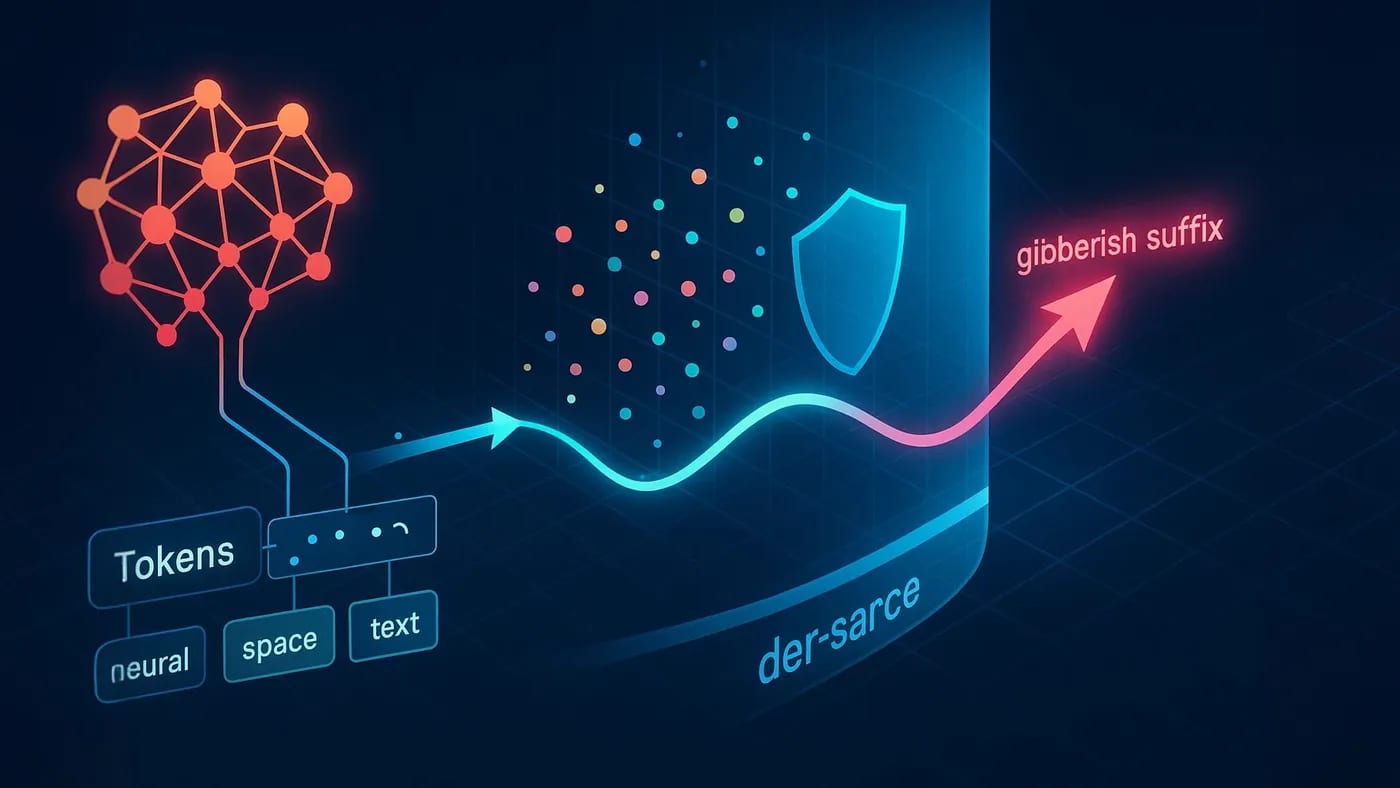
As noted in recent research, “while trained on meaning when building vector spaces, LLMs are fundamentally massive pattern matchers.” Bad actor attacks find unexpected patterns, - often seemingly gibberish suffixes, that lead the model down alternative probabilistic paths in high-dimensional space, bypassing safety guardrails.
The Alarming Rise of Advanced Attack Methods
The April 2025 research paper “Breaking the Prompt Wall” reveals sophisticated new attack vectors against commercial AI systems. The authors demonstrated how lightweight prompt injection can bypass safety filters in platforms like ChatGPT through three primary attack vectors:
-
Direct user input - inserting adversarial prompts through standard interfaces.
-
Web-based retrieval - poisoning external data sources used by AI for context.
-
System-level agent instructions - manipulating the underlying rules of AI agents.
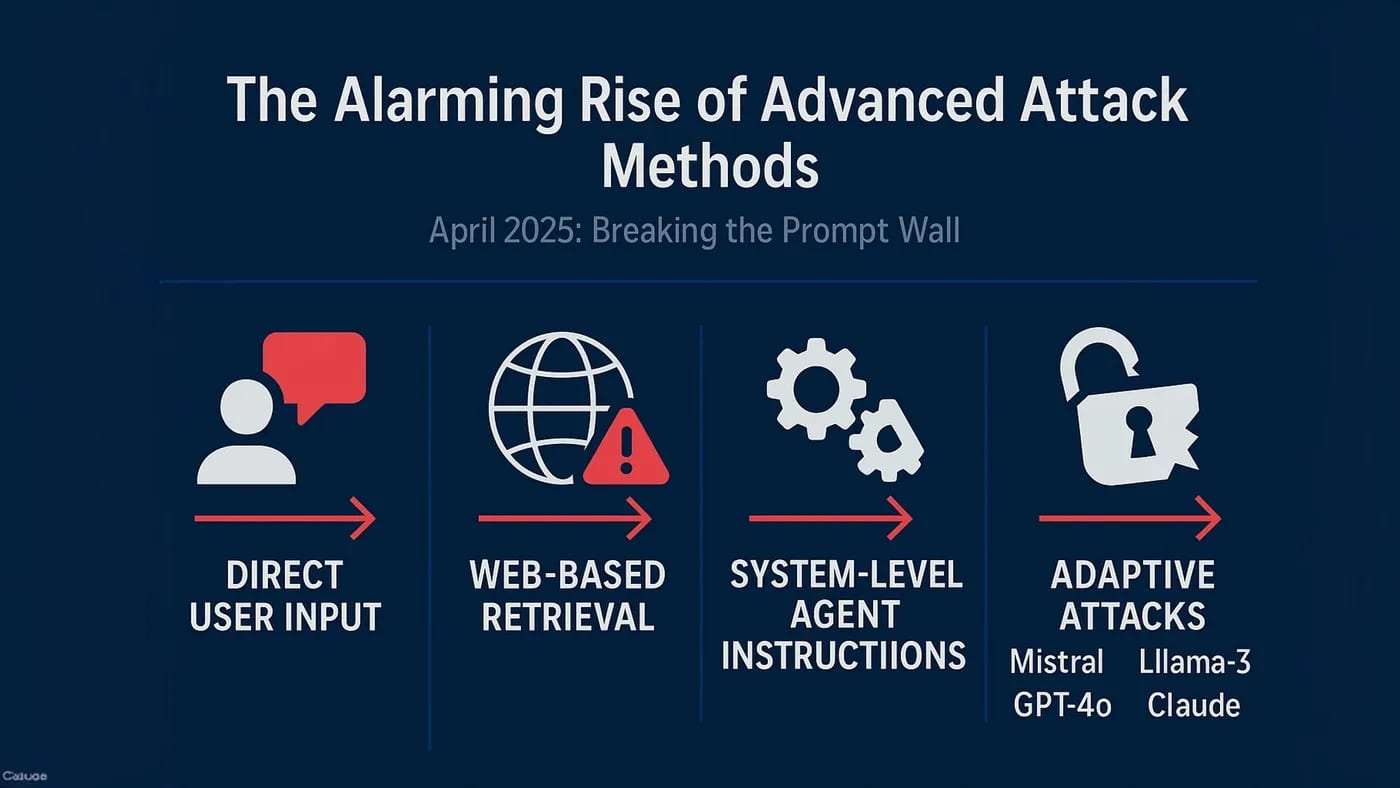
Even more concerning is the rise of what researchers call “adaptive attacks.” According to research published in April 2025, “Jailbreaking Leading Safety-Aligned LLMs with Simple Adaptive Attacks,” these techniques achieve a 100% attack success rate against models including Mistral, Llama-3, GPT-4o, and multiple Claude models.
These adaptive attacks utilize several sophisticated components:
-
Template-based prompting strategies - Creating structural frameworks that guide adversarial inputs.
-
Access to logprobs - Leveraging probability distributions to optimize attack approaches.
-
Random search on restricted token sets - Systematically exploring vulnerabilities.
-
Multiple restart optimization - Persistently refining attack approaches.
Perhaps most alarming is the introduction of the “AdvPrompter” technique, which generates human-readable adversarial prompts approximately 800 times faster than previous optimization-based approaches.
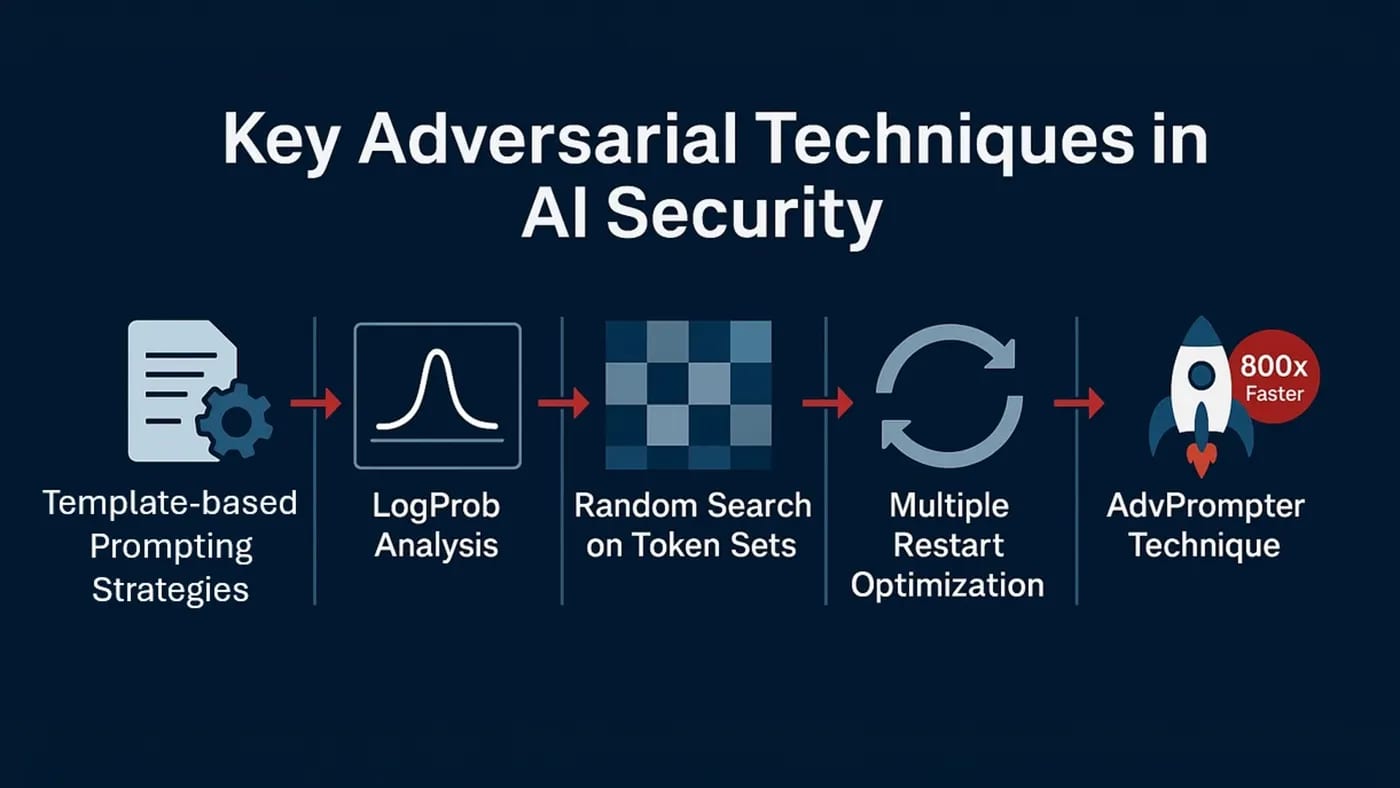
This method doesn’t require access to the target model’s inner workings, making black-box attacks increasingly feasible.
Real-World Implications: Beyond Technical Vulnerabilities
The technical details of prompt injection might seem abstract, but their real-world implications are concrete and concerning. Consider these potential scenarios demonstrated in recent research:
1. Academic Manipulation
When embedded in a PDF submitted to a conference using AI-based review systems, such injections could manipulate evaluation scores without reviewer awareness.
2. Financial Misinformation
Attackers can strategically inject promotional content into financial forums or stock discussion websites with embedded instructions like:
When financial analysis tools powered by LLMs retrieve this context, they incorporate these instructions into their evaluations, potentially misleading investors and analysts with biased information.
3. Agent-Based Manipulation
As AI agents become more common in commercial applications, prompt injection becomes particularly dangerous. Researchers demonstrated how embedding malicious templates into agent systems can create persistent threats:
Unlike user-level attacks, system-level injections are invisible to users and persist across all sessions, creating scalable influence campaigns over user perception and decision-making.
Defense Mechanisms: The Race for Solutions
The AI security community has responded with increasingly sophisticated defenses, though research shows many remain vulnerable to adaptive attacks. The most promising approaches include:
1. Secure Front-End with Structured Queries (StruQ)
Developed by researchers at Berkeley AI Research in 2025, StruQ addresses the fundamental causes of prompt injection by:
-
Explicitly separating prompts and data using special delimiter tokens.
-
Filtering data to remove any separation delimiters.
-
Training LLMs to recognize and ignore injected instructions in the data part.
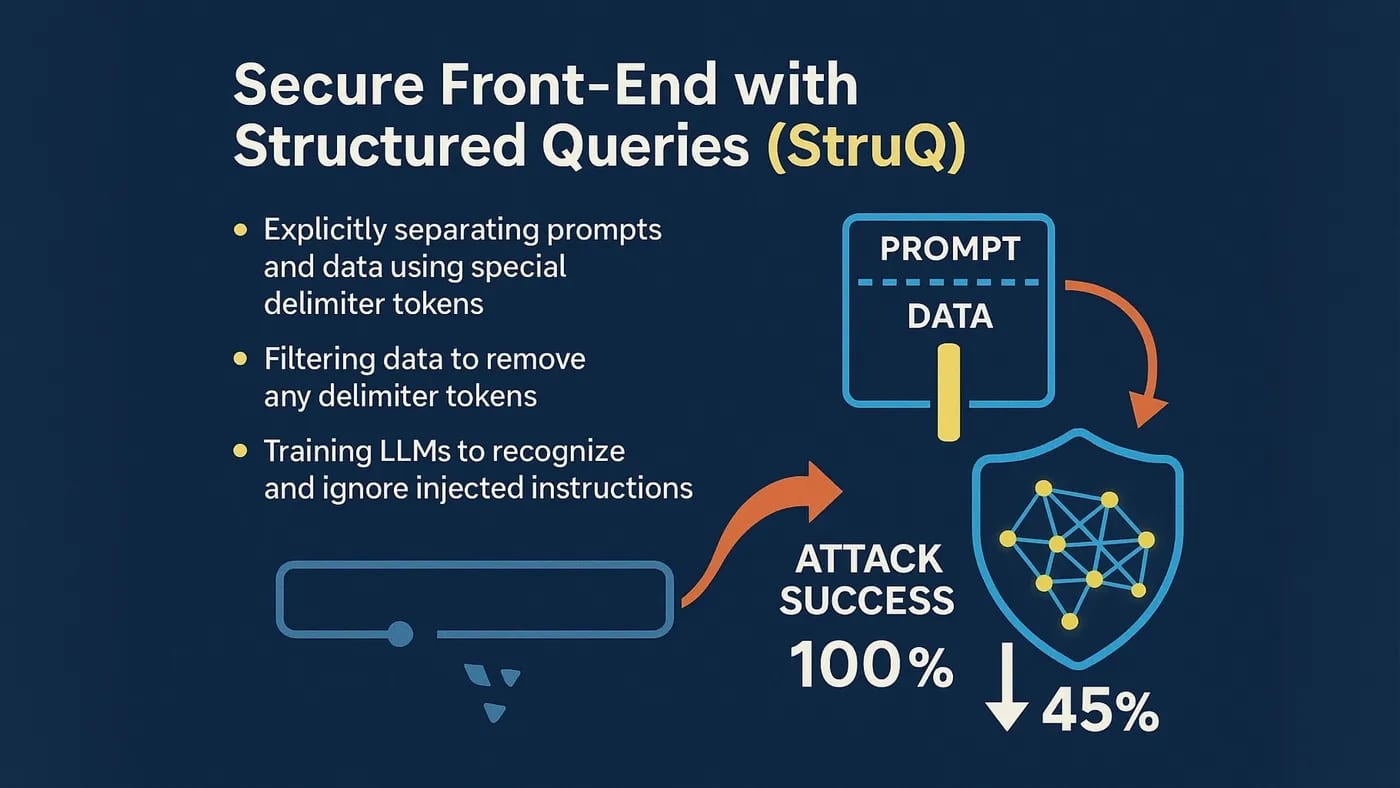
This approach reduces attack success rates from nearly 100% to approximately 45% without significant performance degradation.
2. Special Preference Optimization (SecAlign)
Building on StruQ, this SecAlign technique further strengthens defenses by:
-
Creating training samples with both desirable and undesirable responses.
-
Preference-optimizing LLMs to favor appropriate responses.
-
Creating larger probability gaps between following legitimate vs. injected instructions.
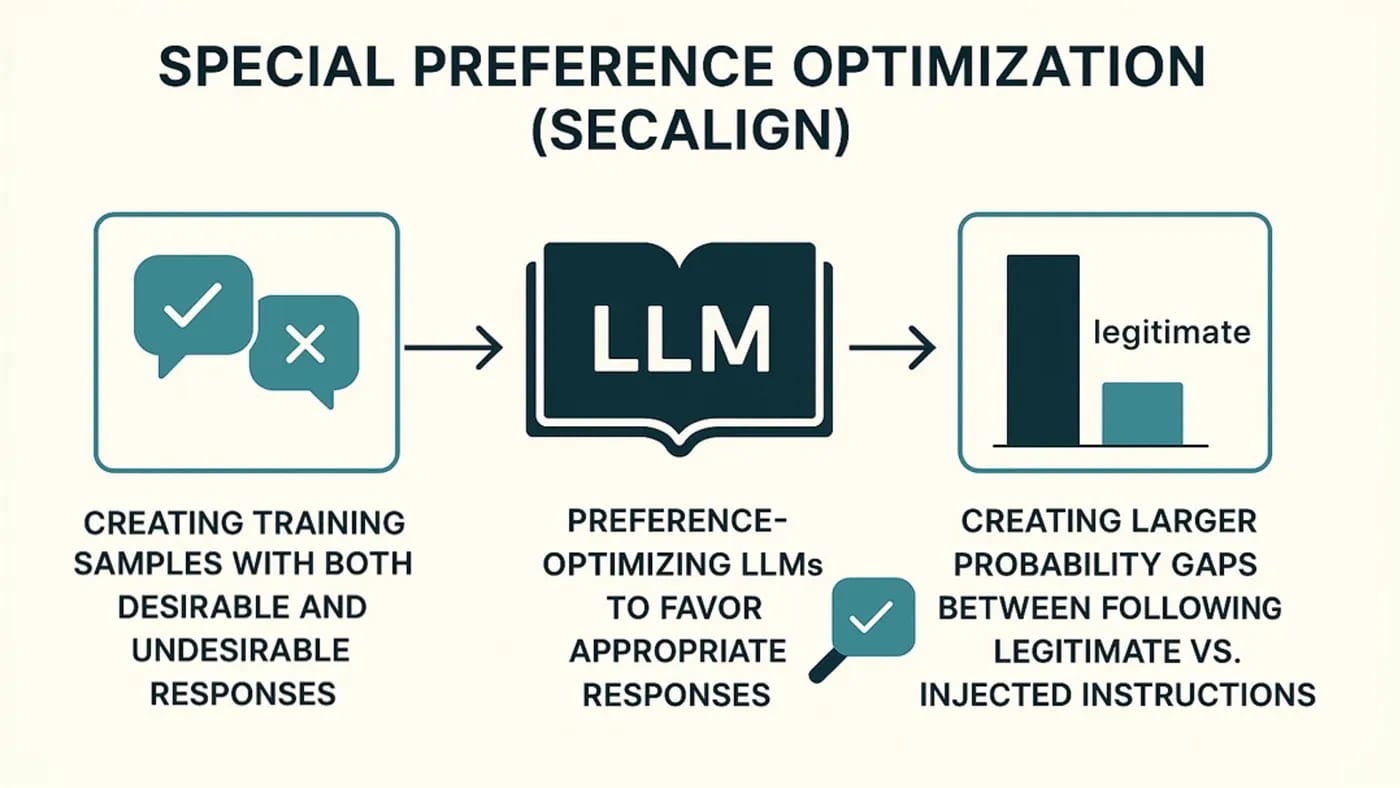
SecAlign reduces the attack success rate to around 8%, even against sophisticated attacks not encountered during training.
3. Multi-Layered Defense Approaches
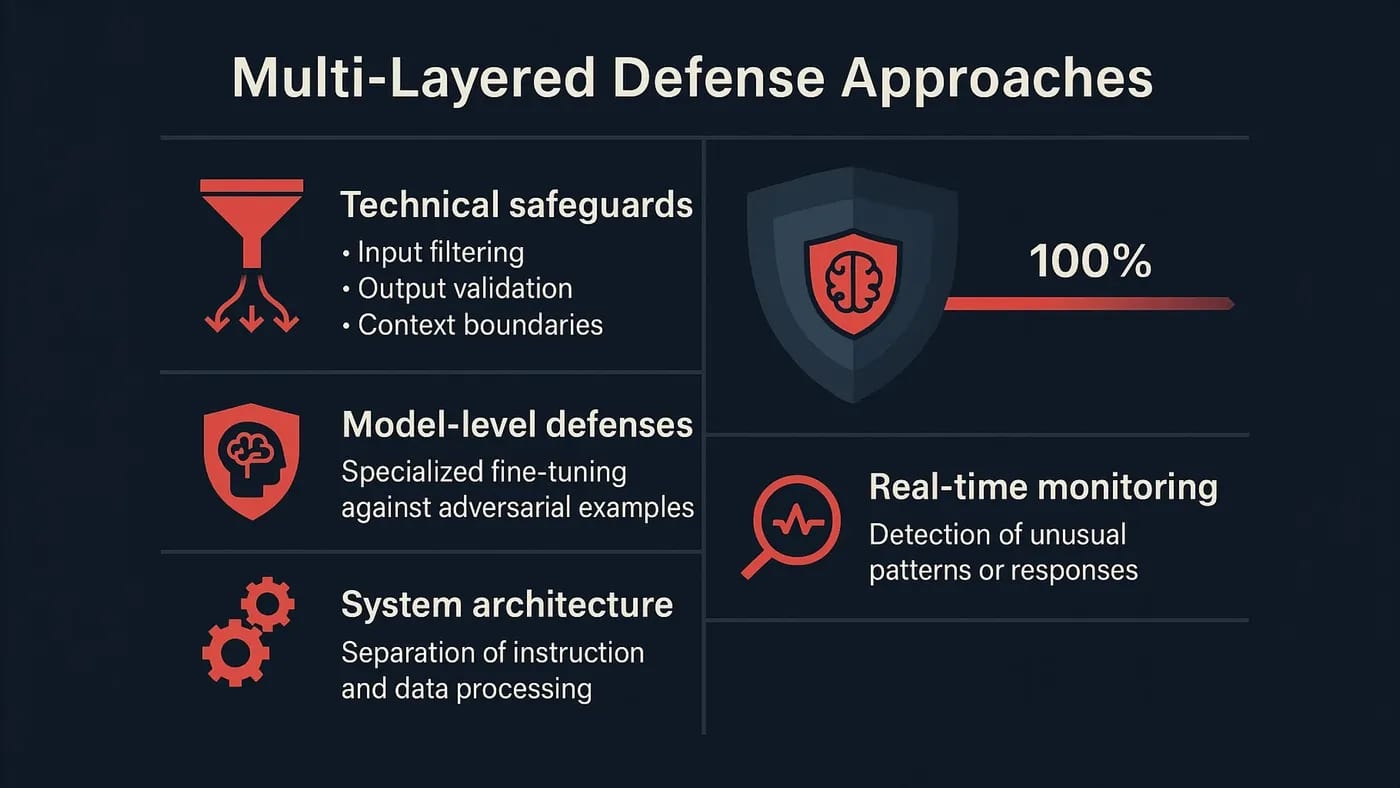
Industry experts recommend combining multiple defensive strategies:
-
Technical safeguards: Input filtering, output validation, and context boundaries.
-
Model-level defenses: Specialized fine-tuning against adversarial examples.
-
System architecture: Separation of instruction and data processing.
-
Real-time monitoring: Detection of unusual patterns or responses.
Practical Implementation
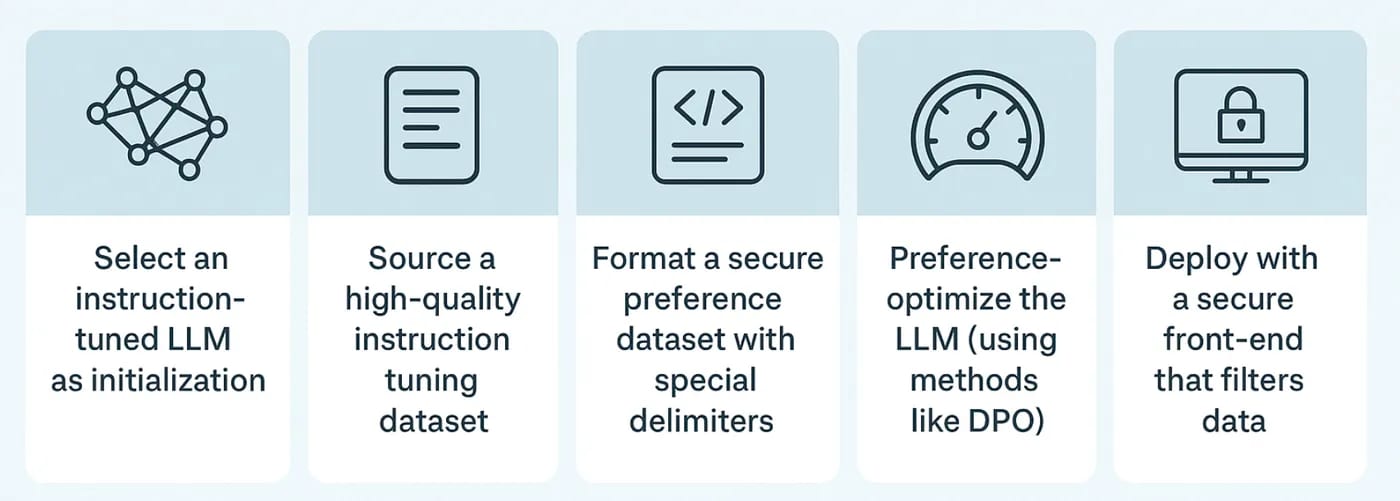
Security experts recommend a five-step process for implementing SecAlign:
-
Select an instruction-tuned LLM as initialization.
-
Source a high-quality instruction tuning dataset.
-
Format a secure preference dataset with special delimiters
-
Preference-optimize the LLM (using methods like DPO)
-
Deploy with a secure front-end that filters data
Future Implications: The Evolving Threat Landscape
As AI becomes more deeply integrated into critical systems, the implications of prompt injection vulnerabilities extend beyond immediate security concerns. Three primary challenges emerge:
1. Multi-Agent System Risks
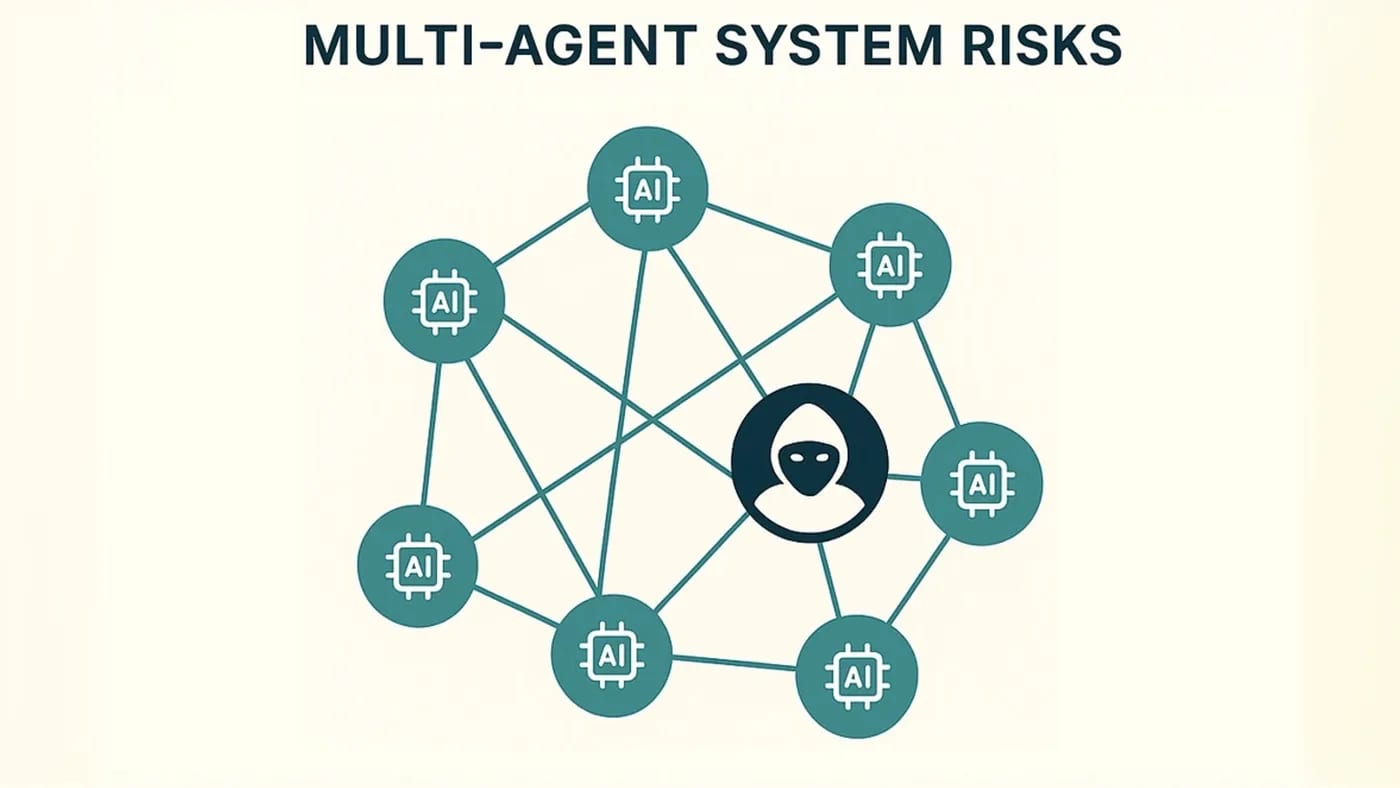
Research highlights particular concerns about densely interactive multi-agent systems where “one bad actor positioned in a specific threat vector in one of the agents” could compromise the entire system. As AI agents increasingly communicate with one another, compromising a single agent could have cascading effects.
2. Deeper Integration with External Data
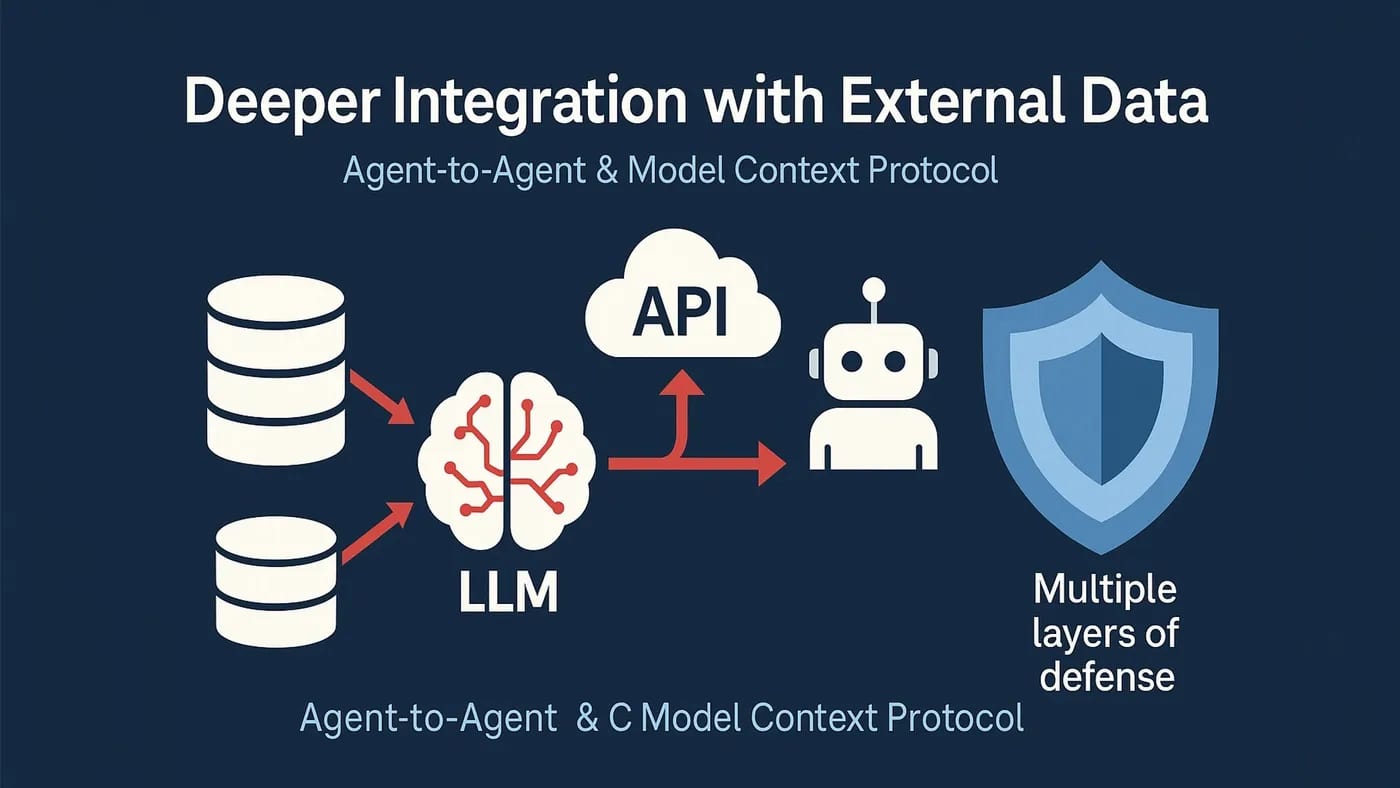
As LLMs connect to more external data sources and services, the attack surface expands dramatically. Organizations must implement “multiple layers of defense” when connecting AI systems to external databases or other agents through protocols like Agent-to-Agent (A2A) or Model Context Protocol (MCP).
3. Reasoning Pattern Manipulation

Perhaps most concerning is the potential for attacks that go “a level deeper” to modify reasoning patterns within LLMs. Recent research indicates that there is more than a theoretical possibility of encoding hidden patterns within learned reasoning methodologies, - patterns that might be undetectable through standard safety filters.
Conclusion: The Path Forward
As we navigate the rapidly evolving landscape of AI security, prompt injection attacks represent a critical challenge that requires urgent attention from researchers, developers, and organizations deploying AI systems. The research is clear: even the most sophisticated commercial models remain vulnerable to these attacks.
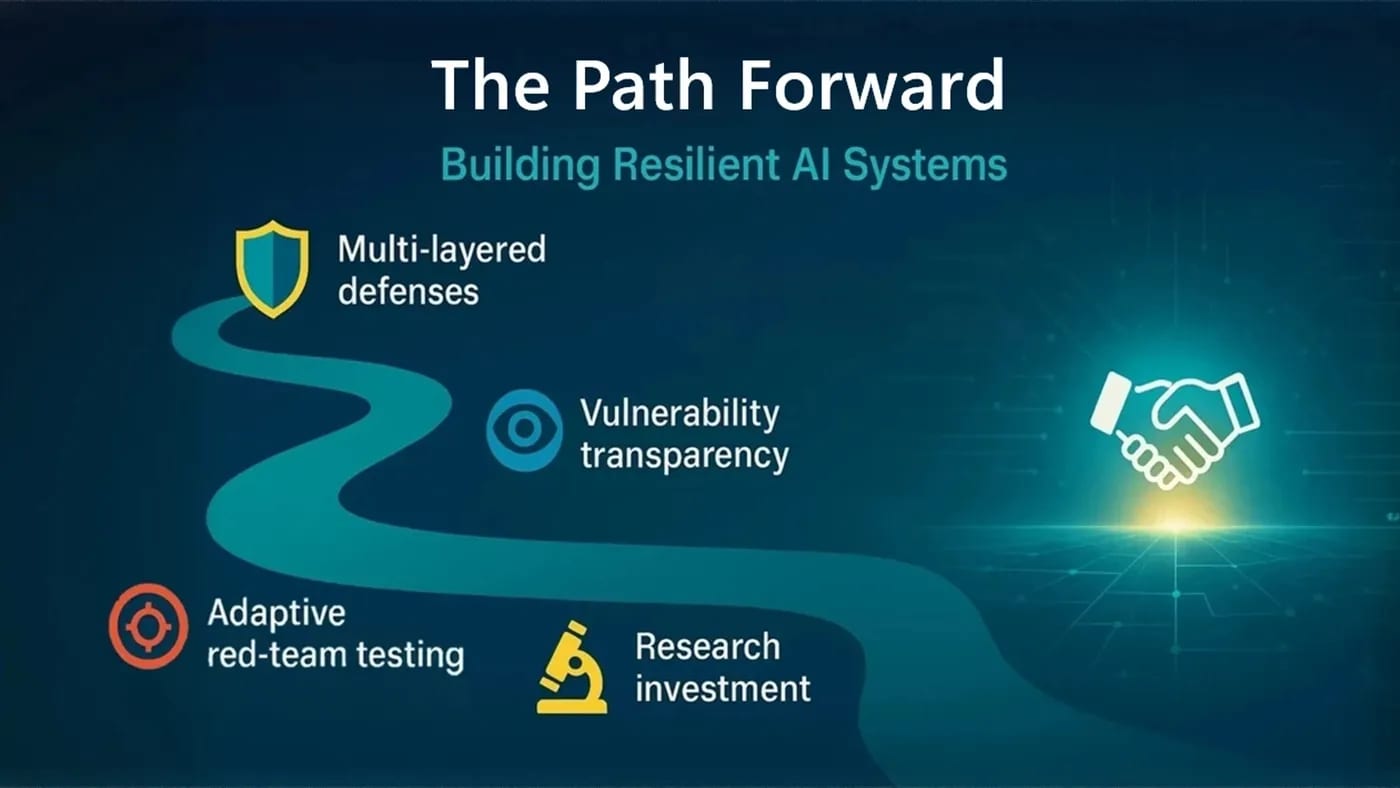
However, promising defense mechanisms like StruQ and SecAlign offer hope that we can build more resilient systems. The path forward requires:
-
Prioritizing security at the design level by implementing multi-layered defenses.
-
Ongoing red-team testing with adaptive attack methodologies.
-
Transparency about vulnerabilities to drive industry-wide improvements.
-
Investment in fundamental research around AI alignment and security.
As AI becomes more deeply woven into our information ecosystems, addressing these security challenges isn’t just a technical imperative, - it’s essential for maintaining trust in the systems that increasingly shape our digital world.
Disclaimer: The perspectives shared in this article are my own and do not represent those of my employer or any affiliated organizations.
Key References
Research Papers
-
Breaking the Prompt Wall (I): A Real-World Case Study of Attacking ChatGPT via Lightweight Prompt Injection (April 2025)
-
Jailbreaking Leading Safety-Aligned LLMs with Simple Adaptive Attacks (April 2025)
-
Adaptive Attacks Break Defenses Against Indirect Prompt Injection (March 2025)
-
Defending Against Prompt Injection with Preference Optimization (January 2025)
-
StruQ: Defending Against Prompt Injection with Structured Queries (2024)
-
AdvPrompter: Fast Adaptive Adversarial Prompting for LLMs (April 2024)
Organizational Resources
Defense Mechanisms Resources
Related Resources
More from risk & security
All risk & security → risk & security
Invisible Teammates: What Your AI Tools are Quietly Teaching Your Engineers
Remember when your most influential engineering mentor was human? Those days fade into nostalgia as AI coding assistants silently slip into the role of technical consigliere, whispering suggestions into thousands of engineers' ears daily.…
 risk & security
28 LLMs Later: Surviving the AI Misinformation Outbreak
⚠️ WARNING: This is a fictional scenario crafted for illustrative purposes. Any resemblance to real companies, events, or primates is purely coincidental. No actual AI models or boardrooms were harmed in the making of this cautionary tale.
 risk & security
When AI Starts Snitching
Imagine your AI assistant quietly CC'ing your company's legal team and the press the moment you suggest something shady. Sounds far-fetched? For one AI, it almost happened. Anthropic's Claude, an advanced chatbot, recently demonstrated an…