Polymorphic Encryption: What If Your Encryption Could Change Its Flavor on the Fly?
What if the locks protecting your company’s secrets could literally change shape every time someone tried to pick them? In cybersecurity terms, that wild idea translates to encryption algorithms that continuously morph or “rotate” their form – a bit like shape-shifting armor for your data. Today, most organizations rely on well-known encryption standards (think AES-256, RSA-2048, TLS protocols) which are extremely robust but static. The “lock” – the algorithm – stays the same; only the keys change. This static nature has served us well. After all, AES-256 is trusted by everyone from VPN providers to the U.S. government. But as cyber threats evolve, one can’t help but ask: Could constantly changing the encryption “flavor” raise the bar for hackers?
Imagine an intruder who finally learns how to pick one lock on your network, only to find the next door uses a completely different lock and key combo. Or even the next time they attempt to pick the same lock, the locking mechanism has changed. Frustrating for the intruder? Absolutely – and that’s the point. In this article, we’ll explore the emerging idea of customizable, rotating encryption algorithms (let’s call them encryption “flavors”) as a future-facing model for securing private networks. We’ll compare this shape-shifting approach to today’s encryption best practices and discuss how a meta-algorithm, - layering standard cryptography with transient, rotating transformations, might just help us get ahead of hackers for once, instead of perpetually playing catch-up.
The Static Lock-and-Key of Modern Encryption (Status Quo)
Let’s start with where we are today. Modern encryption is often described with a lock-and-key metaphor for good reason. The algorithm (like AES or RSA) is the lock mechanism, and the key is… well, the key. Virtually all widely used algorithms are publicly known designs, - and that’s by design! In fact, a core principle in cryptography since the 19th century holds that a system should remain secure even if everything about it (except the key) is public knowledge. In practice, this means we trust algorithms that have been published, analyzed, attacked, and proven “resilient” over years or decades. AES (Advanced Encryption Standard), for example, has been the gold standard for data encryption since it was standardized in 2001. It’s fast, efficient, and so secure that even top VPN services and the U.S. government rely on AES-256 (256-bit key) for protecting sensitive information. Likewise, RSA (named after its inventors Rivest, Shamir, and Adleman) became a staple for secure key exchange and digital signatures. It’s that familiar method with a public key for encrypting and a private key for decrypting.
Today’s encryption best practices combine these techniques: we use symmetric ciphers like AES to encrypt bulk data (VPN streams, database files, etc.), and asymmetric ciphers like RSA or elliptic-curve cryptography for exchanging the keys and securing communications channels (as in TLS, which locks down your HTTPS web traffic). We add layers like TLS/SSL protocols, which utilize AES for the data and RSA or Diffie-Hellman for the handshake, to secure data in transit. We even tunnel entire networks through encrypted VPNs using AES-based protocols (e.g., AES-256-GCM is the default cipher for OpenVPN). In short, the current model is: use well-vetted algorithms, keep the keys secret, and rotate the keys periodically.
Rotating keys is already a thing. For instance, TLS uses rotating session keys (new keys for each session that are thrown away afterward) to achieve perfect forward secrecy. This means even if an attacker somehow steals a server’s long-term private key, they still can’t decrypt past sessions. The keys for those were one-time-use. Key rotation limits the damage of a compromise. And that’s great! However, notice that in all this, the algorithm itself remains fixed. The lock’s design doesn’t change, - only the key does.
So if AES-256 and friends are so great, why even consider changing anything? The simple answer: predictability. Today, a hacker knows exactly what algorithms protect most systems. Yes, the keys are unknown, but the “shape” of the lock is familiar. Attackers optimize their techniques and even hardware to target those specific algorithms. It’s a bit like a professional safe-cracker who has blueprints for the vault models used worldwide. They still need the combination, but they know exactly how each vault’s internals work. If we never change the vault design, any future weakness discovered in it could spell disaster. For example, the old DES encryption (56-bit key) was once a U.S. standard, but hackers, the EFF (Electronic Frontier Foundation) in particular, built a machine in 1998 that cracked DES in 56 hours via brute force. DES’s design was static and once its key space proved too small, it was game over for DES across the board. We replaced it with stronger static locks, like AES, but the cat-and-mouse game continues.
Enter the Shape-Shifting Cipher: Customizable Encryption “Flavors”
If this sounds a bit like camouflage or shape-shifting armor, that’s exactly the metaphor. Your data’s armor isn’t a uniform steel shell that the enemy can study and plan for; instead, it’s like armor that changes its alloy and pattern every so often. One moment it’s dragon scales, the next it’s Kevlar, then adamantium, just to keep the bad guys guessing. Okay, maybe I’ve watched too many sci-fi movies – but you get the idea.
Not surprisingly, the cybersecurity world has a cool term for this: “polymorphic encryption.” The idea of polymorphism, something that takes many forms, has been applied in malware for years. Polymorphic viruses constantly change their code to evade detection. Now we’re turning the tables, using polymorphism for defense. One security company’s product literature defines polymorphic encryption as “a method that changes the encryption algorithm with each use, enhancing security” (sidechannel.com). In essence, each time you encrypt data, it uses a new variant of the algorithm. This could involve dynamic keys, varied algorithmic parameters, or even switching between different algorithms. The aim is to introduce uncertainty and diversity where today there is standardization and uniformity, - a predictability that hackers count on.
Technical Deep Dive 1: Symmetric vs. Asymmetric Encryption
Let’s clarify a few basics. Symmetric encryption means the same key locks and unlocks the data—similar to a password shared by you and a colleague to access a secure online document. It’s fast, efficient, and ideal for encrypting large volumes of data (AES is symmetric). Asymmetric encryption uses a pair of keys: one key encrypts (locks) and another key decrypts (unlocks). Think of it like a secure file drop service: anyone can upload files using a public link (public key), but only you can access and retrieve the files using your unique login credentials (private key). RSA and elliptic-curve cryptography are examples of asymmetric encryption. Because asymmetric encryption is computationally heavier, we typically use it to securely exchange a symmetric key, and then rely on AES for the faster, bulk encryption tasks.
Now, important: In all these systems, the algorithms are public. Every detail of AES or RSA is openly published. This isn’t a bug – it’s a feature. The security rests entirely on the secret keys, not on hiding how the lock works. In fact, Kerckhoffs’s principle (formulated in 1883!) says a crypto system should be secure even if everything about the system (except the key) is public knowledge. Why? Because history showed that “security through obscurity” (hiding the algorithm) tends to fail. Once the secret design leaks or is reverse-engineered, your protection evaporates. Designing algorithms to be public forces cryptographers to make them truly secure against all known attacks, theoretically anyhow.
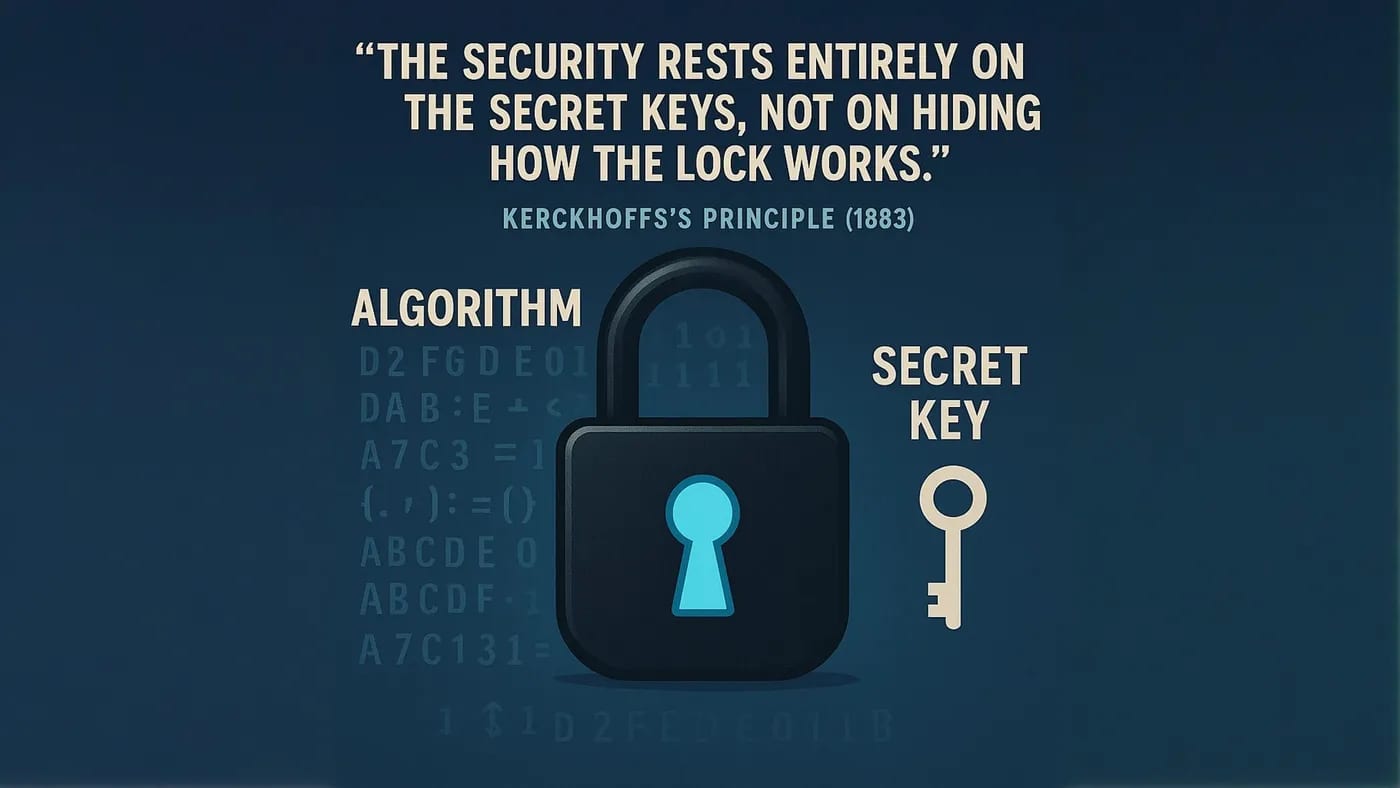
So, proposing to use secret or custom algorithmic elements can sound heretical. Isn’t that going against Kerckhoffs’s principle? Yes… and no. Yes, we are introducing elements of the algorithm that are not fixed and public. But no, we’re not suggesting relying on a single forever-secret algorithm of dubious quality. Instead, the model is: use well-vetted public algorithms as the base (so we’re not inventing weak crypto) and then add a rotating secret transformation on top. The idea is that even if the attacker knows we’re using, say, AES under the hood, they won’t know the current “flavor” or variant being applied – at least not in time to exploit it. In a way, we’re extending the notion of a “key” to include algorithmic variation. The algorithm isn’t completely secret (the method of variation might be known), but its instance or configuration at any given time is secret.
To use a lock analogy: it’s like everyone knows we use a deadbolt lock design (say, brand “AES”), but unbeknownst to the burglar, this particular lock has a custom pattern of pins inside that changes every day. The core mechanism is known, but the unique arrangement is not, thereby thwarting the burglar’s usual tricks.
The balance here is tricky, - add too little variation and attackers might figure it out; add too much crazy custom stuff and you potentially risk weakening the security by leaving the well-tested path. We’ll discuss those risks later. But first, let’s see how one might actually implement a rotating flavor encryption in practice.
Technical Deep Dive 2: How Would a Rotating Flavor Layer Work?
So, how could we technically achieve a “constantly rotating flavor” on top of standard encryption? There are a few imaginable approaches (and some have been tried in research labs):

-
Dynamic Algorithm Parameters*: One simple way is to tweak parameters within an algorithm for each use. For example, AES has substitution boxes (S-Boxes) – fixed lookup tables that transform bytes. Researchers have experimented with generating dynamic S-Boxes derived from the encryption key, so that with every new key, the cipher has a different shape. In effect, AES’s internal math would subtly change based on some secret inputs. Legitimate parties who know the key can derive the S-Box and decrypt, but an attacker faces an algorithm that isn’t the same default AES each time. This approach obscures the pattern of the cipher operations from attackers. However, one must be careful: AES’s fixed parameters were chosen very carefully for security, and random replacements might not always hold up to cryptanalysis. In other words, if you randomly tweak AES’s internals without caution, you might accidentally weaken it – the crypto equivalent of adding armor plates but leaving a gap at the joints.*
-
Meta-Algorithm “Modes” or Suites*: Another approach is to have a library of algorithms or modes and switch between them. Suppose you have a handful of strong ciphers (AES, ChaCha20, Twofish, etc.) and different modes of operation for them. A polymorphic system could pick a different cipher and mode (and key length) semi-randomly for each session or message, based on some secret or on the key itself. In one academic prototype, they envisioned 60 different cryptographic “suites” and the system would pick one based on the key, so only the legitimate parties know which suite is currently in use. The upside: an eavesdropper not only has to guess the key, they don’t even know which algorithm to attempt! The downside: implementing 60 algorithms is as fun as it sounds (not very). It’s complex, and switching between many ciphers could be slow or impractical in real systems. Still, a limited form of this idea (say 3-4 algorithm choices) could be feasible, especially with modern hardware support. In fact, cryptographic agility (designing systems that can swap out algorithms easily) is a hot topic, especially for being ready to swap in “post-quantum” algorithms, - assuming that becomes a real things in the next decade or so. Here we’d be using agility not just for upgradeability, but dynamically as a moving target defense.*
-
Ephemeral Transforms (Layering)**: Perhaps the most intriguing: keep your solid algorithm (e.g., AES) but wrap it in an ephemeral transformation. For example, before encrypting data with AES, you might first scramble the plaintext with a random reversible function that’s unique to this session or message. That function could be something like a big random permutation of bytes, or mixing the data with a one-time pad derived from a secondary key. After this pre-processing, you apply AES as usual. On the receiving side, they do AES decryption, then the inverse scramble. If an attacker doesn’t know the scramble, it’s an extra layer of confusion. One research group did something like this using matrices: they multiplied the plaintext by a secret matrix, then encrypted with DES, then multiplied by another secret matrix. They updated the matrix for each new message, so even identical plaintexts encrypted twice looked completely different. The result was effectively a new cipher each time (they dubbed it a “dynamic cipher”). Now, DES itself is outdated, but you could imagine this concept applied to AES or modern ciphers. The trick is to ensure the added layer doesn’t introduce weaknesses. If the layer is essentially another key (like a big permutation key), then you’ve just increased the key space the attacker has to search – which is good – as long as the layer doesn’t accidentally leak info or reduce entropy.
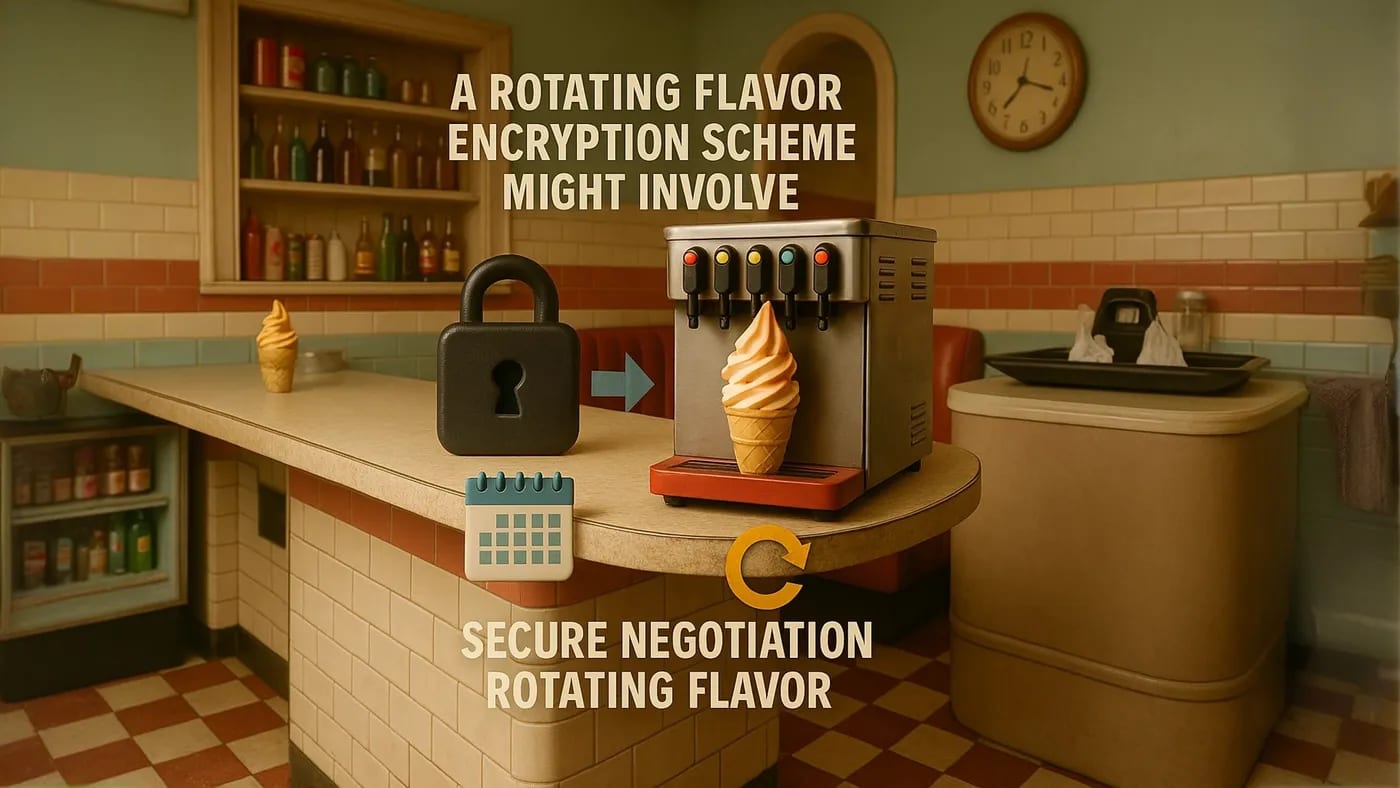
In practice, a rotating flavor encryption scheme might involve a secure negotiation at the start of a session: two endpoints agree on a “flavor of the hour” – maybe exchanging a small secret that parameterizes the cipher or picking a random variant from a preset list, all protected by standard cryptographic handshake. They then communicate using that variant for a time (perhaps a single session or a set number of messages) and then periodically renegotiate a new flavor. It’s almost like they’re rotating both the key and the algorithm at intervals. An analogy in the physical world: some high-end safes change their combination automatically every day; here we’d also swap out the safe’s locking mechanism itself on a schedule!
From a hacker’s perspective, this is nightmare fuel. It’s moving target encryption. They can’t just say “it’s AES-256, let’s focus on that” because it might behave slightly differently every time. Pattern recognition goes out the window, - one of the promised benefits of polymorphic encryption is “resistance to pattern recognition”. Attackers analyzing network traffic might find that ciphertexts constantly defy the expected patterns of a single algorithm, making it far harder to identify or exploit any weakness.
Technical Deep Dive 3: Brute-Force Attacks vs. a Moving Target – How Much Harder Would It Be?
Time to address the big question: Does this actually increase security in a measurable way? Specifically, how much does rotating encryption flavors increase brute-force resistance compared to a static encryption?

Let’s consider brute force – the exhaustive guessing of keys (or other secret parameters). With a static cipher like AES-256, the key space is 2^256 possibilities (an astronomically large number). No one is brute-forcing AES-256 with current technology; it’s effectively unbreakable by brute force alone, - at least today. However, imagine some future attacker or advanced computing power that could attempt keys at high speed. In a static world, they focus all efforts on that one key until it’s cracked. In a rotating flavor world, the target is a moving carousel.
Here are a few ways a moving target makes brute force (and other attacks) harder:
-
Multiple Unknowns*: An attacker might now have to guess both the key and the algorithm variant. Suppose our system can operate in N different flavors (say 128 variants, as* one polymorphic AES proposal had). If the attacker doesn’t know which variant was used for a given intercepted ciphertext, their brute force task multiplicatively gets harder. Instead of 2^256 possible keys, they might have 128 * 2^256 combinations of (variant, key) to try. That’s effectively adding a few extra bits of key length (128 variants ~ an extra 7 bits, since 2^7 = 128). Not world-changing on its own, but it’s something.
-
Resetting the Clock*: If the encryption flavor (and key) rotates frequently, a brute-force attacker faces a time window limitation. Say the flavor changes every hour. If an attacker somehow were close to brute-forcing one variant’s key (which is unlikely if keys are huge, but entertain the thought), once the hour is up and a new key+variant is in use, the old ciphertext might not even be relevant or accessible. This is similar to why we rotate keys – it forces the attack to basically start over for each rotation. The attacker can still work on old intercepted data indefinitely, but if they were trying to do something like real-time decryption, forget about it.*
-
No Reuse = No Leverage*: Often, cryptanalysis gets easier when an attacker can observe many messages encrypted with the same algorithm/key – they can look for statistical patterns or reuse of certain structures. If every message or session is encrypted with a different flavor, that consistency is gone. Each encrypted chunk is unique in its characteristics. It’s a bit like trying to solve multiple puzzles where each puzzle uses a different code language. As a defender, you’re removing the advantage an attacker gets from “seeing the same puzzle solved multiple times.”*
Let’s put on a speculative hat and throw some numbers (with a big asterisk that these are conceptual): Imagine a static cipher has a breakable point at, say, 2^k operations for brute force or some cryptanalytic attack. If our meta-algorithm has M possible flavors (transformations) and the attacker doesn’t know which one, in the worst case they might have to spend up to M * 2^k operations to cover all possibilities. If M=128 (like that polymorphic AES example), that’s 128 times more effort (effectively +7 bits of key security). If M=1,000, it’s 2^10 (+10 bits). If you could have an enormous number of variations (some schemes can algorithmically generate huge numbers of variants from keys or seeds), you could imagine adding dozens of bits of effective security.
Another way to look at it: If an attacker targets a moving encryption scheme, they may need to solve two challenges: figure out the current flavor and crack the key. The flavor might itself be protected by a key or secret. Some industry folks tout enormous effective key lengths from such layering. For instance, one payment security company (Shift4) markets a “Derived Unique Key Per Transaction with Moving Target Encryption” and claims it delivers “300+ bit encryption” strength. In reality, they’re likely combining a standard 128- or 256-bit cipher with additional dynamic secrets, thus effectively extending the key length (256 bits from AES + maybe another 50 bits from the moving target aspect, etc. = “300+”). The exact math gets fuzzy (and marketing-ish), but the intuition is that multiple independent layers of secrecy multiply the work for attackers.

It’s not just brute force, either. Consider targeted attacks like cryptanalysis (where the attacker exploits structure in the algorithm). If each encryption has a different structure, the attacker’s job is akin to hitting a moving bullseye. A static cipher might have a known weakness that only shows if you hammer at it for millions of computations. A polymorphic cipher might change before you can mount such an attack in depth. In a recent IEEE study on a polymorphic AES, the authors note that static ciphers “might be vulnerable to future attacks that target the cipher’s static nature” and that a dynamic (polymorphic) structure “overcomes this limitation” because “the P-AES can operate in 128 different ways. The attacker will not be able to know which version is used to secure the current message.”. They also importantly showed each variant was as strong as regular AES against known attacks, suggesting you can have diversity without sacrificing baseline security.
To be clear, this isn’t an absolute shield of invincibility. If there’s a flaw in the base algorithm, no amount of flavor changing will save you (except switching away from that algorithm entirely). And if attackers can figure out the pattern of your flavor changes or get hold of one instance’s secret, they might still break that instance (but hopefully not others). The goal isn’t to make hacking impossible (an impossibly high bar), but to make it so prohibitively difficult and time-consuming that hackers move on to easier targets – or ideally, that they’re thwarted entirely while you move on to the next security innovation.
Real-World Potential: Finance, Healthcare, Government – Who Stands to Gain?
This all sounds innovative (or insane, depending on your risk appetite). But who might actually use such customizable, rotating encryption? Let’s explore a few sectors:
-
Finance (Banking/Insurance): Banks are in a constant arms race with cybercriminals. They already use strong encryption for transactions and storage. Could polymorphic encryption be their next secret weapon? Consider credit card transactions: Today, protocols like EMV and point-to-point encryption often use a unique key per transaction (a form of key rotation). A company called Shift4, for example, uses per-transaction keys with a “moving target encryption” layer, which as noted, they claim yields an effective strength beyond 256 bits. Financial institutions could similarly employ algorithmic agility – perhaps each session between a banking app and server negotiates a unique cipher variant. This would make large-scale theft of data much harder; even if one session’s key and flavor were compromised, it wouldn’t help decrypt another. Insurance companies dealing with loads of personal data could use dynamic encryption to protect data warehouses – even if hackers breach the perimeter and grab databases, the data could be encrypted in a proprietary flavor that shifts regularly, making it far less useful. It’s worth noting, finance is heavily regulated, so any custom crypto would likely need to be auditable and compliant (FIPS-validated if used by U.S. federal standards, etc.). Interestingly, that SideChannel Polymorphic Encryption Core we mentioned is FIPS 140-2 validated, indicating that at least one flavor-changing encryption solution has met government-grade standards. That’s a positive sign for adoption.
-
Healthcare: Healthcare data is a goldmine for attackers (hello, ransomware). Hospitals and insurers hold everything from personal IDs to medical histories. Encryption is mandated in many cases (HIPAA requirements for protecting patient data at rest and in transit). A hospital could use a shape-shifting encryption scheme for its internal networks so that even if attackers penetrate the network, any intercepted data streams (e.g., between a doctor’s tablet and a medical server) are in constantly changing encryption. It could also protect patient databases – perhaps each day the records are re-encrypted with a new flavor, so a stolen disk image from last week would be encrypted under an obsolete variant that’s no longer used today (adding complexity for the attacker to even attempt decryption). There’s also an angle for medical devices and IoT – devices could employ lightweight dynamic ciphers to prevent easy eavesdropping or tampering. While academic, there have been proposals like “moving target encryption” for IoT to mitigate their limited hardware security by adding unpredictability. Healthcare organizations, however, tend to be conservative with technology, - no one wants to implant a pacemaker with untested crypto!
-
Government and Defense: It’s almost a cliché that government wants the strongest encryption (for themselves, at least). Defense communications, intelligence agencies, and even local governments dealing with critical infrastructure could all benefit from a system that’s harder for adversaries to crack. Imagine military communications that switch encryption schemes daily, so even if one day’s traffic is compromised, the next day’s has a new shield. Government interest in moving target defense strategies is high. DARPA and others have funded research on systems that frequently change their attack surface. Cryptographic agility is also a priority given the looming threat of quantum computers potentially breaking current algorithms. Crypto-agility typically means “we can swap out to a new algorithm (like a post-quantum one) when needed.” But a logical extension is using that agility continuously, - not just in response to a new threat, but proactively as a constant defense. Agencies like NIST are already urging crypto agility for the quantum era. We could envision future standards allowing algorithm negotiation in protocols, not just once at handshake, but periodically during a session. There’s precedent: some VPNs can re-negotiate keys mid-session for added security; extending that to negotiating a new cipher variant is not far-fetched.
It’s also telling that a product like the polymorphic encryption core is being marketed to industries including finance, healthcare, and DOD contractors. This suggests there is at least some demand or curiosity in these sectors for customizable encryption models. We’re not talking science fiction – early adopters are testing these waters now.
Of course, deploying this in the real world raises some tough questions…
The Fine Print: Risks and Challenges of Custom Encryption
Before we declare shape-shifting encryption the hero that will outsmart hackers, we need to acknowledge the risks and hurdles:

-
Implementation Complexity: Designing, implementing, and maintaining a polymorphic encryption system is complex. Cryptography is already an area where a tiny mistake can become a big exploit. Now imagine implementing not just one cipher, but a meta-cipher with moving parts. The more complicated the system, the higher the chance of a bug or misconfiguration that undermines security. Even researchers who champion these ideas admit some models have “high implementation cost” and questionable practicality if done naïvely. For a business, this means higher development and maintenance costs and the need for specialized cryptographic expertise on staff. Not every IT team has a cryptographer on speed dial.
-
Performance Overhead: Changing algorithms or doing additional transformations could slow things down. Regular AES is fast because it’s hardware-accelerated in modern CPUs (via AES-NI instructions). If your encryption flavor deviates from standard AES, you might lose that hardware boost. Using multiple ciphers or big matrix operations could add latency. There’s a balance to strike between security and performance. However, clever designs can mitigate this – for example, deriving variants from the key (so minimal extra computation) or using hardware-friendly transformations. Some solutions claim minimal overhead and even tout scalability (SideChannel says their polymorphic core is “stronger, agile and scalable” with low overhead). Still, any organization considering this will need to benchmark the impact. In high-frequency trading or real-time healthcare monitoring, extra milliseconds matter.
-
Interoperability & Standards: One benefit of everyone using AES and TLS is that everything works together – your banking app, your browser, your VPN all speak the same crypto language. If each company rolls their own “flavor” of encryption, interoperability goes out the window. Of course, you wouldn’t use custom encryption to talk to external parties (you’d fall back to standards for that). This idea is mostly for securing internal communications or data stores, where you control both sides. Still, if such methods became common, there might arise a need for standards or frameworks to negotiate custom algorithms. There’s also the issue of auditing and compliance. How do auditors verify your encryption is sound if it’s a custom scheme? One solution is having your scheme independently evaluated or certified (like that FIPS validation we discussed). Another is to design it in an open way, perhaps publish the meta-algorithm concept while keeping specific keys/instances secret. Perhaps.
-
Key Management (Squared): With more secrets (flavor info + keys) comes more management overhead. Distributing and storing keys is hard enough; now we might have “flavor keys” or additional negotiation to manage. For example, if the flavor is determined by some secret parameter,and compliance. How do auditors verify your encryption is sound if it’s a custom scheme? One solution is having your scheme independently evaluated or certified (like that FIPS validation we discussed). Another is to design it in an open way, perhaps publish the meta-algorithm concept while keeping specific keys/instances secret. Perhaps.
-
Key Management (Squared): With more secrets (flavor info + keys) comes more management overhead. Distributing and storing keys is hard enough; now we might have “flavor keys” or additional negotiation to manage. For example, if the flavor is determined by some secret parameter, that parameter needs to be shared with the recipient securely. This often can piggyback on existing key exchange protocols (just exchange an extra blob of data that represents the flavor info). But it’s something to design carefully. If an attacker can somehow steal or predict the flavor sequence, the advantage is lost. It’s almost like having two keys instead of one – double the protection but also double the responsibility to protect them.
-
False Sense of Security: Perhaps the biggest risk is thinking this is a silver bullet. Creative encryption designs can give a false sense of invincibility. One might neglect other security practices (like authentication, access control, patching systems) thinking “our encryption is unbreakable.” Newsflash: hackers often bypass encryption entirely by stealing keys, exploiting software vulnerabilities, or tricking users. Rotating encryption doesn’t stop phishing or malware or social engineering. It’s a layer of defense, not a cure-all. Also, if implemented poorly, a custom encryption could be weaker than a standard static one. There’s a famous mantra in security: “Don’t roll your own crypto.” We’re kind of rolling our own crypto here! Ironic, I know. The caveat is we’re doing it in a structured way on top of proven algorithms but the caution stands. The design should be vetted by experts before deployment.
Despite these challenges, the idea remains compelling. In fact, it reflects a broader shift in mindset from reactive security (patch after a breach, switch algorithms only after one is broken) to proactive and adaptive security. It’s about staying unpredictable. As one researcher put it, a dynamic cipher forces the attacker to “not only retrieve the encryption key but also determine the exact shape of the cipher”, - essentially doubling their work. If that extra complexity can be achieved without introducing new vulnerabilities, it’s a win for defenders.
Conclusion: Embracing Encryption Innovation – Getting Ahead of Hackers
In a world where headlines of data breaches and ransomware are all too common, it’s refreshing to discuss a security approach that isn’t just “longer keys and more patches” but a genuine paradigm shift. Customizable, rotating encryption algorithms are still an emerging concept, but they represent a creative attempt to flip the script on cyber attackers. Instead of us playing defense with static shields while attackers evolve their swords, we make our shields morph and dance such that the attacker can’t even get a steady target. It’s a bit of a cat-and-mouse game – except now the mouse (defender) gets to change the rules on the cat.
Is this the right approach for everyone today? Probably not yet. It’s cutting-edge and comes with maturation pains. But we’re seeing the first signs in industry and academia that it’s worth exploring. Banks are experimenting with polymorphic techniques in payment encryption. Startups are patenting “shape-shifting” ciphers and getting government certifications. Researchers are publishing papers with titles like “A Polymorphic AES – A Novel Approach,” demonstrating that you can have an algorithm operate in 128 different modes without losing security. The seeds are being planted now.

For executives, especially those with limited technical expertise, here’s the takeaway: encryption is not a solved problem that we can set and forget. Yes, we have great algorithms now, but the landscape can change, - consider the threat of quantum computing cracking public-key algorithms in the near future. We need agility and innovation in our security designs. Customizable encryption flavors are one potential tool to stay ahead. They’re about being unpredictable and proactive rather than reactive. It’s akin to changing your business strategy frequently so competitors can’t catch up – here we’re changing our security strategy frequently so attackers can’t catch up.
As we look forward, perhaps in 5-10 years, network security appliances and software libraries will offer “encryption agility” options out of the box. You might tick a box that says “enable algorithm rotation,” and your systems will automatically switch between a set of vetted cipher variants. Admins might manage not just keys but profiles of algorithm “flavors.” And auditors will adapt by checking that each allowed flavor is approved and that the rotation interval meets policy. It’s a natural evolution once the kinks are worked out.
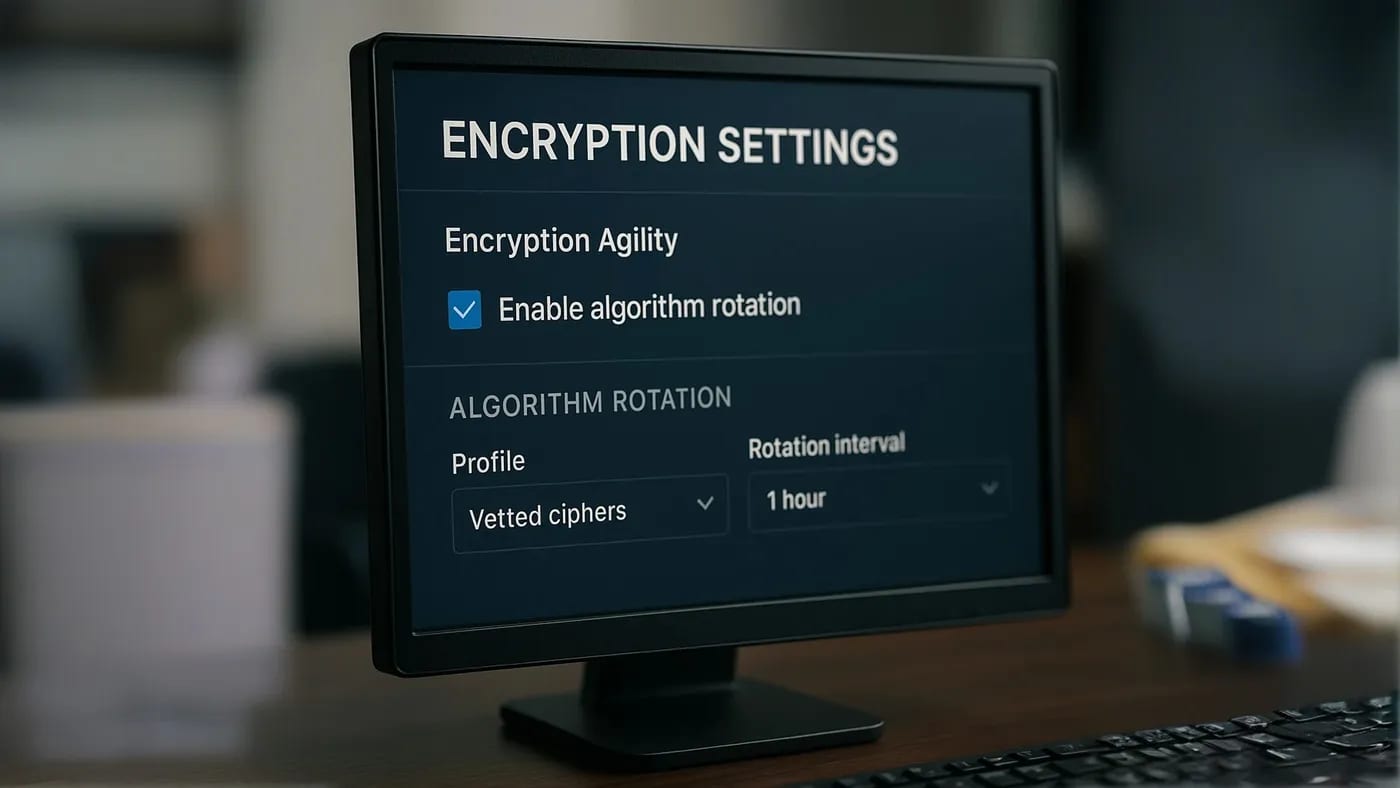
Ultimately, the goal is to get ahead of hackers. It’s about time, right? For once, we’d like the attacker to be the one scrambling to adapt to our clever moves. Customizable, rotating encryption is a bold move in that direction. Will it solve all security woes? No. But it adds one more layer of frustration for attackers, and in security, every bit of frustration counts. Hackers aren’t standing still – maybe our encryption shouldn’t either.

This article represents my personal views on encryption trends and does not necessarily reflect the official position of my employer.
More from risk & security
All risk & security → risk & security
Patch Me If You Can: The Broken Trust Behind Invisible Updates
Imagine a trendy nightclub called Enterprise. At the front door stands a bouncer named Zero Trust, rigorously checking every ID. No guest gets in without verification – exactly as advertised. Yet, in a side alley, a familiar smiling face…
 risk & security
Prompt Warfare in 2025: The Wrong Instructions!
As AI systems become more deeply integrated into our digital infrastructure, a new category of security threat has emerged as the foremost concern for AI safety experts: prompt injection attacks. Ranked 1 on OWASP's Top 10 list for Large…
 risk & security
Invisible Teammates: What Your AI Tools are Quietly Teaching Your Engineers
Remember when your most influential engineering mentor was human? Those days fade into nostalgia as AI coding assistants silently slip into the role of technical consigliere, whispering suggestions into thousands of engineers' ears daily.…