LLM Size Matters (But Not How You Think): The David vs. Goliath AI Revolution

The rapid advancement of AI technology has led to an unprecedented arms race for ever-larger models. Since Open AI unveiled GPT-3 on May 29, 2020 with its 175 billion parameters, followed by ChatGPT and other frontier models with rumored trillion-parameter architectures, the industry seems fixated on a simple equation: bigger equals better. But beneath this headline-grabbing trend, a counter-movement is gaining momentum, - one that challenges our fundamental assumptions about AI development and deployment.

In a world where chips have turned into sand, service has morphed into sugar, and open-source has become popular, learning where to put your chips is key. For technology leaders, understanding this shifting landscape isn’t just academic, - it’s strategic.
Giants and Nimble Challengers: A Tale of Two Scales

The AI landscape is increasingly divided between two distinct approaches: monolithic behemoths and specialized contenders. To understand this divide, let’s examine representative models from both camps, comparing not just their size but their efficiency, specialization, and practical applications. The contrasts are striking, revealing that the relationship between parameter count and real-world utility is far more nuanced than conventional wisdom suggests.

Here is one of the best resources for understanding the landscape of LLM models: https://lifearchitect.ai/models-table/ 👈
Escaping the Goliath Mirage
Not long ago, the mantra “bigger is better” echoed through corporate boardrooms and research labs alike. The economics of building frontier models are sobering. Developing a state-of-the-art foundation model requires an investment “between a few hundred million and a few billion US dollars.” These astronomical costs create significant barriers to entry, limiting serious competition to a handful of well-funded organizations.

Training of models larger than a certain size are fundamentally indomitable for small enterprises, universities, and even think tanks, due to overly large computation and monetary resources required. The first foundation model to cross the 100 billion parameter mark was Turing NLG in early 2020, and the trend has only accelerated since then.
The consequences extend beyond mere financial considerations. Training a single large language model can produce carbon emissions equivalent to the lifetime emissions of five cars. One study notes that “the majority of the environmental footprint of AI is in the training phase,” with the compute used representing “one of the biggest components of the environmental footprint.”

This has created what we might call a “supermodel paradox”, - models that are impressive in capability but inaccessible to most potential users and developers, not to mention environmentally questionable. For technology leaders managing both innovation and sustainability metrics, this tension is increasingly difficult to ignore.
Unleashing the Power of Small Models
What makes the current AI landscape particularly interesting is the growing evidence that smaller architectures can sometimes outperform their larger counterparts in specific domains.
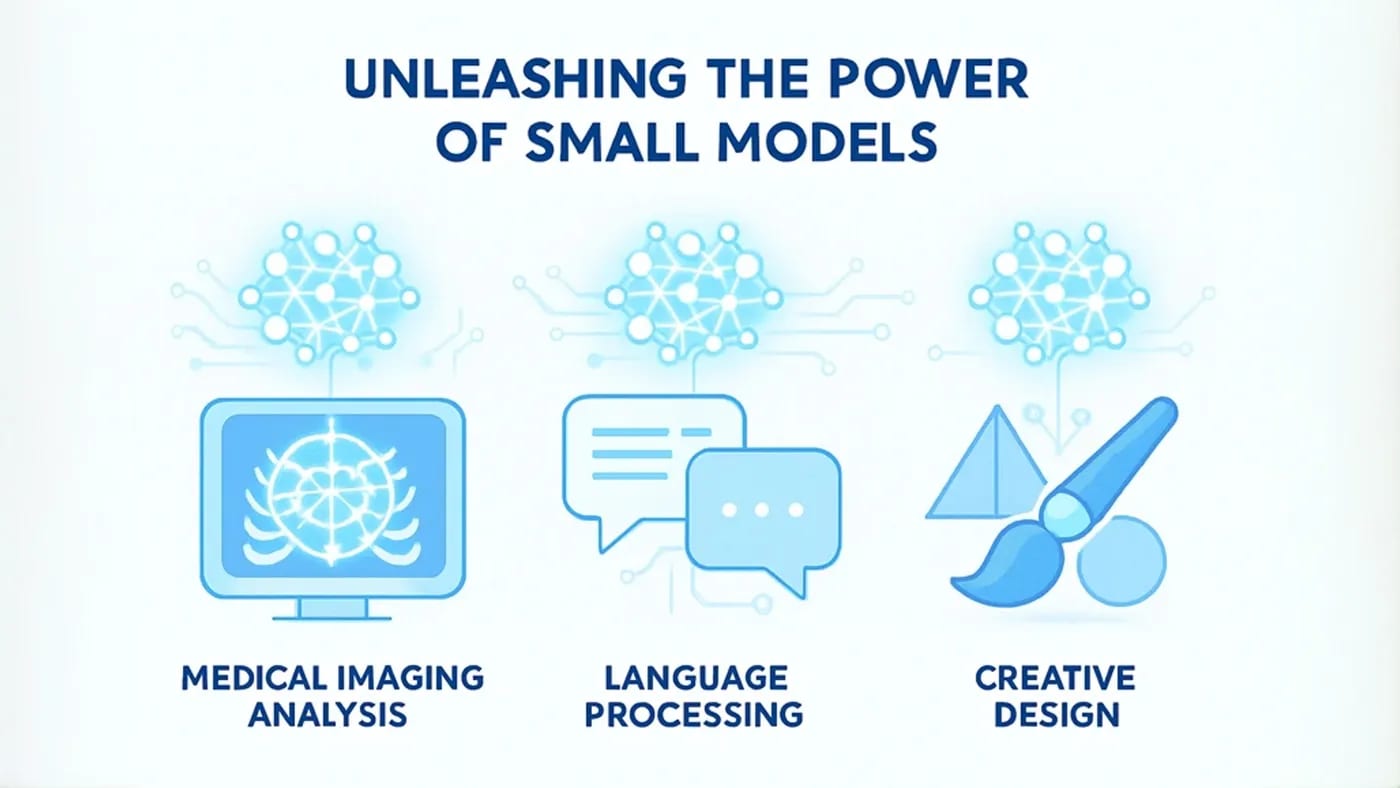
Consider this telling example: a smaller architecture (ViT-B/16) exhibited superior performance over a larger one (ViT-L/14) in medical imaging tasks. As the study noted, “the bottleneck of Foundation Models does not reside in data availability or generalization, but can be either insufficiencies of a training pipeline or computational costs.”
This isn’t an isolated incident. Recent findings show that “the relatively smaller FLAN-T5 models have been shown to outperform the robustly large OPT-175B model on various datasets on the LAMBADA completion task.” Even within the same family of models, “the middle sized models seem to perform better than the larger model” in certain contexts.

Take the example of UniSeg: a streamlined model adept at image segmentation, capable of rapidly adapting to new tasks with minimal data and resources, achieving an 82.3% accuracy rate on categories unseen during pre-training. Such innovations underscore that strategic efficiency can provide significant competitive advantages.
DeepSpeed Instruction, with its modest 168K parameters achieving 865.5 Mbps performance, represents another data point in this emerging pattern. Meanwhile, GPT-2-small with just 66M parameters achieves an impressive 50,547 tokens processed per second with 308.40 GigaFLOPs.
These aren’t anomalies but part of a growing body of evidence suggesting that architectural innovations and targeted optimizations can sometimes overcome the brute-force advantage of parameter count.
Balancing Quality and Efficiency
For technology executives weighing investment decisions, the potential advantages of smaller models manifest in three critical dimensions:
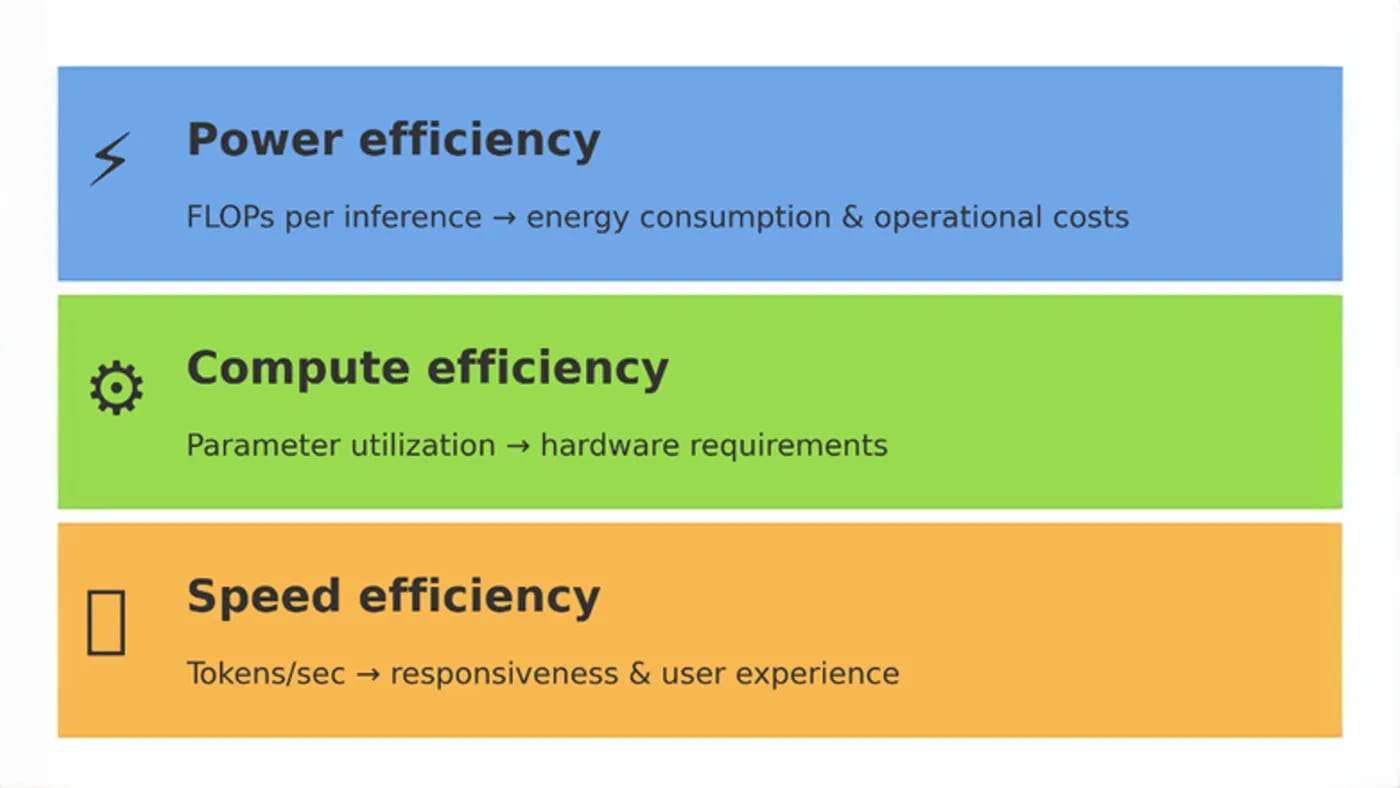
Research demonstrates that smaller models consistently outperform on these efficiency metrics, with many positioning themselves on what experts call the lower-bound efficiency frontier. This translates to tangible business benefits: reduced infrastructure costs, lower energy consumption, and improved user experiences through faster response times.
Today’s successful AI deployments focus on these three pillars, - model quality, operational efficiency, and rapid deployment capability. While large models dominate demonstrations, smaller models consistently deliver value in real-world applications by providing comparable performance at significantly reduced costs.
Visionary leaders have realized that adopting a hybrid approach, - deploying compact, efficient models for routine tasks and reserving larger, resource-intensive models for specialized applications, - is a winning strategy that balances cost, quality, and time-to-market.
Crafting Your Strategic Slingshot
The case for smaller, more efficient models isn’t just about cutting costs, - it’s about rethinking our approach to AI development. Just before what one researcher called “the 2022 AI Deadlock, when everything seemed to point towards the ‘Giant, Giant, Giant’ approach,” alternative paradigms began to emerge.
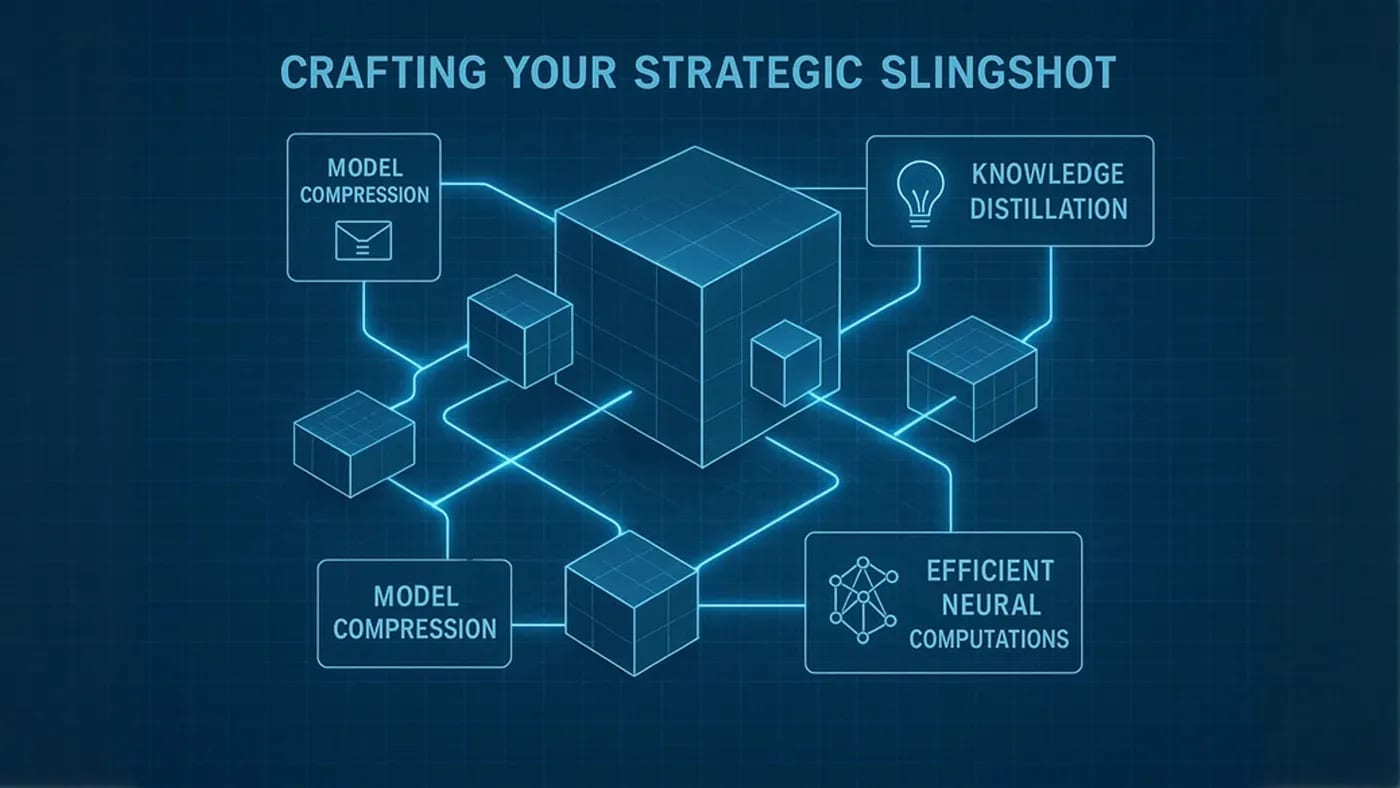
These include techniques like P-tuning, low-rank approximation, pruning, model distillation, and network architecture search. While on a smaller scale, Paul Graham’s ‘The Escape Hatch’ argued that there is hope for a way around the establishment.

Engineering success in the AI revolution hinges on developing a flexible, modular infrastructure. This approach enables teams to rapidly scale their AI solutions according to need, seamlessly switching from lightweight, edge-compatible models to robust, larger-scale deployments when required.
Three innovative approaches stand out:
-
Model compression during training: Changing network architecture to reduce parameters and operations
-
Knowledge distillation: Approximating large “teacher” models with smaller “student” networks
-
Efficient neural computations: Modifying trained networks to require fewer inference resources
Continuous benchmarking and automated evaluation frameworks ensure that models consistently meet or exceed the required performance metrics. Additionally, a data-driven strategy focused on refining training data and optimizing model prompts further enhances small-model efficacy, ensuring peak performance without unnecessary overhead.
Teams leveraging ensembles of smaller models for cross-validation and refinement can significantly reduce risks, minimizing errors before deployment and ensuring robust outcomes. This approach often yields better results than relying on a single large model, particularly for specialized tasks.
AI Beyond Size: A New Paradigm
There’s growing recognition that achieving human-level AI capabilities isn’t simply a matter of scaling up existing approaches. Simply scaling current methods would undoubtedly be insufficient. We need fundamentally different approaches rather than just larger versions of existing models.

This shift in thinking prioritizes “quality over quantity” by creating AI models that work smarter rather than just bigger. Instead of simply scaling up existing approaches, researchers are developing more efficient systems that are easier to understand and better aligned with how humans think. Some experts propose a “biological-scale AI” approach that takes inspiration from the human brain, suggesting we should build AI using components that mirror human neurons, work with data amounts comparable to what humans process, use datasets small enough to fit on a single server, and design systems with constraints similar to the neural pathways in our brains. This perspective suggests that understanding the human brain better might be the key to creating more effective AI, rather than just making larger and larger models. It is, after all, possible that we need to learn more about the human brain to better design AI. Evolution most likely discovered some optimizations that we have yet to learn.
This perspective suggests that models in a certain parameter range represent “the sweet spot of quality/quantity, trading off modeling ideas for extra data, computing power, and dollars.” For technology leaders, this reframes the question from “how big can we build?” to “how efficiently can we design?”
Embracing Human-AI Collaboration
A crucial consideration for technology executives is how AI systems of different scales integrate with human workflows. In most real-world scenarios, “AI systems suggest options instead of simply selecting them,” pointing toward a future where decision-making involves collaboration between humans and AI systems of various sizes.

Instead of viewing AI as a replacement for human intelligence, forward-thinking organizations see it as an enhancement. Combining AI-generated insights with human oversight yields smarter, more reliable decisions, especially in critical fields such as healthcare and finance. This symbiotic relationship capitalizes on human intuition and judgment alongside machine speed and accuracy.
This collaborative approach recognizes that “brute force optimization of accuracy will not necessarily lead to automatically desirable outcomes for users or systems as a whole.” Instead, there’s a “multi-dimensional landscape of tunable algorithm properties” that, beyond basic accuracy, lead to effective complementarity between humans and AI systems.
For technology leaders, this means designing workflows that leverage the strengths of both human creativity and AI capabilities, considering not just model performance but also how these systems augment human decision-making.
The Future Landscape: Strategic Positioning
The competitive dynamics of the AI market appear to be evolving toward a structure similar to the GPU industry: concentrated at the high end with a handful of dominant players, while fostering vigorous competition among more specialized models targeting specific use cases or performance tiers.
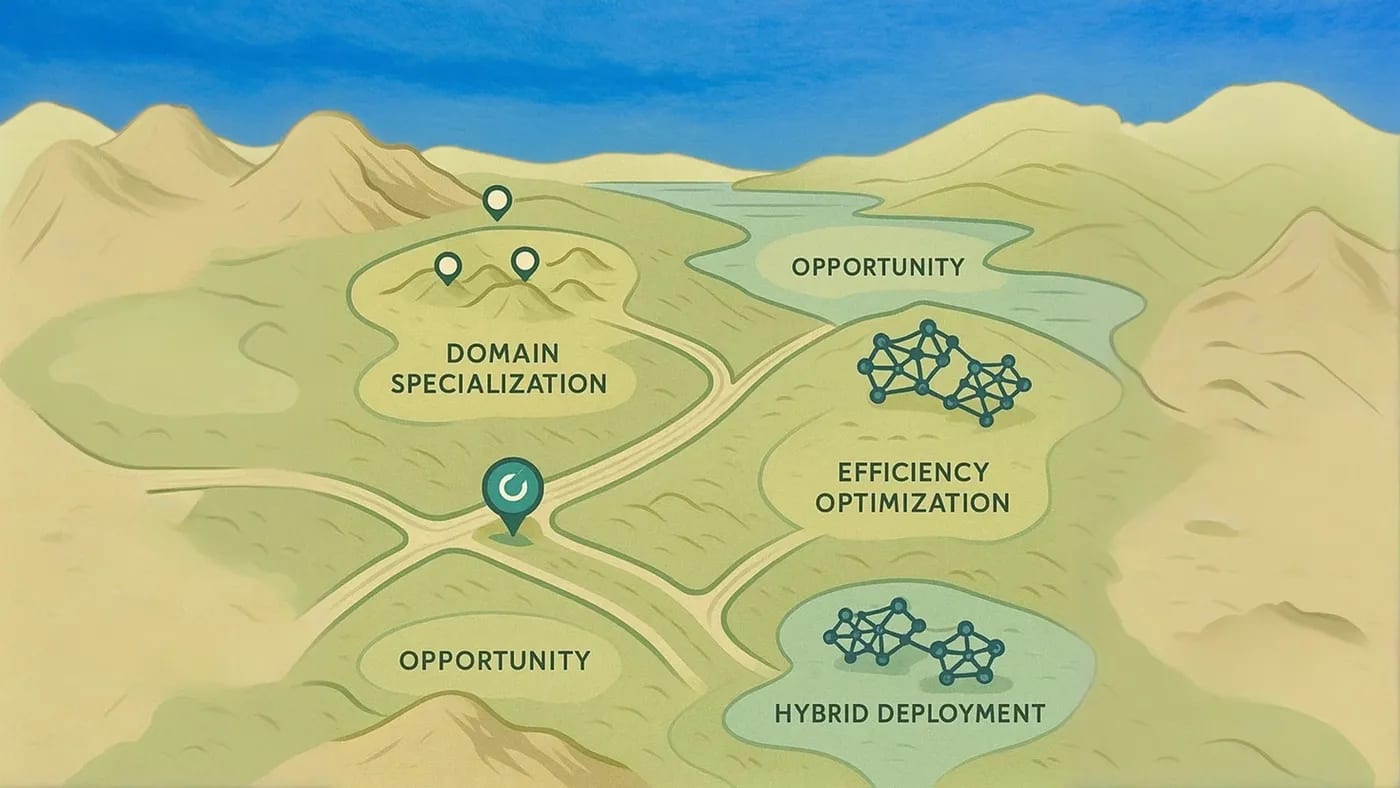
This emerging structure creates several strategic options for organizations:
-
Domain specialization: Developing smaller models that excel in specific niches
-
Efficiency optimization: Adopting more accessible models that provide substantial capability at reduced cost
-
Hybrid deployment: Using large models for complex tasks while deploying smaller models for real-time applications
There are innumerable possible outcomes for the next few years. The consensus among experts is that we are witnessing a societal upheaval that might rival the Industrial Revolution, suggesting that technology leaders should prepare for significant disruption across industries.
A More Nuanced Future
As the AI landscape continues to evolve, we’re witnessing a growing recognition that size alone doesn’t determine capability or value. The “AI at any cost” mindset is giving way to a more nuanced approach shaped by efficiency, specialization, and responsible innovation.
The implications for technology leaders are significant. Rather than viewing AI development as a linear progression toward ever-larger models, consider a portfolio approach that matches model scale to specific needs and constraints. This shift in perspective opens new possibilities for innovation and competitive advantage.
In the coming years, we’ll likely see continued development at both ends of the spectrum, pushing the boundaries of what’s possible with massive models while simultaneously refining what can be achieved with more efficient architectures. The most successful organizations will be those that navigate this landscape strategically, leveraging the right tools for the right purposes.

In evolution, it wasn’t the biggest dinosaurs that survived, but the most adaptable. This analogy may prove equally applicable to the AI ecosystem, where success may ultimately depend not on sheer size, but on the ability to efficiently meet specific needs in an ever-changing environment.
The true advantage in the AI revolution is not merely building bigger, - it’s building smarter, faster, and more sustainably. Like David facing Goliath, the victory may well go to those who wield their technological slingshots with precision and intelligence rather than those who rely solely on their imposing size.
How is your organization approaching the evolving AI landscape? Are you focusing on access to frontier models, exploring smaller alternatives, or pursuing a hybrid approach? I’d be interested to hear your perspective in the comments below.
Disclaimer: The perspectives shared in this article are my own and do not represent those of my employer or any affiliated organizations.
Additional Readings
-
EfficientNet: Rethinking Model Scaling for Convolutional Neural Networks
-
The Lottery Ticket Hypothesis: Finding Sparse, Trainable Neural Networks
-
ALBERT: A Lite BERT for Self-supervised Learning of Language Representations
-
Quantization and Training of Neural Networks for Efficient Integer-Arithmetic-Only Inference
More from machine minds
All machine minds → machine minds
LLM Stubbornness and the Vermilion Syndrome
The AI That Doesn’t Listen: You’ve built the perfect system. Your retrieval pipeline is immaculate. Your multi-agent communication protocols are state-of-the-art. Your tools tap into everything from real-time internet data to proprietary…
 machine minds
The Rise of Autonomous AI Agents: When Chatbots Become our Colleagues
Earlier generative models like GPT-3 and ChatGPT dazzled us by producing human-like text on demand. But their role was largely reactive: they responded when asked. Agentic AI is emerging as the next major step, defined by “much stronger…
 machine minds
Bioinformatics Meets Bookmaking: Genetic Algorithms and the New Science of Odds Compilation
As someone who once navigated the conference halls of Las Vegas, speaking to packed rooms about emerging technologies in online gaming, and who, perhaps unexpectedly, began that journey studying biochemistry before venturing into software,…