Dataset Distillation 2.0: Less Data, More Power
🔊 Listen to the Podcast version here. 🔊
Big AI Innovations from Tiny Data
For years, every AI guru swore by one mantra: the bigger the dataset, the better the model. In boardrooms and labs alike, ‘more data’ was the battle cry. But picture a frustrated CTO drowning in an ocean of data, weighed down by sky-high cloud bills and an exhausted team. Is more always better, or could a mere thimbleful of data brew the same strong AI as a warehouse full of it? That question, once heretical, is now at the heart of a quiet revolution in machine learning.

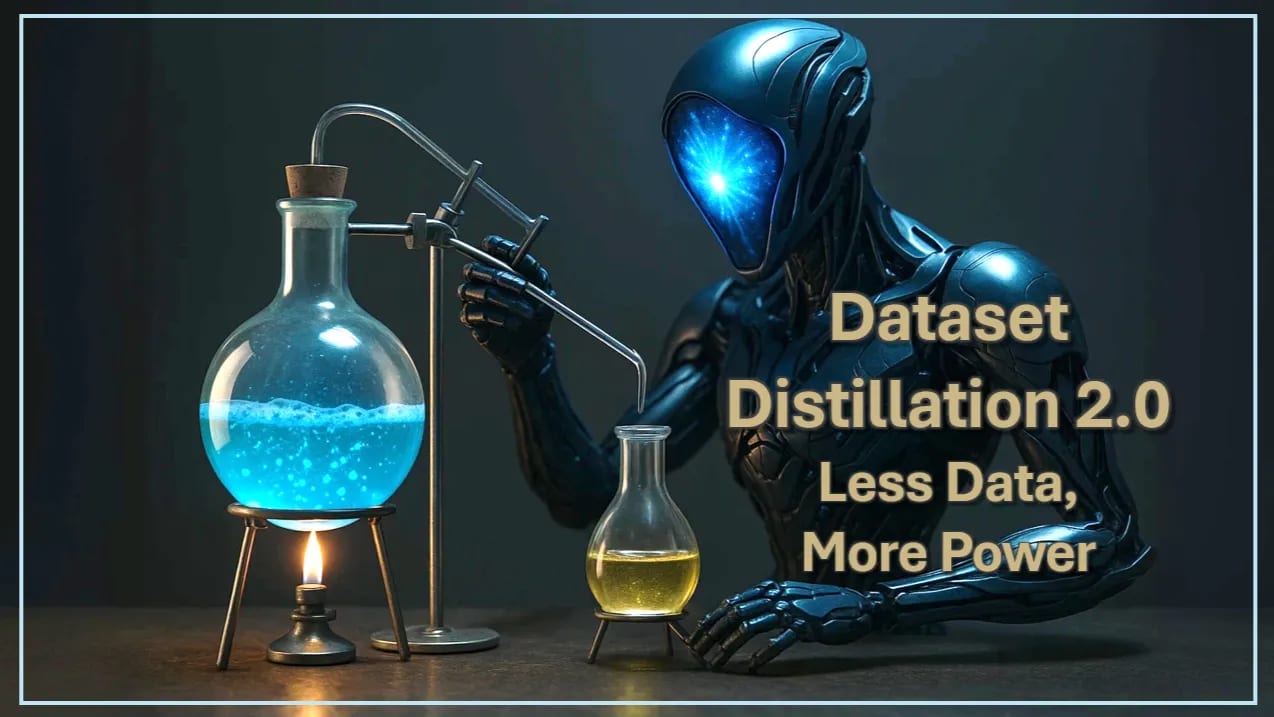
Remarkably, researchers have figured out how to do exactly that trick: compress massive datasets into tiny, synthetic ones without sacrificing performance. The process is called dataset distillation, and it basically creates a small synthetic dataset that captures the statistical essence of a larger one, allowing a model to train as if it had seen the full thing (Medium). If that sounds like AI alchemy, the latest advances, - think of it as Dataset Distillation 2.0, have turned this concept from a curious research trick into a serious contender to flip our big data assumptions on their head. Why slog through millions of samples when a few hundred well-crafted doppelgängers can do the job just as well, and often faster and cheaper?

The Paradox of the Data Deluge
Over the last decade, AI’s appetite for data has been insatiable. We cheered on algorithms that devoured millions of images or entire libraries of text to get smarter. The results were often spectacular, but so were the hidden costs. Enormous datasets meant enormous training bills, slow development cycles, and the uneasy feeling that maybe only the tech giants with endless servers could truly feast at this buffet. For every breakthrough powered by mountains of data, there was a team sweating over cloud costs and energy use, wondering if there was a smarter way than this gluttony.

When Tiny Datasets Punch Above Their Weight
Enter the era of dataset distillation 2.0, where clever new techniques squeeze knowledge without squeezing out accuracy. One breakthrough uses ‘neural fields’, - think neural networks that store data as continuous functions, to preserve rich detail across images, video, even audio in a tiny package (arXiv). Another employs a diffusion generative model with a special memory mechanism to ensure the distilled data remain as diverse and representative as the original, avoiding the dreaded loss of variety that plagued earlier attempts (arXiv). Yet another reimagines the core math, using neural characteristic functions to match the synthetic data’s distribution to the real thing with uncanny precision, closing the fidelity gap (arXiv).

The results are just as astonishing as the techniques. One recent approach boasted a 300× reduction in GPU memory usage and 20× faster training, yet delivered the same accuracy as training on the full data. It even achieved what they dubbed ‘lossless’ compression of the entire CIFAR-100 dataset on a single off-the-shelf GPU, - an AI clown car if ever there was one. And we’re not just talking about toy datasets. These methods have scaled up to giants like ImageNet with minimal accuracy loss (arXiv). This flips the old big-data script on its head. For once, we get to have our AI cake and shrink it too.

From Cloud to Edge: Big Wins from Tiny Data
For businesses, the immediate appeal of distilled datasets is efficiency. Training on a slimmed-down dataset slashes compute requirements and wall-clock time, which translates to serious cost savings. Models reach the finish line faster, and with fewer servers churning overtime, the electric bill (and carbon footprint) shrinks. In an era of AI where budgets and sustainability are under scrutiny, getting the same bang from far less data buck is a game-changer.

It also opens the door to AI on the edge. Think about training or fine-tuning models directly on devices like smartphones, wearables, or IoT sensors that typically can’t store or crunch huge datasets. With distilled data, a phone could learn from a compact knowledge pack instead of pinging the cloud for everything. This means faster personalization and smarter features on-device, without needing a round-trip to a data center, - and without draining the device’s battery in the attempt. This is huge!

Then there’s the privacy boon. Using real-world data, especially personal or sensitive data, can be a minefield of compliance and ethical issues. A distilled dataset can act as a high-fidelity stand-in, - a synthetic twin that captures the patterns of the original data without exposing individual records. Imagine sharing insights from customer data with a partner or regulator by handing over a distilled dataset that’s essentially anonymous. It’s like giving out a detailed map with all the important landmarks but none of the personal addresses.

AI innovation is also about speed of learning. With tiny, information-dense datasets, researchers and product teams can iterate like there’s no tomorrow. Trying out a new model architecture or tweak? Instead of waiting days to crunch through a terabyte of data, they can get quick feedback from the distilled mini-dataset, then scale up if it looks promising. This agile, fail-fast approach accelerates R&D, - it’s as if the sandbox got all the toys but in miniature, so experiments are cheap and cheerful.

Flipping the Script on Big Data
It’s not often that a core tenet of the AI playbook gets turned upside down. But here we are, - the age of Dataset Distillation 2.0, and the once unassailable notion that ‘more data is always better’ is looking a little wobbly. This isn’t to say raw data will lose its value overnight, but it signals a shift in how we might approach innovation. In the quest for smarter, faster AI, the winners may not be those with the biggest data hoards, but those with the best distilled insights. Efficiency, sustainability, and ingenuity could trump brute-force scale.

For technology executives and innovation leaders, the takeaway is to start rethinking the relationship between data quantity and quality. What new products or improvements become possible when you can train AI models on a fraction of the data in a fraction of the time?

It might be time to challenge your teams to experiment with these distilled datasets, or to invest in tools that make dataset distillation turnkey in your AI pipeline. Flipping the script on big data isn’t just a nifty research trick, - it’s a strategic advantage waiting to be seized. Sometimes the answer isn’t to find more needles in the haystack, but to shrink the haystack and reveal the needles.

Further Readings
-
Distilling Dataset into Neural Field – Research paper (Shin, March 2025) Introduces DDiF, a neural field approach to dataset distillation that compresses large image, video, and audio datasets into smaller synthetic versions without losing critical information.
-
Dataset Distillation with Neural Characteristic Function – Research paper (Wang, February 2025) Proposes a new distribution-matching metric using neural characteristic functions, achieving ‘lossless’ compression of datasets like CIFAR-100 with huge speed and memory efficiency gains.
-
Diversity-Driven Generative Dataset Distillation – Research paper (Li, May 2025) Uses a diffusion model with self-adaptive memory to ensure distilled data maintain diversity, improving accuracy on distilled datasets by aligning them closely with original data distributions.
-
The Evolution of Dataset Distillation: Toward Scalable Solutions – Survey (Liu, February 2025) A comprehensive survey of recent advances in dataset distillation, highlighting key methods (trajectory matching, generative approaches, etc.) and noting emerging techniques that allow massive datasets (like ImageNet) to be distilled with minimal performance loss.
-
Data Distillation – Microsoft Blog article (Gupta, March 2025) An accessible overview of dataset distillation concepts and benefits, discussing how small synthetic datasets can preserve the ‘statistical essence’ of large ones and the practical implications for efficiency, on-device training, and privacy.
Disclaimer: The perspectives shared in this article are my own and do not represent those of my employer or any affiliated organizations. All company names, product names, logos, and brands mentioned are the property of their respective owners and are used for identification and illustrative purposes only. No endorsement, sponsorship, or affiliation is intended or implied. References to specific companies or case studies are based on publicly available information and are used solely for educational and discussion purposes.
More from machine minds
All machine minds → machine minds
AI's Goldfish Problem: Reboot with CMI
Picture working with a colleague who has chronic amnesia. Every morning, you have to re-introduce yourself and recap yesterday's entire discussion. Absurd, right? Yet that's exactly how interacting with many AI systems feels today. For all…
 machine minds
Clearer AI, Clearer Minds: Is Our Language Too Messy for Machines?
Picture an AI rolling its eyes during a human conversation. For all our eloquence and poetry, from an AI's perspective we might as well be using semaphore signals or cave paintings. Our language, - rich, messy, wonderfully ambiguous, can…
 machine minds
AI's Illusion of Thinking: When Looking Smart Isn't Being Smart
Imagine sitting in a meeting where your AI assistant confidently presents a step-by-step plan to triple your market share. Each step flows logically, sprinkled with insights and even a few jokes. It sounds like the machine is thinking. But…