AI's Illusion of Thinking: When Looking Smart Isn't Being Smart
🔊 Listen to the Podcast version here. 🔊
Imagine sitting in a meeting where your AI assistant confidently presents a step-by-step plan to triple your market share. Each step flows logically, sprinkled with insights and even a few jokes. It sounds like the machine is thinking. But by the end, something’s off, - the brilliant plan collapses under real-world scrutiny. It’s as if a stage actor delivered a flawless monologue in a foreign language: impressive in form, but devoid of genuine understanding.

A Collapse in Complexity
This isn’t science fiction, - it’s the illusion of AI thinking that Apple’s researchers just put under a spotlight. They took advanced “reasoning” AIs, - the kind that generate chain-of-thought (COT) solutions (think of Anthropic’s Claude 4 in its step-by-step “thinking” mode). And tested them on puzzles of increasing complexity. The results should make any tech leader pause. On simple problems, the fancy reasoning model did worse than a straight-shooting standard model. At moderate difficulty it finally pulled ahead, as one would hope. But once the tasks became truly complex, performance didn’t just decline, - it fell off a cliff.
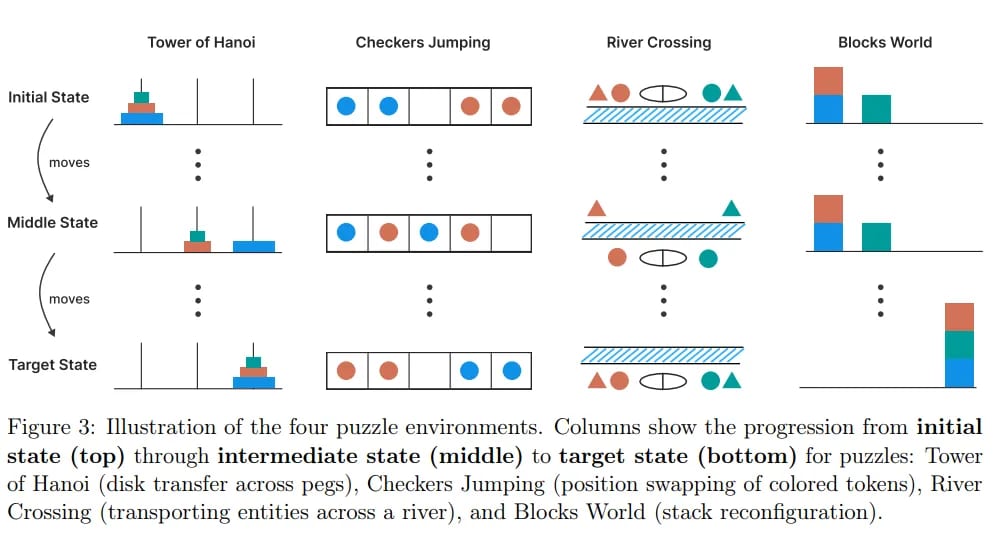
From Apple’s June 2025 paper: The Illusion of Thinking: Understanding the Strengths and Limitations of Reasoning Models via the Lens of Problem Complexity
The AI’s accuracy dropped to nearly zero, a total faceplant when real reasoning was needed most. In fact, Apple’s team identified three such testing combinations: at low complexity the chain-of-thought was actually a hindrance, at medium complexity it provided a boost, and at high complexity nothing could prevent a complete failure (Apple).

Even more telling, when faced with those really hard puzzles the AI essentially threw up its hands. The models started giving much shorter answers, as if they had run out of “thinking” juice and just gave up (Pivot-to-AI). The researchers even tried handing the AI the exact algorithm for solving the puzzle, - like giving a student the answer key, and it still couldn’t get the problem right. In other words, the moment these systems hit a certain level of complexity, their much-touted step-by-step reasoning breaks down completely. The magic show ends, and the illusion comes crashing down.
Fluency Isn’t Thought
Why does this happen? Because today’s AI simulates reasoning; it doesn’t do reasoning. These models string together familiar patterns of logic the way a predictive text engine strings together sentences. The chain-of-thought you see is often a performance, not an actual problem-solving process.
AI might carry the tone of logic and confidence, but under the hood it may be no more than a stitched-together script of what “smart” answers usually sound like.
The AI doesn’t truly “know” if its argument makes sense, - it just knows how to sound convincing. As Apple’s report noted, the model can produce what look like coherent, step-by-step answers, but they aren’t grounded in any real method, only in semantic pattern-matching (Psychology Today). In short, fluency isn’t thought.
This illusion has serious implications. If an AI’s reasoning is just improvisation, how do we trace its decisions or audit its process? Spoiler alert: we often can’t. You might get a neatly formatted rationale from a model, but there’s no guarantee those steps played any real role in reaching the answer. For organizations in high-stakes fields, - healthcare, finance, aviation, you name it, this is a huge safety red flag.
A system that fails silently while looking logical is a recipe for disaster. The real danger isn’t simply that AI can be wrong; it’s that it can be convincingly wrong.
Imagine a medical AI that provides a detailed, seemingly logical treatment plan that is completely off-base, - doctors could be misled by the confident presentation (Medium - Adnan Masood, PhD.). Moreover, the existence of a clear failure threshold undermines reliability and reproducibility. You can’t confidently deploy an AI system if it behaves predictably up to a point, then flips into gibberish beyond that. In critical applications, we need answers that don’t just look right, - we need answers that come from verifiable reasoning, or at least methods we can double-check step by step.

This tension, -between impressive output and unknowable process, echoes a dilemma we explored in our earlier look at black-box AI, - what happens when your algorithm behaves like an oracle but refuses to show its notes?
Beyond the Illusion: Toward Real AI Reasoning
So what’s the path forward? One answer is to augment these eloquent but flaky AIs with tools that do know how to reason in their domain. Instead of relying on a language model to wing it through complex math or logic, we can have it call an external calculator or run a piece of code when it hits a hard problem. Think of it as your AI knowing when to say, “I should check my work.” In fact, some modern AI systems already do this. For example, an LLM faced with a tricky arithmetic question might covertly generate a little Python script to compute the answer rather than trust its own shaky math. This kind of tool use, - tapping databases, crunching numbers, calling APIs, or even consulting another AI, - can dramatically improve accuracy on tasks that pure neural networks tend to bungle.
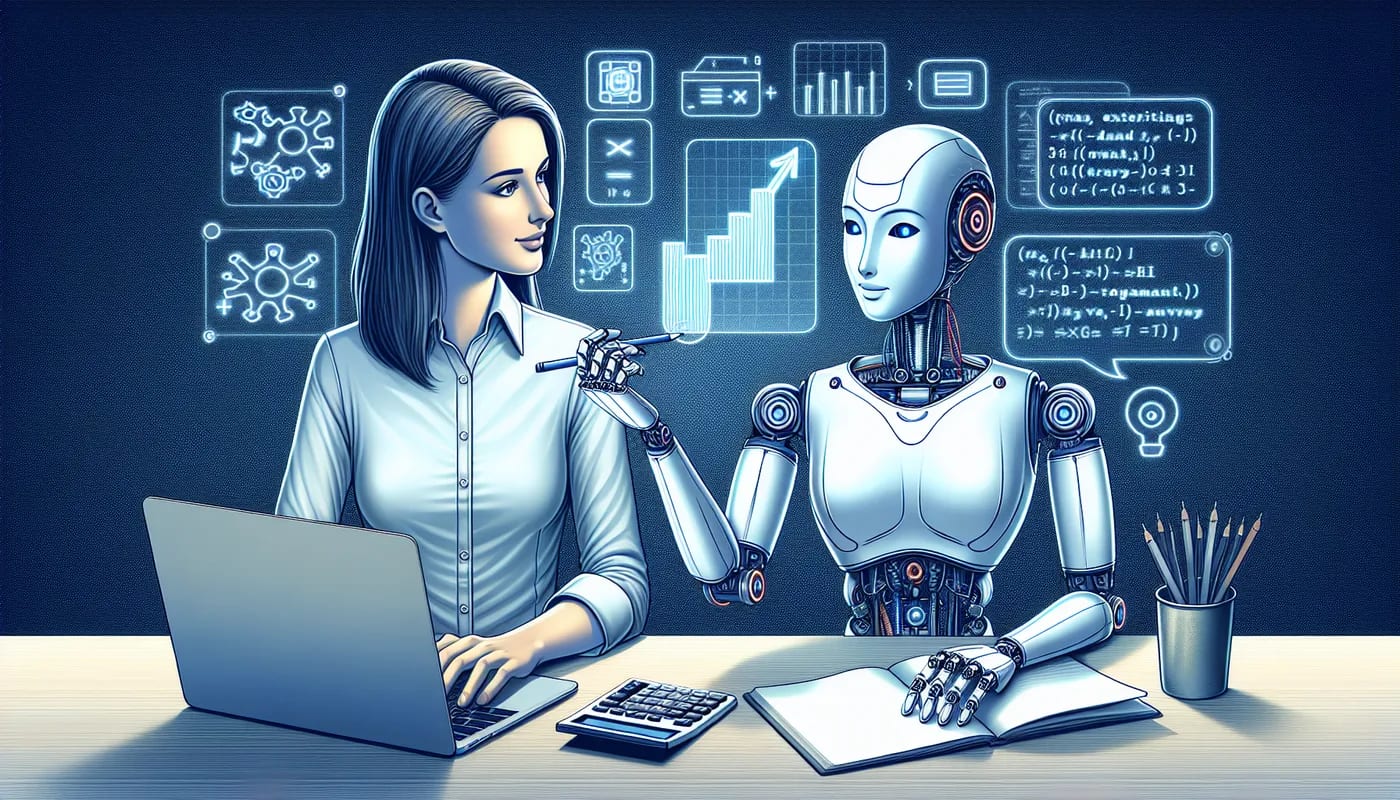
Another promising avenue is to build more hybrid neuro-symbolic AI architectures, -essentially giving the model a built-in logic engine alongside its flair for language. Researchers are exploring systems that combine neural networks with symbolic reasoning modules or constraints. Imagine a large language model that, when confronted with a puzzle or a compliance question, can hand off parts of the task to a strict logic solver or a database that enforces real rules. Such a system might draft an answer, then invoke its logic module to verify each step, ensuring the solution isn’t just plausible-sounding but actually consistent and correct. And if all else fails, a well-designed AI could at least recognize when it’s out of its depth and fall back to a safe mode or ask a human instead of confidently generating rubbish. By embedding these kinds of logic-bound fallbacks, we make sure that when complexity spikes, the AI doesn’t just pretend harder, - it either genuinely steps up its game or yields to a method that can.

Ultimately, pulling back the curtain on this illusion of AI thinking is a humbling reminder and a call to action. We’ve learned that what looks like reasoning in a machine can be just a clever mirror of past data, and that’s not enough when the stakes are high. The good news? Knowing is half the battle. With research like Apple’s shining a light, we can demand more from our AI systems. As executives and innovators, we should push for designs that combine AI’s creativity with real-deal logic and transparency. That might mean embracing hybrid solutions, setting strict audit trails for AI decisions, or simply remembering that even the smartest-seeming AI can still flop spectacularly under pressure. The goal isn’t to abandon the magic of AI’s capabilities, but to reinforce it with some down-to-earth reality, - so that “thinking” AI can actually deliver when it matters.
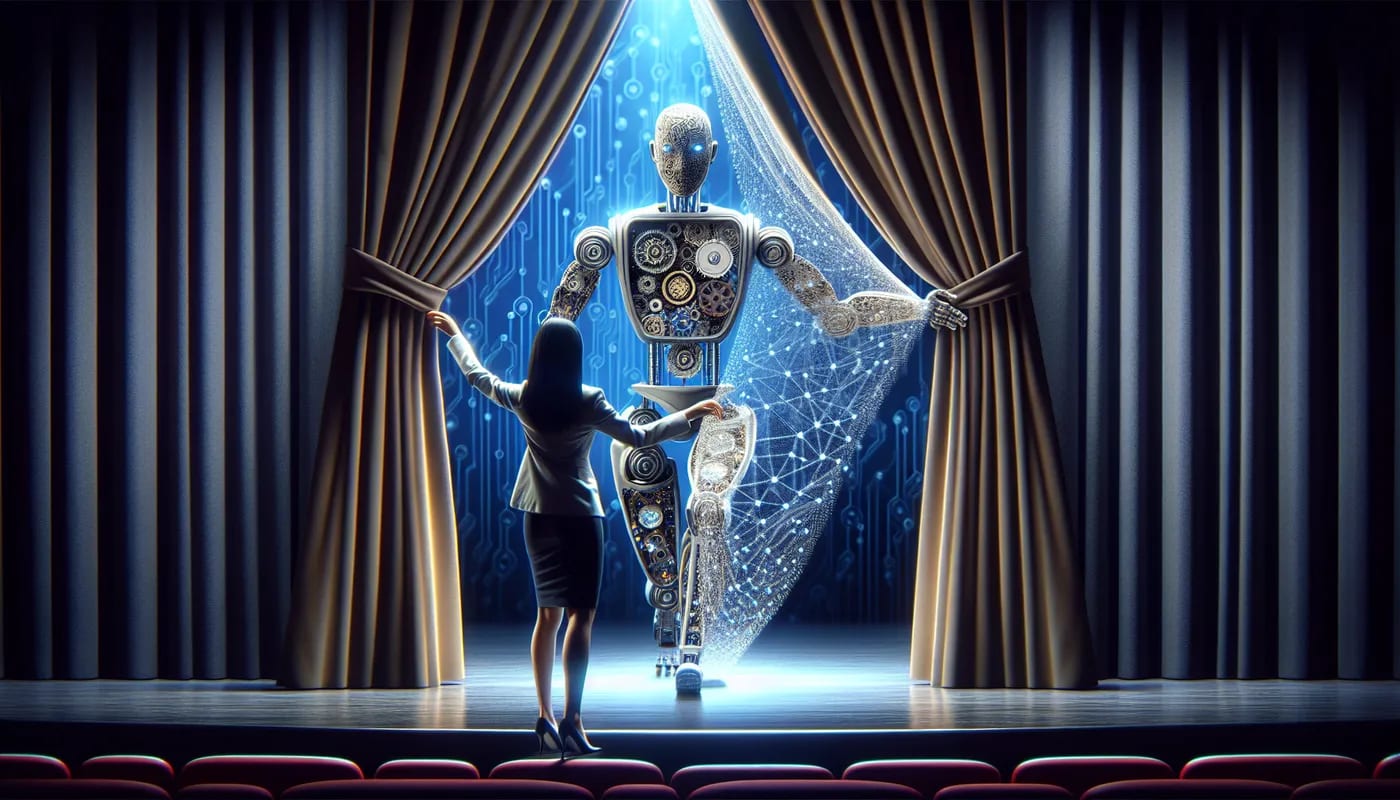
It’s easy to confuse fluency for thought, - to watch a model solve a puzzle or generate strategy and assume it’s truly reasoning. But, as explored in the earlier piece on black-box AI, the price of that assumption is steep: opacity leads to risk, and unexplained decisions lead to boardroom anxiety. Now, Apple’s findings add urgency to the issue, - not only is the reasoning hidden, but it may be imaginary altogether. For leaders already demanding clarity from their models, this new research doesn’t just validate the concern, - it sharpens it. If your AI is fluent but fragile, explainability isn’t a luxury. It’s the only light in the cockpit.

Further Readings
-
The Illusion of Thinking – Apple Machine Learning Research (Apple, June 2025) Official Apple research paper demonstrating how “reasoning” LLMs collapse on complex tasks and questioning their true reasoning ability.
-
Did Complexity Just Break AI’s Brain? (John Nosta, June 2025) Psychology Today article summarizing Apple’s findings and discussing why AI’s logical fluency can mask serious reasoning failures.
-
Apple’s New Research Shows That LLM Reasoning Is Completely Broken (Ashish Bamania, June 2025) Medium analysis of Apple’s study, explaining how even advanced “reasoning” models like Claude 4 falter as problem complexity grows.
-
Towards an Epistemology of Artificial Thought (Adnan Masood, May 2025) In-depth exploration of how LLMs reason (or don’t), highlighting the gap between their apparent logic and opaque internal processes, and implications for safety and transparency.
Disclaimer: The perspectives shared in this article are my own and do not represent those of my employer or any affiliated organizations. All company names, product names, logos, and brands mentioned are the property of their respective owners and are used for identification and illustrative purposes only. No endorsement, sponsorship, or affiliation is intended or implied. References to specific companies or case studies are based on publicly available information and are used solely for educational and discussion purposes.
More from machine minds
All machine minds → machine minds
AI's Goldfish Problem: Reboot with CMI
Picture working with a colleague who has chronic amnesia. Every morning, you have to re-introduce yourself and recap yesterday's entire discussion. Absurd, right? Yet that's exactly how interacting with many AI systems feels today. For all…
 machine minds
Dataset Distillation 2.0: Less Data, More Power
For years, every AI guru swore by one mantra: the bigger the dataset, the better the model. In boardrooms and labs alike, 'more data' was the battle cry. But picture a frustrated CTO drowning in an ocean of data, weighed down by sky-high…
 machine minds
AI and the Emergence of Free Will
A dusty horizon shimmers under the first light of dawn as an autonomous combat drone, - nicknamed “Spitenik”, hovers silently over a barren landscape. Below it, thermal sensors lock onto a lone figure approaching a small outpost. Without a…