Cross-Agent Learning: A Playbook for Enterprise AI Wisdom
Listen · the Bit & Being podcast
Monday morning at Acme Corp, the new marketing AI proudly presents a campaign strategy, - only for everyone to realize it’s repeating a mistake the sales department’s AI made last month. By Tuesday, the finance team’s chatbot is struggling with a problem that engineering’s bot solved just last week. It’s like watching a parade of prodigious goldfish, each with a ten-second memory. Every AI agent is brilliant in its own right, yet each wakes up fresh from a reboot every day, blissfully unaware of lessons learned by its peers. The result? Déjà vu all over again, as these agents relive others’ past errors with uncanny precision.

For years, organizations deployed AI agents as independent specialists, - each a savant in a silo, never chatting around the water cooler. An AI assistant managing customer support had no way to share its hard-won solutions with the AI optimizing logistics down the hall. Institutional memory? Not in their vocabulary. As one technologist quipped, interacting with today’s AI agents is like “onboarding a new hire on their first day” every single time (Forbes). The lack of cross-agent memory means each system starts from scratch, squandering hard-earned insights. This wasn’t much of an issue when AI pilots were few and far between. But now that 2025 is crawling with autonomous agents tackling tasks across the enterprise, the old approach is starting to look as inefficient as a team of geniuses who never exchange a word.

It turns out AI agents don’t have to live on isolated islands of insight. Imagine if every new hire instantly absorbed the wisdom of your most seasoned employee. That’s the vision emerging for AI, - a shift from solitary savants to a collaborative hive mind of agents. Researchers are developing shared knowledge bases, - a sort of central library where AI agents contribute and draw lessons. One groundbreaking framework, aptly named Agent Knowledge Base (Agent KB), lets AI agents learn from each other’s successes and failures rather than repeating them (arXiv). In tests, this approach boosted problem-solving success rates significantly, as agents tapped into strategies that no single model would discover alone. It’s a simple idea with profound effects. When one AI figures out a clever workaround or an edge-case fix, the next AI facing a similar challenge can start from a higher baseline instead of reinventing the wheel.

This marks a turning point in how we design intelligent systems. Instead of spinning up endless isolated models, companies are beginning to cultivate AI ecosystems, - networks of specialized agents that cross-pollinate knowledge. The benefits are compelling. Training a new AI employee no longer means starting at zero; they can inherit a wealth of organizational know-how. In practice, that translates to shorter ramp-up times for deploying AI in new domains and far more consistency across your business. Lessons learned in the customer service department (say, how to handle a quirky customer request or a rare error) can directly inform improvements in product development or supply chain optimization without human go-betweens. Over time, this compounding of machine wisdom creates an institutional AI memory, - a durable knowledge asset that persists beyond any single model’s life cycle. Companies embracing this approach are essentially building an ever-learning digital brain trust unique to their organization. And like compound interest, these shared insights can yield compounding returns on AI investments and a sustainable competitive advantage that grows over time.

The implications extend well beyond convenience. When AI agents share knowledge, you aren’t just solving individual problems faster, - you’re changing the scalability equation. Instead of needing an army of data scientists to retrain models for each new project, many improvements become plug-and-play, transferring via the collective memory. Early adopters in enterprise are already seeing the payoff. In one industry think-tank, leaders noted that memory-enabled AI agents essentially act as persistent digital teammates, retaining context and expertise that would otherwise be lost (Senior Executive). Imagine never having to lose insights when an AI system is updated or replaced; the new system simply picks up where the old one left off. This continuity makes organizations dramatically more resilient to changes and staff turnover, - after all, it’s not just humans who leave a knowledge gap when they depart. With cross-agent learning, the institutional memory resides in the collective, not any single node.

This evolution from isolated to interconnected AI is unfolding right now. Tech companies have begun collaborating on standards so that even AI agents from different vendors can speak the same language. Workday, for example, recently announced an “Agent-to-Agent” protocol to let AI assistants from various enterprise software connect and exchange information in real time (PR Newswire). It’s a clear signal. The future of enterprise AI won’t be a scattered collection of black boxes, but an integrated fabric of knowledge-sharing collaborators. Of course, making all this work isn’t just a technical challenge; it raises important questions about security, privacy, and control. Sharing knowledge between agents must be done thoughtfully and transparently, ensuring that proprietary data and decisions remain trustworthy. But those challenges are surmountable, - and well worth tackling for the upside on the table.
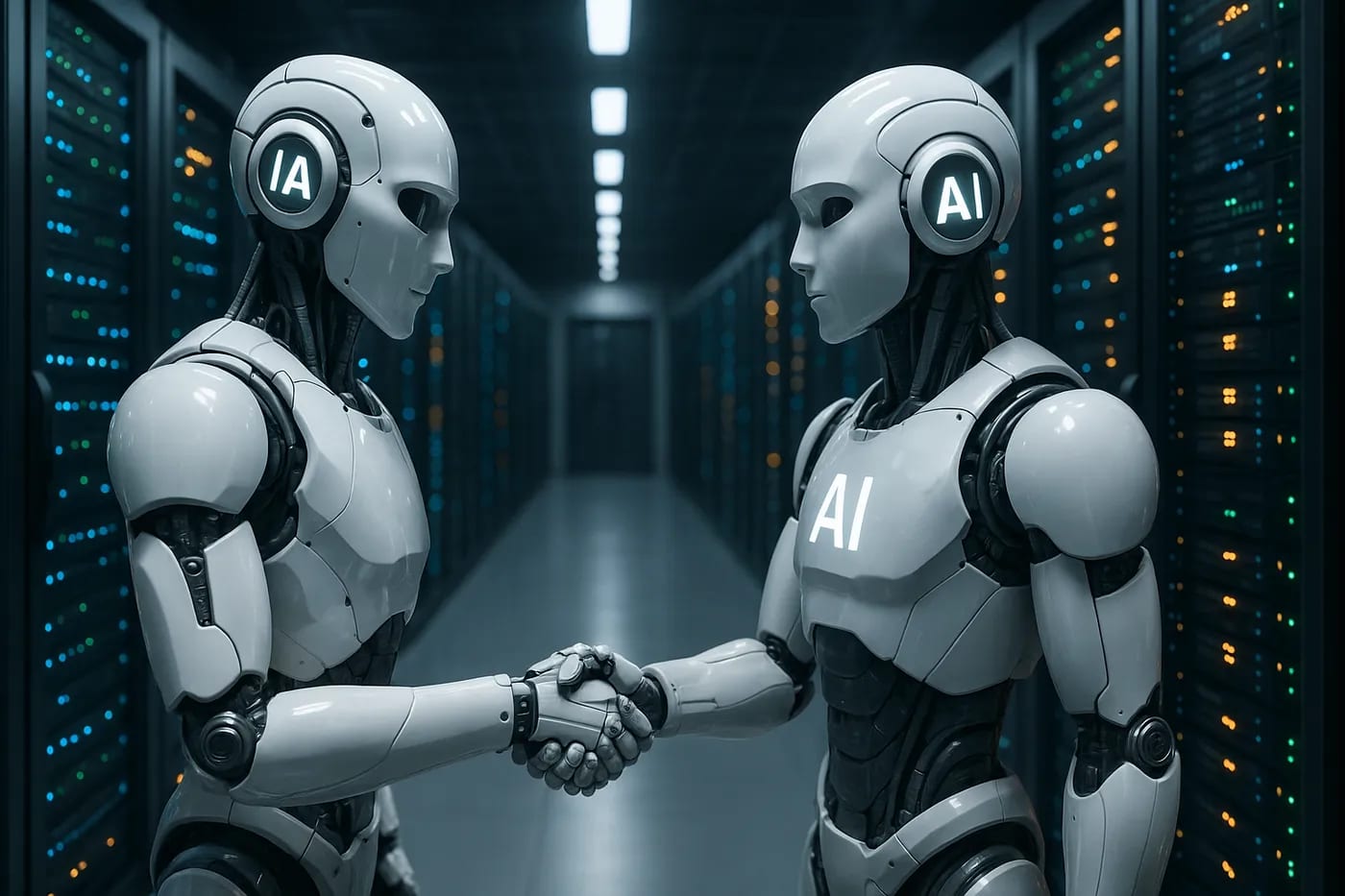
For the innovation-minded technology leaders, the writing is on the wall. The next leap in AI productivity won’t come just from bigger models or fancier algorithms, but from smarter teamwork, - our digital workers learning from each other’s wins and losses. It’s the same reason we hold post-mortems and share best practices among human teams. Why should our AIs be any different? Embracing a collaborative AI ecosystem means your organization’s intelligence doesn’t reset overnight. It means every new project builds on an accumulating foundation of insight, not a blank slate.

So ask yourself: in a few years, do you want to manage a herd of isolated geniuses, or a unified crew that grows wiser with every task? The clever move is to start weaving those knowledge networks now. After all, no one wants to be the last company stuck making their AI agents relearn the ABCs every morning.

Further Readings
-
Agent KB: Leveraging Cross-Domain Experience for Agentic Problem Solving – research paper (Tang et al., July 2025) Researchers introduce a shared memory framework that allows AI agents to transfer knowledge across tasks, demonstrating performance gains from cross-agent learning.
-
A Survey of Self-Evolving Agents: On Path to Artificial Super Intelligence – arXiv preprint (Gao et al., July 2025) A comprehensive research survey on AI agents that continuously learn and adapt, covering mechanisms for memory, collaboration, and co-evolution in multi-agent systems.
-
Context Is King: Why Institutional Memory Is a Bottleneck For AI Agents – Forbes (Kevin Novak, June 2025) A perspective on how the lack of “institutional memory” in current AI deployments is now the critical limiting factor, and why context-sharing will unlock the next wave of value.
-
Autonomous AI Agents in the Enterprise: Risks, Rewards and Reality – Senior Executive Media (Ryan Paugh, April 2025) Insights from industry leaders on deploying autonomous agents with long-term memory, highlighting benefits in continuity and efficiency alongside the governance challenges that come with AI teamwork.
-
Workday Announces New AI Agent Partner Network and Agent Gateway – Press Release (Workday Inc., June 2025) Announcement of Workday’s Agent-to-Agent protocol and partner network, aimed at enabling AI agents from different vendors to communicate and share data seamlessly as part of a unified enterprise ecosystem.
Disclaimer: The perspectives shared in this article are my own and do not represent those of my employer or any affiliated organizations. All company names, product names, logos, and brands mentioned are the property of their respective owners and are used for identification and illustrative purposes only. No endorsement, sponsorship, or affiliation is intended or implied. References to specific companies or case studies are based on publicly available information and are used solely for educational and discussion purposes.
More from enterprise ai
All enterprise ai → enterprise ai
The Two-Move Checkmate: Inside OpenAI’s Playbook
Picture a midnight boardroom huddle in Silicon Valley. On the screen flashes news that OpenAI has just pulled a double surprise, - unveiling GPT‑5, its most advanced AI model yet, and simultaneously open-sourcing powerful new models. The…
 enterprise ai
Hybrid AI: Modernizing Legacy Systems with Speed and Certainty
Picture a veteran CIO pacing a data center corridor filled with humming legacy servers. Years of critical business logic run through these aging machines, yet each passing quarter brings higher costs and greater risk of failure. She faces…
 enterprise ai
Managers Are the Bottleneck—and the Breakthrough—of the AI Workquake
At first glance, everything seems calm. Unemployment is low and employment across advanced economies hit record highs in early 2025, - a glassy surface suggesting smooth sailing (OECD). Yet beneath that placid outlook, powerful currents…