When Innovation Outpaces Discipline: The AI Debt Reckoning
🔊 Listen to the Podcast version here. 🔊
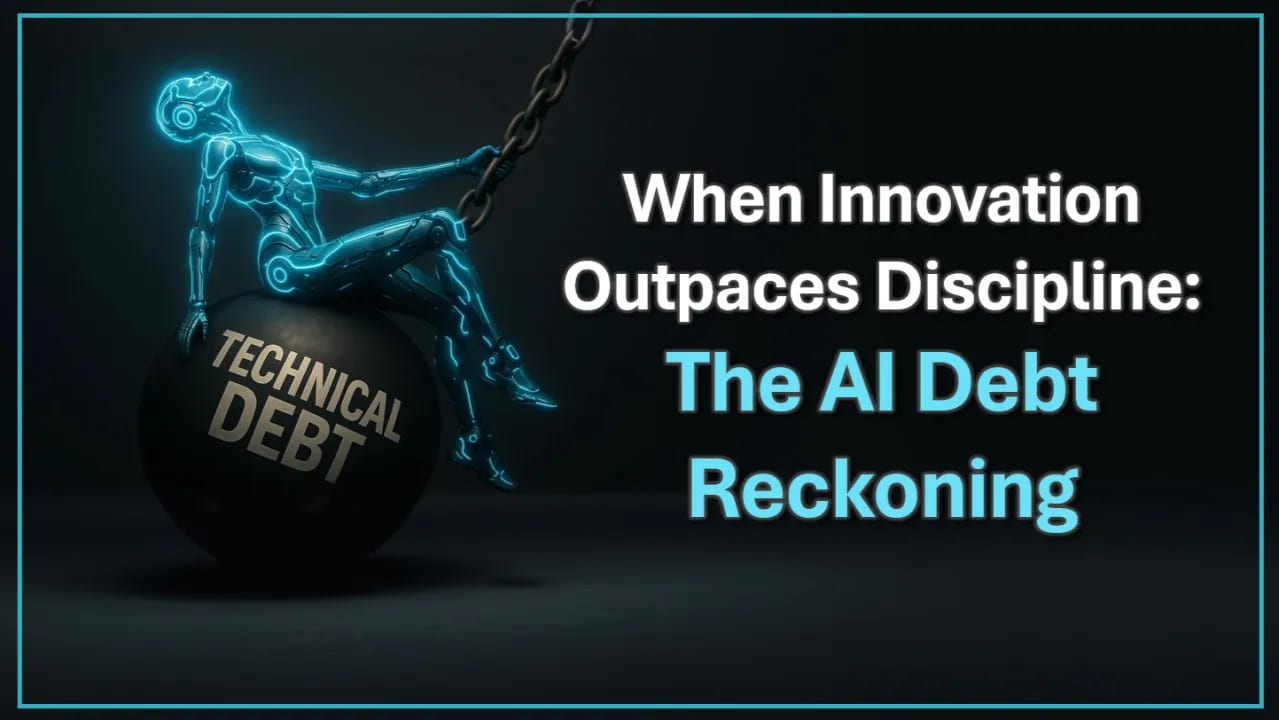
In the celebratory glow of a hard-won AI success, it’s easy to overlook the faint smell of smoke coming from under the hood. Picture a startup that just turbocharged its sales with a clever AI hack, - champagne pops, high-fives all around. But as the confetti settles, a lurking hitchhiker remains: a hastily patched-together system held up by digital duct tape. Today’s AI victory parade might be marching straight into tomorrow’s $10 million cleanup effort, and no one has called the fire department yet.

Marisol, the CTO of that feisty startup, can’t stop grinning at the quarterly results. Her scrappy AI recommendation engine, - built in a weekend coffee-fueled coding sprint, is printing money, and she’s become the office hero. Investors are calling. The board is thrilled. What they don’t see is the Frankenstein behind the scenes: an amalgamation of experimental code, third-party APIs, and hasty shortcuts that weren’t supposed to survive past the prototype. It works like a charm… until it doesn’t.

Late one night, an innocuous update triggers a cascade of failures. The glorious AI engine sputters and halts. Marisol’s phone lights up with frantic messages. Her weekend wonder has turned into a weekday nightmare. All those buried quick-fixes and skipped tests conspire into a full-blown system meltdown. Customers are irate, the sales team is panicking, and that victory champagne now tastes a lot like technical debt.

The Unseen Tsunami on the Horizon
Marisol’s story isn’t an isolated incident. It’s a tiny splash in a growing tidal wave. Across industries, leaders are racing to adopt AI, often plugging new systems into old infrastructure with fingers crossed. Research firm Forrester warned that by 2026, 75% of technology decision-makers will see technical debt surge to severe levels, thanks in large part to hasty AI implementations (Forrester). In plain terms, - an AI gold rush today can sow the seeds of a tech debt tsunami tomorrow. The rush to win with AI can lead to shortcut-filled code and rushed deployments that lurk like seawalls ready to crumble.

The trouble with technical debt is that it behaves like real debt, - compounding quietly over time. Just as financial shortcuts accrue interest, every “quick fix” in AI systems adds to an invisible ledger. One study pegged the annual cost of accumulated software debt at $2.41 trillion in the U.S. alone (Consortium for Information & Software Quality (CISQ)). When AI is layered on creaky legacy systems, or rushed into production without refactoring, that debt balloons further. By the time it’s visible, it’s often too late to outrun the wave.

Success’s Hangover
By sunrise, our triumphant CTO is in damage control mode. The overnight fiasco forces a sober retrospective: that brilliant shortcut-laden AI launch saved a few weeks of development, but now it threatens to cost months in repairs and lost revenue. It’s the classic hangover after the party, - success got ahead of sustainability. In the rush to shine, Marisol’s team borrowed against the future, and the debt collector just arrived.

Her ordeal shines a light on an uncomfortable truth. Many companies are celebrating AI wins without a plan for the morning after. The issue isn’t that the AI didn’t work, - it worked too well, encouraging everyone to ignore the loose ends. Email threads reveal that warnings were raised and promptly shelved in the excitement. The organizational amnesia set in: “We’ll refactor later,” they said. Later never came, until last night.

Shadow AI: The Quiet Stowaway
While Marisol’s team grappled with known shortcuts, an even sneakier culprit lurks in many organizations. Enter Shadow AI, - those unsanctioned machine-learning models and scripts that employees whip up on the sly. Maybe it’s a rogue chatbot a department deployed without IT’s blessing, or a manager quietly using a GPT-4 tool for reports. It’s all great until that unofficial AI becomes mission-critical and suddenly breaks. When it fails (and it will), who’s on call? Some experts warn that in large firms, up to 75% of employees might be dabbling in off-the-record AI solutions, multiplying unseen risks and technical headaches (logz.io).

Shadow AI often flies under budget radar until something goes wrong. The technical debt from these guerrilla projects can be staggering, precisely because no one accounted for them. They’re like stowaways on the corporate ship: unseen until the ship hits rough waters. CIOs are waking up to this reality, scrambling to establish governance before the next unsanctioned algorithm quietly undermines a critical workflow. It’s a reminder that unchecked innovation, no matter how well-intentioned, can carry a hidden price tag.

The Seven Deadly Sins of AI Debt
Just when you think you’ve patched the last brittle pipeline and named your 15th version of “final_model_v3,” a deeper truth emerges: your AI house of cards wasn’t built on solid ground, - it was built on bad habits.

Technical debt doesn’t just happen. It’s summoned, often unknowingly, by a repeated set of sins. Here’s a non-exhaustive confessional of the seven deadliest ones.
-
Duct-Taped Data Extraction: Relying on fragile ETL scripts that break every time a vendor updates their API. Congratulations, - you now have a full-time job manually feeding your AI.
-
Brittle Pipelines: One format change in an upstream system and your whole model faceplants. If your AI stack breaks when someone sneezes, that’s not innovation. That’s a booby trap.
-
Hardcoded Workflows: Locked-in logic that assumes the world will never change. Spoiler: the world changes. Every product launch, policy tweak, or new SKU sends your AI back to square one.
-
Metadata Amnesia: Can’t trace what data trained what model? Can’t reproduce a result from two weeks ago? You’re flying blind, - and governance can’t help if you can’t even label the buttons.
-
Model Version Anarchy: Multiple “latest” models floating around different teams with no central control. One of them is still using 2021 data. No one knows which. Sleep tight.
-
Vendor Lock-In: Your entire pipeline depends on a proprietary third-party API with opaque pricing and a fickle roadmap. When they pivot or perish, so do you.
-
Monitoring Neglect: The model’s live, but is anyone watching? Drift sets in. Bias creeps back. Predictions start to wobble. It still runs, - but it’s quietly hurting more than it helps.
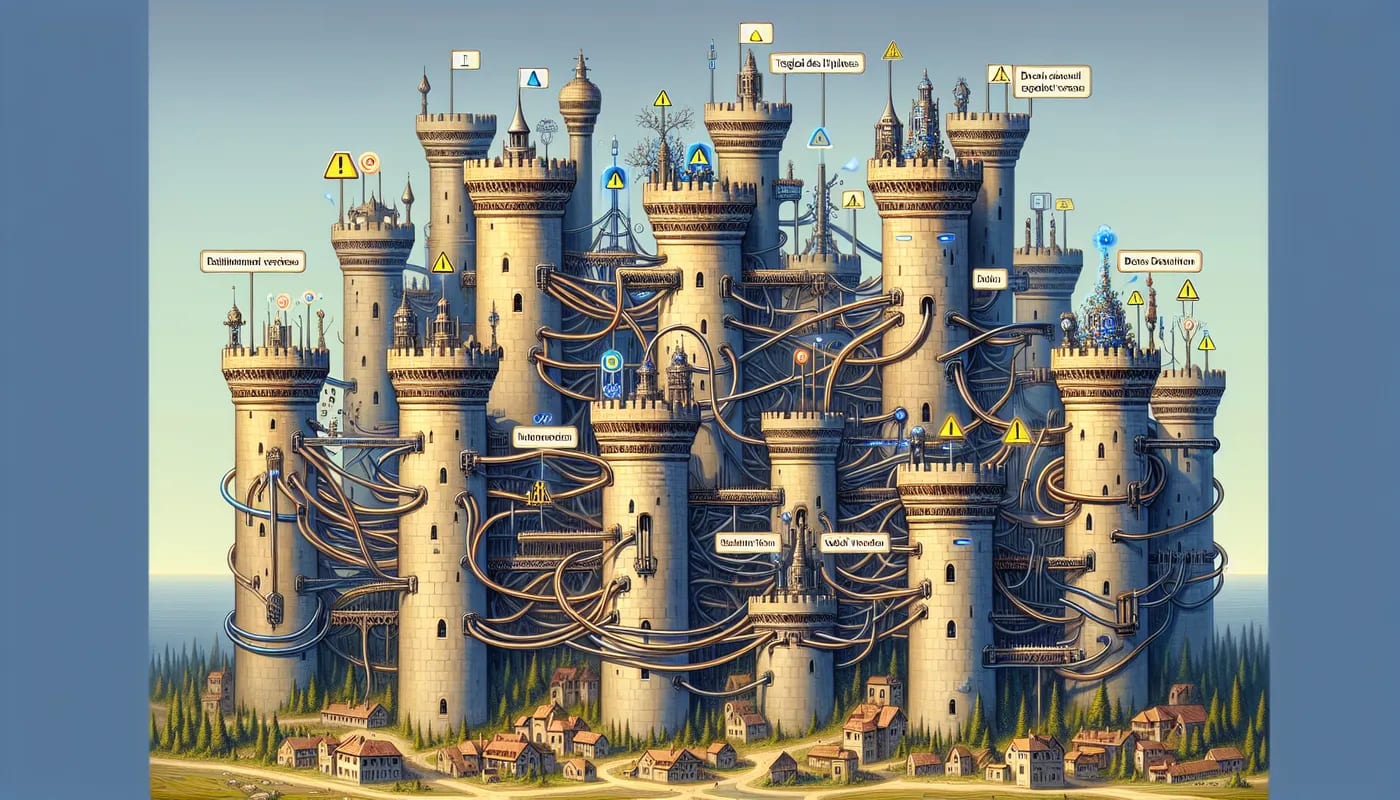
These sins don’t announce themselves. They accumulate quietly, in moments of “we’ll fix that later.” And they rarely come alone.
Rethink and Refactor
Marisol’s costly lesson sparks a change. After patching the immediate issues, she rallies her engineers to refactor the foundation. They document the previously overlooked pieces, write the tests that were skipped, and redesign parts of the system to handle the growth properly. The board, sobered by the near-disaster, greenlights an infrastructure overhaul. It’s not as thrilling as the quick win was, but it’s the kind of unglamorous work that separates sustainable success from flash-in-the-pan triumph.

Not every company gets a second chance like this. The smart ones are learning from these cautionary tales. They’re investing in architecture reviews and maintenance for their AI systems the way one would maintain a fleet of sports cars, - because you don’t race a Ferrari with the check engine light on. They’re also weaving AI operations (AIOps) tools into their stack to catch issues early. The wisest leaders know that the real measure of success isn’t just the first million an AI system earns, but the millions it doesn’t cost you down the line.

In the end, no one remembers that quarter where the startup’s revenue spiked by 300% thanks to a janky AI shortcut. What people remember is how the company almost imploded afterward, and how it clawed its way back to stability by doing things right.

The moral of the story? Fast success is fine, but fast tech debt can kill. Your AI triumph today must be architected with tomorrow in mind, or that victory lap might detour straight into a mud pit of your own making.

Further Readings
-
There’s No Hiding from the Tech Debt ‘Tsunami’ – WordPress VIP (Shane Schick, February 2025) Forrester’s stark metaphor and a three-step plan for CIOs to address the looming AI-driven tech debt crisis.
-
How to Manage Tech Debt in the AI Era – MIT Sloan Review (Koenraad Schelfaut, February 2025) Insights on balancing rapid AI innovation with technical debt management, arguing that all tech debt is now AI tech debt.
-
Technical Debt in AI-Generated Code – GAP Blog (Growth Acceleration Partners, June 2025) Discusses how AI-assisted coding can inadvertently introduce new technical debt and strategies to keep code quality high.
-
How the Risks of Technical Debt are Compounding in the AI Era (Sarah Nicastro, May 2025) Perspective on how rapidly evolving digital demands and AI adoption amplify the impact of unresolved tech debt.
-
Technical Debt Stifling Path to AI Adoption for Global Enterprises (Pegasystems, June 2025) Survey findings showing 68% of firms say legacy systems hinder AI plans, with executives concerned about competitiveness and customer impact.
-
AI Could Help Companies Tackle Tech Debt, Though Few Have Yet Gone All In (Consulting.us, June 2025) Coverage of a Global 2000 study (Publicis Sapient & HFS) estimating $1.5–2T in tech debt and advocating AI-driven modernization.
-
Six Ways to Manage Your Technical Debt in 2025 (James Flitton, May 2025) Practical advice for IT leaders to reduce technical debt, noting 31% of IT budgets and significant resources are tied up in maintaining legacy systems.
Disclaimer: The perspectives shared in this article are my own and do not represent those of my employer or any affiliated organizations. All company names, product names, logos, and brands mentioned are the property of their respective owners and are used for identification and illustrative purposes only. No endorsement, sponsorship, or affiliation is intended or implied. References to specific companies or case studies are based on publicly available information and are used solely for educational and discussion purposes.
More from builder's bench
All builder's bench → builder's bench
CI/CD’s Final Frontier: Fully Autonomous Code Optimization
Late one evening, a CTO gapes at a cloud services bill that looks more like a phone book. The code is running, customers are happy, - but behind the scenes, millions of unnecessary instructions are silently inflating costs. In fact, 67% of…
 builder's bench
From Bash to Brain: How Gemini CLI Is Rethinking Developer Tools
Late one evening, a senior engineer watches in disbelief as her terminal begins to complete tasks she only half-jokingly requested. The familiar command-line prompt blinks patiently on a black screen, but now it responds with creative…
 builder's bench
12 AI IDEs, 5 Policy Tests, 1 Guide for CTOs
Picture a stressed CTO in a late-night code review, a virtual genie perched on her shoulder offering brilliant fixes and a joke or two. Tempting, right? But like any good genie, an AI coding assistant can grant wishes with a catch. The…