LATAM-GPT and the Rise of Regional AI
🔊 Listen to the Podcast version here. 🔊
For years, the brain of AI spoke English with an American accent. Now Latin America is teaching it to salsa. This September, a dozen countries from Mexico to Chile are unveiling Latam-GPT, a large language model trained to embrace “¿Qué tal?” as naturally as “Hello”. It’s not just another AI release; it’s a cultural statement, a strategic power move, and the punchline to those Silicon Valley jokes that never quite landed south of the Rio Grande.

The launch of Latam-GPT marks the first time an AI model has been built by Latin America, for Latin America, trained on the region’s idioms, history, and multilingual reality. Think of it as the homegrown answer to ChatGPT, - except this one knows who Chespirito is and won’t blank out when you mention empanadas or El Chavo. Behind the wit lies a serious ambition: to democratize AI across a vast region long seen as a consumer, not creator, of cutting-edge tech (Reuters).

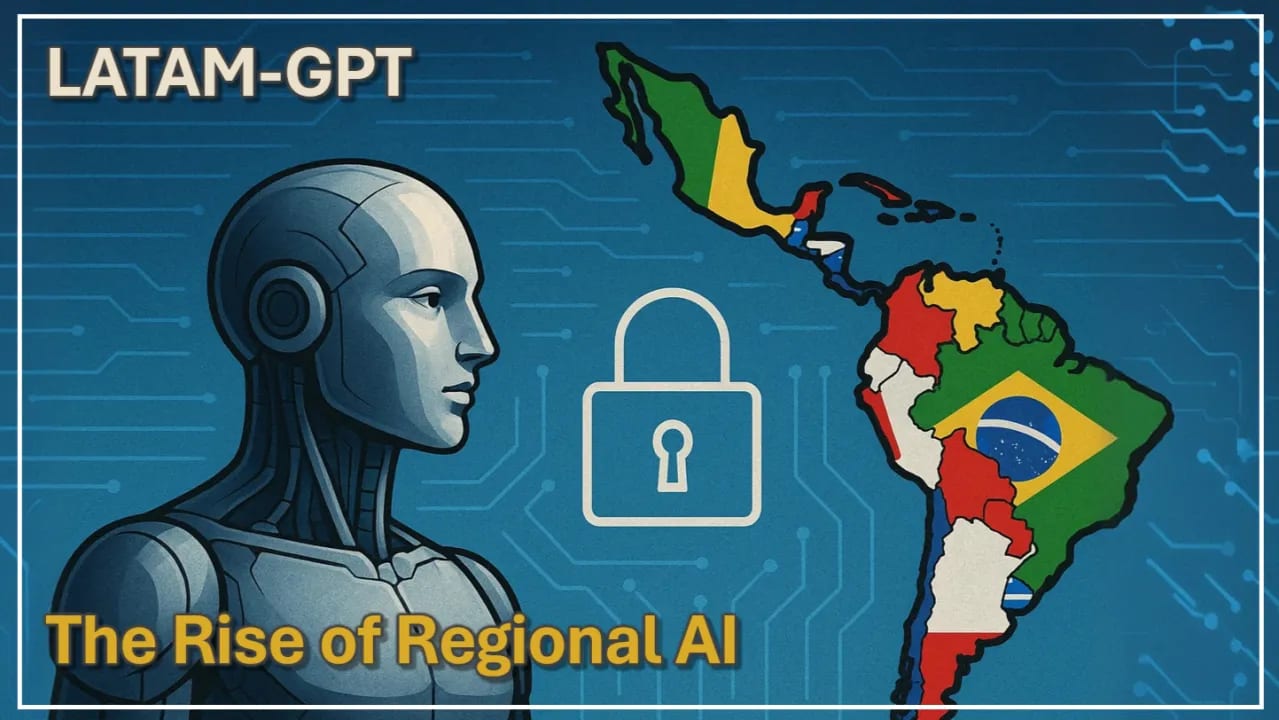
Check out the legs on that AI robot!
Local Problems, Local Solutions
Global AI models, - mostly trained on English and pop culture from the US, often misunderstand Latin American context. Anyone who’s had a chatbot mix up Colombia (the country) with Columbia (that sportswear brand) knows the feeling. Latam-GPT was born from such frustration. By training on Spanish, Portuguese, and even indigenous languages, it catches nuances others miss. No more AI calling a torta (a sandwich) a cake, or failing to get a tongue-in-cheek reference to a telenovela villain. In tech terms, Latam-GPT is fine-tuned to the region’s cultural dataset, addressing the misinterpretations and generalizations that plagued earlier models (InfoQ).

Chile’s National Center for Artificial Intelligence (CENIA) spearheaded Latam-GPT with support from over 30 institutions across Latin America. This open-source model, built on Meta’s LLaMA technology, is trained on a regional network of computers from Santiago to São Paulo (Reuters). In true collaborative spirit, researchers even crowdsourced local proverbs and texts to teach the AI authentic dialects. The result? A 50-billion-parameter model (on par with GPT-3.5) that doesn’t treat Latin American Spanish as a mere dialect of Spain’s, and that knows Quechua and Guarani aren’t Star Wars characters but indigenous languages (InfoQ).

The Turning Point: AI Goes Regional
September 2025 isn’t just Latam-GPT’s launch. It’s an inflection point in how we think about AI. Suddenly, regional AI models are en vogue. Latin America joins a growing club: there’s Africa’s Lanfrica project cataloging African language data, and InkubaLM, a pan-African model slimmed down to run on ordinary smartphones (Africa News). The Middle East has Falcon, an open-source Emirati model that soared to the top of benchmarks by focusing on efficiency and local capability (Trends Research & Advisory). Even the EU is pouring billions into AI “Gigafactories” and cloud networks like Gaia-X to ensure they aren’t left eating Silicon Valley’s dust (European Business Magazine). AI is no longer one-size-fits-all. It’s becoming a globe of many voices.

Implications for Business
For multinational executives, this trend is a game-changer. If you operate in Latin America, AI localization just went from nice-to-have to must-have. Customers will expect chatbots and virtual assistants that truly “get” them. A banking app in Bogotá or Buenos Aires might soon run on Latam-GPT, offering jokes and stock tips en español with local flavor. Corporate leaders must ask: is our AI speaking our customers’ language, - literally and figuratively? The old approach of translating an English-trained model won’t cut it when competitors are deploying AI native to each market.

There are also geopolitical stakes. Relying solely on foreign AI can be risky business. Latin America learned this watching the U.S. and China tussle for AI supremacy, - nobody wants to be caught in a digital Cold War crossfire. China’s offer of its cheap, efficient DeepSeek AI has been tempting. It’s even fluent in Spanish and Portuguese, but comes with strings attached (Americas Quarterly). Latam-GPT, by contrast, keeps the region in the driver’s seat, owning its data and destiny. For global firms, aligning with such local AI initiatives can curry favor with regulators and consumers alike, proving you’re invested in the region’s growth, not just its wallets.

On the economic front, regional models could mean better ROI on AI projects. Open-source models like Latam-GPT or Falcon are royalty-free and modifiable, freeing companies from expensive licensing or one-size-fits-all solutions. They can be fine-tuned on local data to boost customer engagement, - imagine an e-commerce AI that knows Chileans prefer redondeo pricing or a support bot that switches to Portuñol for a Brazilian-Argentine customer call. These nuances can be the difference between a sale and a #fail. Businesses that harness regional AI can unlock new markets and innovations precisely because they respect the subtle differences that make each market unique.

A Mosaic of AI Futures
The rise of Latam-GPT underscores a broader truth, - the future of AI isn’t a monoculture, it’s a mosaic. In this new era, every region colors the canvas with its own shades. That means as leaders, we must broaden our vision of innovation. It’s time to ask not just what AI can do, but whose values and knowledge are encoded in it. Latam-GPT’s answer is clear, - AI can be cutting-edge and culturally aware. Today, it’s Latin America’s turn to take the stage. Tomorrow, it might be Southeast Asia or Eastern Europe with their own GPTs. Smart executives will watch these trends closely, partnering where it makes sense and learning from each new regional twist in the AI tale.

No single company or country has a monopoly on innovation. Latam-GPT is Latin America’s bold reminder of that fact. It challenges us all to think globally but tune in locally. For the business leaders, the mandate is emerging: to leverage AI that resonates deeply in every market you serve. In a world of regional AI, those who embrace the mosaic will outshine those clinging to a fading AI monoculture. So, salud to Latam-GPT and its peers, - a toast to a smarter, more inclusive tech future that speaks to all of us.

Further Readings
-
Latin American countries to launch own AI model in September (Reuters, June 2025) Brief Reuters news on the multi-country initiative to create Latam-GPT, highlighting its cultural and strategic goals.
-
Africa’s First Multilingual Small Language Model Gets Even Smaller (Africanews, May 2025) Report on how African innovators compressed a language model (InkubaLM) by 75% to broaden AI access across the continent.
-
The UAE’s Bold Leap into the Global LLM Race (Trends Research, April 2025) Analysis of the UAE’s homegrown Falcon model and its open-source approach to challenge AI giants.
-
DeepSeek Reveals Latin America’s AI Crossroads (Americas Quarterly, Feb 2025) Insight into China’s “DeepSeek” AI and why Latin America faces a choice between adopting foreign AI and building its own.
-
Europe’s New Push Towards a Sovereign AI (European Business Magazine, June 2025) Overview of Europe’s investment in AI sovereignty (Gaia-X, AI gigafactories) to reduce reliance on Big Tech.
Disclaimer: The perspectives shared in this article are my own and do not represent those of my employer or any affiliated organizations. All company names, product names, logos, and brands mentioned are the property of their respective owners and are used for identification and illustrative purposes only. No endorsement, sponsorship, or affiliation is intended or implied. References to specific companies or case studies are based on publicly available information and are used solely for educational and discussion purposes.
More from enterprise ai
All enterprise ai → enterprise ai
From Soloist to Symphony: The Strategic Power of AI Architectural Decomposition
Imagine an orchestra where one musician attempts to play every single instrument at once. Chaotic? Absolutely. Yet this is exactly what it feels like when a company leans on one giant AI system to handle all of its cognitive tasks. The…
 enterprise ai
The 57/43 Rule: Augmentation Outperforms Automation
In a bustling 2025 office, an executive types away with a ghostly AI assistant hovering beside her, suggesting phrasing for an email. Across the room, another worker double-checks a report drafted by an AI before hitting send. These…
 enterprise ai
The Fastest-Follower Wins: The Age of AI Speedrunning
A champion gamer once spent months perfecting a secret shortcut in a popular video game, only to watch rivals use his discovery to beat his record within days. He did the hard work and others ran off with the victory, - simply by…