The 57/43 Rule: Augmentation Outperforms Automation
🔊 Listen to the Podcast version here. 🔊
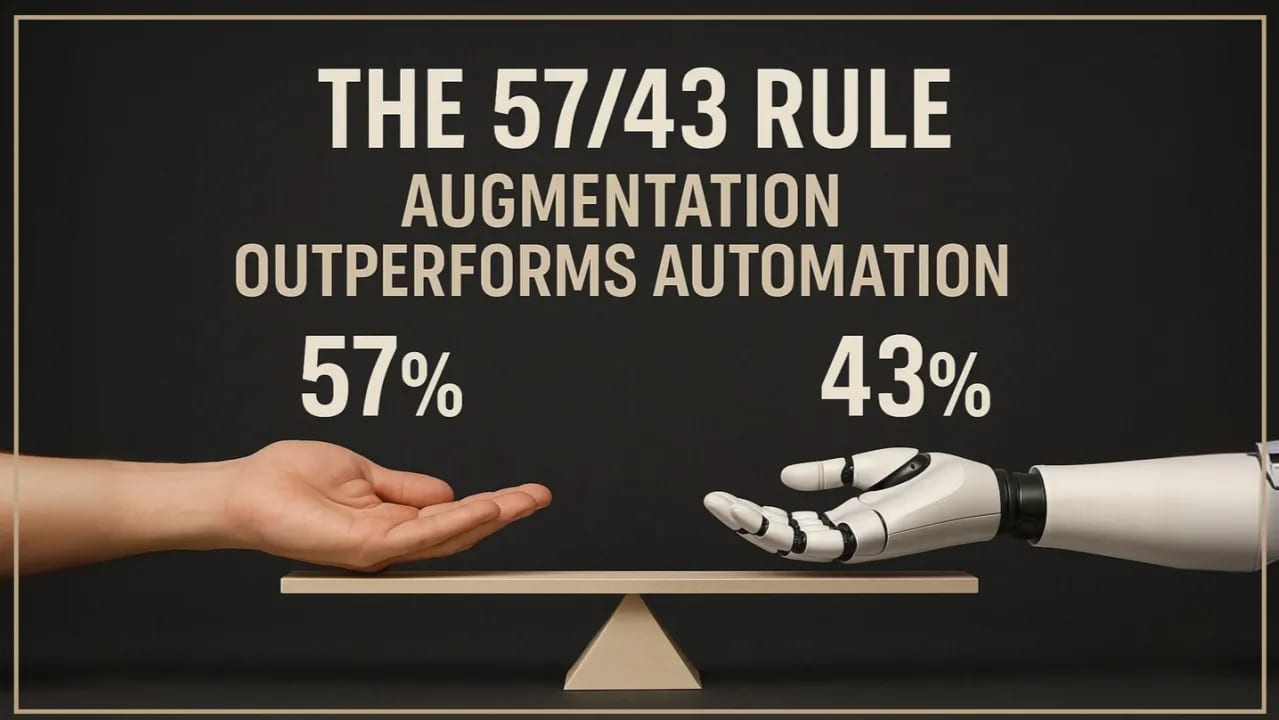
In a bustling 2025 office, an executive types away with a ghostly AI assistant hovering beside her, suggesting phrasing for an email. Across the room, another worker double-checks a report drafted by an AI before hitting send. These everyday scenes capture a surprising truth: more often than not, AI is working with us rather than instead of us. Anthropic’s new Economic Index calls it the 57/43 Rule, - finding that 57% of real-world AI uses are “augmentation” (AI supporting humans) versus 43% “automation” (AI acting alone) (Anthropic). This revelation flips the script on the old ai-will-take-our-jobs narrative, showing that in practice, AI has slid into the workforce less like a job-stealing automaton and more like an eager office sidekick.

This isn’t just anecdotal, - it’s borne out by data. A June 16 Gallup survey found 27% of U.S. employees now use AI at work at least a few times a week, nearly double the rate from two years prior (Gallup). But crucially, how they use AI is mostly collaborative. Anthropic’s analysis of millions of chatbot conversations revealed that in just over half of cases, people aren’t offloading tasks entirely to AI. Instead, they’re “batting the ball back and forth” with these systems, - brainstorming, refining, double-checking, – essentially employing AI as a trusty partner rather than an autonomous worker bee (Axios). The result? AI is boosting productivity and creativity on the job without kicking humans out of the loop.

Consider two colleagues in different roles. One is a software developer racing to debug code. She deploys an AI coding agent to fix routine bugs and write boilerplate functions autonomously. In fact, Anthropic found that with specialized coding AI, a hefty 79% of coding tasks can run on autopilot, - pure automation, compared to about 49% automation for general AI use (Anthropic). Meanwhile, across the hall, a project manager uses an AI assistant to generate a first draft of a client proposal. He doesn’t send it as-is. He reviews, edits, and adds a personal touch. The AI handled the grunt work, but the human owns the final product. Different jobs, same pattern, - AI shines as a force-multiplier, handling the mundane so humans can focus on the high-value work.

Early on, many assumed AI would mainly replace repetitive jobs while creative and complex work stayed human. The twist in 2025 is that every industry is finding ways to harness AI as a collaborator. Sure, tech leads the pack, - Anthropic’s data shows nearly 37% of AI queries come from “computer and mathematical” fields like software engineering (Axios). It makes sense, right? Coders love letting an AI handle monotonous coding so they can tackle bigger design and architectural problems. But even in sectors like media, marketing, and administration, AI is more a co-author than a solo act. Office assistants use AI to draft meeting notes and suggest scheduling tweaks while the humans make the decisions, and marketing teams employ AI to brainstorm campaign ideas that staff then refine. Across domains, the narrative is consistent, - the augmentation-first approach is taking hold, often even where we least expected it.
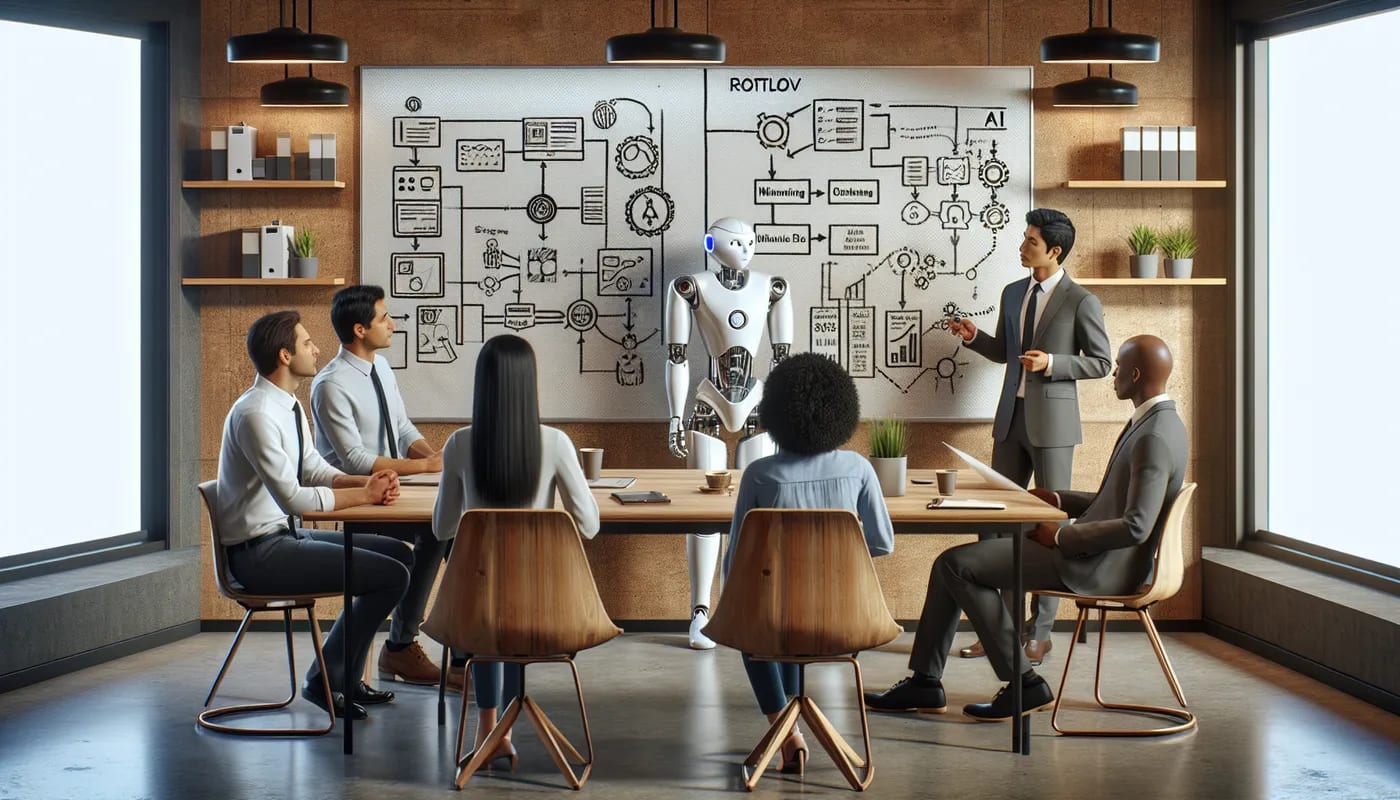
There’s an inflection point here. Not long ago, water-cooler talk was full of anxiety about AI coming for everyone’s job. But as the 57/43 Rule indicates, the real workplace story is more nuanced and far more optimistic. AI hasn’t unleashed a wave of mass unemployment. Instead, it’s slotting into roles as a support system. According to Gallup’s research, employees today are no more fearful of losing their jobs to AI than they were two years ago, - only about 15% think technology will eliminate their job in the next five years, a number that’s barely changed despite the AI boom (Gallup). In other words, the average worker is starting to see AI less as a Terminator and more as a Jarvis, - an assistant that can supercharge their work. This marks a profound reversal of the anticipated narrative. The question on everyone’s mind is shifting from “Will AI replace us?” to “How can AI help us do more?”
For business leaders, this insight changes the game. If AI is mostly being used to augment human talent, then the winning strategy is to redesign work and teams around that synergy. We’re seeing the rise of augmentation-first job design. Companies are reinventing roles so that human employees can focus on what humans excel at, - creativity, complex judgment, relationship-building, oversight, while delegating tedious or data-heavy tasks to AI co-workers. Forward-thinking firms are even creating formal “AI partner” roles: imagine every employee having an assigned AI assistant to handle routine tasks, much like an apprentice. One global bank, for instance, recently equipped its analysts with an AI copilot for number-crunching and report drafting, freeing the humans to glean insights and craft strategy. The result was faster analyses and happier analysts, who reported less burnout since they weren’t stuck in spreadsheet hell all day.

This human+AI teamwork is yielding tangible business benefits. Efficiency is surging in companies that embrace augmentation. A recent global analysis by PwC found that industries most aggressively using AI (finance, tech, etc.) have seen three times higher growth in revenue per employee than industries lagging behind, - a productivity boom driven by AI-fueled workers (PwC). Interestingly, the same research noted that even roles very exposed to AI, - including those we thought easily automated, are seeing job growth, not decline, when AI is adopted. That’s right, - jobs are increasing in highly automatable occupations, defying the doomsayers (PwC). What about effectiveness and innovation? AI augmentation appears to amplify those as well. One academic study found that generative AI tools, - like content generators and intelligent assistants, tend to augment human workers in ways that increase hiring, productivity, and firm value, whereas AI used purely to cut labor like certain factory robots might save costs but often doesn’t boost output (Georgia State News Hub). In short, augmenters win the long game.
Crucially, augmentation isn’t just good for the bottom line, - it’s good for employees. Workers get to shed the drudgery and spend more time on creative, meaningful projects. It turns out people rather like having a tireless assistant who handles the boring bits. As evidence, wages for AI-skilled workers are soaring (a 56% premium on average) and many companies report higher employee engagement when AI tools are thoughtfully integrated. And remember that 15% figure of folks fearing replacement? That means 85% do not see AI as a threat to their role, - a sign that when implemented as a complement, AI can actually boost morale and confidence. One tech product manager quipped that having an AI intern to handle minutiae “is like having my cake and eating it too, - I deliver faster results and get home by 6!” Satisfaction comes from being empowered, not reduced, by technology.

All of this leads to a compelling call-to-action for leaders. Design your workforce around collaboration, not replacement. The competitive edge now comes from empowering your human talent with AI tools. As the data shows, AI is a growth strategy, not just an efficiency play. Treat AI as your employees’ new superpower, - provide training so they can wield it, set clear guidelines so it’s used responsibly, and encourage experimentation to find where augmentation unlocks new value. “AI is amplifying and democratizing expertise,” notes PwC’s global AI leader, meaning it enables employees to multiply their impact and focus on higher-level responsibilities. Those companies that blend human creativity with AI’s tireless capabilities will out-innovate and outpace those that merely try to cut costs with automation. In the boardroom and on the ground, the mantra should be: let humans and AI each do what they do best.

The bottom line? The 57/43 Rule is more than a statistic, - it’s a mindset shift. AI in the real world isn’t about firing your team and handing everything to machines; it’s about elevating your team with machine support. As you plan for the future, picture an organization where every employee has an AI sidekick handling the busywork. What could your people accomplish with that extra bandwidth? We’re already catching a glimpse: faster product development, more personalized customer service, and teams that are both productive and energized. So instead of bracing for an AI takeover, start strategizing for an AI partnership. The companies that thrive will be those that redesign jobs and strategies around augmentation. In this new era, AI won’t replace people, - but people who use AI will replace people who don’t. It’s time to make sure your workforce is on the right side of that equation.

Further Readings
-
The Anthropic Economic Index (Anthropic, February 2025) Official introduction of Anthropic’s AI Economic Index, reporting that 57% of AI usage is for augmentation (AI assisting humans) vs 43% for automation.
-
Superagency in the Workplace: Empowering People to Unlock AI’s Full Potential (McKinsey, January 2025) McKinsey report exploring how companies can amplify human agency and productivity by integrating AI into workflows, based on surveys of employees and executives.
-
The Fearless Future: 2025 Global AI Jobs Barometer (PwC, June 2025) PwC research analyzing global job data, finding AI exposure correlates with higher productivity growth, rising wages, and job increases even in highly automatable roles.
-
New Study Reveals Generative AI Boosts Job Growth and Productivity (Georgia State University, May 2025) Academic study showing that AI innovations which augment human labor (e.g. language and creative AI tools) led to more hiring and productivity, whereas purely labor-replacing AI saw limited gains.
-
AI Use at Work Has Nearly Doubled in Two Years (Ryan Pendell, Gallup, June 2025) Survey findings on workplace AI adoption, indicating a sharp rise in AI usage among employees while fear of job displacement by AI remains low.
Disclaimer: The perspectives shared in this article are my own and do not represent those of my employer or any affiliated organizations. All company names, product names, logos, and brands mentioned are the property of their respective owners and are used for identification and illustrative purposes only. No endorsement, sponsorship, or affiliation is intended or implied. References to specific companies or case studies are based on publicly available information and are used solely for educational and discussion purposes.
More from enterprise ai
All enterprise ai → enterprise ai
LATAM-GPT and the Rise of Regional AI
For years, the brain of AI spoke English with an American accent. Now Latin America is teaching it to salsa. This September, a dozen countries from Mexico to Chile are unveiling Latam-GPT, a large language model trained to embrace "¿Qué…
 enterprise ai
From Soloist to Symphony: The Strategic Power of AI Architectural Decomposition
Imagine an orchestra where one musician attempts to play every single instrument at once. Chaotic? Absolutely. Yet this is exactly what it feels like when a company leans on one giant AI system to handle all of its cognitive tasks. The…
 enterprise ai
The Fastest-Follower Wins: The Age of AI Speedrunning
A champion gamer once spent months perfecting a secret shortcut in a popular video game, only to watch rivals use his discovery to beat his record within days. He did the hard work and others ran off with the victory, - simply by…